

Yeadon, a charming town in the City of Leeds metropolitan borough, West Yorkshire, blends rich history with modern amenities. Nestled northwest of Leeds city center, it offers scenic beauty, aviation heritage, and community spirit ideal for locals and visitors.
Yeadon History
Yeadon’s name derives from Old English gæh dūn, meaning “steep hill,” reflecting its hilly terrain along the High Street known as “the Steep.” The area featured early settlements with burial urns suggesting religious use, part of the Kingdom of Elmet before Anglo-Saxon influence divided it into Yeadon and Nether Yeadon.
Post-Norman Conquest, lands went to the House of Percy and Meschines family; Domesday Book records four carucates (about 328 acres). Bolton Priory and Kirkstall Abbey dominated until the 1354 court victory granting villagers 300 moorland acres, now Leeds Bradford Airport site. Medieval life centered on sheep farming, wool cloth production, and a corn mill powered by Yeadon Gill, with 30 households around key clusters.
The 17th century doubled population to over 400, with efficient farms and social structures like poor relief. 18th-century advancements included a school (now Layton Cottage), stone houses, windmill, and steam mill; Methodism grew via preacher John Yeadon (1764–1833), whose journal details local life and Wesley services.
19th-century industrialization boomed population from 1,695 (1801) to 7,396 (1891), shifting to apparel manufacturing; New Road (A65) and railway aided trade. Gas lighting (1853), waterworks (1861), Board of Health (1863), and Town Hall (1880) modernized the town amid pollution fights. Early 20th-century labor disputes led to 1913 lockout and marches, shortening workweeks. In 1937, Yeadon joined Aireborough Urban District; 1974 integrated into Leeds.
Geography and Tarn
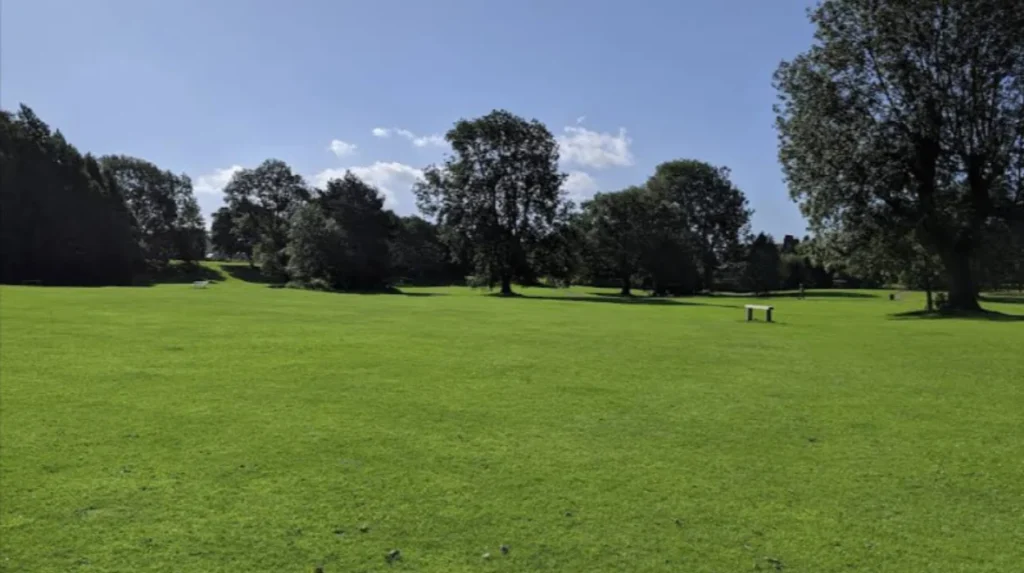
Yeadon sits on sandstone and millstone grit, with shale/clay north enabling Yeadon Tarn’s formation. The town slopes south to Aire Valley, bounded by A65 southwest and A658 southeast; Nunroyd Park separates it from Guiseley. Medieval strips persist in Yeadon Banks fields; 19th-century grid terraces contrast organic Town Street/Ivegate lanes.
Yeadon Tarn, a 7-hectare engineered natural lake at 196m elevation, holds 237,841m³ water from 68ha drainage. Recorded as Yedonmarre (1354 Old Norse mær), it served as fish pond, mill supply; council bought dam 1925 for £2,400, renaming it. Drained WWII to obscure Avro factory; freezes winters for skating/curling. Yeadon Beck outflows to River Aire at Esholt, once polluted.
Demographics and Community
Yeadon population reached 14,245 (2021 Census), with Otley & Yeadon ward at 22,584. Gender split: 6,867 males, 7,378 females; ages: 2,756 under 18, 8,375 18-64, 3,114 65+. Predominantly White (95.7%), UK-born (95.9%); small EU/Asian/African groups.
Part of Leeds North West constituency and Otley & Yeadon ward (three councillors). Strong community via Town Hall (Grade II listed, 1880 Gothic, £5,000 build) for events; library/One Stop Centre in square. Churches include St John the Evangelist (1844), New Life Community (1891 Grade II), St Peter & Paul RC, Methodist, Brethren hall.
Economy and Industry
Historically textile-focused (women’s apparel), Yeadon shifted post-WWII. Avro factory (1938-1946) built 695 Lancasters, 4,500 Ansons east of tarn. Leeds Bradford Airport (opened 1931 as Yeadon Aerodrome) drives aviation; first flights 1935 to Newcastle/Edinburgh/London. WWII expansions; civil ops 1947; runways extended 1978 for regional status.
Today, diverse Leeds economy influences: engineering, printing, food, chemicals (8.8% manufacturing). Local jobs in care, education, engineering consultancies, demos; Morrisons, chains on High Street. Epilepsy Action HQ here; hotels near airport.
Attractions and Recreation
Yeadon Tarn anchors Tarnfield Park (17 acres): sailing (Leeds Sailing/Yeadon Club), fishing (carp), kayaking, model boats; wildlife like ducks, geese (cull for airport safety), cormorants. BMX track, playground, bowls, summer brass bands.
Low Hall (Grade II, 1624 farmhouse, 1658 porch from Esholt Priory, priest hole). Cricket legacy: Yeadon CC (Bradford Premier League) from 1859 Topenders/Lowenders amalgamation; W.G. Grace played 1877. Yeadon FC in Wharfedale Triangle Premier. Aireborough RUFC at Nunroyd.
Town center bustle: pubs, shops; airport heritage via 2168 (Yeadon) Air Training Corps. Events: markets, music (indie, tributes).
Transport and Accessibility
No active rail (Yeadon station closed 1964, goods-focused); path remains. Buses: A2 Harrogate/Bradford, 33/34/27 Otley/Guiseley/Leeds, 966 Guiseley, 747 tarn. Trams to Leeds till 1950s. Airport proximity boosts connectivity; A65/A658 link Leeds/Bradford.
Notable People
Betsy Sawyer (d.1839), escaped slavery Antigua; memorial in Methodist churchyard. Brian Close, Yorkshire/England cricket captain, childhood here. Moses Ayrton (1878–1950), NZ Methodist/socialist born Yeadon.
Living in Yeadon Today
Yeadon thrives as commuter haven: airport jobs, green spaces, schools like Yeadon Westfield Junior (196 pupils). SEO keywords like “Yeadon Leeds history,” “things to do Yeadon Tarn,” “living in Yeadon” highlight its evergreen appeal for families, history buffs. Proximity to Leeds (8 miles) blends suburban calm with urban access.