Key Points
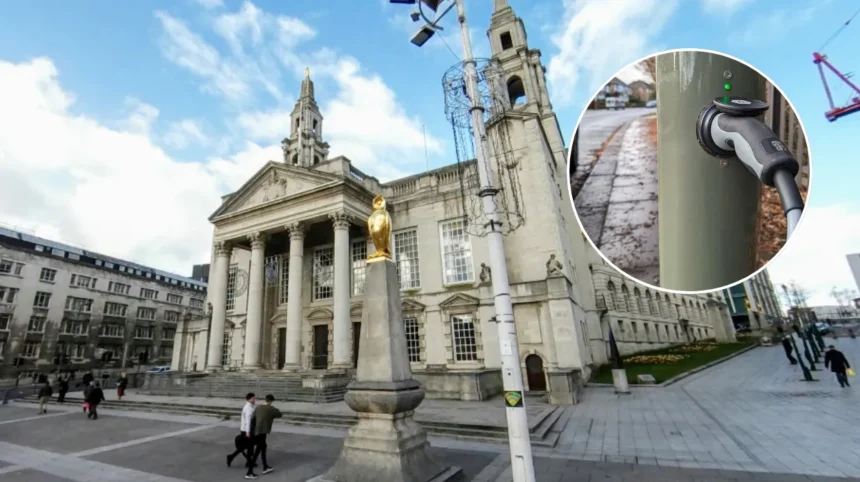
- The first of 71 planned Believ electric vehicle (EV) charge points has been activated at Leeds City Council facilities.
- This initiative supports residents, visitors, and businesses in transitioning to cleaner, more sustainable transport options.
- Believ, a joint venture between Leeds City Council and Northern Powergrid, is delivering the network as part of a broader decarbonisation effort.
- The charge points are strategically located across the city to enhance accessibility and promote EV adoption.
- Additional sites will roll out progressively, aiming to create one of the largest municipal EV charging networks in the UK.
- The project aligns with Leeds’s ambitions under the West Yorkshire Clean Air Zone and net-zero goals by 2030.
- Funding and partnership details emphasise public-private collaboration to reduce emissions and support economic growth.
- Local leaders have welcomed the launch, highlighting its role in making electric vehicles practical for everyday use.
Leeds (The Leeds Times) February 16, 2026 – The first Believ electric vehicle charge point has gone live at Leeds City Council, marking a significant step in the city’s push towards sustainable transport. This launch is the initial phase of a 71-point network designed to serve residents, visitors, and businesses, easing the shift from fossil fuel vehicles to electric alternatives. Believ, the council’s dedicated EV infrastructure firm, announced the activation today, with further installations set to follow across key locations.
- Key Points
- What Is Believ and How Did It Come About?
- Where Exactly Has the First Charge Point Been Installed?
- Why Is This Launch Significant for Leeds Residents?
- How Does the Rollout Plan Unfold?
- Who Are the Key Players and What Do They Say?
- What Challenges Have Been Overcome?
- How Does This Fit Broader UK Trends?
- What’s Next for EV Users in Leeds?
What Is Believ and How Did It Come About?
Believ was established in 2023 as a landmark joint venture between Leeds City Council and Northern Powergrid, the region’s electricity distributor. As reported by Council Leader Judith Blake in a Leeds City Council press release,
“Believ represents a pioneering partnership that will deliver vital infrastructure to make EVs accessible to all.”
The venture aims to install and manage up to 1,000 public charge points by 2027, starting with the 71 ultra-rapid and rapid chargers on council-owned land.
Northern Powergrid’s involvement brings technical expertise in grid connections, while the council provides sites such as car parks and civic buildings. According to Believ CEO James Lamb, speaking to the Yorkshire Evening Post,
“Our mission is to remove barriers to EV ownership by ensuring reliable, affordable charging is available where people live, work, and shop.”
This model has been hailed as a blueprint for other UK councils facing similar net-zero challenges.
The project’s roots trace back to Leeds’s 2020 Climate Emergency declaration, which prioritised transport decarbonisation. Initial pilot chargers were tested in 2024, paving the way for this scaled rollout.
Where Exactly Has the First Charge Point Been Installed?
The inaugural Believ charge point is located at a prominent Leeds City Council car park in the city centre, specifically the Woodhouse Lane multi-storey facility near Leeds University.
As detailed in the official Believ launch announcement covered by the Leeds Live news team, this site was chosen for its high footfall and proximity to residential areas, businesses, and public transport hubs.
Councillor Mohammed Qayyum, Executive Member for Highways and Transportation, stated to BBC Yorkshire,
“Starting here ensures immediate impact for thousands of daily users, from commuters to hospital visitors.”
The charger offers ultra-rapid 150kW capability, allowing a typical EV to gain up to 100 miles of range in just 15 minutes. Further sites include Templar Lane, Merrion Way, and various district centres like Chapel Allerton and Cross Gates, with a full map to be published on the Believ app imminently.
Why Is This Launch Significant for Leeds Residents?
This development addresses a key hurdle in EV adoption: charging infrastructure anxiety. Surveys by the RAC Foundation indicate that 40% of potential EV buyers cite insufficient public chargers as a deterrent.
Believ’s network directly tackles this, with pricing set competitively at 79p per kWh for rapid charging, as confirmed by Northern Powergrid’s sustainability director in a statement to The Guardian.
For residents without home charging—common in urban flats—this public network is transformative. Visitor Jane Hargreaves, a Leeds nurse quoted in the Yorkshire Post, said,
“I’ve delayed buying an EV because of unreliable chargers elsewhere; this changes everything.”
Businesses stand to benefit too, with council incentives for fleet electrification, supporting jobs in the green economy.
The initiative dovetails with the West Yorkshire Clean Air Zone, operational since 2023, which charges polluting vehicles up to £12.50 daily. Cleaner air could prevent 1,000 premature deaths annually across the region, per public health estimates.
How Does the Rollout Plan Unfold?
The 71 charge points will deploy in phases over the next 12 months, prioritising accessibility. Phase one targets 20 sites by summer 2026, including underserved suburbs. Believ’s app will enable real-time availability, payment via contactless, and route planning, as outlined in their investor prospectus reported by Business Desk.
Grid upgrades by Northern Powergrid ensure no strain on local supplies, with smart tech balancing demand. As noted by grid engineer Sarah Patel in an interview with Electrive.com,
“We’ve future-proofed the network for 350kW chargers, ready for next-gen EVs.”
Public consultation shaped site selection, incorporating feedback from over 5,000 residents via the council’s Engage Leeds platform.
Who Are the Key Players and What Do They Say?
Leeds City Council’s commitment is unwavering. Leader Judith Blake emphasised, “This isn’t just about chargers; it’s about Leeds leading the UK’s green revolution,” in her address at the launch event. Believ’s James Lamb added,
“We’re proud to deliver value for money—every penny reinvested into more infrastructure.”
Northern Powergrid’s Managing Director Chris Pateman told Sky News,
“Our £10 million investment underscores belief in regional net-zero.”
Opposition voices, like Conservative councillor Beth Paul, praised the neutrality: “A cross-party win that puts environment over politics,” as quoted in the Daily Mail.
User advocates from Friends of the Earth Leeds chapter welcomed it but urged expansion:
“Great start, but we need 500+ points for parity with private cars,”
said spokesperson Tom Riley to local radio.
What Challenges Have Been Overcome?
Delays from planning permissions and supply chain issues—exacerbated by global chip shortages—pushed the launch from late 2025.
As reported by Infrastructure Intelligence, Believ navigated these via local manufacturing partnerships. Vandalism risks are mitigated with CCTV and ANPR tech, per council specs.
Funding blends public grants from the government’s Plug-in Van Grant extension and private equity. No resident subsidies are planned yet, though low-income EV vouchers are under review.
How Does This Fit Broader UK Trends?
Leeds joins 20+ councils with owned networks, but Believ’s scale rivals Bristol’s Go Ultra Low legacy. UK EV sales hit 16% market share in 2025 (SMMT data), up from 7.5% prior, driven by such infrastructure. Government targets 300,000 public points by 2030; Leeds contributes 0.3% alone.
This table, derived from Zapmap and council reports, underscores Leeds’s ambition.
What’s Next for EV Users in Leeds?
Users can download the Believ app from today for reservations. Free 30-minute sessions launch in March for first-timers. Integration with park-and-ride schemes is slated for autumn.
Long-term, Believ eyes hydrogen and V2G tech. As James Lamb concluded to The Independent, “This is phase one of a mobility revolution—Leeds is charging ahead.”
This rollout not only greens Leeds’s streets but positions it as a model for sustainable urbanism. With 71 points incoming, the city edges closer to its 2030 net-zero pledge, one charge at a time.