

Key Points
- Brad Arthur plays down any concerns over Leeds Rhinos’ short turnaround and physical fatigue ahead of the Castleford Tigers clash, insisting performance will be a matter of mentality and standards.
- The fixture puts Super League at the centre of the rugby league universe for 80 minutes, underlining the intensity, scrutiny and global visibility of the Leeds–Castleford derby.
- Leeds Rhinos seek to build consistency and resilience after an early‑season schedule that has asked serious questions of their squad depth and conditioning.
- Castleford Tigers arrive determined to exploit any signs of fatigue, targeting fast ruck speed and high tempo in the opening stages to put Leeds under pressure.
- Arthur challenges his players to “embrace” the demands of elite competition rather than lean on tiredness as an excuse, framing the derby as a test of character as much as skill.
- Tactical focus for Leeds centres on completion rates, discipline, and control of territory, with Arthur stressing the need to dominate field position against a hungry Castleford pack.
- Castleford’s coaching staff emphasise physicality in the middle and smart kicking to turn Leeds’ back three, aiming to force the Rhinos into repeated defensive sets.
- The derby carries emotional weight for supporters of both clubs, with local pride, bragging rights and long‑running rivalries shaping the atmosphere at Headingley.
- Leeds’ senior players are urged to set the tone, with leadership in defence and talk in the line seen as crucial to preventing energy dips in the latter stages.
- Arthur’s refusal to “buy into” tiredness narratives sends a clear message that standards at Leeds Rhinos must remain non‑negotiable regardless of scheduling challenges.
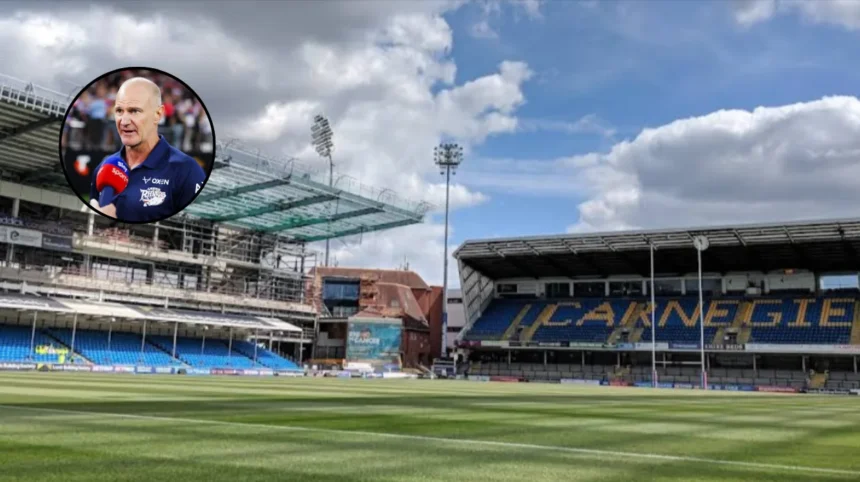
Leeds (The Leeds Times) March 7, 2026 – For 80 minutes, Super League’s glare will fall squarely on Headingley as Leeds Rhinos face Castleford Tigers, with Leeds head coach Brad Arthur brushing aside concerns over fatigue and insisting that the derby will be decided by mind over matter rather than the strain of a demanding schedule.
- Key Points
- How does Brad Arthur dismiss concerns about Leeds Rhinos’ tiredness?
- Why is this Leeds Rhinos v Castleford Tigers clash seen as a global Super League showcase?
- How has Leeds Rhinos’ schedule tested their resilience and depth?
- In what ways are Castleford Tigers aiming to exploit any Leeds fatigue?
- How does Brad Arthur frame tiredness as a question of ‘mind over matter’?
- What tactical priorities has Arthur emphasised for Leeds against Castleford?
- How are Castleford Tigers expected to approach the physical battle?
- Why is leadership within the Leeds Rhinos squad critical in this fixture?
- How does the derby atmosphere between Leeds and Castleford shape the contest?
- What does Arthur’s stance reveal about expectations at Leeds Rhinos?
How does Brad Arthur dismiss concerns about Leeds Rhinos’ tiredness?
In the build‑up to the derby, Brad Arthur has been keen to shut down any narrative that Leeds Rhinos will be disadvantaged by tired legs or a congested run of fixtures, framing the issue as primarily psychological rather than physical.
As reported by the Yorkshire Post, Arthur has effectively drawn a line under tiredness talk, signalling to his squad and the wider game that elite players must accept heavy workloads as part of the Super League landscape.
Arthur’s stance places responsibility back on his players’ mentality, suggesting that while the science of recovery and rotation matters, there is a clear expectation that Leeds will compete with intensity from first whistle to last. By refusing to lean on external factors such as scheduling, travel or previous matches, he underlines a culture at Leeds in which standards do not fluctuate simply because the calendar is unforgiving.
Why is this Leeds Rhinos v Castleford Tigers clash seen as a global Super League showcase?
The Leeds–Castleford fixture has been billed as a moment when, for an 80‑minute window, Super League sits at the centre of the rugby league universe, with attention from fans, broadcasters and commentators trained on Headingley.
This reflects not only the historic rivalry between the two West Yorkshire clubs but also the way such derbies are used to project the competition’s intensity and spectacle to a wider audience.
The match encapsulates many of the characteristics Super League wishes to promote: high pace, physical collisions, passionate support and local narratives that resonate far beyond the immediate region.
For international viewers and neutrals, Leeds v Castleford offers a clear snapshot of what top‑flight British rugby league looks like at full throttle, with the added edge of a coach publicly challenging his side to rise above excuses.
How has Leeds Rhinos’ schedule tested their resilience and depth?
Leeds Rhinos’ early‑season run has featured quick turnarounds and physically demanding contests, conditions that typically test the robustness of a squad’s preparation and the depth of its bench. Such sequences often expose whether a club has the conditioning, medical support and rotation strategy to keep performance levels high across consecutive matches.
For Arthur, the schedule becomes a proving ground for the culture he is building: players are expected to adapt, younger squad members may be asked to shoulder more responsibility, and senior figures must help maintain standards on and off the pitch.
The Castleford game arrives not as an isolated event but as part of a broader examination of whether Leeds can manage the grind of a long Super League campaign while still delivering in marquee fixtures.
In what ways are Castleford Tigers aiming to exploit any Leeds fatigue?
From Castleford Tigers’ perspective, any hint of residual fatigue in Leeds’ line‑speed, contact or decision‑making represents an opportunity to seize control of the contest early. That means prioritising high‑tempo play in the opening stages, pushing the ball wide after quick rucks, and using their forwards to repeatedly challenge Leeds’ middle defenders.
Castleford’s coaching staff are likely to instruct their playmakers to maintain a relentless tempo, forcing Leeds to make repeated efforts in defence and stretching their defensive structures laterally.
A fast start, combined with disciplined completion and territorial pressure, could magnify any small dips in Leeds’ energy levels, turning a narrative about tiredness into a tangible advantage on the scoreboard if the Rhinos are slow to settle.
How does Brad Arthur frame tiredness as a question of ‘mind over matter’?
Arthur’s message, as highlighted in the coverage, positions tiredness primarily as a mental barrier that must be overcome rather than a ready‑made explanation for any drop in performance. By adopting that line publicly, he both challenges his own players and neutralises any suggestion that Leeds are looking for sympathy or pre‑emptive mitigation.
This “mind over matter” framing is also a classic motivational tool, encouraging individuals to focus on controllables: effort, concentration, communication and discipline.
It signals that while recovery protocols and sports science are respected, the expectation is that once the players cross the white line, they will compete at full commitment, regardless of the workload that has preceded the derby.
What tactical priorities has Arthur emphasised for Leeds against Castleford?
Tactically, Arthur’s emphasis ahead of Castleford revolves around basics that become even more important when managing heavy legs: high completion rates, disciplined defence and smart management of field position. Reducing unforced errors and penalties prevents Leeds from having to defend extra sets, which in turn conserves energy for decisive attacking moments.
Control of territory through a strong kicking game is another priority, ensuring that Castleford are forced to start their sets deep in their own half rather than repeatedly receiving the ball in attacking positions. Forwards are tasked with laying a platform through direct carries and quick play‑the‑balls, while key decision‑makers must choose when to inject width and when to play conservatively to maintain pressure.
How are Castleford Tigers expected to approach the physical battle?
Castleford’s game plan is likely built around a willingness to meet, and attempt to exceed, Leeds’ physicality in the middle third, using their pack to win collisions and slow the Rhinos’ ruck speed. By controlling the wrestle and dominating contact, the Tigers can restrict Leeds’ ability to generate momentum, making it harder for Arthur’s side to shift the ball with fluency.
Complementing that forward battle, Castleford’s kickers will aim to repeatedly turn Leeds’ back three, forcing them to cover long distances on kick returns and exposing any fatigue in kick‑chase organisation.
Cross‑field kicks, attacking bombs and grubbers into the in‑goal area can all be used to test Leeds’ concentration and scramble defence, particularly in the later stages when tired minds are more prone to errors.
Why is leadership within the Leeds Rhinos squad critical in this fixture?
In high‑intensity derbies played under a magnifying glass, the role of senior players becomes crucial in maintaining composure and ensuring standards do not slip when pressure builds.
Leaders within the Leeds camp are expected to drive line‑speed, organise defensive structures and keep communication high, particularly when physical strain begins to bite.
Such leadership is not only vocal but behavioural: how experienced players carry the ball out of their own end, how they respond to momentum swings and how they model discipline after contentious calls or errors. In a context where tiredness has been publicly dismissed as a valid excuse, those senior figures must embody the “no excuses” ethos that Arthur has put on record.
How does the derby atmosphere between Leeds and Castleford shape the contest?
The rivalry between Leeds Rhinos and Castleford Tigers injects a level of emotion that can both inspire and unsettle players, with local pride and long‑standing storylines contributing to a charged atmosphere.
For many supporters, victory in this fixture carries significance beyond league points, feeding into bragging rights, social media exchanges and the broader narrative of Yorkshire rugby league.
That intensity can lift performance, but it also demands emotional control; players who are already managing physical fatigue must ensure they do not compound it with ill‑discipline born of frustration or over‑exuberance.
Coaches on both sides will stress the need to use the crowd and occasion as fuel without allowing it to drag their teams into loose or reckless play, particularly around the ruck and in contact.
What does Arthur’s stance reveal about expectations at Leeds Rhinos?
Arthur’s brisk dismissal of tiredness talk offers an insight into the standards he expects to define Leeds Rhinos during his tenure: no soft landings, no pre‑emptive explanations, and a clear focus on performance regardless of circumstances.
It reflects a broader elite‑sport mindset in which scheduling challenges are acknowledged but not allowed to shape the narrative from inside the camp.
For Leeds supporters, that tone may be reassuring, suggesting that the club is intent on matching the ruthless expectations seen at leading outfits across Super League and beyond. Ultimately, the Castleford fixture becomes not only a test of skill and structure, but also a visible examination of whether the Rhinos can live up to the “mind over matter” mantra that their head coach has chosen to put front and centre.