Key Points
- Leeds City Council’s planning committee has approved plans for a new “Corn Exchange Pavilion” in the city centre.
- The pavilion will be located in the public space immediately outside the Grade I listed Corn Exchange building.
- The scheme is led by CX Leeds Ltd, a wholly‑owned subsidiary of Rushbond, the owners of the Corn Exchange.
- The pavilion is intended as a flexible public space for outdoor events, pop‑up shops, food and drink outlets, and community activities.
- The project forms part of wider improvements to the public realm around the Corn Exchange, including pedestrianisation and greenery.
- Previous proposals for a pavilion‑style structure were discussed in earlier council reports and planning documents, but the latest consent grants formal approval for the current scheme.
- The design is expected to respect the historic character of the Corn Exchange and the surrounding Civic Quarter.
- Leeds Civic Trust previously objected to earlier pavilion designs, citing heritage and townscape concerns, but the council has now moved ahead with the approved consent.
- The project sits within the wider Connecting Leeds transport and public‑realm strategy, which encompasses £270 million of investment in the city centre.
- Council officers and councillors have described the pavilion as a “once‑in‑a‑generation” opportunity to re‑anchor the Corn Exchange within a more welcoming, greener public space.
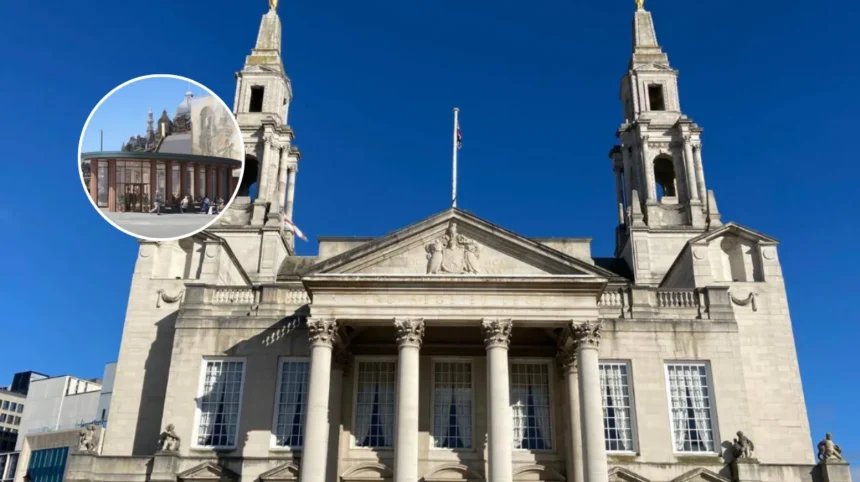
Leeds (The Leeds Times) March 31, 2026 – Leeds City Council has given the go‑ahead for a new “Corn Exchange Pavilion” in the heart of the city centre, formally approving plans for a glazed public‑realm building to sit in front of the Grade I listed Corn Exchange. As reported by Alex Young of the Yorkshire Evening Post, the council’s planning committee granted consent this morning (Tuesday) to proposals submitted by CX Leeds Ltd, a subsidiary of property developer Rushbond, which owns and manages the Corn Exchange.
The approved scheme will create a light, open‑plan structure offering flexible space for outdoor functions, seasonal markets, food and drink outlets and community events, with the aim of making the area more attractive for residents, shoppers and visitors. The pavilion will be positioned within the existing public‑realm space outside the Corn Exchange on Call Lane and Vicar Lane, part of a broader public‑realm upgrade that has been in development since the early 2020s.
What is the Corn Exchange Pavilion?
The Corn Exchange Pavilion is conceived as a contemporary structure designed to complement, rather than compete with, the historic Corn Exchange building, which was built in the 1860s and has long been a focal point of Leeds’ city‑centre retail and cultural scene.
According to design information shared by Rushbond and summarised in earlier council documents, the pavilion will feature a glazed roof and lightweight materials, allowing natural light into the space while keeping the surrounding area visually open.
In a council briefing note referenced by BBC News, officers described the pavilion as a “pavilion‑like” area that would add public amenity to the space while preserving sightlines to the Corn Exchange’s distinctive oval façade. The structure is intended to be non‑permanent in appearance, with the capacity to be adapted or removed if future needs change, something noted by Leeds Civic Trust in its comments on earlier schemes.
Why is the council pushing this scheme?
The pavilion forms part of wider efforts to regenerate the area around the Corn Exchange, which has been identified as a key gateway into the city centre.
As reported by BBC News in earlier coverage of the scheme, Leeds City Council tagged the surrounding area as suffering from “excess street clutter” and “very little in the way of greenery”, and the wider public‑realm improvements include tree planting, enhanced pedestrian crossings and safer cycling routes.
In a 2021 statement quoted by BBC News, Councillor Lisa Mulherin, then executive member for climate change, transport and sustainable development, said the Corn Exchange offered a “once in a lifetime opportunity” to re‑anchor a historic landmark within a greener, more welcoming public space. Building on the council’s Our Spaces Strategy, the proposals aim to create a more attractive environment for people to meet, eat and socialise, while supporting the retail and leisure businesses inside the Corn Exchange.
How does the pavilion fit with the Connecting Leeds programme?
The Corn Exchange scheme is closely linked to the council’s Connecting Leeds transport and public‑realm strategy, a £270 million package of works aimed at improving walking, cycling and public transport in the city centre.
As outlined in the council’s 2021 public‑realm update, the initial phase of work around the Corn Exchange includes pedestrianisation measures, improved crossings and surface treatments, with the pavilion concept introduced as a later, additional element requiring separate planning consent.
Earlier coverage by BBC News explained that the wider Connecting Leeds works were scheduled to begin in May 2021, with the pavilion always treated as a follow‑on project.
The latest approval means that the pavilion can now move towards detailed design and construction, subject to any remaining conditions imposed by the planning committee. Council officers have indicated that the timing will depend on funding flows and the broader Connecting Leeds programme, but the granting of consent is being treated as a key milestone.
Who is behind the project and what are they saying?
The applicant for the pavilion is CX Leeds Ltd, a company wholly owned by Rushbond, which has been involved in the Corn Exchange’s redevelopment for over a decade. According to Insider Media, the company submitted the latest planning application to Leeds City Council earlier this year, building on earlier proposals that had already been subject to consultation and critique.
In a short statement provided to Leeds News via the Yorkshire Evening Post, a Rushbond spokesperson welcomed the committee’s decision, saying the pavilion would “enhance the public space” and
“support the Corn Exchange as a vibrant hub for independent traders and visitors”.
The company emphasised that the design had been shaped by feedback from heritage bodies and the council’s historic‑environment team, though it added that some groups, including Leeds Civic Trust, had previously raised concerns about the scale and impact of earlier versions of the scheme.
What are the heritage and planning concerns?
Leeds Civic Trust, the city’s statutory heritage advisory body, has scrutinised several iterations of the pavilion proposals. In its February 2025 planning‑news bulletin, the trust noted that it had objected to earlier designs for the pavilion in front of the Corn Exchange, citing “unsympathetic” massing and potential impacts on views of the historic building.
The organisation later observed that those earlier plans had already been approved, leaving an extant consent that could influence future development.
Despite those objections, the latest round of plans appears to have been modified to address some of the concerns, with the council’s planning officers recommending approval.
In a background note summarised by BBC News, officers said the pavilion would be “fully reversible” and would not materially alter the setting of the Grade I listed Corn Exchange, a view that appears to have underpinned the committee’s decision.
How might the pavilion be used?
The council and Rushbond have outlined a range of potential uses for the pavilion, which is intended to be flexible enough to respond to different events and seasons.
As described in the council’s 2021 public‑realm update, the space could host outdoor functions, small markets, al‑fresco dining, and community activities such as markets, product launches or cultural events.
The assessment also suggested that the pavilion could be used to support temporary retail or food‑and‑drink units, offering additional footfall and trade opportunities for the Corn Exchange’s independent tenants.
This aligns with the broader objective of the Connecting Leeds strategy to make the city centre more attractive for visitors while maintaining and enhancing the historic character of key buildings.
What happens next?
With planning approval now granted, the next stage is expected to involve final design detailing, coordination with the wider Connecting Leeds works, and the securing of any necessary funding. Council officers have indicated that the pavilion will need to be delivered in a way that does not disrupt the ongoing transport and public‑realm improvements, and that construction timing will depend on the phasing of the wider programme.
For the Corn Exchange’s tenants and the surrounding business community, the approval is being seen as a positive step towards a more attractive and active public space. As reported by Leeds News, trade‑body representatives have welcomed the move, saying that a better‑designed public realm outside the building could help drive more footfall into the historic arcade and support the city’s independent retailers.