
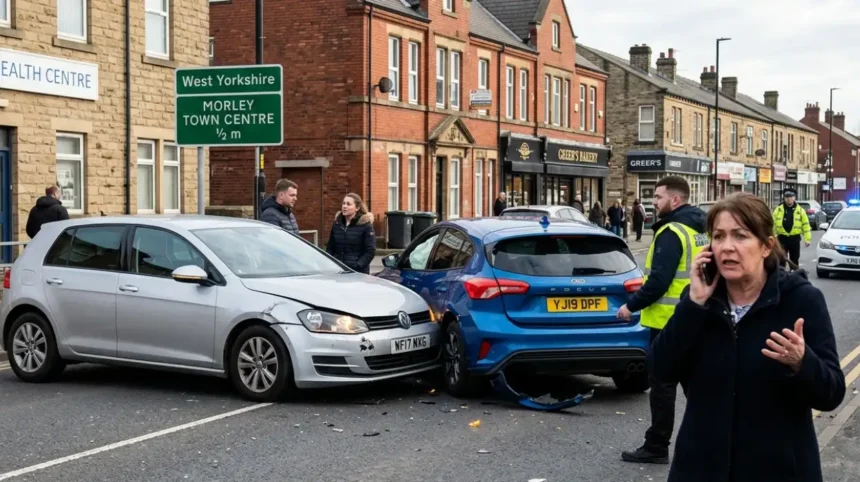
Road traffic collisions represent significant public safety incidents that require structured, legally compliant responses from members of the public. In the market town of Morley, West Yorkshire, witnessing a vehicle collision involves distinct legal responsibilities, safety protocols, and emergency service contact procedures. Data from the Leeds City Council Road Safety Report indicates that Leeds recorded 1,466 personal-injury collisions across the highway network, with multiple incidents occurring on major arterial routes within the Morley sector. Understanding the exact actions required ensures compliance with United Kingdom legislation and assists the emergency services in preserving human life.
- What Are the Immediate Safety Actions to Take After Witnessing a Car Crash?
- How Do You Contact the Emergency Services in Morley?
- Determining the Correct Communication Channel
- Providing Accurate Location Data to Operators
- Relaying the Emergency Assessment Framework
- What First Aid Protocols Apply to Road Accident Witnesses?
- Airway and Breathing Assessment
- Implementing Life-Saving Resuscitation
- Hemorrhage Control and Injury Mitigation
- Spinal Immobilization Restrictions
- What Are the Legal Obligations of a Witness Under UK Law?
- The Absence of a Duty to Rescue
- Criminal Liability for Scene Distraction
- The Witness Statement Process
- How Does Witness Evidence Impact the Accident Investigation?
- Supplementing Digital and Physical Forensic Data
- Resolving Liability Disputes for Insurance Providers
- Types of Evidence Gathered by Investigators
- What Is the Statistical Context of Road Accidents in the Leeds and Morley Region?
- Analysis of Local Collision Density
- Casualty Severity Classification Systems
- Vulnerability Distribution Among Road Users
- What Local Support Services Exist for Accident Witnesses in Morley?
What Are the Immediate Safety Actions to Take After Witnessing a Car Crash?
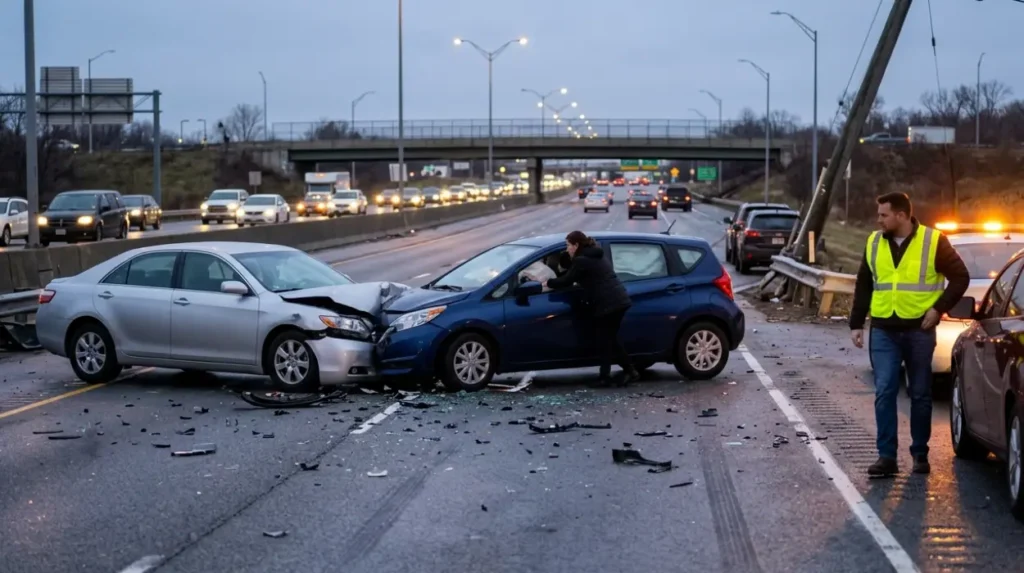
Witnesses to a road accident must first stop their vehicle in a safe location, activate their hazard warning lights, turn off their vehicle ignition, and assess the immediate environment for hazards before approaching the scene to assist casualties.
Establishing a Safe Perimeter
The primary objective of a witness at a collision site is the prevention of secondary accidents. Road traffic accidents create dynamic hazards, including oncoming vehicles, structural debris, and compromised infrastructure. Witnesses must park their own vehicles at least 20 metres away from the incident scene. This distance protects the witness vehicle from potential vehicle fires or structural collapse and preserves access paths for arriving emergency service vehicles. High-visibility garments must be donned if available within the vehicle.
Vehicle Deactivation Protocols
Uncontrolled vehicle systems present severe risks of combustion and electrical grounding. Witnesses must ensure that the ignitions of all involved vehicles are switched off immediately if accessible. Turning off the engine deactivates the fuel pump, reducing the likelihood of a fuel-fed fire. If a vehicle features a hybrid or battery electric powertrain, the witness must look for visible smoke, hissing sounds, or exposed high-voltage wiring, which is universally color-coded in bright orange. Witnesses must not touch damaged components of electric vehicles due to electrocution hazards.
Environmental Hazard Identification
A collision scene requires constant observation for secondary hazards. The three main physical threats are fuel spillages, unstable vehicle positioning, and compromised utility infrastructure. Fuel leaks present a high risk of ignition from electrical sparks or hot exhaust components. Unstable vehicles, such as those resting on embankments, side panels, or roofs, can shift and crush individuals attempting rescue. Witnesses must observe whether the collision has impacted roadside infrastructure, such as electricity pylons, dry stone walls, or traffic signals, which may pose a falling object hazard.
How Do You Contact the Emergency Services in Morley?
Witnesses must dial 999 immediately if an accident causes serious injury, blocks a public highway, involves a fire risk, or indicates a criminal offense, providing operators with the precise location using local street names or coordinates.
Determining the Correct Communication Channel
The United Kingdom emergency services utilize specific telecommunication protocols based on incident severity. The 999 emergency number must be dialled when human life is in immediate danger, a serious crime is in progress, or the road network is completely obstructed. For minor collisions where details have been exchanged, no physical injuries are sustained, and no danger exists, witnesses and participants can report the incident via the 101 non-emergency police number or through the West Yorkshire Police online reporting portal.
Providing Accurate Location Data to Operators
Morley contains a complex mix of urban town roads, rural routes, and major motorways, including the M62 and M621 intersection at the Tingley Interchange. Witnesses must provide exact geographic data to the emergency operator. Useful identifiers include specific street names, such as Queen Street, Fountain Street, or Britannia Road, alongside house numbers or notable landmarks. If the accident occurs on a rural link road like Churwell Hill, witnesses can utilize global positioning applications, such as What3Words, to provide a unique three-word code corresponding to a three-metre square location. On motorways, witnesses must state the motorway number, the direction of travel, and the specific numbers printed on the blue driver location signs situated every 100 metres along the hard shoulder or verge.
Relaying the Emergency Assessment Framework
Emergency dispatchers require structured information to deploy the correct volume and type of emergency personnel. Witnesses must prepare to answer the standard information points known as the METHANE assessment protocol:
- Major Incident: Clarify if the event requires a multi-agency response.
- Exact Location: Provide the geographic coordinates or street data.
- Type of Incident: Specify if it involves cars, heavy goods vehicles, cyclists, or pedestrians.
- Hazards: Detail fuel leaks, fire, chemical spills, or blocked lanes.
- Access: Note the best route for emergency vehicles or any existing road blockages.
- Number of Casualties: Give the approximate count of injured individuals.
- Emergency Services: Detail which services are already present or required.
What First Aid Protocols Apply to Road Accident Witnesses?
Witnesses must check the airway, breathing, and circulation of casualties, perform cardiopulmonary resuscitation if breathing has ceased, control severe external hemorrhaging with pressure, and avoid moving individuals unless an immediate life threat exists.
Airway and Breathing Assessment
The primary medical directive for untrained individuals at an incident scene is the maintenance of vital signs. Witnesses must approach casualties systematically, addressing the quietest individuals first, as unresponsive casualties are at the highest risk of asphyxiation. The witness must check for responsiveness by gently shaking the casualty’s shoulders and shouting. If the casualty is unresponsive, the witness must open the airway using the head-tilt, chin-lift maneuver, then place their ear close to the casualty’s mouth for ten seconds to look, listen, and feel for normal breathing patterns.
Implementing Life-Saving Resuscitation
If the casualty is not breathing normally, the witness must initiate cardiopulmonary resuscitation immediately. The witness must place the heel of one hand in the center of the casualty’s chest, interlock their other hand on top, and deliver continuous chest compressions at a depth of five to six centimeters. The rate of compressions must remain between 100 and 120 compressions per minute. If the witness is trained in first aid, they can deliver two rescue breaths after every 30 compressions; if untrained, the witness must perform hands-only compression therapy until ambulance personnel assume medical control.
Hemorrhage Control and Injury Mitigation
Severe external bleeding can cause fatal hypovolemic shock within minutes. Witnesses must apply firm, direct pressure to open wounds using clean cloth materials, bandages, or sterile dressings found in vehicle first aid kits. If a limb is bleeding heavily, it must be elevated above the level of the heart if no fractures are suspected. Witnesses must keep casualties warm by covering them with coats or blankets to combat physiological shock.
Spinal Immobilization Restrictions
The mechanical forces involved in vehicular collisions frequently cause cervical spine injuries. Witnesses must not remove an injured person from a vehicle unless an immediate, life-threatening danger exists, such as an active vehicle fire or an escalating immersion hazard. Moving a casualty without professional stabilization can cause permanent spinal cord severance, resulting in quadriplegia or death. If a conscious casualty is inside a stable vehicle, the witness must instruct them to remain completely still and manually support their head and neck from behind to prevent involuntary rotation.
Explore More Morley News
Victorian‑Style Bar Opens in Morley 2026
New Morley Bar Approved on Queen Street, Leeds 2026
What Are the Legal Obligations of a Witness Under UK Law?
A witness who is not involved in the collision has no statutory legal duty to stop or provide first aid under United Kingdom law, but they must provide factual statements if requested by police officers.
The Absence of a Duty to Rescue
Unlike jurisdictions governed by civil law codes containing “Good Samaritan” statutes that legally compel citizens to assist individuals in distress, English common law does not impose a general duty to rescue. A passing motorist or pedestrian who witnesses an accident in Morley commits no criminal offense by continuing their journey, provided their own driving did not contribute to or cause the collision. The legal obligation to stop, exchange insurance details, and report the accident applies strictly to the drivers of the vehicles involved in the collision, as defined under Section 170 of the Road Traffic Act 1988.
Criminal Liability for Scene Distraction
While bystanders face no penalties for failing to provide medical assistance, they can face prosecution for actions that degrade road safety at the scene. Motorists who slow down excessively to observe an accident scene, a practice termed “rubbernecking,” can be prosecuted by West Yorkshire Police for driving without due care and attention under Section 3 of the Road Traffic Act 1988. This offense carries a minimum penalty of three penalty points on the offender’s driving license and a £100 fixed penalty notice. Furthermore, using a handheld mobile phone to record video footage of a collision while driving is completely illegal under the Road Vehicles (Construction and Use) Regulations and carries a £200 fine and six penalty points.
The Witness Statement Process
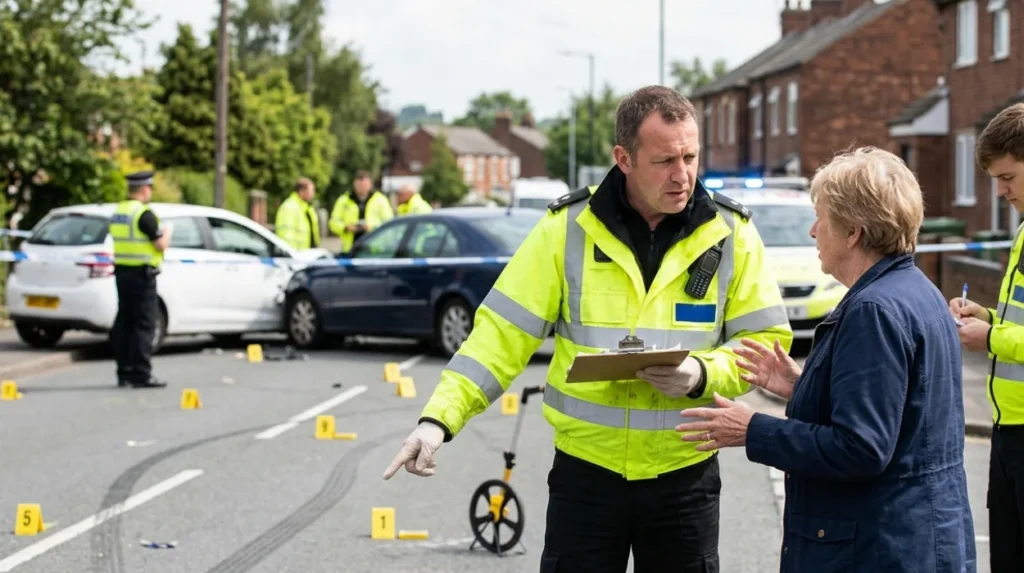
If a witness chooses to stop and assist, or if they are formally identified by law enforcement authorities, they enter the legal framework of the investigation. Police officers attending the Morley collision site will record the witness’s full name, residential address, telephone number, and date of birth. The witness will be required to provide a formal written statement under Section 9 of the Criminal Justice Act 1967. This document serves as a factual account of the events leading up to, during, and after the collision. The statement must be entirely truthful; providing a knowingly false account to police officers constitutes the indictable offense of perverting the course of justice.
How Does Witness Evidence Impact the Accident Investigation?
Witness evidence provides independent, non-biased verification of vehicle speeds, traffic signal compliance, and road positioning, allowing collision investigators to reconstruct the sequence of events accurately.
Supplementing Digital and Physical Forensic Data
Modern collision investigation utilizes various technical data sets, such as closed-circuit television footage, in-vehicle event data recorders, and tyre skid marks left on the road surface. Witness evidence provides the vital contextual framework that connects these physical metrics. While forensic scene investigators can determine the speed of a vehicle prior to braking by analyzing the length of friction burns on a road like Bruntcliffe Lane, an independent witness statement can confirm if the driver was distracted, operating vehicle lighting systems correctly, or reacting to external stimuli such as crossing wildlife or pedestrians.
Resolving Liability Disputes for Insurance Providers
Insurance companies rely heavily on independent witness statements to assign financial liability following a collision. Statements provided by occupants of the vehicles involved are legally classified as self-serving and carry less evidential weight due to inherent bias. An independent witness with no personal or financial connection to either party provides an objective viewpoint. This evidence allows claims adjusters to resolve disputes rapidly, preventing protracted litigation in the civil courts. If a witness records dashcam footage from their own vehicle, this digital media must be preserved and submitted directly to the police or insurance investigators, as it provides timestamped, visual proof of the event mechanics.
Types of Evidence Gathered by Investigators
Collision investigators categorize witness observations into specific types of evidentiary input. These types include:
- Temporal evidence: Identifying the exact minute the collision occurred to match against mobile phone records or signal phase logs.
- Behavioral evidence: Detailing the driving style, erratic movements, or perceived speed of the vehicles before impact.
- Environmental evidence: Reporting local weather conditions, visibility levels, or temporary road obstructions present at the time of the incident.
What Is the Statistical Context of Road Accidents in the Leeds and Morley Region?
The Leeds metropolitan district recorded 1,466 personal-injury collisions in 2024, resulting in 1,893 distinct casualties, with vulnerable road users accounting for approximately half of all deaths and serious injuries.
Analysis of Local Collision Density
Data compiled by Leeds City Council and shared through Data Mill North highlights the consistent presence of traffic collisions across the West Yorkshire highway network. The 1,466 personal-injury collisions recorded in 2024 represent a marginal increase from the 1,463 incidents documented in 2023. These figures indicate that despite continuous infrastructural improvements, road users face a persistent risk of vehicular impacts. The total number of casualties (1,893) exceeds the total number of individual accidents because single collisions often involve multi-occupant vehicles or multiple pedestrians.
Casualty Severity Classification Systems
The United Kingdom Department for Transport utilizes a standardized system called CRASH to categorize casualty outcomes into three distinct tiers of injury severity:
- Slight: Minor injuries including whiplash, abrasions, or minor bruising that do not require extended hospitalization.
- Serious: Severe injuries including fractures, internal bleeding, amputations, or severe concussions requiring inpatient hospital admission.
- Fatal: Injuries that result in human death at the scene or within 30 days of the initial collision event.
In 2024, the Leeds district recorded 11 fatal collisions, which represents the lowest fatality rate since 2020 and a significant decrease from the historical baseline average of 21 fatalities recorded between 2017 and 2019.
Vulnerability Distribution Among Road Users
An analysis of regional collision data reveals that individuals inside enclosed passenger cars are statistically safer than those outside them. Vulnerable road users, who do not benefit from the structural crumple zones or airbag deployment systems of modern motor vehicles, suffer disproportionately high rates of death and serious injury.
In 2024, the distribution of Killed or Seriously Injured categories across the Leeds district demonstrated the following demographic breakdown:
- Pedestrians: Constituted 21% of all serious and fatal injuries, with 92 serious injuries and 4 fatalities recorded.
- Pedal Cyclists: Represented 15% of the total serious injuries, accounting for 68 serious injuries and 2 fatalities.
- Motorcyclists: Made up 13% of the total, suffering 60 serious injuries and 1 fatality during the calendar year.
These statistics emphasize the need for immediate, precise witness intervention, as half of all severe incidents involve unprotected road users who require urgent medical stabilization.
What Local Support Services Exist for Accident Witnesses in Morley?
Witnesses can access psychological support through national charities like Brake and the West Yorkshire Victim Support unit, alongside reporting tools provided by local police stations.
Addressing Psychological Trauma and Post-Traumatic Stress
Witnessing a severe motor vehicle collision can induce acute stress reactions and long-term psychological conditions, including Post-Traumatic Stress Disorder. The sudden exposure to physical trauma, vehicular fires, or fatal injuries can overwhelm normal emotional processing systems. National road safety charities, such as Brake, operate dedicated helplines that provide free, confidential support and counseling services to individuals affected by road crashes. These services help witnesses process their experiences and manage symptoms of anxiety or flashbacks.
Regional Support Infrastructure
Within West Yorkshire, the local government funds specific victim care services designed to assist individuals who have interacted with traumatic events or participated in criminal investigations. The West Yorkshire Victim Support unit provides localized care plans, offering telephone support, face-to-face meetings, and assistance throughout the judicial process if a witness is required to give evidence in court. This service operates independently of the police force, ensuring complete confidentiality for the user.
Local Administrative and Reporting Facilities
For administrative actions, including the formal submission of witness statements, dashcam media, or property logs, witnesses utilize local infrastructure managed by the West Yorkshire Police force. While Morley Police Station on Corporation Street functions primarily as a deployment base for local neighborhood policing teams and does not maintain a 24-hour public desk, formal appointments can be scheduled there for statement collection. Major public enquiries and physical evidence drop-offs are routed through larger regional hubs, such as Leeds Central Police Station or Elland Road Police Station, which provide the full administrative support needed for active collision investigations.
What should I do first if I witness a car accident in Morley?
The first step is to stop safely, switch on your hazard lights, and assess the area for immediate dangers such as fuel leaks, fire, or moving traffic before approaching anyone injured.