

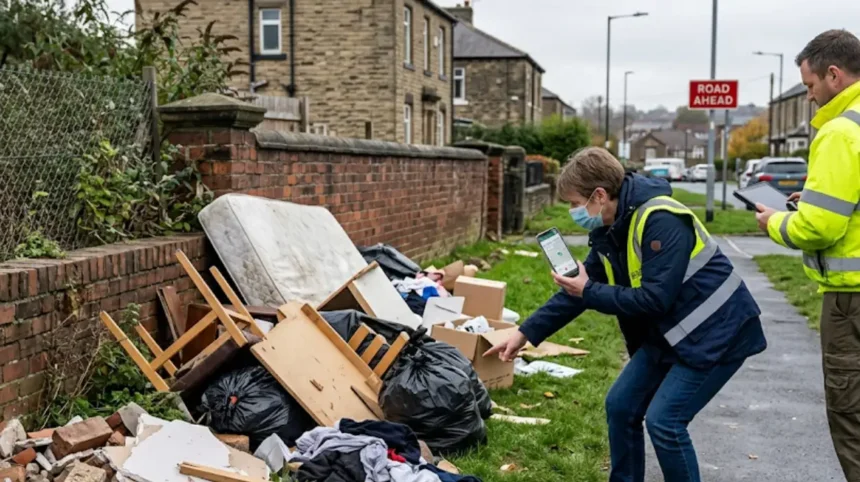
Fly-tipping near Pudsey town centre is reported to Leeds City Council when the waste is on public land, and to another landowner or authority when it is on rail, canal, or private land. The most useful report includes the exact location, the waste type, the amount, a photo, and any details about the person or vehicle involved.
- What counts as fly-tipping near Pudsey town centre?
- Who should you report it to?
- How do you report it to Leeds City Council?
- What details help most?
- What should you do if you see it happening?
- What happens after you report it?
- Why is fly-tipping a serious issue in Pudsey?
- What does the law say?
- How can residents prevent repeat dumping?
- Why does fast reporting matter?
- What is the clearest reporting route?
What counts as fly-tipping near Pudsey town centre?
Fly-tipping is the illegal dumping of waste onto land that is not licensed to receive it, including streets, pavements, parks, alleyways, and council land near Pudsey town centre. Leeds City Council treats rubbish dumped on public land as reportable fly-tipping, while national guidance classifies both small-scale dumping and larger waste crimes as illegal disposal.
Fly-tipping covers a wide range of waste. The national definition includes several bin bags, one or two pieces of furniture, small commercial waste loads, garden waste, and some hazardous waste such as a drum of industrial waste or a sheet of asbestos. In practical terms, the key test is simple: if waste has been dumped where it has no legal right to be, it is fly-tipping.
Pudsey town centre matters because town centres contain pavements, service roads, rear access lanes, car parks, and mixed-use areas where dumped waste becomes visible quickly and can create nuisance or public health risk. Leeds City Council also investigates waste left in gardens or on business premises when the issue falls within its reporting categories.

Who should you report it to?
Report fly-tipping on public land to Leeds City Council, report large-scale dumping or serious waste crime to the Environment Agency, and report crime anonymously to Crimestoppers when needed. The correct route depends on the location, scale, and risk level of the incident, so the first step is identifying where the waste sits.
Leeds City Council is the right contact for waste dumped on public land such as roads, pavements, parks, alleyways, and council land. If the waste is on a canal or railway, Leeds Council directs reports to the Canal and River Trust or Network Rail instead.
The Environment Agency handles larger dumping incidents and serious waste crime, including lorry-load dumping, hazardous waste, or organised criminal activity. The national incident hotline is 0800 80 70 60 and operates 24 hours a day. Crimestoppers also accepts anonymous reports on 0800 555 111.
How do you report it to Leeds City Council?
Use Leeds City Council’s fly-tipping reporting service and give the location, waste type, amount, and any evidence such as a photo or suspect details. The council says the form asks for where the waste is, what type it is, how much there is, and who left it if known.
A strong report starts with the exact location. For Pudsey town centre, that means naming the street, nearby landmark, alley, car park, or rear access point where the waste sits. Leeds Council also accepts photos, which help officers judge the size and nature of the pile.
The report should also describe the waste clearly. For example, list black bags, mattresses, tyres, building waste, garden cuttings, white goods, or mixed rubbish. Leeds Council says this information helps it decide how to remove the waste and whether enforcement action is possible.
If you know who dumped the waste, include that detail. Leeds Council says it may be able to issue a fine or prosecute the offender when the suspect can be identified. If you stay anonymous, the council warns it may be unable to take enforcement action against the person responsible, although it will still remove fly-tipped waste on public land.
What details help most?
The best report includes the location, date, time, waste description, photos, vehicle registration, witness details, and any evidence linking the waste to a person or business. Leeds Council explicitly asks for location, type of waste, quantity, suspect details if known, and photos.
The Environment Agency gives similar guidance for larger incidents and says useful information includes when the waste was seen, where it is, what was dumped, how much was dumped, vehicle registration if known, and details of any people present. That same evidence model also helps local council enforcement teams.
What3words can help when a precise address is missing, especially in back lanes, service yards, or edge-of-centre locations where postcode data is weak. Several councils now encourage it for accurate site location, and the Environment Agency guidance also values exact position details. For Pudsey, that matters when fly-tipping appears behind shops, near boundary roads, or in shared access routes.
What should you do if you see it happening?
Do not confront the fly-tipper, and if the incident is active or dangerous, call 999 or 101 and report the crime immediately. National guidance for waste crime says not to challenge the offender, because fly-tipping is a criminal act and the people involved can react unpredictably.
If the dumping is taking place on a road and causes an obstruction or a direct hazard, emergency reporting becomes more urgent. National guidance on waste crime says active, dangerous dumping should be escalated immediately, while the council route remains appropriate for ordinary reports after the event.
Take a photo or note the vehicle registration only if it is safe to do so. Useful evidence includes how many people were involved, whether a vehicle was used, and whether anyone else saw the incident. Safety comes first, and the report should come after you are away from danger.
What happens after you report it?
Leeds City Council investigates reports on public land, removes waste it accepts as council responsibility, and uses enforcement powers where evidence identifies the offender. The council says it will remove fly-tipped waste on public land even if the reporter chooses to remain anonymous.
If evidence links the waste to a person, the council can fine or prosecute them. Leeds Council states that fly-tipping can lead to a fine, prosecution, or in serious cases a prison sentence, and it also warns that people who pay an unlicensed remover can be fined and receive a criminal record.
The national legal framework treats fly-tipping seriously because it creates environmental harm, public safety risk, and clean-up costs. Government guidance says illegal dumping can include small-scale household waste and larger criminal operations, while serious cases move beyond local clean-up into criminal enforcement.
Local news coverage from Leeds has shown that the council uses CCTV and targeted enforcement in Pudsey-area hotspots when evidence links repeated offences to offenders. Leeds City Council has also reported successful prosecutions for waste-related offences in other parts of the city, showing that fly-tipping enforcement is not limited to clearing rubbish alone.
Why is fly-tipping a serious issue in Pudsey?
Fly-tipping in Pudsey matters because town-centre waste blocks pavements, harms local appearance, attracts further dumping, and can support repeated offending when sites are left uncleared. Government guidance treats fly-tipping as illegal dumping, while Leeds Council links it to fines, prosecutions, and removal action.
Pudsey sits within a busy urban and edge-of-urban environment, so dumped waste often appears in places with high footfall, rear alleys, and access lanes. These locations make reporting important because visible waste often becomes a magnet for more waste if it remains in place. That is one reason councils prioritise fast reporting and clear location data.
The public interest is also financial. Government guidance notes that if waste is dumped illegally after someone hires an unlicensed remover, the householder can face penalties. That means prevention matters just as much as reporting, because poor disposal choices create both environmental and legal consequences.
What does the law say?
Fly-tipping is illegal under waste law, and offenders face fines, prosecution, and in serious cases prison. Leeds City Council states this directly on its reporting page, and government guidance confirms that illegal dumping includes both small-scale fly-tipping and larger waste crime.
The law also places responsibility on the person producing waste. Government guidance says people must deal with their own waste properly and can be fined if they do not dispose of it correctly. That legal duty is the reason councils ask residents and businesses to use licensed carriers, authorised disposal sites, and official reporting routes.
This matters for Pudsey residents, landlords, and businesses because waste left behind by contractors or tenants can trigger enforcement problems. Leeds Council’s reporting options for gardens and business premises show that waste issues are not limited to open streets and public land.
How can residents prevent repeat dumping?
Use licensed waste carriers, keep disposal receipts, secure bins, and report new incidents quickly so council officers can connect patterns of offending. National guidance stresses proper disposal, while Leeds Council provides reporting routes for both public and private settings.
Residents should store bins securely, avoid leaving bags outside for long periods, and make sure bulky items are booked through proper collection services or household waste facilities. National guidance also says people who hire private waste removal should check that the carrier is registered. That step reduces the risk that waste later reappears in a lane or empty space near Pudsey town centre.
Businesses should also keep loading areas tidy and monitor rear access points. Leeds Council allows reporting where a company has left waste on its property or has overflowing bins, and it may act where business waste affects the neighbourhood. In a busy town-centre setting, prevention and quick reporting work together to reduce repeat incidents.
Why does fast reporting matter?
Fast reporting gives enforcement teams a better chance to identify offenders, clear waste before it spreads, and stop repeat fly-tipping at the same site. Council and government guidance both rely on accurate, prompt evidence because waste can be moved, added to, or contaminated very quickly.
A timely report also protects public health and street use. Dumped waste can block footpaths, create trip hazards, and attract vermin or further littering. Leeds Council’s public-land approach shows that removal is part of the response, but enforcement depends on the quality of the report.
For Pudsey town centre, speed is especially important because central locations are highly visible and often checked by residents, traders, and passers-by. A good report can convert a nuisance into an actionable case, which is exactly what council cleansing and environmental enforcement systems are designed to do.
What is the clearest reporting route?
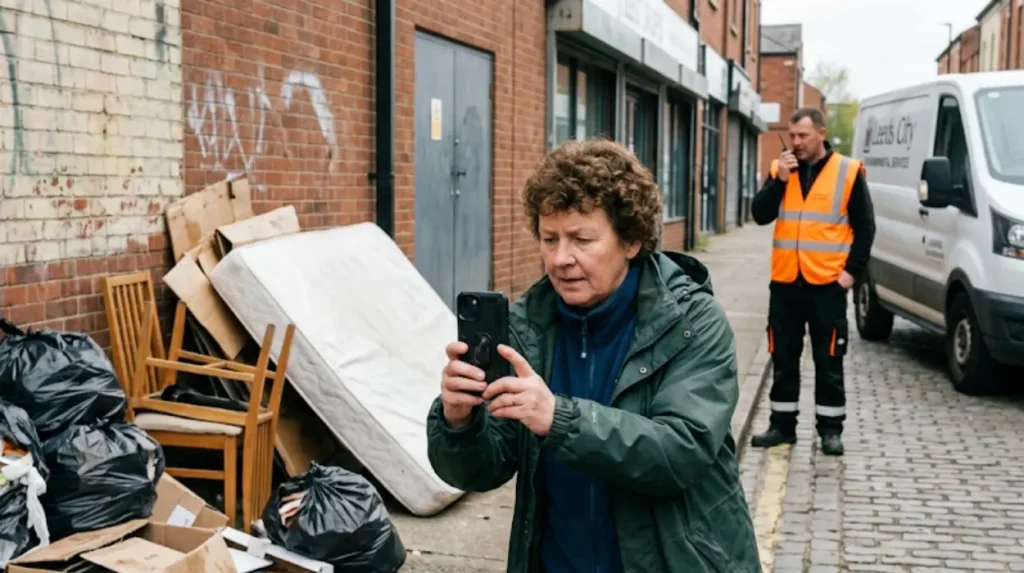
For most fly-tipping near Pudsey town centre, the clearest route is Leeds City Council’s online fly-tipping report for waste on public land, supported by photos and exact location details. If the incident is large-scale, hazardous, or linked to organised waste crime, escalate to the Environment Agency.
That simple split keeps the process efficient. Public-land dumping belongs with the local council, serious crime belongs with national enforcement, and anonymous crime reporting belongs with Crimestoppers when needed. For rail, canal, or private land, the report must go to the relevant landowner or operator rather than the council’s standard public-land route.
How do I report fly-tipping near Pudsey town centre?
You can report fly-tipping on public land near Pudsey town centre through Leeds City Council’s fly-tipping reporting service. Include the exact location, the type and amount of waste, photos if available, and any information about the person or vehicle involved.