
The National Health Service provides subsidised dental treatment to eligible residents across the United Kingdom, but securing a placement has become a significant administrative challenge. In the town of Morley, situated within the metropolitan borough of the City of Leeds, West Yorkshire, the local demand for public dental services matches a broader national shortage of primary care dental contracts. Understanding the systemic structure of National Health Service dentistry, the local infrastructure within the LS27 postcode area, and the official pathways for enrollment is essential for securing dental treatment.
- What Is the Status of NHS Dentistry Availability in Morley?
- How Do You Use Official Channels to Locate an Open Practice?
- What Are the Active Registration Procedures and Waiting Lists in LS27?
- How Much Does Public Dental Treatment Cost in West Yorkshire?
- Who Qualifies for Free Exempt NHS Dental Treatment?
- What Are the Solutions for Urgent and Emergency Dental Crises?
- What Are the Future Implications for Local Healthcare Infrastructure?
What Is the Status of NHS Dentistry Availability in Morley?
Finding an open National Health Service dental slot in Morley requires navigating severe supply constraints, long centralized waiting lists, and strict practice capacities. Local primary care infrastructure currently operates at maximum registration thresholds due to regional contract limitations across West Yorkshire.
National Health Service dentistry operates under a unique system where dental practices are independent commercial businesses contracted by the government to deliver a set quota of dental treatments. These quotas are measured in Units of Dental Activity, which are legal metrics used in the General Dental Services contract introduced by the Department of Health and Social Care under the National Health Service Act 2006. Because funding is capped per financial year, dental practices in Morley possess a finite number of allocations for public patients, meaning that registration is not guaranteed by physical residency in the Leeds metropolitan district.
Historically, the structural availability of public dental services in West Yorkshire shifted following the 2006 contract reforms, which decoupled dental registration from permanent patient lists. Unlike General Practitioner medical clinics, where patients register within a strict geographic catchment area, a National Health Service dental practice holds no statutory obligation to maintain a permanent patient list indefinitely. A patient is legally considered registered only for the duration of their active course of treatment, meaning that local practices can close their intakes as soon as their commissioned Units of Dental Activity allocations are exhausted.
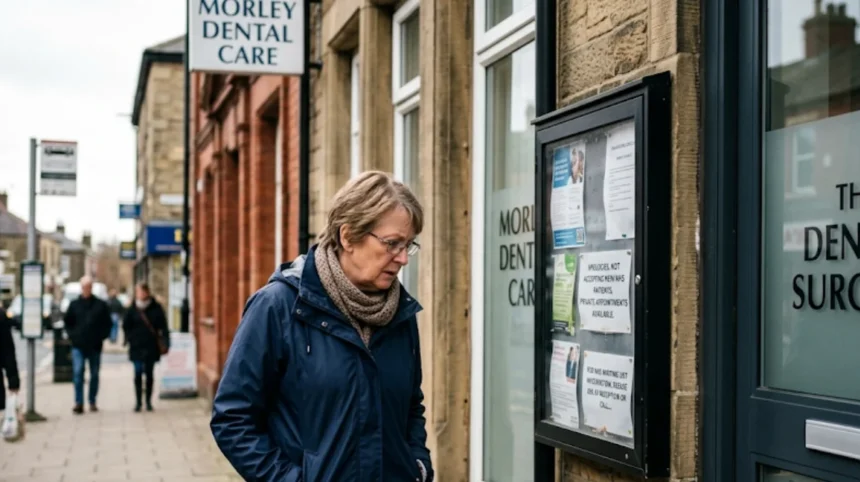
In the town of Morley, primary dental care is distributed across established facilities located around the commercial center of Queen Street, Commercial Street, Little Fountain Street, and Watson Street. This includes dedicated clinics such as the mydentist practices on Windsor Court and Queen Street, Safe Dental on Commercial Street, Fountain Dental Practice on Little Fountain Street, and Morley Dental Partners on Watson Street. The current regional data from the West Yorkshire Integrated Care Board shows that the majority of these clinics maintain closed intake books for public patients or operate internal wait-management systems that extend past six months.
How Do You Use Official Channels to Locate an Open Practice?
Locating an operational public dental practice requires systematic utilization of the National Health Service Find a Dentist website, direct communication with regional West Yorkshire health authorities, and formal alignment with the Healthwatch Leeds public reporting network.
The primary digital mechanism for tracking local clinic availability is the centralized National Health Service Find a Dentist search database. This platform relies on individual dental providers manually updating their intake status, which categorizes practices into four distinct administrative operational states. These states are: taking new National Health Service patients, taking new National Health Service patients only by referral, only taking specific groups such as children or vulnerable adults, and not taking new public patients.
To execute an accurate search for options in the LS27 area, specific protocols must be followed to filter data effectively across the municipal boundary of Leeds:
- Access the official search framework via the National Health Service website and input the target postcode or the geographic locator “Morley, Leeds”.
- Filter the results by distance metrics to isolate the core clinics situated within a two-mile radius of Morley Town Hall.
- Verify the update timestamp displayed alongside the practice profile, as statutory guidelines require clinics to refresh their availability status regularly.
- Cross-reference the findings with secondary digital registries, including the independent Dental Choices platform, which monitors regional patient-reported waiting times.
When digital registries indicate zero immediate vacancies across local providers, the administrative escalation path shifts to the West Yorkshire Integrated Care Board. The West Yorkshire Integrated Care Board is the statutory NHS body responsible for planning, funding, and commissioning local health services across the five metropolitan districts of West Yorkshire, including Leeds. The Integrated Care Board manages the dental budget allocations and holds the master record of which independent contractors have received supplementary funding to expand their capacity or clear local waiting queues.
Concurrently, residents can utilize the services of Healthwatch Leeds, an independent health watchdog operating under the Health and Social Care Act 2012. Healthwatch Leeds collects real-time feedback from patients regarding healthcare accessibility, logs the operational status of local clinics, and provides guidance via telephone, email, and text services. While Healthwatch Leeds cannot directly register a patient at a clinic, its officers maintain direct communication channels with dental practice managers across Leeds and can identify unadvertised intake openings.
What Are the Active Registration Procedures and Waiting Lists in LS27?
Securing enrollment at a Morley dental clinic involves joining practice-specific waiting lists, submitting detailed demographic and clinical triage documentation, and completing an initial face-to-face oral health assessment to formalise the care contract.
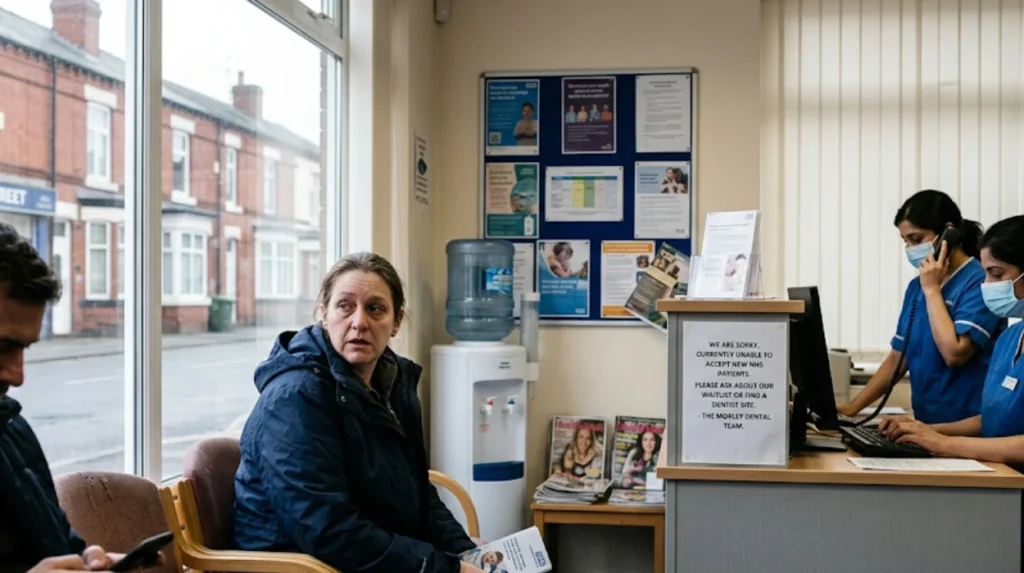
Because there is no single, unified waiting list for the whole of Leeds or West Yorkshire, patients must apply to individual dental practices independently to join their internal wait-management registries. For example, Morley Dental Partners on Watson Street manages its own waiting lists, which scale according to available staff numbers and contract capacities. System protocols permit individuals to join multiple practice waiting lists simultaneously across the region to increase their probability of selection, as names are processed in chronological order without geographic exclusion zones.
The administrative process of joining a waiting list requires providing comprehensive personal datasets to the practice administrator. Applicants must supply their full name, date of birth, home address within the Leeds district, telephone contact details, and their unique ten-digit National Health Service number, which can be retrieved from General Practitioner records. Additionally, practices require a disclosure of the applicant’s medical history and any specific accessibility needs to ensure compliance with the Equality Act 2010.
Once a position becomes vacant and a patient is selected from the list, the clinic schedules a mandatory initial diagnostic appointment. At this stage, the patient fills out an official National Health Service General Dental Services PR form to formally declare their eligibility for public subsidised care. This form requires the patient to state whether they are paying standard patient charges or qualify for full fee exemptions under statutory criteria.
The registration is only validated upon the completion of the clinical assessment by the General Dental Practitioner. This assessment includes a full diagnostic examination of the soft tissues, periodontal tracking, and digital intraoral radiographs to establish a baseline treatment plan. If a patient fails to attend this initial appointment or skips subsequent routine recall examinations, the practice retains the contractual right to remove them from their active roster to free up capacity for other applicants on the waiting list.
How Much Does Public Dental Treatment Cost in West Yorkshire?
Public dental treatment costs are standardized across England into three distinct statutory pricing bands, which dictate set fees for diagnostic, restorative, and surgical interventions performed within an active course of therapy.
Except for individuals who qualify for statutory financial exemptions, all adults accessing public dental care in Morley must pay uniform fees regulated by the Department of Health and Social Care. These charges are fixed across the country and do not vary between clinics, meaning a procedure costs the same at a mydentist facility on Queen Street as it does at an independent clinic in central Leeds. The payment framework is organized logically into three clear tiers based on the clinical complexity of the intervention required.
Band 1 covers basic diagnostic and preventative interventions. This tier encompasses a comprehensive clinical examination, charting, professional advice, necessary intraoral X-rays, and basic scaling or polishing procedures if clinically indicated. It also includes urgent care stabilization therapies designed to manage immediate pain or minimize infection risk before a comprehensive treatment plan is initiated.
Band 2 builds upon the diagnostic foundations by adding definitive restorative treatments. This band includes all items covered in Band 1, plus clinical interventions such as silver amalgam or composite tooth fillings, non-complex root canal extractions, and surgical tooth extractions. A patient pays a single flat fee for a Band 2 course of treatment, regardless of whether they require one filling or multiple restorations across different quadrants of the mouth.
Band 3 represents the highest cost tier and covers complex laboratory-fabricated prosthetics. This includes all necessary treatments from Bands 1 and 2, along with the provision of custom-made dental appliances such as porcelain crowns, bridges, inlays, and full or partial acrylic dentures. The fee for Band 3 accounts for the external dental laboratory fabrication costs required to produce these permanent appliances.
The NHS payment system operates on a per-course-of-treatment model rather than a per-visit fee structure. If a single course of treatment requires three separate appointments to complete a series of fillings and a final extraction, the patient is billed a single Band 2 charge at the conclusion of the cycle. However, if a patient returns months later with a new, distinct clinical issue, a new course of treatment is opened, which triggers a separate statutory charge based on the relevant band.
Who Qualifies for Free Exempt NHS Dental Treatment?
Full exemptions from public dental charges are granted to specific patient demographics based on age, educational status, pregnancy, recent childbirth, and validated low-income criteria verified by the Department for Work and Pensions.
Statutory exemptions from the standard three-tier payment bands are strictly governed by the National Health Service Act 2006. Patients in Morley who claim an exemption must present physical or digital evidence of their qualifying status to the dental receptionist when signing the PR declaration form. The Business Services Authority regularly audits these claims, and making a false declaration can result in a statutory penalty charge notices alongside the original cost of the treatment.
Age and educational status provide automatic exemptions for younger demographics. Anyone under the age of 18 qualifies for free dental treatment, as do individuals aged 18 who remain in full-time continuous education at a recognized school, college, or home-schooling network. Additionally, women receive complete exemption from dental charges if they are pregnant at the start of their treatment course, or if they have given birth within the preceding 12 months, verified by a valid Maternity Exemption Certificate.
Financial exemptions are linked directly to income-related welfare benefits managed by the Department for Work and Pensions. Individuals are entitled to free dental care if they, or their partner, receive specific state benefits, which include:
- Income Support or Income-based Jobseeker’s Allowance.
- Income-related Employment and Support Allowance.
- Pension Credit Guarantee Credit.
- Universal Credit, provided the net monthly earnings fall below statutory thresholds set by the Department of Health and Social Care.
Patients who do not qualify for automatic benefit exemptions but have a low household income can apply to the National Health Service Low Income Scheme by completing an HC1 form. The Business Services Authority assesses household income, housing costs, and essential expenditures against national guidelines. Depending on the financial calculation, the applicant receives an HC2 certificate offering full payment exemptions, or an HC3 certificate providing partial financial assistance toward their dental fees.
Explore More Help & Resources
How to appeal a parking fine in Rothwell quickly
How to report a problem landlord in Pudsey now
What Are the Solutions for Urgent and Emergency Dental Crises?
Urgent dental care in Morley is accessed by calling the NHS 111 telephony triage system, which coordinates sameday clinical appointments through the West Yorkshire urgent care network and the Leeds Dental Institute.
When a resident experiences a severe dental emergency and is not registered with a local practice, they cannot wait for a standard waiting list placement. The system separates routine care from emergency provisions, meaning that emergency treatment does not require permanent registration at the hosting clinic. To enter this emergency pathway, individuals must dial the toll-free NHS 111 service, which uses the specialized Clinical Assessment Framework to determine the severity of the oral crisis.
The telephone triage system evaluates the patient’s symptoms against defined clinical markers to route them to the correct facility. If the patient presents with uncontrolled hemorrhaging from the oral cavity, severe facial swelling that compromises the airway, or major dental trauma resulting from an accident, they are directed to the nearest Accident and Emergency department, such as the emergency unit at Leeds General Infirmary on Great George Street.
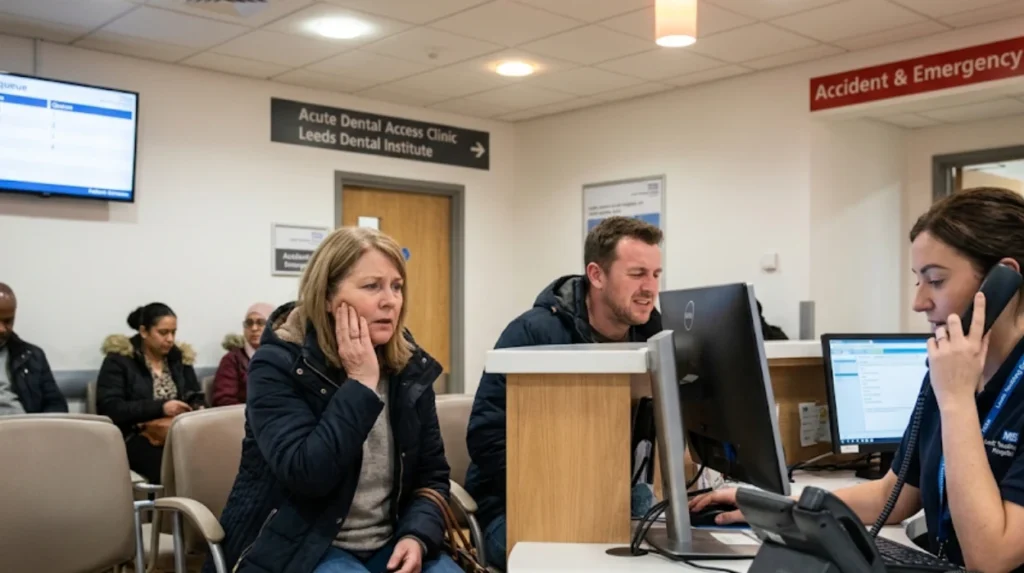
For non-life-threatening urgent conditions—such as a localized tooth abscess, severe pulpitis pain that cannot be managed with over-the-counter analgesics, a broken tooth with an exposed nerve root, or painful bleeding gums—the NHS 111 operator coordinates a one-off urgent appointment. These slots are distributed across a network of designated urgent care clinics in West Yorkshire, which include the acute dental access clinics in central Leeds and the Leeds Dental Institute located on Clarendon Way.
The Leeds Dental Institute functions as a specialized teaching and clinical facility run in partnership with the University of Leeds and the Leeds Teaching Hospitals NHS Trust. It provides advanced oral surgery, restorative, and emergency care services for the wider Yorkshire region. Access to the Leeds Dental Institute is strictly controlled via clinical referrals from general dental practitioners, medical doctors, or the NHS 111 triage team, and the facility does not accept self-referrals or walk-in patients without prior digital booking validation.
What Are the Future Implications for Local Healthcare Infrastructure?
The future availability of public dental services in Morley depends on planned changes to contract funding, workforce recruitment strategies in West Yorkshire, and the expansion of community dental clinics.
The long-term outlook for public dental access in the LS27 area is closely tied to ongoing national discussions regarding the reformation of the 2006 General Dental Services contract. The Department of Health and Social Care, alongside the British Dental Association, has identified that the current Units of Dental Activity payment model disincentivises dentists from taking on complex high-needs public patients. Future policy shifts aim to replace this model with a capitation-based framework, which pays practices based on the total number of patients they manage rather than the volume of individual treatments completed.
Workforce retention and recruitment present significant structural challenges across the Leeds metropolitan district. The West Yorkshire Integrated Care Board has noted a growing trend of general dental practitioners reducing their committed public hours to shift toward private dental care models. To address this issue, regional healthcare strategies are focusing on creating joint clinical-academic posts with the Leeds Dental Institute to retain newly qualified dental professionals within the local West Yorkshire workforce.
Additionally, the role of the Community Dental Service is expanding to support vulnerable demographics who are left out by mainstream practices. The Community Dental Service provides specialized care for children, individuals with severe learning difficulties, physical disabilities, profound dental phobias, or complex medical conditions that prevent treatment in a standard high-street clinic. In Leeds, these services are coordinated by the Leeds Community Healthcare NHS Trust, which uses dedicated clinics to ensure that high-need groups continue to receive public dental care despite fluctuating commercial capacities in the primary care market.
Is it difficult to find an NHS dentist in Morley?
Yes. Many NHS dental practices in Morley have limited capacity due to NHS contract funding and workforce shortages. Some practices operate waiting lists or may not be accepting new NHS patients, so availability can change frequently.