

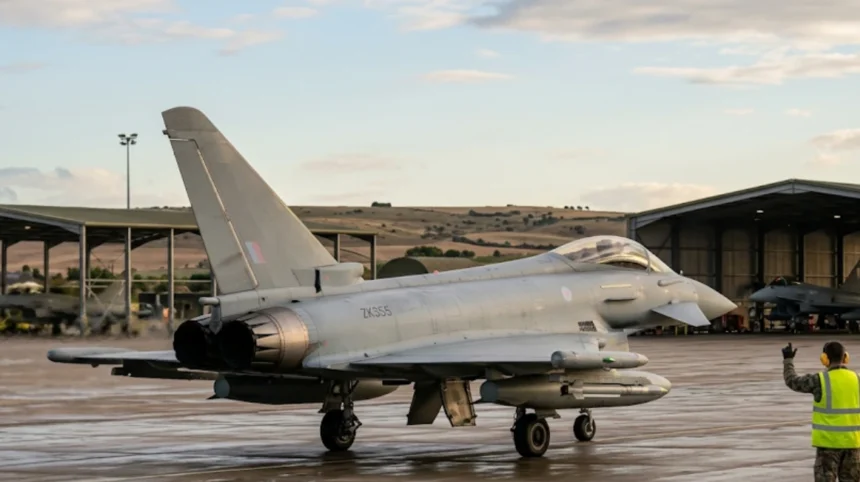
The Eurofighter Typhoon is a twin-engine, canard delta wing, multirole fighter aircraft developed by a consortium of European nations to serve as an advanced air-superiority platform with multirole strike capabilities. Originally conceived in the 1980s as a multinational effort to modernise European air defences, the Typhoon entered operational service in 2003 and has since become one of the world’s most advanced combat aircraft, operated by the air forces of the United Kingdom, Germany, Italy, Spain, Austria, Saudi Arabia, Oman, Kuwait, Qatar, and Turkey.
- What Is the Eurofighter Typhoon?
- Where and How Was the Eurofighter Typhoon Developed?
- What Are the Key Technical Specifications of the Eurofighter Typhoon?
- What Avionics and Sensor Systems Does the Typhoon Use?
- What Weapons Can the Eurofighter Typhoon Carry?
- How Is the Eurofighter Typhoon Produced and Upgraded?
- Which Countries Operate the Eurofighter Typhoon?
- What Role Does the Eurofighter Typhoon Play in Modern Air Combat?
- What Is the Future of the Eurofighter Typhoon Programme?
- How Does the Eurofighter Typhoon Compare to Other Modern Fighters?
What Is the Eurofighter Typhoon?
The Eurofighter Typhoon is a European multinational, supersonic, twin-engine fighter jet designed primarily for air superiority but capable of precision ground-attack missions. Built by Eurofighter Jagdflugzeug GmbH—a joint venture of Airbus (Germany/Spain), BAE Systems (UK), and Leonardo (Italy)—the aircraft combines advanced aerodynamics, digital fly-by-wire controls, and cutting-edge avionics to achieve exceptional agility, speed, and mission flexibility.
The Typhoon was originally developed under the Future European Fighter Aircraft (FEFA) programme, launched in 1983 by the UK, Germany, France, Italy, and Spain. France withdrew in 1985 over disagreements about design authority and operational requirements, choosing instead to develop the Dassault Rafale independently. The remaining four nations—UK, Germany, Italy, and Spain—continued the collaboration, resulting in the Eurofighter Typhoon.
A technology demonstrator, the British Aerospace EAP, first flew on 6 August 1986. The first Eurofighter prototype made its maiden flight on 27 March 1994. The name “Typhoon” was officially adopted in September 1998, continuing the storm-theme naming convention established by the Panavia Tornado, a predecessor jointly developed by the UK, Germany, and Italy.
Where and How Was the Eurofighter Typhoon Developed?
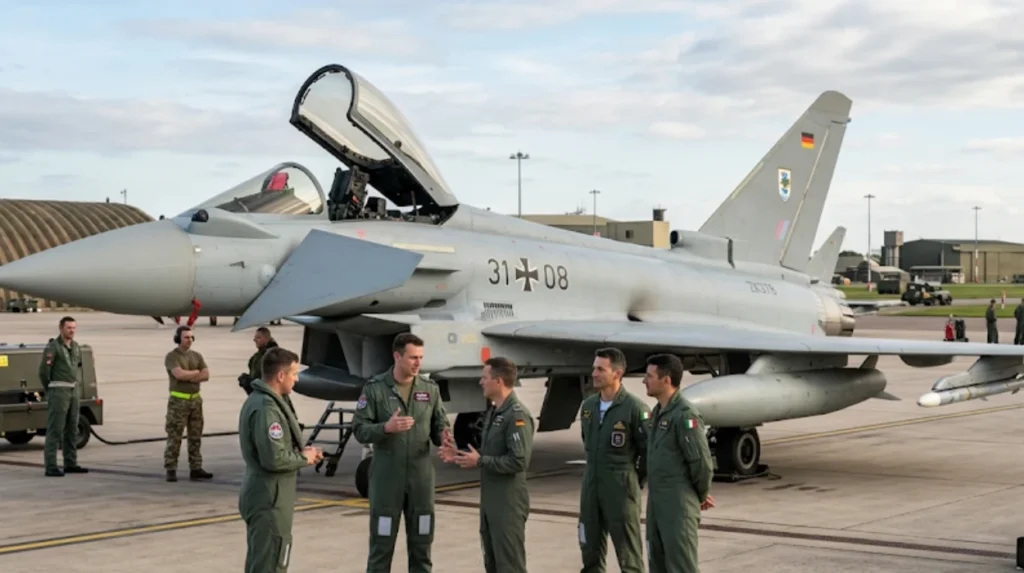
The Eurofighter Typhoon was developed across multiple European countries, with final assembly lines in the UK, Germany, Italy, and Spain to share production and industrial benefits. The programme is managed by the NATO Eurofighter and Tornado Management Agency (NETMA), which represents the four partner nations and acts as the prime customer for the aircraft.
Development began formally in 1983, but the roots of European collaborative fighter development trace back to the 1970s with the Panavia Tornado project. The Typhoon’s design emphasised relaxed stability, a delta wing with canards, and a digital flight control system to maximise agility at both subsonic and supersonic speeds. The aircraft’s aerodynamic configuration includes a 53-degree leading-edge wing sweep and low wing loading, enabling high manoeuvrability even at high angles of attack.
Final assembly occurs at four sites:
- BAE Systems in Warton, Lancashire, UK
- Airbus in Manching, Germany
- Leonardo in Turin, Italy
- Airbus in Getafe, Spain
Each partner nation produces specific components: the UK manufactures the forward fuselage and tail assemblies; Germany produces the centre fuselage and wings; Italy builds the rear fuselage; and Spain produces additional components and performs final assembly for its own fleet.
What Are the Key Technical Specifications of the Eurofighter Typhoon?
The Eurofighter Typhoon measures 15.96 metres in length, has a wingspan of 10.95 metres, and is powered by two Eurojet EJ200 engines, each producing more than 90 kN of thrust with afterburners. The aircraft has a maximum speed of Mach 2.35 (2,495 km/h) at altitude and can supercruise—sustain supersonic flight without afterburners—at speeds up to Mach 1.5.
The Typhoon’s airframe uses advanced composite materials to reduce weight and radar cross-section. Its digital fly-by-wire control system provides artificial stability, enabling precise handling in all flight regimes. The aircraft’s thrust-to-weight ratio exceeds 1:1, allowing it to accelerate rapidly and sustain high-G manoeuvres.
Key performance figures include:
- Maximum speed: 2,495 km/h (Mach 2.35) at 11,000 m; 1,530 km/h (Mach 1.25) at sea level
- Supercruise speed: Mach 1.5
- Service ceiling: 19,812 m (65,000 ft)
- Range: 2,900 km (1,800 mi) with conformal fuel tanks
- Combat radius: 1,389 km (863 mi)
- Rate of climb: 315 m/s (62,000 ft/min)
The EJ200 engines, developed by Eurojet Turbo GmbH—a consortium of Rolls-Royce (UK), MTU Aero Engines (Germany), Avio (Italy), and ITP (Spain)—are specifically designed for high performance, low weight, and maintainability. As of 2007, the EJ200 had accumulated 50,000 engine flying hours in service.
What Avionics and Sensor Systems Does the Typhoon Use?
The Eurofighter Typhoon features a CAPTOR-E AESA radar, PIRATE infrared search and track system, and PRAETORIAN defensive aids suite for advanced situational awareness and survivability. These systems enable the aircraft to detect, track, and engage multiple targets simultaneously while defending against radar and missile threats.
The CAPTOR-E radar is an electronically scanned array (AESA) that provides high-resolution tracking, ground mapping, and synthetic aperture radar imaging. It supports long-range detection of air and surface targets, even in adverse weather or electronic warfare environments.
The PIRATE (Passive Infra-Red Airborne Track Equipment) system is a forward-looking infrared (FLIR) sensor mounted on the port side of the cockpit. It provides passive detection and tracking of heat signatures from aircraft and ground targets, enhancing the Typhoon’s ability to operate in radar-denied environments.
The PRAETORIAN suite integrates radar warning receivers, laser warning sensors, and countermeasure dispensers to detect and defeat incoming threats. It automatically deploys chaff, flares, and electronic countermeasures to protect the aircraft from radar-guided and heat-seeking missiles.
The cockpit includes three large-area displays (LADs), a helmet-mounted display (HMD), and voice command input, enabling the pilot to manage weapons, sensors, and navigation with minimal manual input. The human-machine interface is designed to reduce pilot workload and improve decision-making speed.
What Weapons Can the Eurofighter Typhoon Carry?
The Eurofighter Typhoon can carry more than 9,000 kg of payload across 13 hardpoints, including air-to-air missiles, air-to-ground munitions, and precision-guided bombs. This multirole capability allows the aircraft to switch between air superiority and ground-attack missions within a single sortie.
The Typhoon’s primary air-to-air armament includes:
- AIM-120 AMRAAM (Advanced Medium-Range Air-to-Air Missile)
- MBDA Meteor (long-range, active radar-guided missile)
- ASRAAM (Advanced Short-Range Air-to-Air Missile)
- IRIS-T (Infrared Imaging System Tail-controlled)
- AIM-9 Sidewinder
For air-to-ground operations, the Typhoon can deploy:
- Paveway IV laser-guided bombs
- EGBU-16 enhanced guided bomb units
- Storm Shadow cruise missiles
- Brimstone anti-armour missiles
- Marte ER anti-ship missiles
A typical multirole loadout for a Tranche 2 aircraft includes four AMRAAMs, two ASRAAMs or IRIS-Ts, four Paveway IV or EGBU-16 bombs, two 1,000-litre supersonic fuel tanks, and a targeting pod. This configuration enables the Typhoon to engage both aerial and ground targets in a single mission.
The aircraft also carries a 27 mm Mauser BK-27 revolver cannon with 150 rounds, mounted internally on the starboard side of the fuselage. The cannon provides a close-range engagement option for air-to-air and air-to-ground scenarios.
How Is the Eurofighter Typhoon Produced and Upgraded?
The Eurofighter Typhoon is built in five production tranches, with each tranche incorporating incremental improvements in avionics, weapons integration, and operational capabilities. Tranche 1 aircraft entered service in 2003, while Tranche 5 represents the latest standard, featuring advanced electronic warfare systems, sensor fusion, and enhanced weapon compatibility.
Production is divided into tranches to allow for continuous upgrades:
- Tranche 1: 2000–2008, basic air-superiority capability
- Tranche 2: 2008–2014, improved multirole capability
- Tranche 3: 2014–2019, enhanced avionics and weapons integration
- Tranche 4: 2019–2023, further sensor and defensive suite upgrades
- Tranche 5: 2023–present, AESA radar, advanced electronic warfare, and new weapons
The UK’s Project Centurion and P3Ec (Project Centurion 3 Enhancement) programmes have upgraded RAF Typhoons with new displays, sensors, and weapons. In 2021, the UK announced the retirement of all Tranche 1 aircraft by 2025, with remaining fleets upgraded to Tranche 3/4 standards.
In 2024, the UK began delivering P3Ec upgrades, including large-area displays and improved mission computers. These enhancements ensure the Typhoon remains interoperable with fifth-generation fighters like the F-35 Lightning II and compatible with emerging weapons such as the Meteor and Storm Shadow.
Which Countries Operate the Eurofighter Typhoon?
The Eurofighter Typhoon is operated by ten air forces worldwide, with 769 total orders and 609 aircraft delivered as of January 2025. The original four partner nations—UK, Germany, Italy, and Spain—remain the largest operators, while export customers include Austria, Saudi Arabia, Oman, Kuwait, Qatar, and Turkey.
Operator breakdown:
- United Kingdom: 160 aircraft (RAF)
- Germany: 143 aircraft (Luftwaffe)
- Italy: 96 aircraft (Aeronautica Militare)
- Spain: 73 aircraft (Ejército del Aire)
- Austria: 15 aircraft (Österreichische Luftstreitkräfte)
- Saudi Arabia: 72 aircraft (Royal Saudi Air Force)
- Oman: 12 aircraft (Royal Air Force of Oman)
- Kuwait: 28 aircraft (Kuwait Air Force)
- Qatar: 24 aircraft (Qatar Emiri Air Force)
- Turkey: 2026 order for 40 aircraft (Turkish Air Force)
The Typhoon entered combat during the 2011 military intervention in Libya, when RAF and Italian Air Force aircraft conducted air-to-ground strikes and reconnaissance missions. Since then, the type has taken primary responsibility for air defence duties in most customer nations, including Quick Reaction Alert (QRA) scrambles in the UK and NATO airspace policing.
In December 2021, the RAF executed its first operational air-to-air engagement with a Typhoon, destroying a hostile drone with an ASRAAM missile near the Al-Tanf coalition base in Syria. This demonstrated the aircraft’s readiness for modern asymmetric threats.
What Role Does the Eurofighter Typhoon Play in Modern Air Combat?
The Eurofighter Typhoon serves as a high-performance, swing-role combat aircraft capable of air superiority, interception, ground attack, and reconnaissance missions in contested environments. Its combination of speed, agility, advanced sensors, and diverse weapons makes it a cornerstone of European and allied air power.
In air superiority missions, the Typhoon uses its CAPTOR-E radar and Meteor missiles to engage enemy aircraft at long range, while its IRIS-T and ASRAAM missiles provide close-combat capability. The aircraft’s supercruise ability allows it to maintain supersonic speeds without afterburners, conserving fuel and reducing infrared signature.
For ground attack, the Typhoon employs laser-guided bombs, cruise missiles, and anti-armour munitions to strike high-value targets with precision. Its sensor fusion capability integrates data from radar, infrared, and defensive systems into a single tactical picture, enabling rapid decision-making.
The Typhoon also performs reconnaissance using pods such as the RAPTOR (in RAF service), which provides high-resolution imagery and signals intelligence. This multirole flexibility ensures the aircraft remains relevant in both conventional and asymmetric conflicts.
What Is the Future of the Eurofighter Typhoon Programme?
The Eurofighter Typhoon will remain in service with multiple air forces into the 2040s, supported by continuous upgrades and integration with next-generation weapons and systems. While fifth-generation fighters like the F-35 and the future Tempest programme advance, the Typhoon’s low operating costs, high payload capacity, and proven performance ensure its continued operational value.
The Tranche 5 standard, equipped with AESA radar, advanced electronic warfare, and new weapon integrations, extends the aircraft’s service life. Export orders from Kuwait, Qatar, and Turkey demonstrate sustained international demand.
In the UK, the Typhoon will operate alongside the F-35B until the Tempest sixth-generation fighter enters service in the 2030s. Germany, Italy, and Spain plan similar transitions, with the Typhoon forming a bridge between legacy and next-generation platforms.
The programme’s total order count stands at 769 aircraft, with 609 delivered as of January 2025. Ongoing upgrades and export sales indicate the Typhoon will remain a key asset for European and allied air forces for at least two more decades.
How Does the Eurofighter Typhoon Compare to Other Modern Fighters?
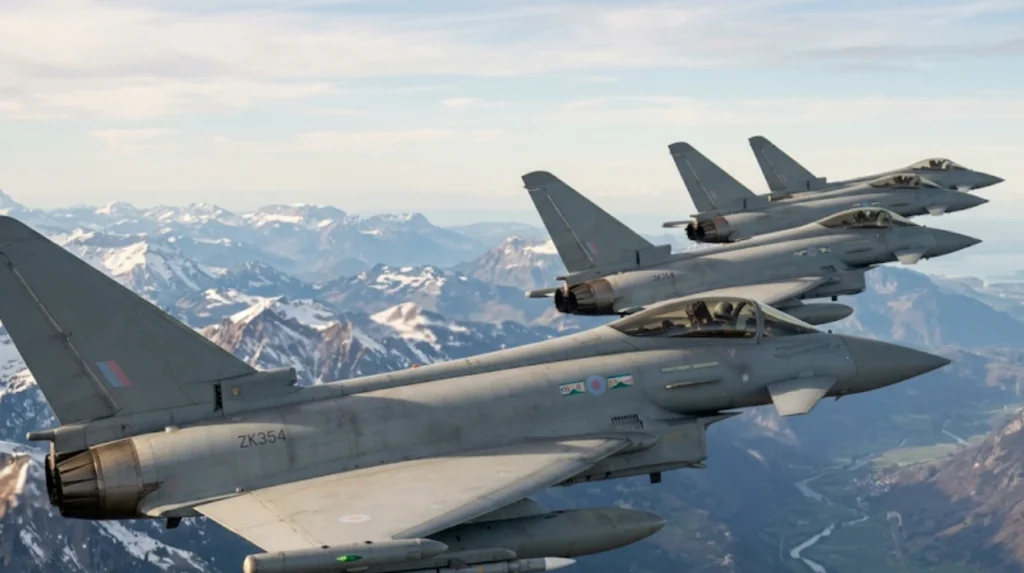
The Eurofighter Typhoon ranks among the world’s most capable fourth-generation fighters, competing with aircraft like the Dassault Rafale, F-15EX, and Su-35 in speed, agility, and multirole performance. Its twin-engine design, supercruise capability, and advanced sensor fusion distinguish it from many contemporaries.
Compared to the Dassault Rafale, the Typhoon offers higher top speed (Mach 2.35 vs Mach 1.8) and greater thrust-to-weight ratio, but the Rafale features carrier compatibility and a broader range of nuclear and conventional weapons. The F-15EX provides similar payload capacity but lacks the Typhoon’s canard-delta agility and European industrial base.
The Typhoon’s modular design allows for continuous upgrades, ensuring compatibility with emerging threats and weapons. Its operational history, from Libya to NATO air policing, demonstrates reliability and effectiveness in diverse mission profiles.
With 769 total orders and service in ten nations, the Eurofighter Typhoon remains a cornerstone of European defence and a globally recognised multirole combat aircraft.