Key Points
- A brand new artwork celebrating former manager Howard Wilkinson and his 1991–92 First Division championship-winning side has been formally unveiled in Beeston.
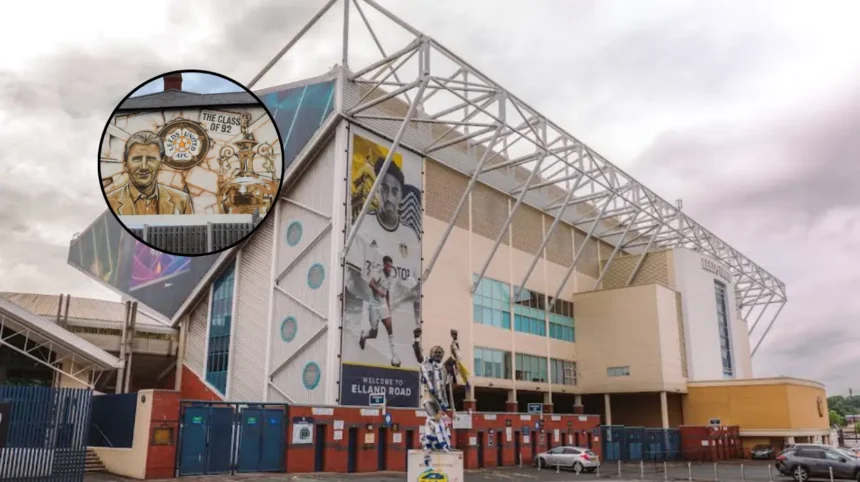
- The artwork is prominently displayed on the exterior wall of the South Leeds Conservative Club, serving as a landmark visual tribute in close proximity to Elland Road.
- The piece highlights ‘Sergeant Wilko’ alongside core members of the iconic squad who secured the final English top-flight title prior to the launch of the Premier League.
- The project forms part of a wider community-led artistic movement across South Leeds aimed at capturing historic moments and cultural icons connected to Leeds United.
- Local residents and supporters have welcomed the artwork as a permanent reminder of the club’s golden era and modern heritage.
Leeds United (The Leeds Times) August 8, 2026 – A landmark new public artwork commemorating former Leeds United manager Howard Wilkinson and his historic 1991–92 title-winning squad has officially been unveiled in South Leeds, offering football supporters and residents a vivid new visual tribute to the club’s modern golden age. Located on the side facade of the South Leeds Conservative Club in Beeston, the mural pays homage to the man affectionately known across English football as ‘Sergeant Wilko’ and the group of players who captured the final Football League First Division championship title before the formation of the FA Premier League in the summer of 1992.
- Key Points
- Where is the new Howard Wilkinson mural located in Beeston?
- Who is featured in the 1992 Leeds United title-winning artwork?
- Why is Howard Wilkinson such a pivotal figure in Leeds United history?
- What is the background of this particular artwork development?
- How will this development affect local Leeds United supporters and the Beeston community?
Where is the new Howard Wilkinson mural located in Beeston?
The newly completed artwork sits directly on the exterior wall of the South Leeds Conservative Club, positioned along a primary pedestrian and transport route through Beeston. The site was selected due to its proximity to Elland Road stadium, making it an immediate focal point for thousands of home supporters during matchday pilgrimages toward the ground.
By situating the piece in the heart of the Beeston community, the visual installation establishes a physical bridge between the residential neighborhood and the stadium precinct. Surrounding streets in South Leeds already host several notable street art tributes, and this latest addition integrates into the established mural walk that connects Holbeck, Beeston, and the Lowfields Road approach to Elland Road.
Who is featured in the 1992 Leeds United title-winning artwork?
The centerpiece of the mural is a portrait of Howard Wilkinson, who managed Leeds United between 1988 and 1996. Positioned alongside Wilkinson are key figures from the 1991–92 championship campaign, capturing the spirit and determination of a squad that overcame significant competition from Manchester United to lift the trophy.
The artwork depicts iconic players who formed the backbone of Wilkinson’s side, highlighting:
- Gordon Strachan: The influential club captain whose leadership and work rate drove the team’s midfield.
- Gary McAllister, David Batty, and Gary Speed: The celebrated mid-field unit that defined the energy and tactical discipline of the era.
- Lee Chapman: The prolific center-forward whose goals proved vital throughout the championship run.
- Tony Dorigo and Mel Sterland: Key defensive figures who provided width and defensive solidity.
The design incorporates classic club imagery, including the historic kit styling from the early 1990s and symbolic references to the trophy presentation that took place following the conclusion of the 1991–92 league season.
Why is Howard Wilkinson such a pivotal figure in Leeds United history?
Howard Wilkinson holds a singular place in the history of Leeds United and modern English football. Appointed in October 1988 with the club struggling in the Second Division, Wilkinson executed a comprehensive restructuring of the club’s coaching, scouting, physical conditioning, and youth academy infrastructure.
Under his guidance, Leeds United achieved promotion to the top flight in 1990 by winning the Second Division title. In their first season back in the First Division, the team secured an impressive fourth-place finish before going on to claim the League Championship title in the 1991–92 campaign.
To this day, Wilkinson remains the last English manager to win the top-flight league title in English football.
Beyond his immediate silverware success, Wilkinson established the foundational framework for the Leeds United Academy at Thorp Arch, which subsequently produced generations of top-tier talent, including James Milner, Jonathan Woodgate, Alan Smith, and Paul Robinson.
Explore More Leeds United News
Leeds United Hailed for Smart Shea Charles Transfer Stance, Leeds 2026
Charlie Cresswell Seals €28m Rennes Move Boosting Leeds United: Leeds 2026
What is the background of this particular artwork development?
The installation of the Howard Wilkinson mural represents the culmination of ongoing efforts by community groups, local businesses, and supporter networks to preserve and display the rich historical legacy of Leeds United through public art.
Over the past decade, South Leeds has experienced a substantial rise in urban art projects, many of which are commissioned to reflect the cultural identity of the area.
Previous mural projects across the city have commemorated various eras and personalities, including the legendary 1960s and 1970s squad under Don Revie, the transformative tenure of Argentine manager Marcelo Bielsa, and individual tributes to club stalwarts such as Lucas Radebe, Albert Johanneson, and Gary Speed.
The decision to feature Howard Wilkinson and the 1992 squad addresses a long-standing desire among the fanbase to see equal representation for the achievement of the early 1990s. While the Revie era and recent promotion seasons have received extensive artistic coverage, the 1991–92 triumph represents the club’s most recent top-flight league title.
The agreement with the South Leeds Conservative Club provided the necessary wall space and visibility to bring this specific project to fruition, ensuring that ‘Sergeant Wilko’ and his players receive permanent visual recognition in the district adjacent to Elland Road.
How will this development affect local Leeds United supporters and the Beeston community?
The introduction of the Howard Wilkinson mural in Beeston is expected to yield tangible social and cultural benefits for both local residents and the broader Leeds United fanbase.
For the local community in Beeston and South Leeds, the artwork serves as a point of civic pride, enhancing the visual landscape of the neighborhood and transforming a plain building facade into an engaging cultural landmark.
Public art initiatives of this nature frequently encourage foot traffic, attracting visiting supporters and sports tourists into local commercial areas before and after matches, thereby providing modest support to nearby independent businesses, shops, and hospitality venues.
For the fanbase, particularly younger generations of supporters who did not witness the 1991–92 season firsthand, the mural acts as an educational and historical marker.
It reinforces the continuity of the club’s identity by celebrating a golden chapter that bridges the historic accomplishments of Don Revie with modern club milestones. By institutionalising the memory of Howard Wilkinson’s squad in the physical architecture of Beeston, the development ensures that one of the greatest technical and managerial achievements in Leeds United’s history remains visible and appreciated for years to come.