

Key Points:
- Financial Aid Offered: The United Kingdom government has pledged £5 million in emergency financial aid to assist the Nepalese government following catastrophic flash flooding.
- Offer of Search and Rescue Teams: The UK has offered to deploy specialized emergency responders to assist on-the-ground operations, subject to formal acceptance by Nepalese authorities.
- British Casualties and Missing: Over 30 British nationals, including a 13-year-old girl and a 14-year-old boy, are among hundreds unaccounted for in the affected region.
- Escalating Death Toll: Nepalese disaster authorities have confirmed hundreds of fatalities, with vast areas buried under mud and severe destruction reported across the Rasuwa district bordering Tibet.
- Consular Support Deployed: 24/7 consular support staff are being deployed to assist missing individuals’ families and British nationals in the affected area.
London, UK (The Leeds Times) August 27, 2027 — The UK has offered £5 million to help the Nepalese government amid a “very distressing and devastating situation” following the country’s flash floods, the Prime Minister has said. More than 30 British nationals are among hundreds of people missing and feared dead as rescue efforts continued on Thursday after flooding in the Rasuwa district, which borders China’s autonomous region of Tibet. Andy Burnham told reporters an offer had also been made for emergency responders to head to the affected area.
- Key Points:
- What Is the Scale of the Devastation in Nepal?
- How Is the UK Government Responding to the Crisis?
- What Is Known About the Missing British Nationals?
- What Caused the Unexpected Himalayan Disaster?
- Background of the Himalayan Flash Floods Development
- Prediction: How Will This Development Affect International Tourists, Local Communities, and Disaster Policy?
What Is the Scale of the Devastation in Nepal?
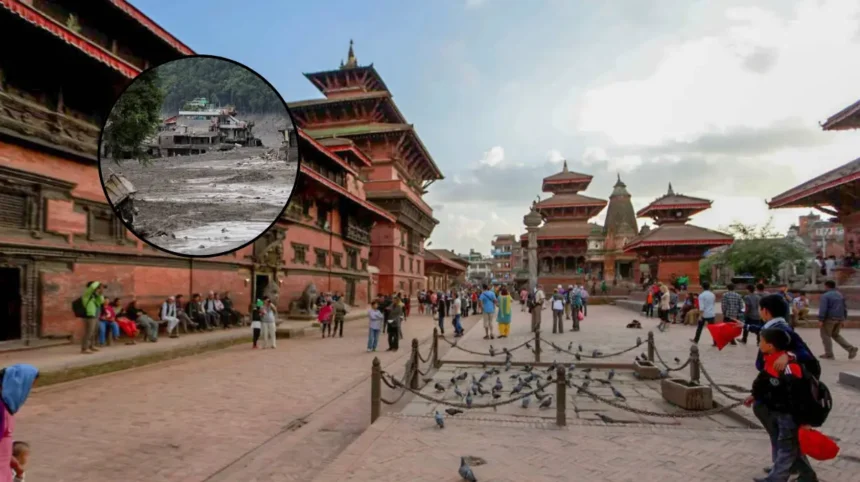
As reported by Josh Payne, the disaster struck with sudden intensity after rivers in the Himalayan region burst their banks, inundating populated valleys, sweeping away critical infrastructure, and burying whole settlements under thick layers of mud.
As reported by Josh Payne, Nepal’s National Disaster Risk Reduction and Management Authority confirmed that over 165 bodies have already been recovered, while local authorities noted that the total fatalities in the Rasuwa district have risen rapidly, with additional deaths confirmed across the border in Tibet. The total number of missing individuals across the affected zone has escalated sharply from 403 to over 820 as rescue crews attempt to reach isolated villages.
Footage emerging on social media platforms captured torrents of muddy water rushing through mountain valleys, destroying bridges and causing residents and tourists to flee uphill to survive.
As reported by Bishal Nath Upreti, President of the Nepal Centre for Disaster Management, on BBC Radio 4’s Today programme, the catastrophic event resembled a “tsunami from the sky” that left several mountain villages “completely wiped out”. Bishal Nath Upreti stated that “the damage to the infrastructure has been so extensive only helicopters can be used to reach the site of the disaster,” citing destroyed bridges and nearly 25 miles of damaged roads blocking ground access.
How Is the UK Government Responding to the Crisis?
Speaking to journalists during a visit to South Wales, Prime Minister Andy Burnham outlined the British government’s immediate response and official stance.
As reported by Josh Payne, Andy Burnham stated:
“It’s a devastating picture that is emerging from what has happened in Nepal. Scenes that we’ve never seen the like before, I don’t think, certainly the scale of the devastation”.
The Prime Minister confirmed immediate operational steps to assist both the Nepalese authorities and British citizens caught in the surge.
As reported by Josh Payne, Andy Burnham stated:
“So there is immediate action being taken. We are deploying consular support staff to the region so that British nationals will be able to access support 24/7. An offer has been made of emergency responders to head to the region but that’s obviously a matter for the Nepalese government. But also we’ve offered £5 million to help with that response effort”.
Addressing the emotional toll on affected families in Britain, Andy Burnham added:
“Obviously, there are a number of British nationals who currently are thought to be missing and we’ll be providing all the support we can to their families in what is a very distressing and devastating situation”.
What Is Known About the Missing British Nationals?
At least 33 British citizens remain unaccounted for following the surge of floodwaters. Among those missing are two teenagers, aged 13 and 14.
As reported by Josh Payne, figures provided by the Nepal Tourism Board indicate that nearly 580 travellers are missing across the flood zone, including more than 460 foreign nationals.
Tour operators in the region have reported significant disruptions and uncontactable groups. Tour operator Kailash Journeys confirmed that it has been unable to account for seven UK nationals—five women and two men aged between 18 and 55—who were travelling with the firm in the region.
In an official statement released by the Foreign, Commonwealth and Development Office (FCDO), a spokesperson stated that the department was “deeply saddened by the loss of life and devastation caused by the floods in Nepal,” adding: “British nationals in Nepal should follow local authority advice and exercise caution while travelling”.
Royal responses have also been voiced following the events. The King expressed that he and the Queen were “heartbroken” and extended their “most profound sympathy” to those impacted, noting:
“Many in the United Kingdom have strong, deep and personal ties to this part of the world”.
Similarly, the Prince and Princess of Wales issued a statement conveying their shock, stating:
“We are thinking of everyone caught up in this terrible disaster”.
What Caused the Unexpected Himalayan Disaster?
Geological and environmental experts have been analyzing the conditions that triggered the destructive deluge along the Nepal-Tibet border. Initial local reports suggested seismic activity, but scientific monitoring later clarified the sequence of events.
As reported by scientific analysts evaluating seismic and satellite data, additional analysis of nearby seismic stations, long-period seismic waves, and satellite imagery led to the determination that the seismic event was instead a glacial collapse and debris flow, and that no earthquake had occurred.
Environmental campaign groups have drawn attention to the broader environmental factors behind Himalayan disasters.
As reported by Bethan Sayed, Head of Politics and Advocacy for Climate Cymru, the disaster represents an extreme outcome of shifting weather patterns:
“What is unfolding in Nepal right now is… an undeniable consequence of climate change. Anyone claiming otherwise is ignoring clear scientific warnings. As recent research published in Frontiers in Climate makes clear, warming rates across the Himalayan region far exceed global averages”.
Bethan Sayed added:
“The rapid melting of glaciers and the rising threat of Glacial Lake Outburst Floods represent visible, devastating indicators of climate-induced loss and damage. Entire communities, infrastructure, and lives are being swept away”.
Background of the Himalayan Flash Floods Development
The Rasuwa district, situated along Nepal’s northern border with Tibet, is geographically vulnerable to extreme hydrological events due to its steep topography and proximity to major glacial river systems. The region acts as a primary hub for cross-border trade, trekking routes, and pilgrimage paths connecting Nepal to China.
In recent years, the Himalayan belt has experienced an increase in Glacial Lake Outburst Floods (GLOFs) and intense monsoon cloudbursts. Rapid temperature changes across high-altitude regions have accelerated glacier retreat, creating large, unstable moraine-dammed lakes. When these natural dams collapse or suffer structural failure due to icefalls, landslide impacts, or localized extreme rainfall, millions of cubic metres of water and heavy sediment cascade down narrow river valleys with minimal advance warning.
Infrastructure in these remote mountain regions—including rural roads, suspension bridges, and hydroelectric projects—remains highly susceptible to high-velocity debris flows. Previous major flooding events in Nepal, such as those in 2021 and 2024, highlighted the challenges of establishing early-warning systems in rugged terrains where physical communication links are easily severed.
Explore More UK News
Ironman Leeds Swim Cancelled Over Toxic Algae Concerns Leeds 2026
Fatal A66 Collision Involving Police Vehicle Claims Lives South Bank 2026
Prediction: How Will This Development Affect International Tourists, Local Communities, and Disaster Policy?
The catastrophe in Rasuwa and the subsequent deployment of aid and search personnel will have direct short-term and long-term implications for several key groups:
- For Families of Missing Nationals and Tourists: In the immediate future, search operations will remain severely hampered by collapsed bridges and damaged roads. Families waiting for news will rely heavily on FCDO updates and helicopter-based rescue sweeps. Travel agencies operating in high-altitude zones will face increased scrutiny regarding disaster preparedness, real-time satellite tracking, and emergency evacuation protocols for tour groups.
- For Local Nepalese Communities and Infrastructure: The destruction of vital transport corridors and local housing will require multi-year reconstruction efforts. With entire villages flattened and topsoil washed away, displaced populations will face severe humanitarian challenges, requiring sustained bilateral aid beyond the initial £5 million package. Economic recovery in Rasuwa, which depends heavily on border trade and tourism, will experience prolonged delays.
- For Global Disaster Preparedness and Himalayan Tourism: This incident is expected to accelerate calls for stricter environmental regulations and enhanced monitoring of glacial lakes across Nepal, India, and China. International travel advisories for mountain regions during peak monsoon and transition seasons may be revised to reflect heightened risks of sudden debris flows and glacial outbursts.