Key Points
- The United Kingdom has sanctioned eight Israeli construction and property development companies linked to West Bank settlements.
- The measures impose asset freezes and director disqualifications on the designated firms.
- The United Kingdom also sanctioned Tzav 9, an Israeli activist movement accused of blocking humanitarian aid to Gaza.
- Foreign Secretary Ed Miliband warned companies not to bid for, build or profit from the E1 settlement project.
- The sanctions were announced as final tender deadlines approached for E1, which would divide the West Bank and separate it from occupied East Jerusalem.
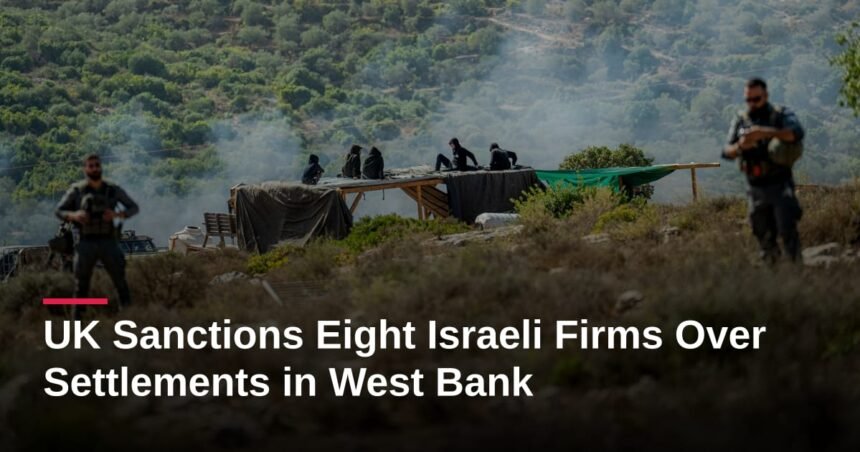
Leeds (The Leeds Times) November 17, 2026 – The United Kingdom has imposed sanctions on eight Israeli construction and property development companies involved in settlement activity in the occupied West Bank, alongside measures against Tzav 9, an Israeli activist movement accused of obstructing humanitarian aid deliveries to Gaza. The action includes asset freezes and director disqualifications and was announced shortly before final tender deadlines for the E1 settlement project.
As reported by Reuters, the companies include Har Hevron Development Company Ltd, Hemdat Shomron Ltd and S.A.G. (Velvel) Construction and Development Ltd. The United Kingdom said the businesses plan, construct, market or supply housing and infrastructure for Israeli settlements in the West Bank.
Which companies were sanctioned by the United Kingdom?
The United Kingdom’s official announcement listed eight designated companies: Har Hevron Development Company Ltd, Hemdat Shomron Ltd, S.A.G. (Velvel) Construction and Development Ltd, Lev HaHar Yazamut Ltd, Harey Zahav, Ariel Residential Judea & Samaria Ltd, Ami Gvirtzman Architects 2021 Ltd and Z.F. Building Company Ltd.
The Foreign, Commonwealth and Development Office said the companies were involved in developing, designing, constructing or marketing homes and public infrastructure in Israeli settlements and outposts. The measures freeze assets subject to United Kingdom jurisdiction and disqualify company directors under the announced sanctions framework.
Why did the United Kingdom warn companies over E1?
The sanctions were announced before final tenders for E1, a proposed settlement project east of Jerusalem. British officials said the project could bisect the occupied West Bank, restrict territorial continuity with East Jerusalem and undermine the prospect of a future Palestinian state.
“Protecting the two-state solution is the North Star of this Government’s approach,” Foreign Secretary Ed Miliband said, warning companies: “do not bid, do not build, and do not profit from the destruction of the two-state solution.”
Why was Tzav 9 included in the sanctions?
The United Kingdom said Tzav 9 had organised and carried out blockades of crossings, ports and roads used by humanitarian aid convoys bound for Gaza. Al Jazeera reported from London that the Foreign, Commonwealth and Development Office linked the action to severe humanitarian conditions, including families affected by catastrophic flooding.
The Independent reported that Tzav 9 had obstructed aid convoys as recently as October. The sanctions are separate from the measures against the construction companies but were announced in the same package.
What wider developments accompanied the announcement?
The measures follow a marked deterioration in relations between the United Kingdom and Israel over Israel’s war in Gaza and settlement expansion in the West Bank. The two governments also reached a last-minute agreement after Israel threatened to close the British consulate building in occupied East Jerusalem in response to earlier British trade measures targeting settlement goods.
Palestinian news agency Wafa reported raids and arrests by Israeli forces in several West Bank locations on the same day. Medical sources said a Palestinian woman was killed and 10 Palestinians, including an elderly man, were injured when Israeli settlers opened fire near Ein ad-Duyuk at-Tahta in the Jericho governorate. Wafa also reported arrests in Jalazone refugee camp and el-Bireh, as well as raids in Nablus, Tubas and villages in Bethlehem governorate.
Background to the sanctions
Israeli settlements in the occupied West Bank are regarded as illegal under international law by the United Kingdom and the International Court of Justice. The British government said settlement construction threatens the territorial basis of a two-state solution. E1 has remained particularly contentious because development there could divide the West Bank and affect access between Palestinian communities and East Jerusalem. The new measures are the United Kingdom’s latest action aimed at restricting financial support for settlement expansion.
How could the measures affect United Kingdom sanctions policy?
The sanctions broaden the United Kingdom’s response from trade restrictions on settlement-related goods to direct measures against companies and directors associated with construction and development. They may increase compliance risks for British banks, investors, contractors and insurers dealing with the designated firms. The inclusion of Tzav 9 also signals that the government is willing to target non-state groups it says obstruct humanitarian aid. Further sanctions could depend on developments in settlement construction, E1 tenders, aid access and the United Kingdom’s wider diplomatic policy towards Israel and the Palestinian territories.