

Key Points
- Ireland has proposed giving the United Kingdom partner status in the European Union’s Made in Europe scheme.
- The draft would allow Britain to join without matching European Union tariffs on Chinese electric vehicles.
- The proposal would also cover Switzerland and European Economic Area countries including Norway.
- The plan remains subject to discussion by European Union governments, the European Commission and the European Parliament.
- UK and European carmakers are seeking protection from rules that could exclude British-built vehicles from European subsidies and procurement opportunities.
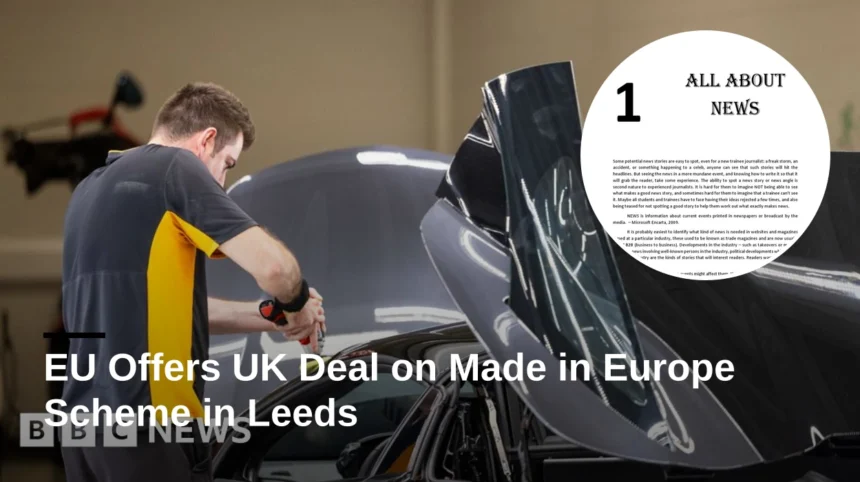
Leeds (The Leeds Times) November 25, 2026 – Ireland has proposed a fresh arrangement that could allow the United Kingdom to participate in the European Union’s “Made in Europe” industrial scheme without imposing equivalent tariffs on Chinese electric vehicles. The proposal, included in a draft compromise on the Industrial Accelerator Act, would give British electric vehicles and components access to selected European support measures while preserving separate UK trade policy. The plan is intended to protect closely integrated British and European automotive supply chains from exclusion under new industrial rules.
- Key Points
- What has Ireland proposed for the United Kingdom?
- Why does the scheme matter to British carmakers?
- What have British ministers said?
- What decisions are still required?
- What could the deal mean for electric-vehicle buyers and workers?
- Background to the development
- How could this affect the scheme’s intended audience?
What has Ireland proposed for the United Kingdom?
As reported by the BBC, Ireland, which holds the European Union’s rotating presidency, has suggested that the United Kingdom could receive partner status under the proposed scheme. The arrangement would also apply to Switzerland and European Economic Area countries such as Norway.
The proposal would depend on non-European Union countries granting reciprocal access to subsidy and public procurement schemes. A further reported condition is that the United Kingdom would maintain access for vehicles manufactured in the European Union.
Why does the scheme matter to British carmakers?
The Industrial Accelerator Act is designed to strengthen European manufacturing and supply chains, particularly in electric vehicles, batteries and clean energy. Under earlier proposals, products made in the United Kingdom could have been excluded from incentives and procurement opportunities available to manufacturers within the European Union.
European and British industry groups have warned that such restrictions could increase costs for manufacturers operating across the Channel. Reports cited by the Society of Motor Manufacturers and Traders and the European Automobile Manufacturers’ Association indicate that stricter rules could affect vehicles, parts and batteries made in Britain.
Separate rules of origin under the United Kingdom-European Union Trade and Cooperation Agreement are also due to become stricter. Industry reporting has estimated that 82% of electric and plug-in hybrid cars produced in the United Kingdom and European Union could face a 10% tariff from January 1 if an agreement is not reached.
What have British ministers said?
Following the United Kingdom-European Union summit in Brussels, Prime Minister Andy Burnham said the scheme had become “a source of real concern” across the British economy, particularly for carmakers. He said the commitment by both sides to avoid measures that would harm each other’s industries would provide relief to workers.
Chancellor of the Exchequer John Healey is expected to press European Union finance ministers on British participation. Earlier reporting said the British Government was cautiously optimistic about securing terms it could accept.
What decisions are still required?
The proposal remains at an early stage. European ambassadors are expected to examine it before European Union competition ministers consider a further compromise text. The European Commission and European Parliament would also need to approve the final legislation.
European Union governments and Members of the European Parliament are still negotiating the Industrial Accelerator Act, which is not expected to be finalised before early 2027. France initially opposed British inclusion but reportedly accepted participation on the condition that Britain aligned its tariffs with the European Union; the Irish proposal would remove that requirement.
What could the deal mean for electric-vehicle buyers and workers?
If adopted, the arrangement could help preserve access for British-built cars and components to European support programmes while avoiding an immediate requirement for Britain to raise tariffs on Chinese electric vehicles. That could reduce the risk of higher prices for consumers and retaliation against British exports, although the final terms remain unsettled.
For workers and manufacturers in the British and European automotive sectors, the main effect would be continued access to interconnected supply chains and markets. The proposal would not itself guarantee subsidies or prevent future trade disputes, because the legislation and reciprocal-access conditions still need approval.
Background to the development
The European Union’s Made in Europe initiative, formally linked to the Industrial Accelerator Act, seeks to favour European-made inputs in subsidies and public procurement. Its main targets include dependence on Chinese supply chains and competitive pressure in electric vehicles and batteries. Earlier proposals risked excluding British products because the United Kingdom is outside the European Union. The British Government has therefore sought partner status while resisting automatic alignment with European tariffs on Chinese vehicles.
How could this affect the scheme’s intended audience?
The proposed compromise could give British and European carmakers a clearer route to participate in support programmes while limiting disruption to consumers and workers. European manufacturers would retain access to British supply chains, and British manufacturers could avoid being treated as entirely external suppliers. Chinese electric-vehicle producers could face continued differences between European Union and United Kingdom trade rules. The final impact will depend on negotiations, reciprocal market access and approval of the Industrial Accelerator Act.