
Horsforth is a historic settlement in north-west Leeds where families can explore more than 900 years of documented history through museums, churches, parks, historic streets, surviving buildings and former industrial landscapes. Its heritage is spread across the neighbourhood rather than concentrated at one attraction.
- What is the history of Horsforth?
- How did Kirkstall Abbey influence Horsforth?
- What can children learn at Horsforth Village Museum?
- Which historic buildings should families look for in Horsforth?
- Why is St Margaret’s Church important to Horsforth history?
- How can families explore Horsforth Hall Park as history?
- How did railways change Horsforth?
- What role did farming and industry play in Horsforth?
- How did Horsforth become part of Leeds?
- How can families turn Horsforth history into a self-guided walk?
- What can families learn from Horsforth’s historic landscape?
- Why is local history useful for children visiting Horsforth?
- How can visitors respect Horsforth’s heritage while exploring with children?
- What makes Horsforth a strong family destination for local history?
For children, this makes local history practical. A short walk can connect medieval landholding with Victorian architecture, railway expansion, farming, industry and modern suburban life. Families can see how a settlement changed rather than simply reading about dates in a textbook.
Horsforth appears in the Domesday Book of 1086, with the settlement recorded under several spellings. Leeds City Council’s heritage assessment states that Horsforth was associated with three Anglo-Saxon thanes before the Norman Conquest and that the settlement’s name is probably connected with a horse crossing over water.
The area’s history subsequently became closely connected with Kirkstall Abbey, a Cistercian monastery founded in 1152. The abbey controlled a substantial proportion of Horsforth’s land before the Dissolution of the Monasteries in the sixteenth century.
Later centuries brought private estates, farming, stone quarrying, textile activity, transport infrastructure and rapid population growth. Horsforth eventually became part of the City of Leeds in 1974.
For families, the strongest approach is to combine Horsforth Village Museum, historic buildings, Hall Park, St Margaret’s Church and a self-guided walk. Each location provides a different part of the area’s story.
What is the history of Horsforth?
Horsforth has a documented history stretching from the Anglo-Saxon period to modern Leeds, with evidence of medieval landholding, monastic ownership, farming, industry, transport, Victorian expansion and twentieth-century suburban development still visible today.
The earliest important documentary reference is the Domesday Survey of 1086. Horsforth appears under variations including Horseford and Hoseforde. The survey recorded three manors and three thanes associated with the settlement before Norman rule.
The meaning of Horsforth is generally linked to an Old English reference to a horse ford. Leeds City Council’s historical assessment connects this interpretation with a crossing over water, probably associated with the River Aire and the Newlay area.
This provides an accessible starting point for children. A place name becomes evidence of how people used the landscape. The ford was not simply a geographical feature. River crossings supported movement between communities and influenced routes through the wider area.
Horsforth remained predominantly agricultural for centuries. Fields, estates, mills and local industries gradually changed the settlement’s economic structure.
The arrival of improved roads, railways and other transport connections accelerated development during the nineteenth century. Horsforth increasingly became connected with the expanding industrial economy of Leeds.
The settlement later developed into a substantial suburban community. Its historic identity remains visible through older buildings, street layouts, parks, churches and surviving architectural features.
This long chronology gives families a simple framework: Saxon settlement → medieval landholding → monastic influence → private estates → agriculture and industry → Victorian expansion → modern Leeds.
How did Kirkstall Abbey influence Horsforth?
Kirkstall Abbey influenced Horsforth through medieval land ownership, agriculture and economic activity. Founded in 1152, the Cistercian monastery became a major landholder in the area before the Dissolution transferred its estates into private ownership during the sixteenth century.
Kirkstall Abbey was founded by Cistercian monks from Fountains Abbey in 1152. Historic England records that the monastery developed substantial wealth through sheep farming and the wool trade.
Horsforth formed part of the abbey’s wider landholding network. Leeds City Council’s heritage assessment states that the monks eventually owned approximately three quarters of Horsforth’s land.
This connection is important when explaining medieval life to children. A monastery was not only a religious building. It was also a landowner and an economic organisation.
Agricultural land supplied food and resources. Sheep supported the wool economy. Roads and river routes connected communities and markets.
The Dissolution of the Monasteries changed this structure. Under Henry VIII, Kirkstall Abbey was surrendered in the sixteenth century and its lands were subsequently transferred into private ownership. Historic England records the end of monastic life at Kirkstall in 1540.
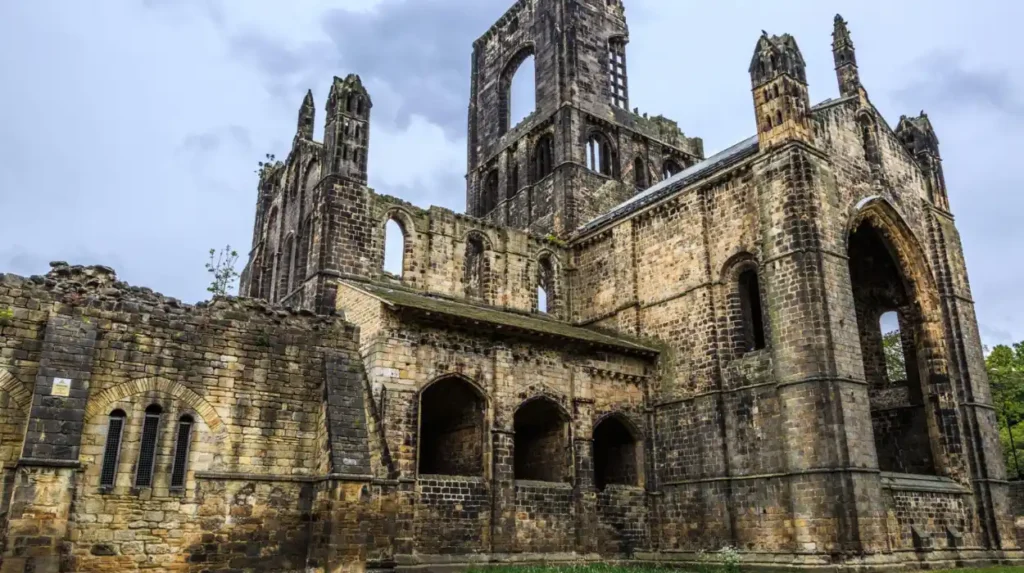
Families visiting nearby Kirkstall Abbey can therefore connect its surviving ruins with Horsforth’s local history. The abbey provides physical evidence of the medieval institution that influenced landholding in the surrounding area.
As you explore the modern neighbourhood, you are crossing land with a deep heritage. Read about the full to understand its origins.
What can children learn at Horsforth Village Museum?
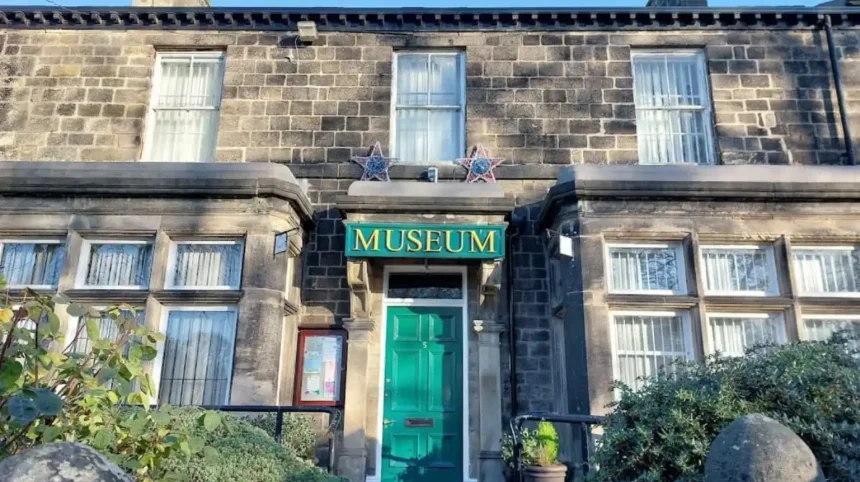
Horsforth Village Museum provides families with a direct introduction to local heritage through objects, displays and community history. Opened in 1988, the volunteer-run museum occupies a central position on The Green in the old village.
Horsforth Village Museum opened its doors in 1988. Horsforth Town Council describes it as a volunteer-run museum dedicated to preserving the area’s history. It is located on The Green, within the historic village centre.
The museum is particularly useful for children because local history becomes tangible. Objects provide evidence of how residents lived, worked, travelled and communicated.
A museum visit also helps children understand the difference between primary evidence and historical interpretation. An original object, photograph, document or artefact is evidence from the period or a direct record of it. A display label provides interpretation that explains its context.
Families can use simple questions while viewing exhibits:
What is this object?
Who used it?
What material is it made from?
What does it tell us about daily life?
How is it different from something used today?
These questions turn a museum visit into an informal history lesson.
The museum also reinforces Horsforth’s distinctive identity. The town council describes Horsforth as an ancient town with a strong village character despite its position within the modern City of Leeds.
Opening times, exhibitions and events can change, so families should check the museum’s current information before travelling.
Which historic buildings should families look for in Horsforth?
Families can identify several important historic buildings and structures around Horsforth, including the former Horsforth Hall stable block, St Margaret’s Church and older buildings within the village and conservation areas that reveal different stages of local development.
The stable block of former Horsforth Hall is one of the clearest surviving physical links with the area’s landed-estate history.
Historic England lists the structure as Grade II, meaning it has special architectural or historic interest. The building dates principally from the later eighteenth century but incorporates a datestone marked 1707. It is constructed from coursed squared sandstone and has a two-storey, eight-bay arrangement.
The stable block belonged to the former Horsforth Hall estate associated with the Stanhope family.
The hall itself no longer survives, but its historical association remains important. Hall Park occupies part of the landscape connected with the former estate.
For children, the stable block introduces the concept of an estate. A large historic house required supporting buildings for horses, storage, servants and agricultural management.
The building also demonstrates how historians use physical evidence. A carved date such as 1707 provides a specific historical clue.
Families should avoid treating historic buildings as playground structures. Looking closely from public areas and following local access arrangements provides a safe way to examine architectural details.
Why is St Margaret’s Church important to Horsforth history?
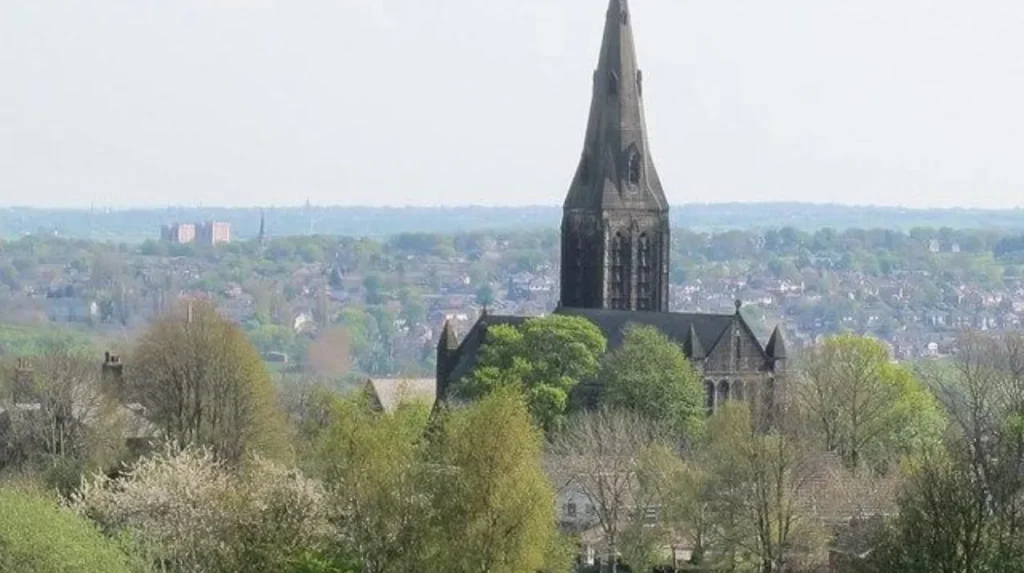
St Margaret’s Church records Horsforth’s rapid nineteenth-century growth. Built between 1877 and 1883 to designs associated with architect J. L. Pearson, the Grade II listed church became an important architectural landmark as the expanding population required larger religious facilities.
St Margaret’s Church stands on Church Lane and is listed at Grade II by Historic England. The main church was constructed between 1877 and 1883. Its spire was completed in 1902.
The church was designed in the Early English architectural style and uses coursed squared sandstone with a slate roof. Historic England records features including a nave, aisles, transepts, chancel and prominent tower.
The church replaced the earlier Bell Chapel, which had become too small for Horsforth’s growing congregation.
This is a useful example of how population growth changes buildings. As Horsforth expanded, existing community infrastructure became insufficient. A larger church represented the scale of nineteenth-century development.
Children can identify architectural features such as:
- pointed arches
- lancet windows
- sandstone construction
- a tower
- a spire
These features provide an introduction to architectural vocabulary without requiring specialist knowledge.
St Margaret’s also demonstrates the importance of listed buildings. Listing recognises buildings with special architectural or historic interest and provides a framework for protecting their character.
Historic England’s National Heritage List for England records St Margaret’s as entry 1261804.
How can families explore Horsforth Hall Park as history?
Horsforth Hall Park combines present-day recreation with the historic landscape of the former Horsforth Hall estate. Families can use the park to understand land ownership, estate planning, public open space and how historic landscapes become part of modern communities.
Horsforth Hall Park is one of the easiest places to connect outdoor activity with local history.
The park is associated with the former Horsforth Hall estate. Although the hall itself was demolished, the surviving stable block and landscape preserve part of the area’s estate history.
The Stanhope family played a particularly important role in Horsforth after the Dissolution of the Monasteries. Leeds Libraries’ heritage research records a Stanhope connection lasting for more than two centuries and identifies surviving street names such as Stanhope Avenue and Stanhope Drive as reminders of this association.
This provides a straightforward family activity. Children can look for historical place names and ask why streets carry particular names.
A park visit also demonstrates how land use changes over time. Land once associated with a private estate is now part of a public recreational environment.
Families can discuss three stages:
Estate land: land controlled as part of a large private property.
Historic landscape: land shaped by buildings, boundaries, routes and estate management.
Public park: land used today for recreation and community activity.
This makes Hall Park useful for understanding continuity and change.
How did railways change Horsforth?
Railways transformed Horsforth during the nineteenth century by strengthening connections with Leeds and neighbouring communities, supporting population growth and helping the settlement develop from an agricultural village into a substantial suburban area within the wider Leeds economy.
Transport is central to understanding Horsforth’s modern development.
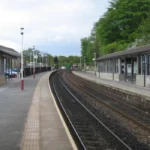
The Leeds and Bradford Railway opened through the area in 1846, strengthening connections between Horsforth and the growing industrial centres of West Yorkshire.
Railways changed the practical geography of the settlement. Travel became faster and more predictable than many earlier forms of movement.
Improved transport supported commuting, commercial activity and residential expansion. Horsforth increasingly became connected to Leeds rather than functioning primarily as a rural agricultural settlement.
Families can use the railway as an example of technological change. A railway line is infrastructure, but its wider effect is social and economic.
Children can compare transport in different periods:
Medieval period: walking, horses and carts.
Industrial period: canals, turnpike roads and railways.
Modern period: trains, buses, cars and cycling routes.
This comparison explains why transport history is important. Infrastructure affects where people live, where businesses operate and how communities interact with nearby cities.
Horsforth’s railway heritage therefore forms part of the wider story of Leeds’s nineteenth-century industrial expansion.
What role did farming and industry play in Horsforth?
Farming shaped Horsforth for centuries, while later quarrying, milling, tanning, textiles and manufacturing diversified the local economy. These activities changed employment, land use, transport requirements and the physical appearance of the settlement before suburban growth transformed the area.
Horsforth was predominantly agricultural until the nineteenth century. Fields and rural land formed a major part of everyday life.
The area’s geology also supported stone quarrying. Historical accounts record that Horsforth stone was used locally and transported beyond the settlement. Leeds City Council’s heritage material identifies quarrying as an important part of the area’s industrial history.
Water-powered mills also operated around Horsforth Beck, supporting textile-related activity.
Another notable industrial development was tanning. A tannery was established at Woodside around 1820 by the Watson family. The business later developed into soap manufacturing and moved to Leeds.
These industries demonstrate how natural resources influenced economic development.
Stone provided building material. Water supported mills. Agricultural land supported farming. Transport routes allowed goods and workers to move.
Children can understand this as a chain:
Natural resource → local industry → employment → transport demand → settlement growth.
This approach also explains why historic place names and industrial remnants remain valuable. They provide clues about work that took place before Horsforth became predominantly residential.
How did Horsforth become part of Leeds?
Horsforth developed from a historic township into an urban district during the nineteenth century before becoming part of the modern City of Leeds in 1974. Its administrative history reflects the wider transformation of settlements around rapidly expanding industrial cities.
Horsforth became a separate civil parish in 1866 and later became Horsforth Urban District in 1894. These administrative changes reflected its increasing population and urban importance.
During the nineteenth century, Horsforth experienced substantial growth as Leeds expanded.
Its location provided access to major transport routes while nearby industrial centres generated employment and economic connections.
The twentieth century continued this transformation. Horsforth retained a strong local identity while becoming increasingly integrated into the metropolitan structure of Leeds.
In 1974, the former Horsforth parish and urban district were abolished as part of local government reorganisation and incorporated into the new metropolitan district of Leeds.
The story demonstrates that administrative boundaries change even when local identity remains strong.
Horsforth Town Council was later established following a petition submitted in 1999.
For children, this creates an opportunity to distinguish between place identity and administrative government. A community can retain its historic name and character while becoming part of a larger local authority.
How can families turn Horsforth history into a self-guided walk?
A family history walk works best when it links several nearby evidence points, including The Green, Horsforth Village Museum, historic streets, Hall Park, the former Horsforth Hall stable block and St Margaret’s Church, creating a chronological route through local development.
A self-guided walk removes the need for a formal tour.
Start around The Green, where Horsforth Village Museum provides an introduction to local history. The area represents the older village core and gives families a useful starting point.
Continue towards historic streets and buildings. Look for sandstone construction, older façades, boundary walls and street names connected with earlier landowners.
Move towards Hall Park to explore the landscape associated with the former Horsforth Hall estate. The surviving stable block provides a physical architectural reference.
Continue towards St Margaret’s Church on Church Lane. The church introduces the Victorian period and the impact of population growth.
The route can finish by discussing modern Horsforth and its relationship with Leeds.
A simple family worksheet can use five questions:
What is the oldest feature you can identify?
What material was used to construct it?
Who used the building or land?
What changed around it?
What is the site used for today?
This turns passive sightseeing into historical investigation.
Families should distinguish between publicly accessible spaces and private property. Historic buildings can be viewed externally where appropriate, but visitors should follow signs, opening arrangements and access restrictions.
What can families learn from Horsforth’s historic landscape?
Horsforth’s historic landscape shows how communities change through successive periods of settlement, land ownership, industry, transport and urban growth. Families can read these changes through buildings, streets, parks, place names, religious sites, museum collections and surviving archaeological evidence.
Historic landscapes contain multiple chronological layers.
A medieval settlement can retain a street pattern long after its original buildings disappear. An eighteenth-century estate can leave a stable block and street names. A Victorian church can demonstrate population growth. A railway can reveal industrial-era expansion.
Horsforth contains examples of all these processes.
The area’s conservation approach also recognises its architectural and historical character. Leeds City Council’s heritage documentation identifies Horsforth and Horsforth Cragg Hill as conservation areas.
A conservation area is an area designated because of its special architectural or historic interest. The designation focuses on preserving the character and appearance of the area rather than protecting only one individual building.
For children, this concept explains why streetscapes matter.
A historic environment is not simply a collection of old buildings. The relationship between buildings, roads, walls, open spaces and landmarks also contributes to character.
This is particularly relevant in Horsforth because much of its heritage remains integrated into an active modern community.
Why is local history useful for children visiting Horsforth?
Local history helps children understand national historical events through familiar places. Horsforth connects the Domesday Survey, medieval monasteries, the Dissolution, industrialisation, Victorian expansion, railway development and twentieth-century local government with locations families can physically explore.
Local history gives historical periods a geographical reference.
The Domesday Survey connects Horsforth with Norman England. Kirkstall Abbey connects the area with medieval monastic life. The Dissolution connects it with Tudor religious and political change.
Industrial development connects Horsforth with the economic transformation of West Yorkshire. Railways connect it with nineteenth-century technological expansion.
The Victorian church demonstrates population growth. Modern parks demonstrate changes in land ownership and public recreation.
This creates a chronological learning sequence without requiring a formal classroom.
Children can also learn how historians establish facts. Different sources provide different forms of evidence. A museum object provides material evidence. A listed-building record provides architectural documentation. A heritage assessment provides historical interpretation. A street name provides evidence of remembered associations.
Reliable sources should be compared rather than treated as identical.
For example, Historic England provides authoritative information about listed buildings such as St Margaret’s Church and the former Horsforth Hall stable block. Leeds City Council provides local heritage and conservation information. Horsforth Town Council provides community information about the museum and local identity.
Explore More Area Guide
Peaceful Morning Outdoors in Horsforth, Leeds 2026
Horsforth Meeting Places & Social Spaces Guide
How can visitors respect Horsforth’s heritage while exploring with children?
Visitors can protect Horsforth’s historic character by staying on public routes, respecting private property, following museum and church rules, avoiding damage to historic structures and treating listed buildings, memorials, archaeological evidence and community spaces as protected heritage.
Responsible heritage tourism is straightforward.
Historic buildings should not be climbed, touched unnecessarily or entered without permission. Children should stay with adults around roads, railway infrastructure, water and uneven ground.
Museums require additional care because collections contain original objects and fragile historical evidence.
Visitors should also respect residents. Horsforth is a living community rather than an open-air museum. Historic streets remain residential and commercial areas.
Photography should follow site-specific rules, particularly inside museums, churches and privately operated buildings.
The same principle applies to parks. Public access does not remove the responsibility to protect planting, structures and other facilities.
Families who follow these practices help preserve the physical evidence that makes local history accessible to future visitors.
What makes Horsforth a strong family destination for local history?
Horsforth offers families an accessible historical journey because its heritage is distributed across a museum, village streets, listed buildings, churches, parks, former estate land and transport routes. These sites connect everyday places with major periods of British and Leeds history.
Horsforth works particularly well for family history because the subject does not depend on one large attraction.
The Horsforth Village Museum provides curated local evidence. The Green provides a historic village setting. Hall Park connects present-day recreation with the former Horsforth Hall estate. The stable block provides surviving eighteenth-century architectural evidence. St Margaret’s Church represents Victorian expansion. Railway infrastructure demonstrates nineteenth-century transport development.
Together, these places create a clear historical sequence.
The most effective family visit does not require children to memorise large numbers of dates. It requires them to identify evidence and understand change.
Horsforth’s history demonstrates a simple but important principle: modern communities contain layers of earlier activity.
The settlement recorded in Domesday was not the same community that developed around Victorian railways, and Victorian Horsforth was not the same place that became part of the City of Leeds in 1974. Each period left evidence behind.
That makes Horsforth particularly suitable for families seeking an educational day out close to Leeds.
What is Horsforth famous for?
Horsforth is known for its long history, village character, historic buildings, Horsforth Village Museum, former Horsforth Hall estate, St Margaret’s Church and connections with Kirkstall Abbey.