

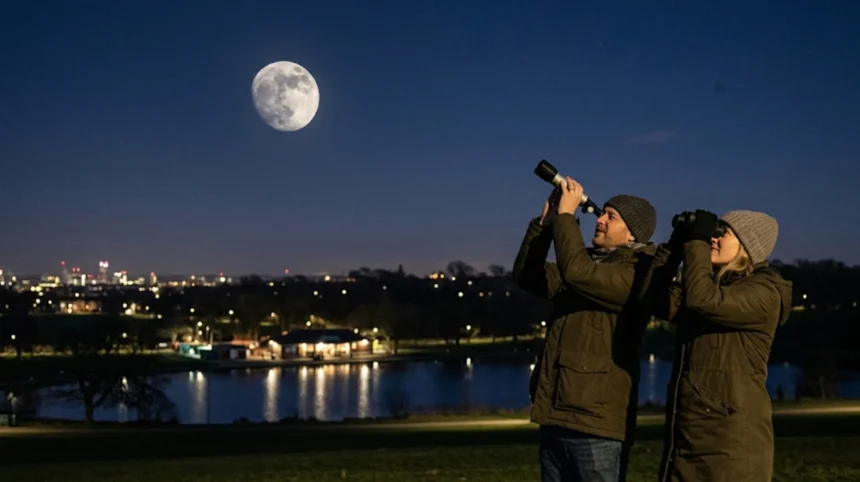
Moon phases are the changing shapes of the illuminated portion of the Moon as seen from Earth, caused by the Moon’s orbit around Earth and the Sun’s lighting angle. The complete lunar cycle lasts 29.5 days and includes eight distinct phases: new moon, waxing crescent, first quarter, waxing gibbous, full moon, waning gibbous, third quarter, and waning crescent. Leeds residents can observe all eight phases clearly from the city’s dark sky pockets, especially in Roundhay Park and the Leeds countryside.
- What Is a Moon Phase and How Does It Work?
- The Science Behind Lunar Illumination
- What Are the Eight Moon Phases in Order?
- New Moon: The Starting Point
- Waxing Crescent: First Visible Light
- First Quarter: Half-Illuminated Moon
- Waxing Gibbous: Growing Toward Full
- Full Moon: Complete Illumination
- Waning Gibbous: Shrinking After Full
- Third Quarter: Opposite Half Illuminated
- Waning Crescent: Final Visible Sliver
- Why Does the Moon Take 29.5 Days to Cycle Through Phases?
- How Do Moon Phases Affect Tides on Earth?
- Spring Tides at New and Full Moons
- Neap Tides at Quarter Moons
- How Can You Observe and Track Moon Phases in Leeds?
- Best Times to Observe Each Phase in Leeds
- Tools for Tracking Moon Phases in Leeds
- What Is the Difference Between Waxing and Waning Moon Phases?
- Visual Differences Between Waxing and Waning
- Timing Differences
- How Do Moon Phases Influence Culture and Calendars in Leeds?
- Lunar Calendars and Religious Observances in Leeds
What Is a Moon Phase and How Does It Work?
A moon phase is the visible portion of the Moon’s sunlit side from Earth, changing as the Moon orbits Earth every 27.3 days while the full cycle takes 29.5 days. Half the Moon is always illuminated by sunlight, but our viewing angle changes throughout the month.
The Moon does not produce its own light. Sunlight reflects off the Moon’s surface, and Earth observers see different amounts of this reflected light depending on the Moon’s position relative to Earth and the Sun. When the Moon sits between Earth and the Sun, its illuminated side faces away from Earth, creating a new moon. When Earth sits between the Sun and Moon, the full illuminated side faces Earth, creating a full moon.
The lunar cycle, also called a synodic month, lasts 29.5 days on average. This is longer than the Moon’s orbital period of 27.3 days because Earth moves around the Sun during the Moon’s orbit, requiring the Moon to travel farther to realign with the Sun and Earth.
The Science Behind Lunar Illumination
The Moon is a rocky celestial body approximately 3,474 kilometers in diameter, orbiting Earth at an average distance of 384,400 kilometers. The Moon’s surface reflects about 12% of incoming sunlight, a property called albedo. This reflected light travels 1.3 seconds to reach Earth.
The geometry of Sun-Earth-Moon alignment determines the phase. At new moon, the angular separation between Sun and Moon is 0°. At first quarter, it is 90°. At full moon, it is 180°. At third quarter, it returns to 270° (or -90°).
Leeds astronomers and amateur stargazers in the Yorkshire region benefit from decreasing light pollution in outlying areas like truly rural spots near Otley and Wensleydale, which are just 30 minutes from Leeds city centre.
What Are the Eight Moon Phases in Order?
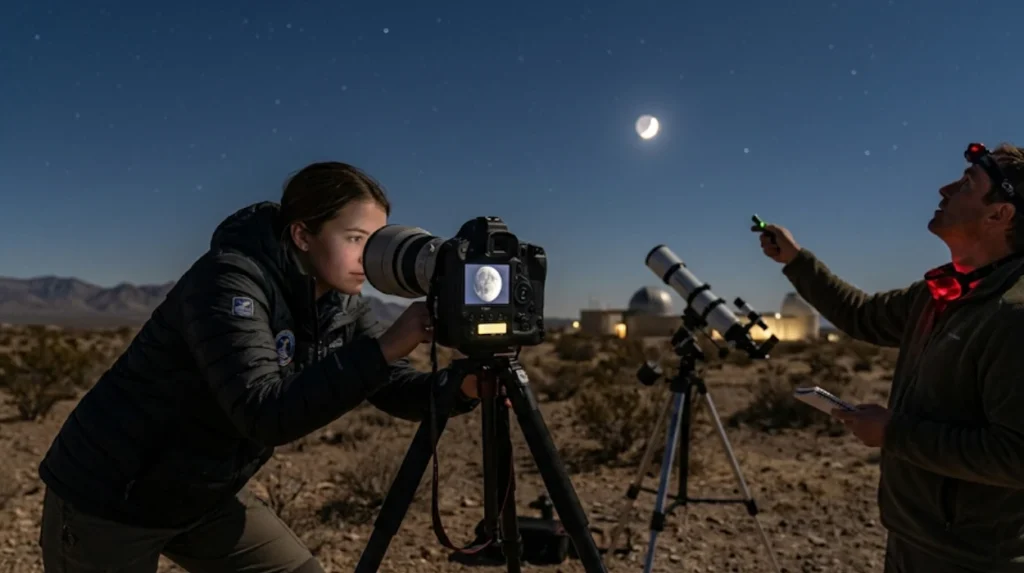
The eight moon phases in order are new moon, waxing crescent, first quarter, waxing gibbous, full moon, waning gibbous, third quarter, and waning crescent, completing one 29.5-day lunar cycle. Each phase lasts approximately 3.7 days on average. Leeds skywatchers can track these phases using local astronomy clubs or The Leeds Times’ monthly sky guide.
New Moon: The Starting Point
During a new moon, the Moon’s illuminated side faces away from Earth, making it invisible to naked-eye observers. The Moon rises and sets with the Sun, appearing in the daytime sky. A total solar eclipse can only occur during a new moon when the Sun, Moon, and Earth align perfectly.
The new moon marks day 0 of the lunar cycle. At this phase, the Moon is approximately 384,400 kilometers from Earth, though this distance varies due to the elliptical orbit. The Moon’s gravitational pull still creates tides despite being invisible.
Leeds residents interested in eclipse viewing often join Yorkshire Astronomical Society events at Leeds City Museum, where telescopes and expert guides explain new moon phenomena safely.
Waxing Crescent: First Visible Light
The waxing crescent appears as a thin curved sliver of light on the right side in the Northern Hemisphere. “Waxing” means increasing in size. This phase occurs 2–3 days after the new moon, when observers see 1–49% of the Moon’s surface illuminated. The crescent resembles a “Cheshire Cat smile”.
Waxing crescent moons are visible in the western sky shortly after sunset. The illuminated portion grows nightly by approximately 3–4%. During this phase, the Moon sets about 1–2 hours after the Sun.
From Leeds city centre, waxing crescent moons are best seen from elevated spots like Kirkstall Abbey ruins or the roundhay Park woodland clearings, where western horizons remain unobstructed.
First Quarter: Half-Illuminated Moon
The first quarter moon appears as a half-moon with the right half illuminated in the Northern Hemisphere. Despite the name “quarter,” half the visible disk is lit because we see one-quarter of the Moon’s total surface (the other three-quarters are either dark or not facing Earth). This occurs approximately 7.4 days after the new moon.
At first quarter, the Moon rises around noon and sets around midnight. The angular separation from the Sun is 90°. This is a primary moon phase, occurring at a specific moment rather than spanning multiple days.
Leeds photography enthusiasts capture first quarter moons beautifully from the Aire Valley trails, where the illuminated half contrasts sharply against the darkening Yorkshire skyline.
Waxing Gibbous: Growing Toward Full
The waxing gibbous phase occurs between first quarter and full moon, when 51–99% of the Moon’s surface is illuminated. “Gibbous” means convex or humped. The Moon appears more than half-lit but not yet complete. This phase lasts approximately 3.7 days.
During waxing gibbous, the Moon rises in the afternoon and is visible most of the night. The illuminated portion continues growing nightly. Observers see increasing detail on the Moon’s surface as lighting angles improve.
Leeds gardeners traditionally use waxing gibbous phases for planting above-ground crops, following centuries-old Yorkshire farming folklore that links lunar illumination to plant growth cycles.
Full Moon: Complete Illumination
The full moon occurs when Earth sits between the Sun and Moon, showing 100% of the illuminated side. This happens approximately 14.8 days after the new moon. The Moon rises at sunset and sets at sunrise, visible all night. A total lunar eclipse can only occur during a full moon.
During a full moon, the Moon is opposite the Sun in the sky. The Moon’s apparent magnitude reaches approximately -12.7, making it the brightest natural object in the night sky after the Sun. The full moon’s light is about 400,000 times dimmer than sunlight.
Leeds host “Moonlight Walks” in Roundhay Park during full moons, where families enjoy the bright illumination without artificial lights. The Leeds Unicorn Festival also schedules nighttime performances around full moon dates for maximum natural lighting.
Waning Gibbous: Shrinking After Full
The waning gibbous phase occurs between full moon and third quarter, when 99–51% of the Moon’s surface remains illuminated. “Waning” means decreasing in size. The Moon still appears mostly lit but shrinks nightly. This phase lasts approximately 3.7 days.
During waning gibbous, the Moon rises after sunset and sets after midnight. The illuminated portion decreases by 3–4% nightly. Observers in the Northern Hemisphere see the left side darkening.
Leeds night runners choose waning gibbous nights for outdoor jogging along the Leeds-Liverpool Canal path, when the Moon provides sufficient light but isn’t overwhelmingly bright.
Third Quarter: Opposite Half Illuminated
The third quarter moon (also called last quarter) appears as a half-moon with the left half illuminated in the Northern Hemisphere—the opposite side from first quarter. This occurs approximately 22.1 days after the new moon. Like first quarter, exactly half the visible disk is lit.
At third quarter, the Moon rises around midnight and sets around noon. The angular separation from the Sun is 270°. This is another primary moon phase, occurring at a precise moment.
Early morning Leeds commuters spot third quarter moons rising over the city’s eastern skyline, especially from train windows on the Leeds-Bradford route.
Waning Crescent: Final Visible Sliver
The waning crescent appears as a thin curved sliver of light on the left side in the Northern Hemisphere. Only 1–49% of the Moon’s surface is illuminated. This phase occurs 2–3 days before the next new moon, completing the cycle.
During waning crescent, the Moon rises in the early morning hours and is visible in the eastern sky before sunrise. The crescent shrinks nightly until the Moon becomes invisible at the next new moon, restarting the cycle.
Leeds early risers—bakers, delivery drivers, and shift workers—often see waning crescent moons during their pre-dawn journeys through Horsforth and Headingley neighbourhoods.
Why Does the Moon Take 29.5 Days to Cycle Through Phases?
The Moon takes 29.5 days to complete its phase cycle because Earth moves around the Sun during the Moon’s orbit, requiring the Moon to travel an extra 2.2 days to realign with the Sun and Earth. The Moon’s orbital period is 27.3 days, but the synodic month is 29.5 days.
The 27.3-day period is called the sidereal month, measured relative to distant stars. During this time, the Moon completes one 360° orbit around Earth. However, Earth has moved approximately 27° along its orbit around the Sun during those 27.3 days.
For the Moon to return to the same phase (e.g., new moon to new moon), it must travel an additional 27° to realign with the Sun-Earth line. This extra travel takes 2.2 days, making the synodic month 29.5 days total. The formula is: synodic month = sidereal month ÷ (1 − sidereal month ÷ tropical year).
This difference matters for calendars, tides, and eclipse predictions. Most lunar calendars use the 29.5-day synodic month, not the 27.3-day sidereal month.
Leeds school science departments use this 29.5-day cycle to teach Year 5 and Year 6 students about celestial mechanics, often timing classroom observations to match local moon phase calendars.
How Do Moon Phases Affect Tides on Earth?
Moon phases directly control Earth’s tides because the Moon’s gravitational pull creates bulges in ocean water, with spring tides occurring at new and full moons and neap tides at quarter moons. The Sun also influences tides but with only 46% of the Moon’s effect.
Spring Tides at New and Full Moons
Spring tides occur during new moon and full moon phases when the Sun, Earth, and Moon align. Their gravitational forces combine, creating higher high tides and lower low tides. The tidal range (difference between high and low tide) is approximately 20% greater than average.
Spring tides happen twice per lunar month—once at new moon and once at full moon. The word “spring” refers to the water “springing forth,” not the season. Spring tides can increase flooding risk in coastal areas during storms.
Although Leeds is landlocked 70 kilometers from the coast, spring tides affect Leeds’ water companies that draw from coastal reservoirs. Manchester Ship Canal operators also adjust schedules based on tidal predictions originating from Moon phases.
Neap Tides at Quarter Moons
Neap tides occur during first quarter and third quarter phases when the Sun and Moon form a 90° angle relative to Earth. Their gravitational forces partially cancel, creating lower high tides and higher low tides. The tidal range is approximately 20% smaller than average.
Neap tides also happen twice per lunar month. During neap tides, coastal currents are weaker, and marine life experiences less stress from rapid water level changes. Fishermen often prefer neap tide conditions for certain activities.
Leeds anglers fishing in nearby reservoirs like Roundhay Lake or Lotherton Lake notice that neap tide periods correlate with calmer water conditions, though these inland waters don’t experience true tides.
How Can You Observe and Track Moon Phases in Leeds?
You can observe moon phases by looking at the Moon nightly and noting its shape, position, and illumination percentage, using tools like moon calendars, apps, or simple sketches to track the 29.5-day cycle. The Moon is visible most nights except during new moon. Leeds residents benefit from local astronomy groups and low-light-pollution parks.
Best Times to Observe Each Phase in Leeds
New moon: Not visible (observe solar eclipses safely with proper equipment)
Waxing crescent: Visible 1–2 hours after sunset in western sky, best from Leeds western suburbs like YApton and Morley
First quarter: Visible from noon to midnight, highest at sunset, excellent from Leeds city centre rooftops
Waxing gibbous: Visible afternoon through most of night, clear from Headingley hills
Full moon: Visible all night, highest at midnight, spectacular over Leeds skyline
Waning gibbous: Visible late evening through morning, best from eastern Leeds areas
Third quarter: Visible midnight to noon, highest at sunrise, visible from Leeds morning commuters
Waning crescent: Visible 2–3 hours before sunrise in eastern sky, ideal for early Leeds workers
Tools for Tracking Moon Phases in Leeds
Moon calendars show phase dates for entire years. Mobile apps like NASA’s “Moon Phases” provide real-time data. Timeanddate.com offers interactive lunar calendars for any location, including Leeds postcode LS1–LS29. Simple observation journals work equally well—sketch the Moon’s shape and record the date nightly.
The Yorkshire Astronomical Society hosts monthly moon-watching events at Leeds City Library, providing telescopes and expert guidance for beginner observers. The Leeds Arts University also runs lunar photography workshops during full moon periods.
The Moon’s illumination percentage changes predictably. On day 1 (new moon), illumination is 0%. On day 7.4 (first quarter), it is 50%. On day 14.8 (full moon), it is 100%. On day 22.1 (third quarter), it returns to 50%. On day 29.5, it reaches 0% again.
What Is the Difference Between Waxing and Waning Moon Phases?
Waxing means the illuminated portion is increasing (new moon to full moon), while waning means it is decreasing (full moon to new moon). In the Northern Hemisphere, waxing moons show illumination on the right, waning moons on the left. This distinction helps identify the Moon’s position in its cycle. Leeds skywatchers use this rule to plan photography sessions.
Visual Differences Between Waxing and Waning
Waxing crescent: Right side lit, looks like a “D” shape
Waning crescent: Left side lit, looks like a “C” shape
Waxing gibbous: Right side mostly lit, shadow on left
Waning gibbous: Left side mostly lit, shadow on right
A simple mnemonic for the Northern Hemisphere: “Light on the right, growing bright” (waxing). “Light on the left, losing strength” (waning). In the Southern Hemisphere, these directions reverse.
Leeds primary schools teach this mnemonic using “Moon Letter” worksheets, helping children remember whether the Moon is growing or shrinking each night.
Timing Differences
Waxing phases occur during days 0–14.8 of the lunar cycle. Waning phases occur during days 14.8–29.5. The Moon rises earlier each night during waxing phases and later during waning phases. Waxing moons are visible in the evening sky; waning moons appear in the morning sky.
Leeds evening bus drivers notice waxing moons illuminating routes through Horsforth and Otley, while early-morning milk delivery drivers see waning moons over Leeds eastern industrial estates.
How Do Moon Phases Influence Culture and Calendars in Leeds?
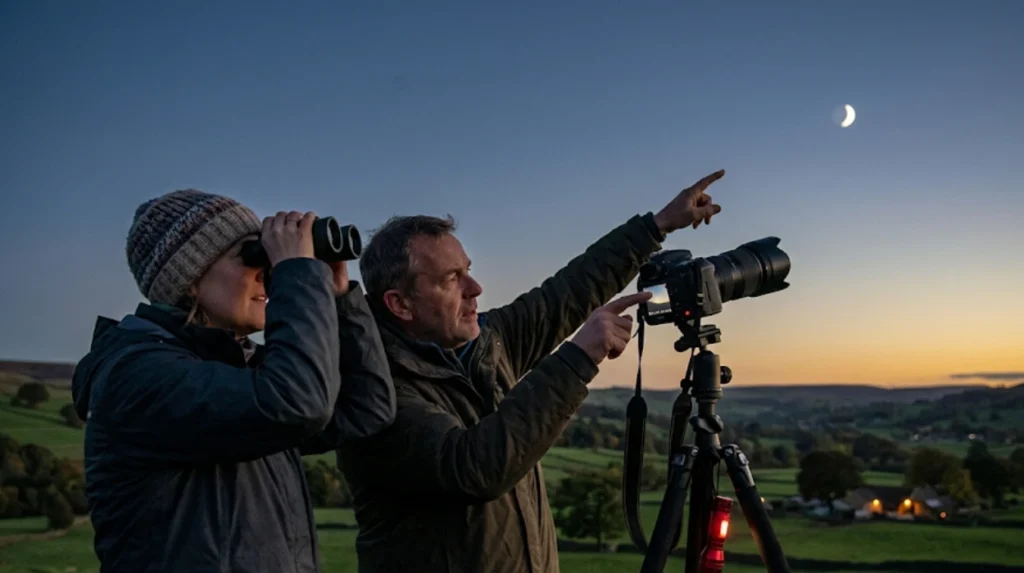
Moon phases have shaped human calendars, religious observances, and cultural traditions for millennia, with lunar calendars still used for Islamic, Hebrew, and Hindu religious dates. The 29.5-day synodic month forms the basis of “months” in many traditional calendars. Leeds’ diverse communities celebrate lunar-based festivals annually.
Lunar Calendars and Religious Observances in Leeds
The Islamic calendar is purely lunar, with 12 months totaling 354 or 355 days. Ramadan begins at the first visible waxing crescent moon. Leeds’ large Muslim community in Beeston and Harehills marks Ramadan’s start with moon-sighting ceremonies at Leeds Grand Mosque. The Hebrew calendar combines lunar months with solar years, adding leap months periodically. Easter’s date depends on the first full moon after the spring equinox.
Leeds Jewish community at Becket Street Liberal Synagogue follows the lunar calendar for High Holy Days. The Leeds Hindu Temple schedules Diwali and Navratri according to lunar phases, drawing thousands of worshippers from across Yorkshire.
Most modern civil calendars use the solar year (365.25 days), causing lunar months to drift relative to seasons. A 12-month lunar year is 11 days shorter than a solar year. This is why Islamic holidays shift earlier each Gregorian year.
What are moon phases?
Moon phases are the different shapes of the Moon’s illuminated portion visible from Earth as the Moon orbits Earth and reflects sunlight.