

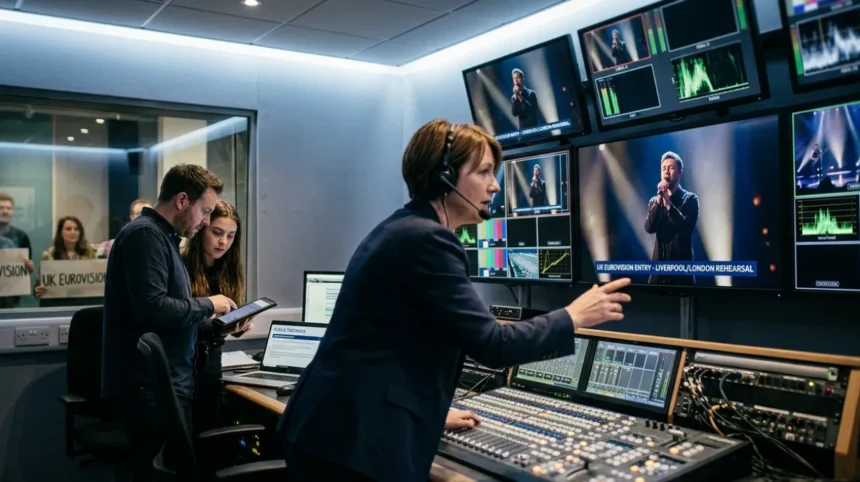
The United Kingdom remains one of the most prominent participants in the Eurovision Song Contest, an annual international song competition organized by the European Broadcasting Union. The British Broadcasting Corporation manages the selection, production, and broadcast of the UK entry each year, balancing public engagement with industry expertise to compete on the global stage. From production hubs in London to northern media centers and passionate fan bases across West Yorkshire, the nation’s approach to the contest continues to evolve.
- What is the history of the UK Eurovision entry?
- Early Decades and Competitive Dominance
- Late 20th Century Successes
- Twenty-First Century Performance Decline
- The 2022 Resurgence and Subsequent Years
- How does the BBC select the UK Eurovision entry?
- Why does the UK automatically qualify for the Eurovision final?
- What rules govern the UK Eurovision entry?
- Song Specifications and Originality
- Performer and Staging Limitations
- Political Neutrality and Commercial Imagery
- What is the economic and cultural impact of the UK entry?
- Television Viewership and Domestic Ratings
- Commercial Success and Music Industry Integration
- Host City Economics and Regeneration
- How has the voting system affected the UK’s performance?
What is the history of the UK Eurovision entry?
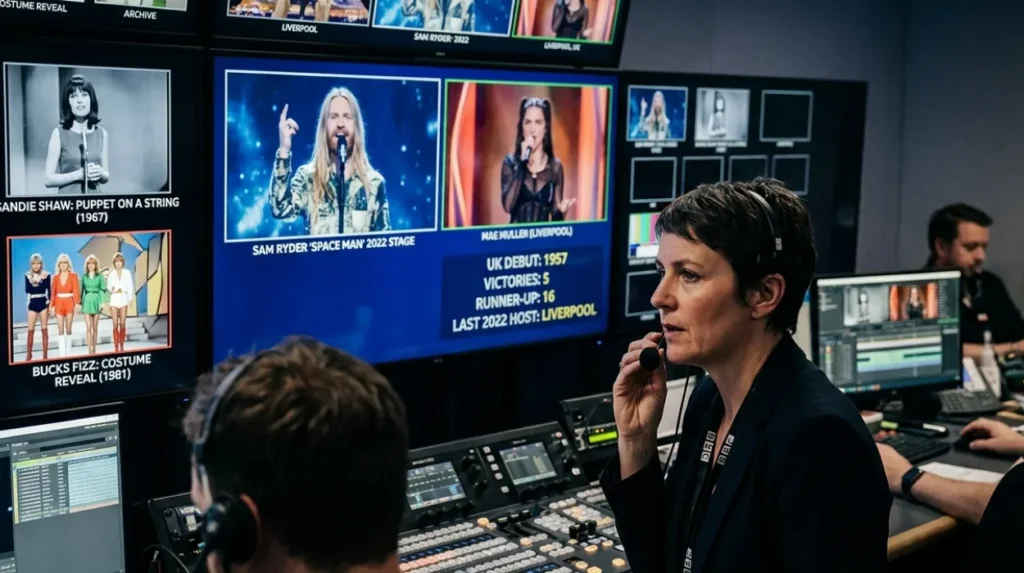
The UK Eurovision entry debuted in 1957, establishing a legacy that includes five victories, a record sixteen second-place finishes, and continuous participation since 1959. The British Broadcasting Corporation manages the selection process to represent British musical talent to a global audience.
Early Decades and Competitive Dominance
The United Kingdom did not participate in the inaugural Eurovision Song Contest in 1956 but joined the competition in 1957. Patricia Bredin was the first performer to represent the nation, singing “All” at the contest in Frankfurt, Germany. After skipping the 1958 event, the country established a permanent presence in 1959 with the duo Pearl Carr and Teddy Johnson, who secured a second-place finish with the song “Sing, Little Birdie.” This sparked widespread interest in international pop music across major British metropolitan areas, establishing dedicated viewing traditions from London to Yorkshire.
During the 1960s and 1970s, the United Kingdom achieved unprecedented commercial and competitive success in the contest. Sandie Shaw secured the first British victory in 1967 with the song “Puppet on a String” in Vienna, Austria. Lulu achieved the second victory in 1969 with “Boom Bang-a-Bang” in Madrid, Spain, sharing the first-place position with Spain, the Netherlands, and France due to a tie in voting points. Brotherhood of Man won the 1976 contest in The Hague, Netherlands, with “Save Your Kisses for Me,” which sold more than six million copies globally and prompted massive celebrations across regional UK music venues.
Late 20th Century Successes
The nation maintained its competitive momentum into the 1980s and 1990s. Bucks Fizz won the 1981 contest in Dublin, Ireland, performing “Making Your Mind Up,” a track notable for its choreographed costume reveal that became an iconic moment in television history. Katrina and the Waves secured the fifth victory for the nation in 1997 with “Love Shine a Light” in Dublin, winning by a then-record margin of 70 points over the runner-up, Ireland. This historic 1997 win triggered widespread celebration across the north of England, filling nightlife venues from the Millennium Square district to local entertainment hubs.
Twenty-First Century Performance Decline
The introduction of televoting and the expansion of the contest to include Eastern European nations coincided with a decline in the competitive outcomes for the United Kingdom. In 2003, the pop duo Jemini performed the song “Cry Baby” in Riga, Latvia, and received zero points from both the national juries and the public, marking the first time the country finished in last place. The nation finished in last place again in 2008 with Andy Abraham, in 2010 with Josh Dubovie, and in 2019 with Michael Rice. In 2021, James Newman performed “Embers” in Rotterdam, Netherlands, and received zero points from both the jury and the televote under the modern voting system, placing last out of 26 finalists.
The 2022 Resurgence and Subsequent Years
The British Broadcasting Corporation restructured its selection process for the 2022 contest in Turin, Italy, collaborating with the global music management company TaP Music. The partnership selected Sam Ryder, a musician who gained prominence on the social media platform TikTok. Ryder performed the song “Space Man,” securing first place in the national jury voting and second place overall with 466 points, finishing behind Ukraine.
Because of the ongoing conflict in Ukraine, the United Kingdom hosted the 2023 contest on behalf of the Ukrainian broadcaster Suspilne. While several major northern cities launched highly competitive bids to host the event, the European Broadcasting Union ultimately selected Liverpool over shortlisted contenders, drawing massive crowds of travelling fans through regional transit hubs like Leeds City Station. Mae Muller represented the host nation with “I Wrote a Song,” finishing 25th. In 2024, Olly Alexander represented the country with the song “Dizzy” in Malmö, Sweden, finishing 18th overall after receiving zero points from the public televote but gaining 46 points from the professional juries.
How does the BBC select the UK Eurovision entry?
The BBC selects the UK Eurovision entry through shifting mechanisms that alternate between public televised selections and internal industry appointments. The current strategy relies on internal selection in collaboration with record labels and music management companies to ensure commercial viability.
The Era of Public Selection
For several decades, the British Broadcasting Corporation relied on the British public to choose both the artist and the song through televised national selection shows. From 1957 to 2010, variations of these selection programs aired under different titles. The most enduring format was A Song for Europe, which operated from 1961 to 1995. Under this model, the broadcaster typically invited a single prominent artist, such as Cliff Richard in 1968 and 1973 or Olivia Newton-John in 1974, to perform six potential songs, which the public voted on via postcards or telephone lines.
In 1996, the format changed to The Great British Song Contest, which allowed multiple artists to compete against one another with distinct tracks. This format evolved into Making Your Mind Up between 2004 and 2007, and Eurovision: Your Decision in 2008. The final iteration of the modern public selection era was Eurovision: You Decide, which ran from 2016 to 2019. This format utilized a combination of public televoting and an expert industry panel to determine the winner from a shortlist of six acts, drawing considerable phone-in participation from major student populations and urban communities across West Yorkshire.
The Shift to Internal Selection
The broadcaster abandoned public selection shows in 2011, shifting to an internal selection process to attract established commercial artists who feared the reputational risk of a public national final. The internal selection process involves executive producers from BBC Studios, music executives, and radio programmers reviewing submitted tracks and approaching signed artists directly.
Examples of internally selected artists during the early 2010s include:
- Blue, an established boy band that competed in 2011 with the song “I Can”.
- Engelbert Humperdinck, a veteran ballad singer who performed “Love Will Set You Free” in 2012.
- Bonnie Tyler, a prominent rock vocalist who performed “Believe in Me” in 2013.
Record Label and Management Partnerships
In 2019, the British Broadcasting Corporation announced a partnership with BMG, an international music publishing and recording company, to source and select the entries for the 2020 and 2021 contests. BMG utilized its global roster of songwriters and producers to secure tracks, selecting James Newman for both years after the 2020 event faced cancellation due to the COVID-19 pandemic. Notably, Newman was raised in Yorkshire, bringing a distinct northern connection to the national spotlight during his selection campaign.
In 2021, the broadcaster changed partners, aligning with TaP Music, the management firm responsible for global artists such as Dua Lipa and Lana Del Rey. This partnership focused on targeting credible, emerging talent with existing streaming platforms. The collaboration led to the selection of Sam Ryder in 2022 and Mae Muller in 2023. Following the conclusion of the TaP Music agreement, the BBC internally selected Olly Alexander, the lead vocalist of the Brit Award-nominated act Years & Years, for the 2024 contest in Sweden, demonstrating a continued commitment to high-profile industry figures.
Why does the UK automatically qualify for the Eurovision final?
The United Kingdom automatically qualifies for the Eurovision grand final as a member of the “Big Five,” the group of countries providing the highest financial contributions to the European Broadcasting Union. This status bypasses the competitive live semifinal elimination rounds.
Origin of the Rule
The automatic qualification rule originated in 1999 following the financial and logistical challenges faced by the European Broadcasting Union when major economic contributors failed to qualify for the final. In 1996, Germany failed to progress from a non-televised pre-qualification round, which reduced television viewership and advertising revenue for the host broadcaster. To prevent a recurrence, the European Broadcasting Union established the “Big Four” rule in 2000, guaranteeing a permanent place in the grand final for the highest financial contributors. The group became the “Big Five” in 2011 when Italy returned to the competition after a thirteen-year absence.
Financial Structure and EBU Contributions
The European Broadcasting Union requires all participating broadcasters to pay a participation fee to enter the contest. The fee varies for each country, calculated based on the nation’s population size, gross domestic product, and the relative reach of its public broadcaster. The British Broadcasting Corporation, alongside national broadcasters from France, Germany, Italy, and Spain, pays the largest shares of the central organization budget. These collective funds are sourced nationally, reflecting the mandatory television license contributions collected from households across major metropolitan areas, including urban centers in the north of England.
The Mechanism of Semifinal Immunity
The modern Eurovision format consists of two live semifinals held on the Tuesday and Thursday preceding the Saturday grand final. Approximately 30 to 35 countries must compete in these semifinals, with only ten nations from each show advancing based on public televotes.
The United Kingdom, the host nation, and the other four members of the Big Five are exempt from this elimination process. Although British acts do not compete in the semifinals, the BBC must broadcast both semifinal shows to the British public. Furthermore, the UK entry performs a live rendition of their song during one of the semifinal broadcasts to ensure equal promotional exposure alongside the competing semifinalists.
What rules govern the UK Eurovision entry?
The UK Eurovision entry must comply with strict rules dictated by the European Broadcasting Union, governing track length, live vocal delivery, performer age, and political neutrality. Failure to adhere to these standardized guidelines results in immediate disqualification from the international competition.
Song Specifications and Originality
The European Broadcasting Union dictates precise parameters for all song submissions to ensure a fair competition and a standardized broadcast format. Every song must be entirely original and cannot exceed a maximum duration of three minutes. The rules prohibit the commercial release or public broadcast of any entry before September 1 of the year preceding the contest. This regulation ensures that all competing tracks enter the Eurovision season with equal commercial exposure on regional radio playlists, from major London stations to northern networks.
Performer and Staging Limitations
The live performance on the Eurovision stage is subject to structural limitations to manage the broadcast schedule and staging logistics. No more than six individuals are permitted on stage during a single performance. This limit encompasses the lead artist, backing vocalists, dancers, and instrumentalists. All performers must be at least sixteen years of age on the day of the first semifinal.
The European Broadcasting Union enforces strict rules regarding live sound:
- All lead vocals must be performed live on stage.
- Lip-syncing is strictly prohibited for all performers.
- Backing vocals can be pre-recorded on the backing track, a rule introduced in 2021 to reduce delegation sizes during health restrictions and retained to allow modern pop production styles.
- Live instruments are not permitted to be plugged into the sound system; all instrumental music must be pre-recorded on the official backing track.
Political Neutrality and Commercial Imagery
The contest is explicitly designated as a non-political event. The European Broadcasting Union reviews all lyrics, staging concepts, and promotional materials to ensure compliance with this status. No entry may contain lyrics, speeches, gestures, or branding of a political, commercial, or institutional nature. The rules strictly forbid swear words, blasphemy, and promotional language targeting commercial brands or products. The European Broadcasting Union reserves the right to demand lyric modifications or disqualify entries that breach these guidelines.
What is the economic and cultural impact of the UK entry?
The UK Eurovision entry drives significant domestic television viewership, influences international music streaming charts, and generates millions of pounds in economic activity during hosting years. The contest serves as a cultural platform for British creative industries to reach global markets.
Television Viewership and Domestic Ratings
The Eurovision Song Contest represents one of the highest-rated live entertainment broadcasts for the British Broadcasting Corporation. The grand final regularly attracts a substantial share of the domestic viewing audience, competing directly with major sporting events and national celebrations.
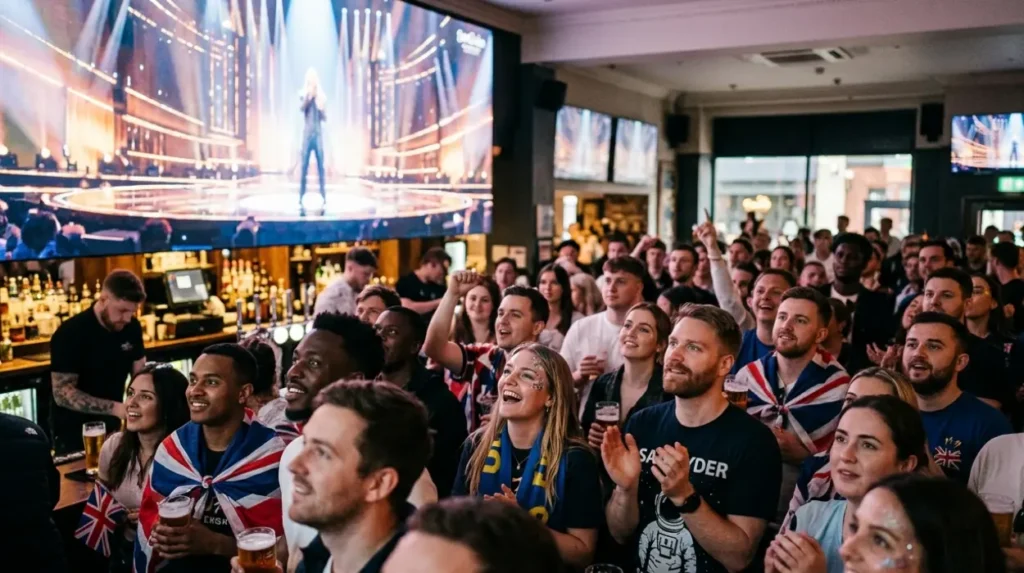
The 2023 grand final, hosted in Liverpool, achieved a peak domestic audience of 11 million viewers and an average audience of 9.9 million, equating to a 63% audience share for BBC One. This broadcast set a record as the most-watched grand final in the history of the contest within the United Kingdom, driven by massive communal screening events held in public plazas and independent bars across the UK, including dedicated fan zones in West Yorkshire.
Commercial Success and Music Industry Integration
The UK entry directly impacts the official UK Singles Chart and international digital streaming platforms. Success at the contest frequently translates into commercial longevity for the participating artists. Sam Ryder’s “Space Man” reached number two on the UK Singles Chart following the 2022 contest, making it the highest-charting UK Eurovision entry since 1996.
In 2023, Mae Muller’s entry “I Wrote a Song” became the first UK Eurovision track in over a decade to debut in the top ten of the official UK Singles Chart during the pre-contest promotional window, driven by digital downloads, streaming metrics, and heavy rotation across northern student radio networks.
Host City Economics and Regeneration
When the United Kingdom hosts the contest, the economic benefits extend to regional tourism, hospitality, and infrastructural investment. The 2023 contest serves as a primary example of this economic impact. A report commissioned by the Liverpool City Council indicated that hosting the event generated a direct economic boost of £54.8 million for the city region.
The influx of international visitors filled hotel accommodations to 96% capacity in May 2023, benefiting hotels, transport networks, and retail sectors across the North, drawing significant foot traffic through neighboring transportation hubs like the Leeds area as fans commuted to the live shows. The cultural program surrounding the event attracted over 473,000 visitors, establishing long-term tourism interest and reinforcing the wider region’s status as a major cultural corridor.
How has the voting system affected the UK’s performance?
The shifting voting system, which transitioned from purely national juries to public televoting and then to a combined 50/50 scoring split, directly correlates with the historical fluctuations in the United Kingdom’s competitive rankings.
The Evolution of the Scoring System
The Eurovision voting system has undergone multiple structural revisions since its inception in 1956. From 1975 to 1996, the contest used a standardized jury system where a panel of music professionals in each country awarded points from 1 to 8, 10, and 12 to their favorite songs. The United Kingdom excelled under this format, as the professional juries prioritized traditional song structures, vocal accuracy, and radio-friendly arrangements common in the Western music industry.
In 1997, the European Broadcasting Union introduced mass televoting, allowing television viewers to cast their votes via telephone lines. By 1998, the majority of participating nations transitioned to televoting as their primary scoring mechanism. This shift marked the beginning of a prolonged competitive decline for the United Kingdom, as public voting patterns favored high-energy staging, visual spectacle, and regional cultural styles over traditional British pop ballads.
The Introduction of the 50/50 Combined System
To balance public enthusiasm with professional musical assessment, the European Broadcasting Union introduced the modern 50/50 voting system in 2009 for the grand final. Under this mechanism, each country’s total score is calculated by combining the points awarded by a five-member professional jury with the points generated by the public televote.
In 2016, the system was refined further so that the jury points and televoting points were announced separately, doubling the total number of points available and creating distinct scoreboards for professional and public preferences.
The Divergence Between Jury and Public Appeal
The modern dual-voting system frequently highlights a significant divergence between how professional juries and the general public evaluate UK entries. Professional juries assess vocal capacity, composition quality, performance execution, and contemporary chart potential. Public televoters often vote based on entertainment value, memorable staging, and cultural familiarity.
The performance of the United Kingdom in recent contests demonstrates this divide:
- In 2011, the boy band Blue finished 5th in the public televote with “I Can,” but placed 22nd with the professional juries, resulting in an 11th-place finish overall.
- In 2022, Sam Ryder won the international jury vote with 283 points, but placed 5th in the public televote with 183 points, securing 2nd place overall, a result heavily praised by music writers across northern publications.
- In 2024, Olly Alexander received 46 points from the professional national juries, but received zero points from the global public televote, demonstrating a complete separation between industry appraisal and viewer preference.
Why does the UK automatically qualify for Eurovision?
The United Kingdom automatically qualifies because it is part of the “Big Five,” the five countries contributing the most funding to the European Broadcasting Union. This status guarantees a place in the grand final every year.