
Key Points
- Rashid Boachie, aged 44, sentenced to 15 and a half years for sexually assaulting a woman in Leeds.
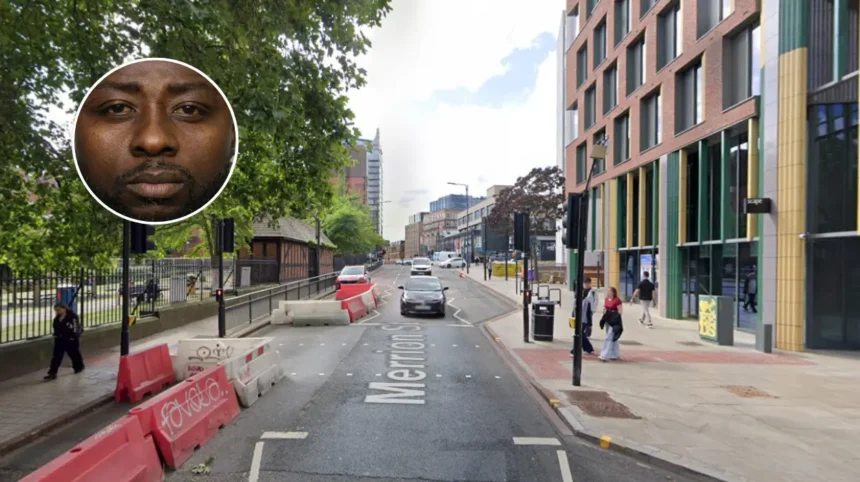
- Offence took place behind a Travelodge near Merrion Street after he approached the victim alone at night.
- CCTV footage and forensic evidence linked Boachie to the crime.
- Intervention by a hotel worker prevented the crime from escalating further.
- Leeds Crown Court imposed an extended sentence for public protection.
- The judge said Boachie posed “a serious risk to women” and must serve at least 11 years before parole review.
- Evidence revealed previous convictions and predatory behaviour targeting vulnerable women.
- Victim impact statement outlined the lasting trauma caused by the attack.
- Police praised the bravery of the victim and the actions of the hotel staff member who reported the crime.
Leeds (The Leeds Times) April 7, 2026 — Rashid Boachie, 44, has been sentenced to 15 and a half years’ imprisonment for the sexual assault of a woman he targeted in the city centre during a night out last August. Leeds Crown Court heard detailed evidence of how Boachie had lingered around nightlife areas seeking vulnerable women alone.
- Key Points
- How did the incident unfold on the night of the attack?
- What did the court reveal about Boachie’s history and behaviour?
- What evidence led to his conviction?
- How did the victim respond and what support was offered?
- What did authorities and local community representatives say?
- How long will Rashid Boachie remain in custody?
- What safety measures has Leeds introduced since this attack?
- Why was the judge’s decision considered crucial for public safety?
- Background of the Case
How did the incident unfold on the night of the attack?
As reported by Mark Lavery of the Yorkshire Evening Post, prosecutors said CCTV footage showed Boachie approaching a woman near Merrion Street, Leeds, shortly before midnight on August 19, 2025. He struck up conversation and persuaded her to accompany him toward a nearby Travelodge, where he led her down a secluded alleyway behind the building.
According to court evidence presented by the Crown Prosecution Service (CPS), Boachie then sexually assaulted the woman in the alley.
The attack ended abruptly when a member of the hotel staff, hearing the victim’s screams, rushed to the scene. Boachie fled immediately but was later identified through detailed CCTV footage and forensic trace evidence recovered at the location.
Detective Inspector Dan Bates of West Yorkshire Police, who led the investigation, told reporters outside court:
“The footage was critical in identifying Boachie. He deliberately targeted women he thought were isolated, and his actions were predatory from the outset.”
What did the court reveal about Boachie’s history and behaviour?
As covered by BBC News Leeds, the Crown Court heard that Boachie had previously been convicted for similar sexual offences, and that his record demonstrated clear patterns of predatory behaviour. Prosecutor Jessica Slater described him as someone who
“intentionally sought out women whom he perceived as vulnerable,”
adding that
“the risk to the public remains high given his continued denial and lack of remorse.”
During sentencing, Judge Simon Phillips KC noted that Boachie’s conduct caused “severe and enduring harm” to the victim. The judge said Boachie posed “a significant and continuing danger” to women, making an extended sentence necessary. Under the ruling, Boachie will serve a custodial period of 11 years, followed by a four-and-a-half-year extended licence period for monitoring after release.
In his remarks, Judge Phillips said:
“This was a sustained attack on a lone woman who was entitled to feel safe on a night out. You exploited vulnerability and showed calculated intent.”
What evidence led to his conviction?
As detailed by Sky News, investigators identified Boachie through high-definition CCTV tracking from multiple cameras in central Leeds. Footage traced his movements between venues earlier that evening, showing him watching groups of women and engaging briefly with several individuals before approaching the victim.
Forensic analysis of clothing and materials recovered from the alley confirmed DNA links between Boachie and the victim, supporting the CCTV timeline.
When arrested two days later, Boachie denied any involvement. However, his mobile phone data placed him at the scene at the time of the assault, and distinctive footwear marks found at the location matched shoes seized from his residence.
Detective Inspector Bates added:
“The evidence gathered gave us a clear picture of predatory movement. He was actively seeking someone alone. This conviction shows the power of coordinated city CCTV networks and prompt reporting.”
How did the victim respond and what support was offered?
In court, a victim impact statement read by the prosecutor conveyed that the woman continues to experience trauma and severe anxiety. She said she avoids going out alone and struggles to feel safe, even in familiar surroundings.
As reported by ITV News Calendar, the victim said:
“This attack completely changed my life. I have nightmares and panic attacks. I used to enjoy being with friends in Leeds city centre, but now I can’t think of that area without fear.”
West Yorkshire Police confirmed that specially-trained officers supported the woman throughout the investigation and that she continues to receive trauma counselling. The hotel staff member, who intervened and raised the alarm, has also been commended for quick thinking, preventing further harm.
What did authorities and local community representatives say?
In a statement published by West Yorkshire Police’s official media unit, Detective Chief Superintendent Sue Jenkinson praised both the victim’s courage and the hotel worker’s fast response. She said:
“Rashid Boachie showed manipulative and calculated behaviour. His imprisonment is necessary to protect the public, and we commend everyone who helped bring him to justice.”
Leeds City Council’s community safety lead, Councillor Abigail Marshall Katung, commented to the Yorkshire Post, calling the case
“a reminder of the need for continual vigilance and public safety efforts.”
She reaffirmed that city authorities are working with police to enhance CCTV coverage and lighting in nightlife zones to deter such offences.
How long will Rashid Boachie remain in custody?
As explained by Court Correspondent Chris Burn of the Yorkshire Post, under the extended sentence imposed by Leeds Crown Court, Boachie must serve at least two-thirds of his 11-year custodial term before parole consideration. Following release, he will remain under supervision for four and a half years.
Judicial records show that the Sentencing Council guidelines for rape and serious sexual assault were applied due to aggravating factors, including the use of isolation, previous convictions, and the calculated nature of the attack. The total sentence ensures continued monitoring under the Multi-Agency Public Protection Arrangements (MAPPA) system.
What safety measures has Leeds introduced since this attack?
As highlighted by The Guardian in its coverage of similar local cases, Leeds City Council has expanded the Safer Nights Initiative, introducing dedicated safety patrols and public awareness campaigns.
Police patrol frequencies in high-footfall areas such as Call Lane, Merrion Street, and the Headrow have increased, particularly during weekends.
The council also confirmed collaboration with local venues to improve staff training on identifying vulnerable individuals and responding to harassment or intimidation. The new system encourages licensing venues to liaise directly with city CCTV teams in real time.
DI Bates confirmed:
“We are actively working alongside local businesses and street marshals to make sure lone individuals are protected and that intervention comes swiftly where needed.”
Why was the judge’s decision considered crucial for public safety?
Legal analyst Helen Pidd of The Guardian explained that the judge’s extended sentence reflects growing judicial emphasis on protecting the public from high-risk offenders. Under UK law, extended sentences are reserved for cases where an offender poses ongoing danger even after standard release intervals.
Police data referenced during trial showed Boachie had prior arrests connected to harassment and public indecency, though not previously convicted for direct sexual assault. This pattern, combined with his refusal to engage in rehabilitation programmes, influenced the extended sentence ruling.
Judge Phillips added:
“The sentence imposed today is not only about retribution—it is about community protection.”
Background of the Case
The investigation began when Leeds city centre security staff reported an emergency call about a distressed woman behind the Travelodge on Merrion Way. Police arrived within minutes, and the victim was taken to hospital for medical examination. Officers secured the crime scene and collected multiple items as evidence.
During the following days, detectives reviewed hours of CCTV footage, ultimately tracing Boachie’s movements through Albion Street, Millennium Square, and finally to the Travelodge area. He was arrested from his Armley address after analysis confirmed he matched the suspect profile. Local residents identified him as someone often seen late at night around bars and bus stops.
Boachie’s trial began on March 12, 2026, lasting four days. The jury returned a unanimous guilty verdict within four hours. He will be held at HMP Wakefield, a high-security facility also known as “Monster Mansion,” which houses several dangerous offenders across West Yorkshire.