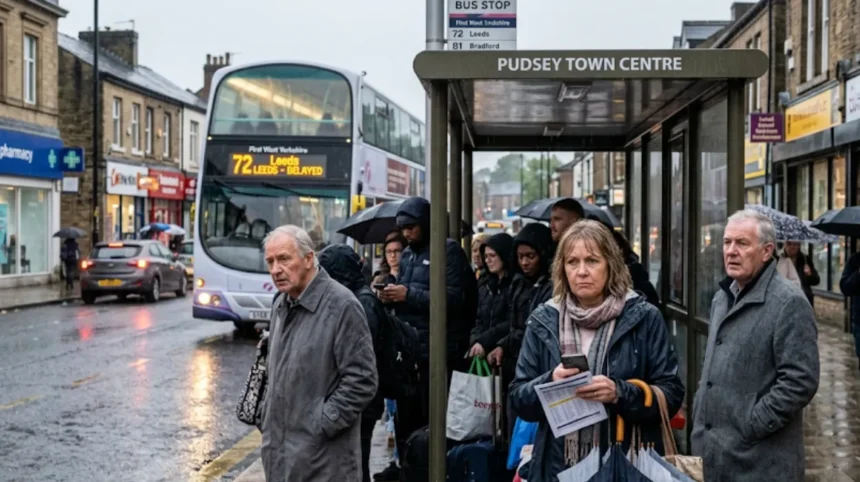
Complain directly to the bus operator first (usually First Bus for Pudsey routes), providing journey details and your desired outcome. Allow 14 working days for a response. If unsatisfied, escalate to Bus Users UK, the independent complaints handler for bus services in England outside London. For persistent service failures, report to the Driver and Vehicle Standards Agency (DVSA) to trigger regulatory investigation.
- What is the official complaints process for bus delays in Pudsey?
- Which bus operators serve Pudsey and how do I contact them?
- What information must I include in my bus delay complaint?
- How long should I wait for a response from the bus operator?
- When should I escalate my complaint to Bus Users UK?
- What role does DVSA play in bus delay complaints?
- What compensation or refunds can I expect for bus delays?
- How can I track my complaint status and follow up effectively?
- What are the most common bus delay issues reported in Pudsey?
- What are my rights if the bus never arrives or leaves early?
- How do I report systemic bus service failures in West Yorkshire?
Bus delays affect thousands of passengers across West Yorkshire annually, with Pudsey residents relying heavily on services connecting to Leeds city centre, Bradford, and surrounding towns. The complaint process follows a clear regulatory framework established under the Public Service Vehicles (Conduct of Drivers, Inspectors, Conductors and Passengers) Regulations 1990 and subsequent amendments.
What is the official complaints process for bus delays in Pudsey?
The official process requires passengers to first contact the bus operator directly with full journey details, wait 14 working days for resolution, then escalate to Bus Users UK if unresolved, and finally report systemic issues to DVSA for regulatory action.
Bus services in Pudsey operate under England’s national bus complaint framework, which applies to all services outside London. The process follows a three-tier escalation model designed to resolve individual complaints while identifying broader service reliability issues.
The first tier involves direct contact with the operator. Pudsey’s primary bus services are operated by First Bus (routes 4, 4F, 14, 16, 16A, 30, 81, 91, and others), with additional operators including Square Peg, TLC, and Yorkshire Buses serving Pudsey Bus Station. Passengers must provide specific information: date and time of the delay, service number, boarding and destination stops, and the operator name.
Operators must respond within 14 working days under the Bus Passenger Charter framework adopted across West Yorkshire. If the response proves unsatisfactory or no response arrives within the timeframe, passengers escalate to Bus Users UK, the Alternative Dispute Resolution (ADR) body approved by the Chartered Trading Standards Institute.
Bus Users UK handles complaints covering driver behaviour, vehicle condition, reliability, punctuality, and accessibility issues. The service remains free to passengers, with operators paying either £6.50 per vehicle annually or £100 per accepted complaint. The average complaint resolution takes 90 days, though this varies by case complexity.
The final tier involves reporting to DVSA (Driver and Vehicle Standards Agency), which aggregates passenger reports to identify operators with systemic reliability problems. DVSA passes evidence to the Traffic Commissioners for Great Britain, who hold regulatory powers including licence revocation.
Which bus operators serve Pudsey and how do I contact them?
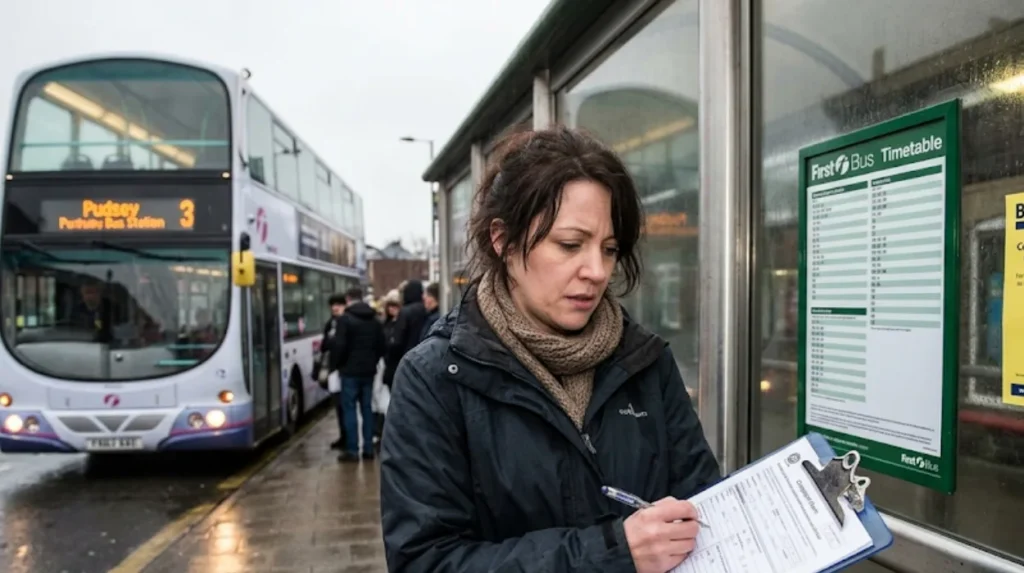
First Bus operates most Pudsey routes including services 4, 14, 16, 16A, 30, 81, and 91, reachable via 0345 646 0707 or their website complaint portal, while MetroLine provides general travel enquiries on 0113 245 7676.
Pudsey Bus Station serves as the primary hub for local bus services, handling over 2,023 departures weekly as of 2023 data. Multiple operators serve the town, each with distinct contact procedures and complaint channels.
First Bus dominates Pudsey’s bus network, operating the majority of routes connecting to Leeds city centre, Bradford, Seacroft, Halton Moor, Horsforth, and Dewsbury. The operator maintains a West Yorkshire-specific contact centre at Princes Exchange, Leeds (LS1 4HY), with telephone support on 0345 646 0707. First Bus provides online complaint forms through their website, mobile app tracking for real-time service updates, and accepts contactless payment with mobile ticketing options.
Square Peg, TLC, and Yorkshire Buses operate additional services from Pudsey Bus Station, though with fewer routes than First Bus. Passengers should check tickets or bus stop information for specific operator identification, as complaint procedures vary by company.
West Yorkshire Metro’s MetroLine service (0113 245 7676) provides general travel enquiries and can direct passengers to appropriate operators. MetroLine operates 7am-8pm Monday to Saturday, and 8am-8pm on Sundays and Bank Holidays (excluding Christmas Day, Boxing Day, and New Year’s Day).
For written complaints, passengers can contact operators via email or post. First Bus maintains online complaint portals, while other operators publish contact details on their websites or at Pudsey Bus Station information points.
What information must I include in my bus delay complaint?
Complaints must include the date and time of the incident, bus service number, boarding and destination stops, operator name, detailed description of the delay, and your desired resolution (refund, apology, or compensation).
Specific information requirements ensure complaints receive proper investigation and resolution. The DVSA mandates five core data points for all bus delay reports occurring in England outside London.
Date and time information must specify when the delay occurred, including whether the bus arrived late, departed early, failed to stop, or did not appear at all. Precise timing helps operators cross-reference with driver schedules, vehicle tracking data, and traffic conditions.
Service number identification proves critical, as Pudsey hosts multiple routes (4, 4F, 14, 16, 16A, 30, 81, 91, 205, X11) operated by different companies. Passengers should note the route number displayed on the bus front and side, plus any destination signage.
Location details require both the intended boarding stop and destination stop. Pudsey Bus Station features multiple stands (A through F) with specific stop numbers (45026239 through 45026244), which passengers should reference where possible.
Operator identification strengthens complaints, though passengers can proceed without this if uncertain. First Bus, Square Peg, TLC, and Yorkshire Buses all serve Pudsey routes.
Complaint narratives should describe what happened factually: the scheduled arrival time, actual arrival time (if the bus appeared), number of missed connections, and impact on the passenger’s journey.
Desired outcomes vary by circumstance. Passengers may request refunds for single tickets, compensation for season ticket holders, apologies for service failures, or explanations for recurring delays on specific routes.
Contact details remain optional for DVSA reports but prove essential for operator complaints and Bus Users UK escalations, enabling follow-up communication and resolution confirmation.
How long should I wait for a response from the bus operator?
Bus operators must respond within 14 working days under the West Yorkshire Bus Passenger Charter, though Bus Users UK complaints average 90 days for full resolution through their Alternative Dispute Resolution process.
The 14-working-day response window applies across England for bus services outside London, established through industry self-regulation and reinforced by the Bus Passenger Charter framework adopted by West Yorkshire operators.
Working days exclude weekends and Bank Holidays, meaning a complaint submitted on Monday, 6 July 2026, would require a response by Friday, 24 July 2026, assuming no public holidays intervene.
Operators failing to respond within 14 working days trigger automatic eligibility for Bus Users UK escalation. Passengers should retain proof of their initial complaint (email confirmations, posted letter receipts, or screenshots of online submissions) to demonstrate the operator’s non-response.
Bus Users UK’s Alternative Dispute Resolution process averages 90 days from complaint acceptance to final decision. This extended timeframe reflects the mediation nature of ADR, which involves gathering evidence from both passengers and operators, reviewing service records, and attempting negotiated settlements.
The 90-day average includes cases where operators pay the £100 per-complaint fee rather than the annual £6.50 per-vehicle subscription, indicating more complex disputes requiring intensive investigation.
Passengers should note that Bus Users UK cannot adjudicate complaints about commercial decisions such as ticket pricing or route changes, focusing instead on operational failures including delays, driver conduct, and vehicle conditions.
If operators exceed the 14-day window without response, passengers should immediately contact Bus Users UK rather than waiting indefinitely. Bus Users maintains telephone support (0300 111 0001), email (complaints@bususers.org), and online complaint forms for escalations.
When should I escalate my complaint to Bus Users UK?
Escalate to Bus Users UK after receiving an unsatisfactory operator response, after 14 working days with no response, or when the operator refuses to engage with your complaint about delays occurring within the last 12 months.
Bus Users UK serves as the recognised complaints handler for bus and coach services across the UK, excluding London (handled by London TravelWatch) and Northern Ireland (Consumer Council for Northern Ireland).
The 12-month time limit applies to incident dates, meaning complaints about delays occurring before 24 July 2025 would fall outside Bus Users UK’s jurisdiction as of today’s date (24 July 2026).
Three escalation scenarios qualify for Bus Users UK intervention: unsatisfactory operator responses, operator non-response after 14 working days, or operator refusal to engage with the complaint process.
Unsatisfactory responses include blanket denials without evidence, offers of inadequate compensation (such as single-ticket refunds for season ticket holders experiencing repeated delays), or responses that fail to address the specific complaint raised.
Bus Users UK handles complaints covering: driver rudeness or unprofessional conduct, damage to passenger property, buses arriving too late or too early, buses failing to stop at designated stops, buses not appearing at all, vehicle condition issues, accessibility failures, and personal security concerns.
The service excludes non-passengers (such as pedestrians complaining about bus speeds), commercial decisions (ticket pricing, route cancellations), and complaints already subject to legal proceedings. Passengers under 16 require parental or guardian consent for Bus Users UK to process their complaints.
Contact methods include telephone (0300 111 0001, free from UK landlines and mobiles), email (complaints@bususers.org), or online complaint forms at www.bususers.org/complaints. Bus Users UK maintains offices at Victoria Charity Centre, 11 Belgrave Road, London SW1V 1RB, though all complaint handling occurs remotely.
What role does DVSA play in bus delay complaints?
DVSA (Driver and Vehicle Standards Agency) aggregates passenger reports to identify systemic reliability problems with bus operators, passing evidence to Traffic Commissioners who can impose regulatory sanctions including licence restrictions or revocations.
The Driver and Vehicle Standards Agency operates as an executive agency of the Department for Transport, responsible for monitoring vehicle safety and operator compliance across Great Britain.
DVSA’s role in bus delay complaints differs fundamentally from operator complaints and Bus Users UK escalations. The agency does not pursue individual refunds, compensation, or apologies for passengers. Instead, DVSA uses aggregated passenger reports to identify patterns of service failure across operators and routes.
When multiple passengers report delays on the same route or by the same operator, DVSA analysts cross-reference these reports with operator performance data, vehicle maintenance records, and driver scheduling information. This intelligence-led approach enables targeted investigations into operators failing to meet registered timetables.
Bus operators must register local services with the Traffic Commissioner, including detailed route descriptions and timetables. Operators face legal obligations to run services according to registered timetables, with deviations requiring 42 days’ notice to the Traffic Commissioner and 21 days’ public notification.
DVSA passes evidence of systematic failures to the Traffic Commissioners for Great Britain, who hold statutory powers to: issue formal warnings, impose conditions on operator licences, reduce the number of authorised vehicles, or revoke operating licences entirely.
Passengers report to DVSA via online forms requiring the same core information as operator complaints: date and time, service number, boarding and destination stops, and operator name. Passengers may choose whether to provide personal contact details, as DVSA does not respond to individual reports.
DVSA’s Intelligence Unit operates from The Ellipse, Padley Road, Swansea (SA1 8AN), with telephone support on 0800 030 4103 (Monday to Friday, 7:30am to 6pm).
What compensation or refunds can I expect for bus delays?
No statutory compensation scheme exists for bus delays in England outside London, though individual operators may offer single-ticket refunds, partial season ticket reimbursements, or travel vouchers at their discretion based on complaint circumstances.
Unlike rail services, which operate under Delay Repay schemes mandating compensation for delays exceeding specific thresholds, bus services in England (outside London) lack legislated compensation requirements.
Operator discretion governs all compensation decisions. First Bus and other Pudsey operators may offer single-ticket refunds for passengers experiencing significant delays causing missed connections or appointment failures. Season ticket holders experiencing repeated delays may receive proportional refunds or travel vouchers, though no formula dictates these amounts.
Bus Users UK’s Alternative Dispute Resolution process can recommend compensation as part of mediated settlements, though these recommendations remain non-binding on operators. Operators accepting Bus Users UK membership agree to consider ADR outcomes in good faith, improving compliance rates compared to direct passenger negotiations.
The West Yorkshire Bus Passenger Charter 2024-25 outlines passenger expectations for service reliability, punctuality, and complaint handling, though it does not create enforceable compensation rights. The Charter serves as an industry commitment to service standards rather than a legally binding document.
Passengers should specify desired outcomes when submitting complaints: full refunds for single tickets, proportional refunds for season tickets affected by repeated delays, travel vouchers for future journeys, or formal apologies acknowledging service failures.
Ticket retention proves critical for compensation claims. Bus Users UK explicitly advises passengers to keep tickets as evidence supporting complaint narratives and refund calculations.
Contactless payment records and mobile ticket confirmations provide equivalent evidence to paper tickets, with operators able to access transaction histories linking passengers to specific journeys.
How can I track my complaint status and follow up effectively?
Maintain written records of all complaint submissions with dates, reference numbers, and correspondence copies, follow up after 14 working days if operators fail to respond, and request escalation to Bus Users UK immediately upon receiving unsatisfactory responses.
Effective complaint tracking requires systematic documentation from initial submission through final resolution. Passengers should create dedicated folders (physical or digital) for each complaint, storing all related correspondence and evidence.
Initial complaint submissions should generate confirmation emails, reference numbers, or posted letter receipts. Passengers not receiving confirmations should follow up within 48 hours to verify complaint receipt, as lost submissions delay resolution timelines.
Calendar reminders prove essential for tracking the 14-working-day operator response window. Passengers should note the submission date and calculate the deadline, accounting for weekends and Bank Holidays. A complaint submitted on Friday requires 14 working days from the following Monday, not from the submission date.
Follow-up communications should reference original complaint details, submission dates, and any reference numbers provided. Polite but firm language improves response rates compared to aggressive or emotional correspondence.
Escalation to Bus Users UK requires copies of: the original complaint to the operator, any operator response (or evidence of non-response), journey tickets or payment confirmations, and a clear summary of the desired resolution.
Bus Users UK maintains complainants informed at each process stage, though the 90-day average resolution time means updates may arrive weeks apart. Passengers should contact Bus Users UK if communication gaps exceed four weeks without explanation.
Final resolution documentation should include: the outcome achieved, any compensation paid, and confirmation that the complaint closes. Passengers dissatisfied with Bus Users UK outcomes can pursue further action through small claims courts, though this route incurs costs and requires legal preparation.
What are the most common bus delay issues reported in Pudsey?
Passengers frequently report delays on routes connecting Pudsey to Leeds city centre (particularly services 16, 16A, and 81), overcrowding during peak hours, and buses failing to stop at designated stops when running behind schedule.
Pudsey’s bus network faces structural challenges affecting service reliability across multiple routes. The town’s geographical position between Leeds and Bradford creates dependence on corridors prone to congestion, particularly the A660 through Headingley and the A65 through Kirkstall.
Recent service changes have exacerbated delay complaints. The X84 limited-stop service, which previously connected Leeds, Otley, and Ilkley with faster journey times, was discontinued in October 2024 and replaced by services 25 and 26 making frequent stops. Passengers reported journey times extending from 40 minutes to over 60 minutes, with buses “clustering” along the Headingley corridor causing capacity issues.
First Bus deployed additional buses during peak hours (4:00pm to 6:30pm, Monday to Friday) to address overcrowding, though passengers continued reporting unreliable frequencies and buses failing to appear.
The X84 route faced such severe reliability complaints that Otley Town Council commissioned a survey of 895 passengers, revealing widespread frustration with frequency, reliability, and timeliness. Councillors described the 10-mile A660 stretch as a “corridor of uncertainty,” with residents missing medical appointments, students skipping classes, and workers unable to commute reliably.
Pudsey-specific routes (16, 16A, 81) experience similar pressures, with buses bunching during peak hours and passengers reporting full buses bypassing stops. The Pudsey Bus Station handles over 2,023 weekly departures, creating complex scheduling interactions that amplify delays when single services run late.
Traffic congestion from roadworks, particularly around Leeds city centre and the M621 junction, contributes significantly to delays. First Bus acknowledges these external factors while maintaining responsibility for timetable adherence under their registered service obligations.
Explore More Help & Resources
How to find affordable housing near Otley right now
How to get free holiday activities for kids in Morley
What are my rights if the bus never arrives or leaves early?
Passengers have the right to complain about buses that fail to appear or depart early from scheduled stops, with operators obligated to investigate and provide explanations or compensation, and Bus Users UK empowered to mediate disputes over these service failures.
The Public Service Vehicles (Registration of Local Services) Regulations 1986 require operators to run services according to registered timetables filed with the Traffic Commissioner. Buses failing to appear or departing early constitute breaches of these registered obligations.
Buses not arriving at scheduled times fall under the same complaint framework as delayed buses. Passengers should report the incident to the operator with the scheduled time, actual outcome (bus never appeared), and impact on their journey.
Early departures present particular challenges, as passengers arriving at stops at the scheduled time find buses already gone. These incidents require passengers to report the scheduled departure time, their actual arrival time at the stop, and any witness accounts or CCTV evidence from the stop location.
Pudsey Bus Station features multiple stands with specific stop numbers (45026239 through 45026244), enabling precise location reporting for missed or early buses. Passengers should note the stand letter and stop number when filing complaints.
Bus Users UK explicitly covers complaints about buses “not turning up at all” within their remit, provided incidents occurred within the preceding 12 months. The organisation handles these complaints through the same ADR process as delay complaints, with 90-day average resolution times.
DVSA aggregates reports of buses failing to appear or departing early to identify operators with systemic scheduling or driver management issues. Multiple passenger reports on the same route trigger regulatory investigations that can result in Traffic Commissioner sanctions.
Passengers experiencing repeated no-shows or early departures on specific routes should document each incident with dates, times, and stop locations. Pattern evidence strengthens both individual compensation claims and DVSA reports highlighting operator-wide failures.
How do I report systemic bus service failures in West Yorkshire?
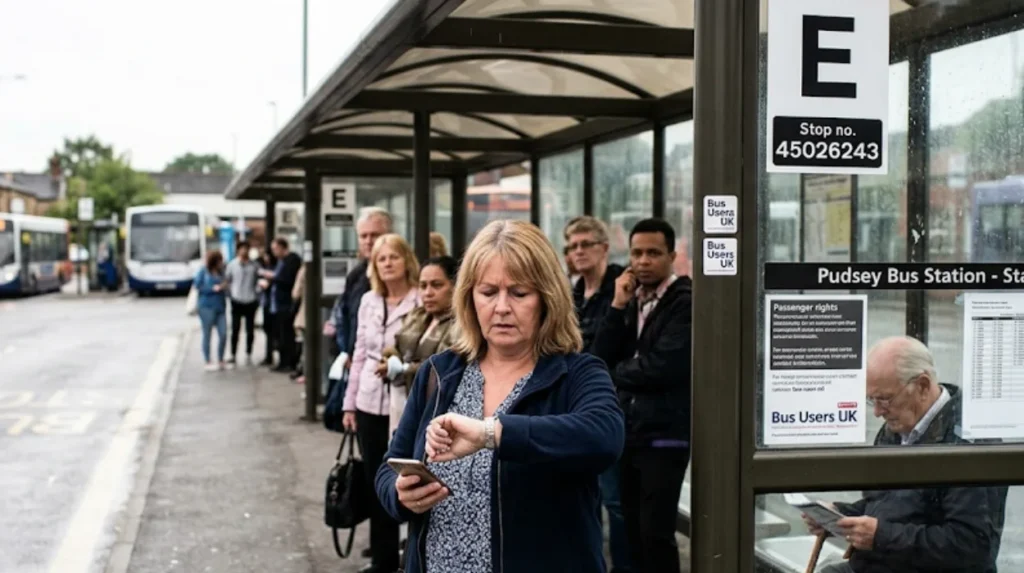
Report systemic failures to DVSA via their online form with multiple incident details, contact West Yorkshire Combined Authority at customerfeedback@westyorks-ca.gov.uk for route-level concerns, and notify local councillors to escalate through political channels.
Systemic bus service failures affect entire routes or operators rather than individual journeys, requiring different reporting approaches than single-incident complaints.
The DVSA online form accepts multiple incident reports from the same passenger, enabling documentation of repeated failures on specific routes. Passengers should list each incident with dates, times, and service numbers, creating a pattern evidence file that triggers regulatory investigation.
West Yorkshire Combined Authority (WYCA) holds strategic responsibility for bus service planning across the region, including Pudsey. While WYCA directs operator-specific complaints back to companies or Bus Users UK, they accept feedback on route-level concerns, service frequency issues, and infrastructure problems affecting multiple operators.
WYCA contact channels include: telephone (0113 251 7272, Monday to Friday, 9am to 5pm), email (customerfeedback@westyorks-ca.gov.uk), and post (Wellington House, 40-50 Wellington Street, Leeds, LS1 2DE).
West Yorkshire Metro’s MetroLine (0113 245 7676) provides an additional reporting channel for systemic issues, with staff able to escalate concerns to WYCA transport planners. MetroLine operates extended hours (7am-8pm Monday to Saturday, 8am-8pm Sundays and Bank Holidays) compared to WYCA’s business-hours-only telephone support.
Local councillors represent constituents experiencing systemic transport failures. Pudsey falls under Leeds City Council wards (Pudsey, Calverley and Farsley), with councillors able to raise issues at council committees, contact WYCA directly, and lobby operators for service improvements.
Passenger surveys and petitions strengthen systemic failure reports. The Otley Town Council survey of 895 passengers demonstrated the power of aggregated passenger voices in prompting operator responses and council interventions.
Community transport forums and social media groups (such as r/Leeds on Reddit) provide platforms for passengers to share experiences and coordinate reporting efforts, amplifying individual complaints into collective action.
Traffic Commissioners hold quarterly public inquiries where passengers can present evidence of systemic operator failures, though this route requires substantial documentation and potentially legal representation.