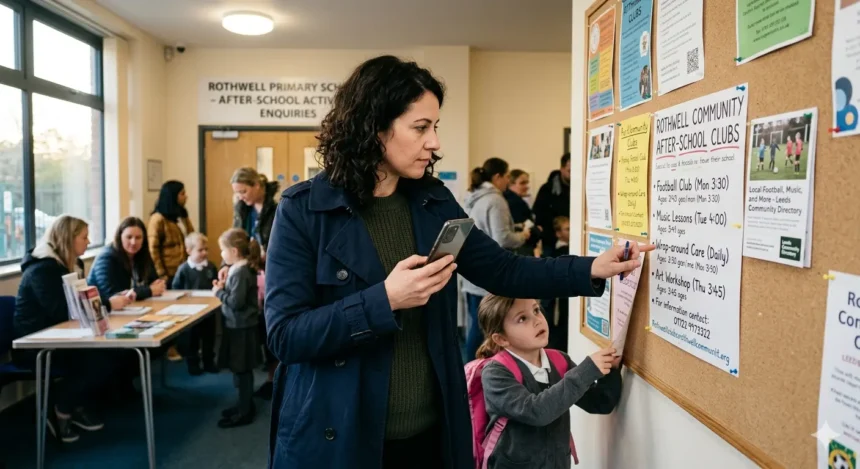
Finding after-school clubs for children in Rothwell starts with school websites, local club directories, and community providers in Leeds. The fastest route is to check a child’s own primary school, then compare timings, age groups, costs, and booking rules against local football, music, and wraparound childcare options.
- What counts as an after-school club in Rothwell?
- Where should parents look first?
- Which local providers run clubs?
- How do you search effectively?
- What information should parents check?
- How much do clubs cost?
- What role do schools play?
- What wider options exist?
- Why does after-school childcare matter?
- What is the best Rothwell search path?
What counts as an after-school club in Rothwell?
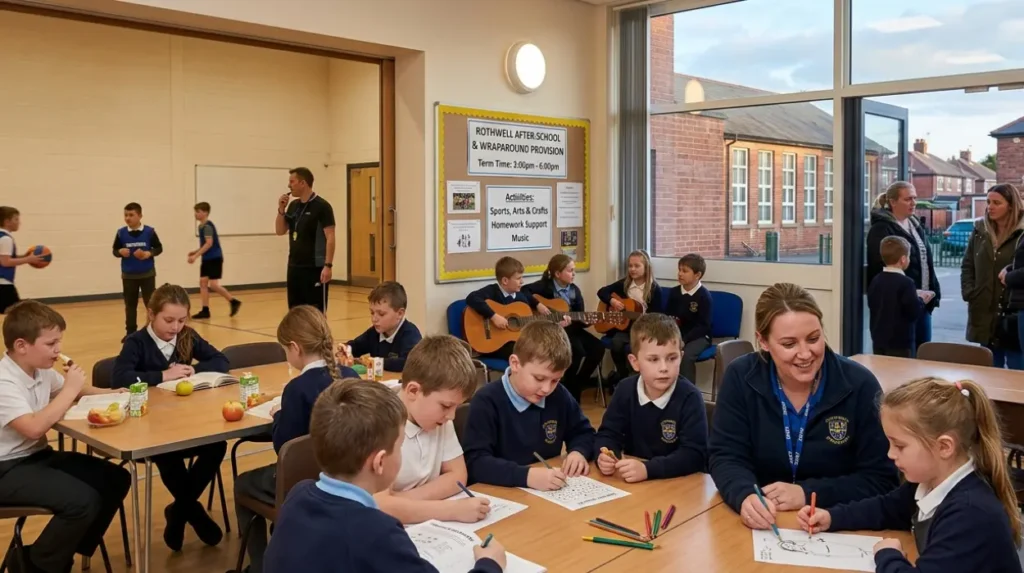
An after-school club is supervised childcare or activity provision that runs after the school day, usually from about 3 pm to 6 pm. In Rothwell, it includes school-based clubs, sports sessions, music groups, and wraparound care that supports working parents and gives children a structured place to stay after lessons.
After-school clubs sit inside a wider category of school-age childcare. The Department for Education defines school-age childcare as provision that supports families during term time and holidays, including before-school clubs, after-school clubs, breakfast clubs, and holiday childcare. The national wraparound programme aims to expand access so parents of primary school-aged children can find care locally from 8 am to 6 pm by 2026.
In Rothwell, the term covers more than one format. School clubs focus on activities such as football, dodgeball, guitar, choir, maths, or multi-sports, while wraparound settings combine childcare with games, homework time, crafts, reading, and snacks. That distinction matters because parents often search for clubs for different reasons: sport, enrichment, supervision, or childcare coverage.
Where should parents look first?
Parents should begin with their child’s school website, because many Rothwell schools publish current club lists, start times, age groups, and booking details there. Local school pages often show the most reliable information, because clubs change each term and school offices manage sign-up.
Rothwell Primary School lists a weekly after-school programme that includes KS1 Dodgeball, Y5/6 Invasion Games, Guitar Club, Y3/4 Football Club, Y4/5/6 Multi-sports, Y3/4 Music Club, and Y1/2 Music Club. The school says the clubs run from 3.15 pm to 4.15 pm, and families should contact the school office to book a place.
Rothwell St Mary’s also publishes an enrichment timetable. Its clubs include rotating sports, Book Club, Maths Club, Comic Club, Mini Vinnies, Revision, Choir, Girls’ Football, Chess, and football intervention with Leeds United Foundation. The school states that most clubs begin at 3 pm and end at 4 pm, with bookings handled through School Money.
Victoria Junior School in Rothwell also lists after-school clubs on its parent pages, showing that club availability changes by term and by provider. That is important for searchers because the best local option often depends on the child’s year group, the school’s current timetable, and whether the family needs activity-based care or longer wraparound hours.
Which local providers run clubs?
Rothwell families can find clubs through schools, sports clubs, and childcare providers. The strongest local examples include football provision, multi-sport enrichment, school-run clubs, and wider children’s activity directories that list nearby sessions and holiday camps.
Rothwell Juniors FC is a major local football provider. It is an England Football Accredited club based near Leeds and runs Mini Soccer sessions for children under 6, plus junior teams from under 7 through under 16. For younger children, it offers Saturday morning Mini Soccer for Nursery, Reception, and Year 1 children on a 3G pitch, which makes it relevant for families looking for sport-led after-school pathways.
Club Hub UK also lists Rothwell children’s clubs and activities, including baby classes, gymnastics classes, holiday camps, and toddler sessions. That makes it useful for parents who need a broader search beyond one school’s noticeboard, especially when the child attends a school outside Rothwell or wants a non-school club.
ClassForKids shows activity sessions in and around Rothwell, including baby classes at Rothwell Baptist Church and wider children’s camps and dance provision in the local area. That type of platform helps parents compare age bands, venue names, and session types in one place, which speeds up the search process.
How do you search effectively?
The best search method is to combine the child’s school, age, and activity type in one query. Use terms such as “Rothwell after-school football,” “Rothwell Year 3 club,” or “Rothwell wraparound childcare” to surface the most relevant local options quickly.
Searches work best when they narrow the intent. A parent looking for a sport should search by activity, such as football, multi-sports, or dodgeball. A parent looking for childcare should search by setting type, such as wraparound care, after-school club, or school-age childcare. A parent looking for enrichment should search by interest, such as music, chess, choir, or revision club.
School websites usually give the clearest local information because they publish current term dates, age groups, and contact details. Community directories work well as a second layer because they show what else is available nearby, including clubs that sit outside a child’s own school network.
Parents should also search by postcode and local landmark. Rothwell clubs often appear under Leeds, West Yorkshire, LS26, or nearby church and school venues, so a broader search is useful when a club does not use the Rothwell name in its title.
What information should parents check?
Parents should check the age range, collection time, cost, booking method, safeguarding, and what the club includes. These five details decide whether a club fits the school run, the family budget, and the child’s needs.
Age range matters because many clubs are targeted to a specific key stage, such as KS1, KS2, or year groups like Y3/4 or Y5/6. Rothwell Primary’s list separates activities by year group, while St Mary’s combines whole-school clubs with targeted sessions such as Y6 revision and KS2 choir. That separation shows why parents should always match the club to the child’s age rather than assuming every club accepts all pupils.
Timing matters because some clubs run for only one hour, such as 3.15 pm to 4.15 pm, while wraparound childcare can extend much later. Sacred Heart Catholic Primary School in Leeds, for example, lists a club that runs from 3.15 pm until 6.00 pm and includes a snack, showing the difference between short enrichment and longer childcare provision.
Safety and booking rules matter as well. Government guidance for parents says clubs should have clear safeguarding arrangements, emergency contact details, parental consent forms, staff codes of conduct, complaint procedures, and appropriate policies for online safety and children’s needs. That guidance also says parents should ask who will supervise their child, whether other adults are present, and how the setting supports allergies, medication, and special educational needs or disabilities.
How much do clubs cost?
Costs vary by provider, length of session, and whether the club is school-run, sports-led, or full wraparound care. Short school clubs often cost less than extended childcare, while clubs that include snacks, supervision until 6 pm, or external coaching usually charge more.
Public pages for Rothwell schools do not always list fees on the same page as the timetable. Rothwell Primary and Rothwell St Mary’s show the club structure and booking route, but not a standard published price list on the pages reviewed. That means families often need to check directly with the school office or booking platform for current costs.
Where prices are published, the pattern is clear. Sacred Heart Catholic Primary School’s wraparound club in Leeds charges £13.00 per session and includes outdoor play, board games, films, crafts, homework support, computer games, and a snack. That example shows how longer after-school provision costs more because it covers both care and activities for several hours.
Families should also ask whether the price covers one activity session or an entire childcare block. A one-hour club, such as music or dodgeball, serves a different purpose from a three-hour wraparound setting that includes collection, supervision, and food.
What role do schools play?
Schools act as the main access point for Rothwell after-school clubs because they control premises, communicate termly schedules, and often manage bookings. Some schools run clubs directly, while others bring in external specialists such as football foundations or sports coaches.
Rothwell St Mary’s shows the clearest example of mixed provision. It says clubs are mainly run by school staff, but some are delivered by external providers known to the school, such as Leeds United Foundation. That model gives schools flexibility and gives children access to specialist coaching without leaving the school site.
Rothwell Primary also demonstrates the traditional school-led model. Its after-school schedule is built around school-age groups and runs immediately after lessons. That is a common structure because it uses the school day, the school site, and the school office as the main administrative route.
This matters for search visibility and for parents. School-run provision usually appears on a school’s website or parent portal first, so families who search only on general directories can miss the most practical option.
What wider options exist?
Wider options include football clubs, local activity directories, holiday camps, and baby-to-school-age classes. These options suit families who want sport, skill building, or flexible care beyond the school gate.
Rothwell Juniors FC gives children a pathway into organised football with age-structured teams and Mini Soccer sessions. For many families, it functions as an after-school sport choice even when it is not delivered inside the school building. It also creates continuity because children can progress from introductory sessions into longer-term club membership.
Club directories expand the search field. Club Hub UK lists local activities such as baby classes, gymnastics, holiday camps, and toddler classes in Rothwell, which is useful for siblings of different ages or for families wanting a club outside school hours.
ClassForKids and similar platforms help identify exact venues and dates. They are especially useful when a family wants an activity run at a church hall, sports venue, or private studio rather than a school hall.
Why does after-school childcare matter?
After-school childcare matters because it supports working families, extends children’s supervised time, and creates access to enrichment and social development. Government guidance and national policy now place school-age childcare inside a wider plan to expand term-time and holiday provision.
The Department for Education’s 2026 guidance says schools and trusts should understand their role in supporting families to access school-age childcare during term time and holidays. It also refers to free breakfast clubs and the holiday activities and food programme, showing that after-school provision is part of a larger childcare system rather than a standalone extra.
The national wraparound programme is designed so that, by 2026, primary-school parents who need care can access term-time provision from 8 am to 6 pm in their local area. That target gives after-school clubs a broader importance because they are part of the daily childcare chain before and after school.
For Rothwell families, that means club choice affects more than leisure time. It affects school-run logistics, work hours, affordability, and how much structure a child has after lessons.

What is the best Rothwell search path?
The best search path is simple: check the school website, compare local directory listings, then contact the provider directly for places, timings, and costs. That order gives the quickest route to current information and avoids relying on outdated term sheets or old social media posts.
Start with the child’s school because Rothwell schools already publish real clubs, year groups, and session times. Then widen the search to local football clubs, activity directories, and wraparound providers if the school list does not match the child’s age, interests, or pick-up needs.
The final check should cover collection time, age range, booking platform, and safeguarding. Parents should ask whether the club accepts new joiners mid-term, whether it includes food, and whether it supports allergies, medication, or additional needs. That information decides whether the club works in practice, not just on paper.
A practical Rothwell example is this: a Year 4 child who likes sport and needs care until 4.30 pm fits a school multi-sports club or football club, while a child who needs supervision until 6 pm fits wraparound care. The correct match depends on the family’s timetable, the child’s interests, and the provider’s published hours.
What are after-school clubs in Rothwell?
After-school clubs are activities or childcare sessions that run after school, usually between 3pm and 6pm. They can include sports, music, homework help, or full childcare.