If your home in Pudsey is at risk of flooding, the first step is to check the live flood warning service, sign up for alerts, and follow official advice from the Environment Agency, your local council, and emergency services. The most important supports are the Floodline helpline, your insurer, your landlord if you rent, and Leeds City Council if you need emergency accommodation or help staying safe.
- What flood help is available in Pudsey?
- When to act
- How do you check flood risk in Pudsey?
- What each warning means
- What should you do before flooding starts?
- Items to prioritise
- Who should you contact first if your home is at risk?
- When to call emergency services
- What should you do during a flood in Pudsey?
- Safety rules inside the home
- What help can homeowners, tenants, and landlords get afterwards?
- Financial support after flooding
- How do you clean up safely after floodwater?
- Disposal and hygiene
- What local flood risk issues matter most in Pudsey?
- Why this matters long term
- What should Pudsey residents prepare now?
What flood help is available in Pudsey?
Flood help in Pudsey comes from national warning services, the local council, your insurer, and emergency responders. The main support includes flood alerts, evacuation advice, emergency accommodation, property safety guidance, and recovery help after the water has gone.
Pudsey sits in the Leeds area, where flood risk can come from rivers, groundwater, rainfall, and surface water. The official live flood service for Leeds shows current warnings, alerts, and a five-day forecast for the area, which helps households act before conditions worsen.
Flood support is designed to do three jobs. It warns people early, protects life during the incident, and helps families recover afterwards. In practice, that means checking alerts, preparing the home, contacting the right organisations, and documenting damage for insurance and housing support.
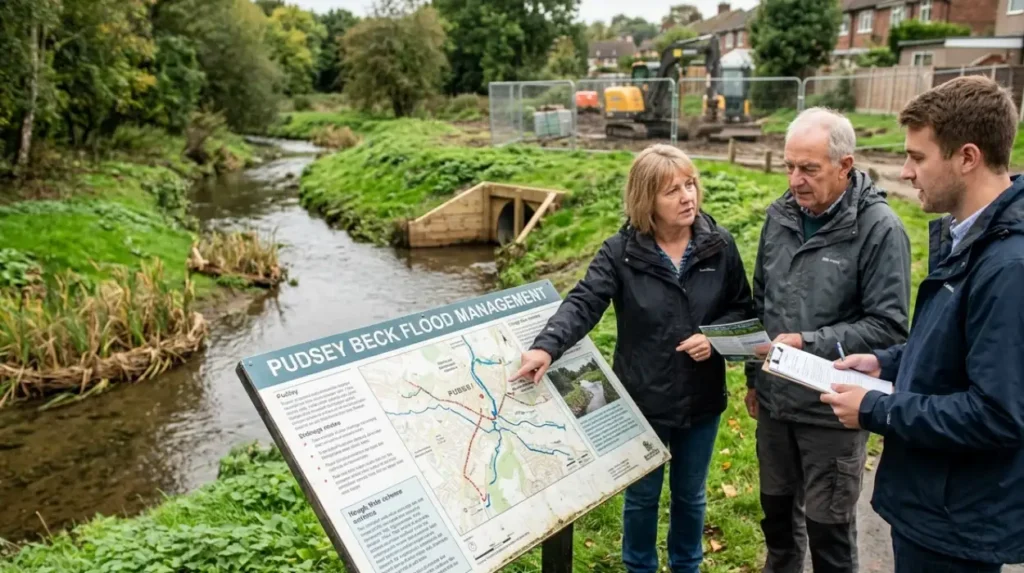
The local context matters because flood risk in Pudsey is connected to the wider Leeds drainage and water system. Yorkshire Water has also announced improvements at Pudsey Beck, including a wetland scheme intended to treat storm water and improve water quality, which shows that flood resilience is part of ongoing local infrastructure work.
When to act
Act as soon as a flood alert or warning appears. Flood water can rise quickly, and official guidance says homes can be affected in minutes.
Check the live flooding service for Leeds, then call Floodline for advice if the risk increases. Floodline is a 24-hour service on 0345 988 1188, and it provides practical guidance on what to do next.
How do you check flood risk in Pudsey?
Check flood risk in Pudsey by using the live GOV.UK flooding service, signing up for flood warnings, and watching local council updates for surface water flooding. This gives the fastest official picture of river, groundwater, and rainfall risk.
The GOV.UK flooding service shows current warnings and alerts for Leeds and also provides a five-day flood forecast. It covers river, sea, groundwater, and rainfall levels, which helps households understand short-term risk before travel, school runs, or overnight storms.
The official service does not cover every kind of flooding in the same way. GOV.UK says that if you want to know about surface water flooding, also called flash flooding, you should contact your local council. That matters in built-up areas where runoff, blocked drains, or intense rainfall create local flooding without a river overflowing.
Signing up for flood warnings gives another layer of protection. The warning system can send alerts by text, phone, or email, which helps people react even when they are away from home, asleep, or not watching local news.
What each warning means
A flood alert means flooding is possible. A flood warning means flooding is expected. A severe flood warning means there is a danger to life and evacuation is likely.
Those terms define the response. Alerts require readiness. Warnings require immediate preparation. Severe warnings require urgent action, including leaving the property if instructed.
What should you do before flooding starts?
Before flooding starts, make a simple flood plan, protect valuables, move vehicles, and prepare to shut off utilities if it is safe. These steps reduce damage, speed up evacuation, and improve your position for insurance claims and recovery.
A flood plan is the main household tool. It should list emergency contacts, insurance details, medication, pet arrangements, transport options, and where to move important items. GOV.UK advises people to use a personal flood plan if they have one.
Protective actions depend on the warning level. If flooding is expected, official advice says to use flood barriers or air brick covers if you have them, move family members, pets, vehicles, and important items to safety, and place valuables on higher levels.
Power and gas safety are part of preparation. GOV.UK advises turning off gas, electricity, and water supplies if it is safe to do so, but not touching electrical switches while standing in water. That instruction protects against electrocution and gas hazards.
Items to prioritise
Focus on documents, medication, chargers, passports, insurance papers, and sentimental items. Large furniture is lower priority than portable items, because raised small items are easier to save quickly.
If you own a car, move it to higher ground before water rises. Cars lose steering and can float in floodwater, so relocation is safer than waiting until access roads are affected.
Who should you contact first if your home is at risk?
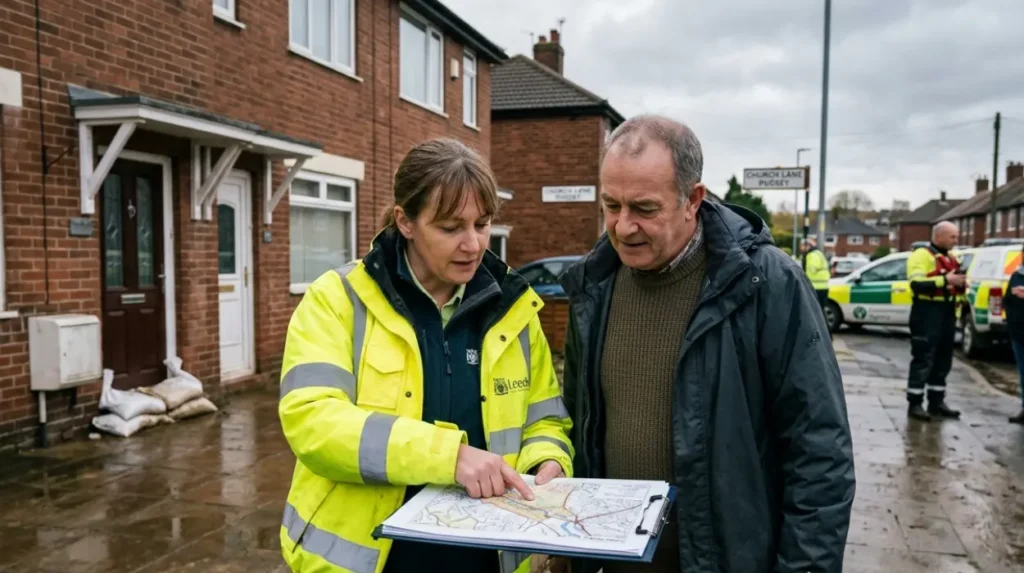
Contact Floodline, your insurer, and Leeds City Council in that order of urgency, while also informing your landlord or housing provider if you rent. These contacts cover safety advice, claims, emergency housing, and property responsibilities.
Floodline is the national advice line for flood situations. It operates 24 hours a day on 0345 988 1188 and gives advice on practical steps, risk levels, and what to do next.
Your insurer is the next essential contact if your home is insured. GOV.UK says to phone the emergency claims line for buildings or contents insurance and to get advice before starting any clean-up work. That protects the claim and reduces the risk of causing extra damage.
If you rent, tell your landlord as soon as possible. Shelter states that tenants should contact the landlord, get agreement in writing about moving out if needed, and clarify when they can return after repairs.
Leeds City Council becomes central if you are homeless because of flooding. Shelter states that councils must provide emergency accommodation if flooding leaves someone homeless, and that the person counts as being in priority need for homelessness help.
When to call emergency services
Call 999 if someone is in immediate danger. That applies when floodwater threatens life, access is blocked, or there is an urgent rescue need.
What should you do during a flood in Pudsey?
During a flood, stay away from floodwater, follow emergency instructions, switch off utilities only if it is safe, and leave the area if you are told to evacuate. The priority is life safety, not property protection.
Do not walk or drive through floodwater. GOV.UK warns that floodwater can hide sewage, wreckage, broken drain covers, uneven roads, and pavements, and that driving or wading through it creates severe risk.
If emergency services or the council instruct you to leave, leave immediately. Official guidance says people must follow advice from local authorities and emergency services, and severe flood warnings indicate a danger to life.
If you are told to stay put, move upstairs or to higher ground inside the home. Keep family members, pets, documents, medication, and phones together, and keep listening for updated instructions.
Safety rules inside the home
Avoid touching electrical appliances or switches if water is present. Keep away from contaminated water, because floodwater can carry sewage and other hazards.
If you can safely do so before flooding reaches the property, turn off gas, electricity, and water at the relevant isolators. If there is any doubt, do not attempt it and wait for emergency guidance.
What help can homeowners, tenants, and landlords get afterwards?
After flooding, homeowners use insurance and repair services, tenants rely on landlords and the council, and both groups can seek housing help if the property becomes uninhabitable. The main issue after the event is safe recovery and legal responsibility.
Homeowners are usually responsible for repairs to a flood-damaged property, but insurance often covers buildings repairs, contents replacement, and temporary accommodation. Shelter notes that leasehold flat owners should also check whether the freeholder’s insurance covers repairs.
Tenants have a different route. The landlord is responsible for making the property safe and carrying out repairs, and in some cases should organise alternative accommodation if the tenant cannot stay there. Shelter also advises tenants to get any rent reduction, rent suspension, or move-out agreement in writing.
If flooding leaves someone homeless, the council must help with emergency accommodation. That point is important because flooded homes can remain unsafe for long periods while repairs, drying, and inspections happen.
Financial support after flooding
Insurance is the main financial protection for owned homes. Shelter states that buildings insurance should cover flood risk, and contents insurance can cover damaged belongings.
Some households also qualify for benefits or housing support after moving out because of essential repairs. Shelter says people may be able to claim the universal credit housing element or housing benefit depending on the circumstances and the type of accommodation provided.
How do you clean up safely after floodwater?
Clean-up starts only after the property is declared safe, and it should focus on hygiene, documentation, and controlled drying. The main risks after flooding are contaminated water, hidden electrical faults, and damaged building materials.
Before cleaning, contact your insurer and get advice on what to discard, what to photograph, and what repairs to begin. GOV.UK specifically advises getting insurer guidance before starting clean-up work.
Avoid contaminated food, including tins that touched floodwater, and do not drink tap water until it has been declared safe. Flood advice also says to keep children away from floodwater and to wash hands carefully after any contact with contaminated surfaces.
For electricity, gas, and structural damage, use qualified professionals. Floodwater can damage wiring, sockets, boilers, and appliances in ways that are not visible immediately, so a cautious assessment is essential.
Disposal and hygiene
Throw away food, soft furnishings, and contaminated garden produce that contacted floodwater. Clean cuts and grazes, keep them covered, and contact a GP if anyone feels unwell after exposure.
What local flood risk issues matter most in Pudsey?
Pudsey’s flood risk is shaped by local waterways, storm runoff, and drainage capacity, with Pudsey Beck and the wider Leeds area central to planning and mitigation. That makes both household preparation and public infrastructure important.
Yorkshire Water has said its Pudsey Beck improvement work includes a nature-based wetland at Hough Side. The stated aim is to treat storm water and improve water quality, which reflects the way flood prevention increasingly combines engineering and land management.
Local reporting has also noted a funding shortfall on the Wortley Beck flood prevention scheme, which shows that flood mitigation in west Leeds depends on long-term investment rather than one-off fixes. Infrastructure schemes take time because they involve design, land, funding, and environmental approvals.
For residents, this means flood help is not only about emergency response. It also involves checking local planning, understanding whether the home sits near a beck or low-lying drainage route, and keeping up with council and water company projects that reduce future risk.
Why this matters long term
Flooding is not only a storm-time problem. Repeated water intrusion damages walls, flooring, electrics, and heating systems, and it also affects insurance, housing stability, and local property values.
What should Pudsey residents prepare now?
Pudsey residents should prepare a flood plan, sign up for alerts, know the emergency numbers, and keep documents and valuables easy to move. Preparation turns a flood warning into a clear sequence of actions instead of a crisis.
Keep Floodline’s number, your insurer’s claims line, your landlord’s contact details, and Leeds City Council’s housing contact details in your phone and written on paper. If the power fails, paper copies remain useful.
Store insurance papers, passports, medication lists, and utility information in a waterproof folder. Check where your gas, water, and electricity shut-offs are, and make sure everyone in the household knows how to reach them safely.
For households in known flood-prone streets, the best preparation is regular review. Check the live flood map, watch for rainfall alerts, and update your plan before winter storms or heavy rain periods. That routine creates the fastest response when the risk rises.
What should I do first if my home in Pudsey is flooding?
The first step is to check the official flood warning service, stay away from floodwater, and follow instructions from emergency services and local authorities.