

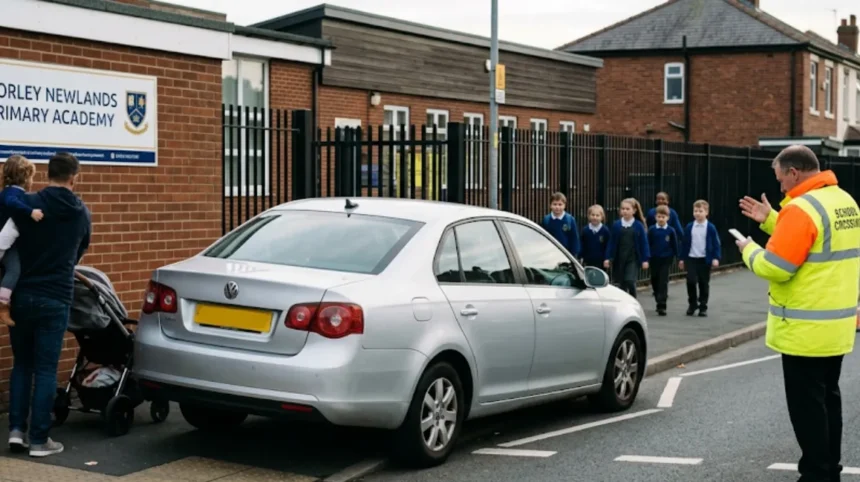
To report dangerous parking near Morley schools, contact Leeds City Council Parking Services on 0113 376 0442 or email parkingservices@leeds.gov.uk for civil parking offences such as double yellow lines, School Streets violations, and dropped kerb obstructions. For parking that blocks pedestrian access, creates a safety hazard, or obstructs emergency routes, report to West Yorkshire Police via 101 or their online nuisance parking form. In emergencies where a vehicle poses immediate danger to children or blocks emergency access, call 999.
- What counts as dangerous parking near Morley schools?
- Highway Code Rule 243 violations
- School Streets restrictions
- Dropped kerb obstructions
- Yellow line and zig-zag violations
- Who enforces parking violations around Morley schools?
- Leeds City Council Parking Services
- West Yorkshire Police Nuisance Parking Team
- Emergency services for immediate threats
- When should you call police instead of the council?
- Obstructive parking requiring police action
- Crimes in progress and dangerous behaviour
- Council-only parking contraventions
- How do you report dangerous parking to Leeds City Council?
- Phone reporting for urgent issues
- Email reporting with evidence
- Online reporting platforms
- What information do you need when reporting?
- Essential vehicle details
- Location precision requirements
- Temporal information and patterns
- How do School Streets schemes work in Morley?
- Operational hours and restrictions
- Permit eligibility and application
- Enforcement and penalties
- What are the legal consequences for dangerous parking?
- Civil Penalty Charge Notices
- Police fixed penalties and points
- Criminal prosecution for serious offences
- How quickly will authorities respond to reports?
- Council priority categories
- Police response protocols
- Factors affecting response speed
- What can schools do to prevent dangerous parking?
- School Streets implementation
- Infrastructure improvements
- Parent engagement and education
- Where can you find additional parking safety resources?
- Leeds City Council parking information
- West Yorkshire Police reporting portals
- National guidance and advocacy
What counts as dangerous parking near Morley schools?
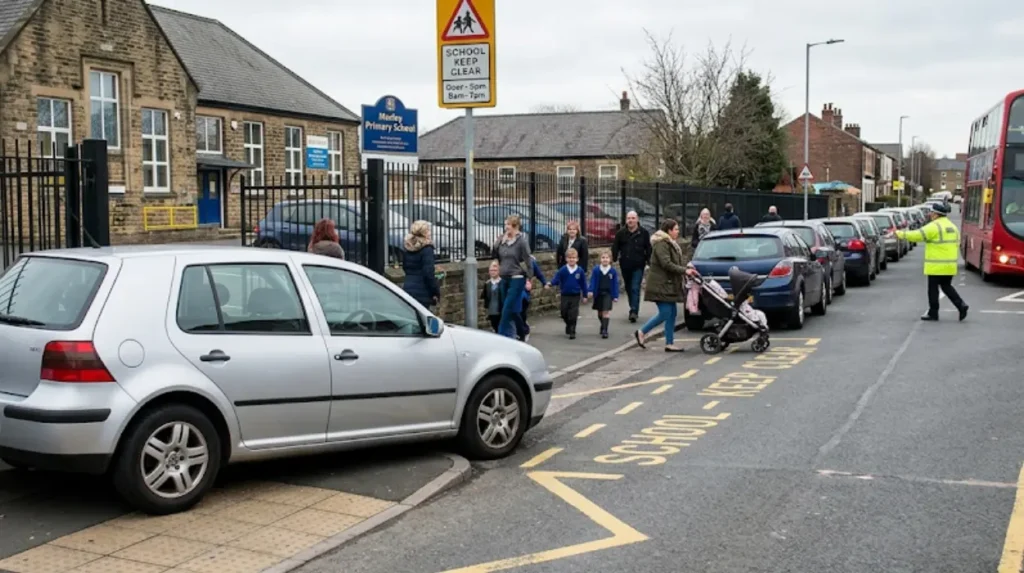
Dangerous parking near Morley schools includes vehicles blocking dropped kerbs, stopping on yellow zig-zag lines during restricted hours, parking across driveways, obstructing School Streets during operational times, and stopping within 10 metres of junctions or near school entrances as defined by Highway Code Rule 243.
Dangerous parking around schools in Morley creates significant risks for children, parents, and other road users. The term encompasses several specific violations that compromise safety in school zones across the LS27 postcode area.
Highway Code Rule 243 violations
Highway Code Rule 243 explicitly prohibits stopping or parking near school entrances, anywhere that would prevent access for emergency services, at or near bus or tram stops, on the approach to level crossings, opposite or within 10 metres (32 feet) of junctions, near the brow of hills or hump bridges, where kerbs have been lowered to help wheelchair users, and in front of property entrances.
School Streets restrictions
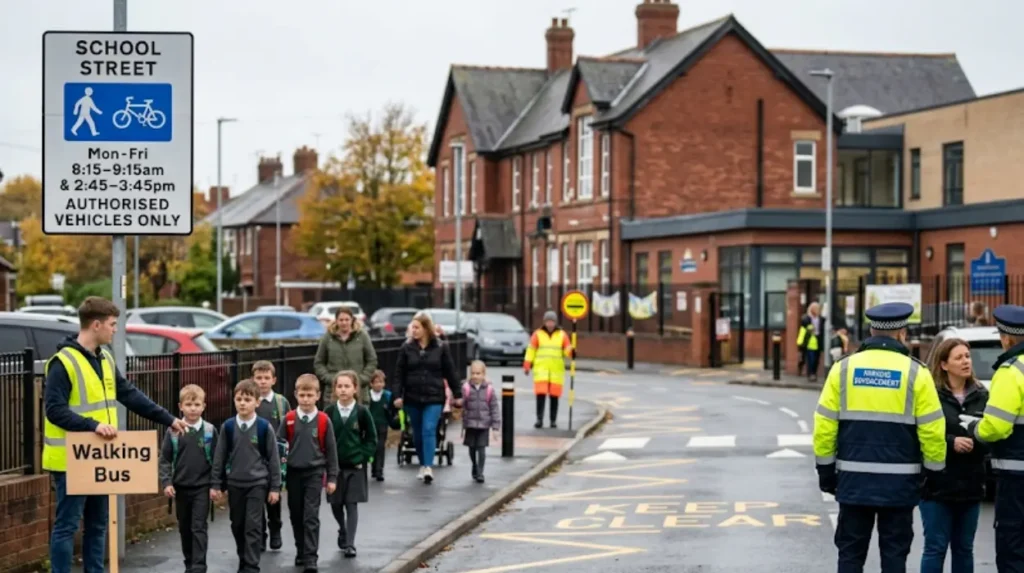
Leeds City Council operates School Streets schemes at multiple locations across the district, including schools in the Morley area. These schemes restrict vehicular access during specific drop-off and pick-up times, typically 8:00am to 9:15am and 2:30pm to 4:00pm on school days.
Dropped kerb obstructions
Parking across or adjacent to dropped kerbs prevents safe crossing for pedestrians, wheelchair users, parents with prams, and mobility scooter users. The Traffic Management Act 2004 prohibits parking that obstructs dropped kerbs designed to assist pedestrian access in special enforcement areas.
Yellow line and zig-zag violations
Yellow zig-zag lines outside schools indicate no waiting or parking during restricted times. While zig-zag lines without accompanying signs carry advisory status in some areas, parking on double yellow lines at any time constitutes a civil parking offence enforceable by Leeds City Council Civil Enforcement Officers.
Who enforces parking violations around Morley schools?
Leeds City Council Civil Enforcement Officers handle parking contraventions including double yellow lines, School Streets permits, and dropped kerb obstructions, while West Yorkshire Police officers deal with nuisance and obstructive parking that blocks roads, pavements, or creates immediate safety hazards.
Understanding which authority enforces different parking violations streamlines the reporting process and ensures faster action.
Leeds City Council Parking Services
Leeds City Council Parking Services operates Monday to Friday, 8:30am to 5pm, reachable on 0113 376 0442 or via email at parkingservices@leeds.gov.uk. Civil Enforcement Officers patrol school zones, issue Penalty Charge Notices for parking contraventions, and respond to reported violations.
The council manages School Streets permits, processes public liability claims related to parking enforcement, and maintains parking restriction assessments. Reports submitted through the council’s online highways problem form or FixMyStreet platform route directly to Parking Services for action.
West Yorkshire Police Nuisance Parking Team
West Yorkshire Police handles nuisance and obstructive parking where vehicles block roads, pavements, or create hazards that endanger pedestrians or other road users. Their online reporting form specifically addresses obstruction offences rather than parking contraventions.
Police officers can issue fixed penalty notices for causing unnecessary obstruction under the Road Traffic Act 1988. This includes parking that forces pedestrians into traffic, blocks emergency vehicle access, or prevents school buses from entering or exiting school premises.
Emergency services for immediate threats
Vehicles posing immediate danger to children, blocking fire engine access, or creating hazardous situations requiring urgent removal warrant 999 calls. Emergency operators coordinate with police traffic units and council enforcement teams for rapid response.
When should you call police instead of the council?
Call West Yorkshire Police on 101 or use their online form when a vehicle blocks the road, prevents pedestrian passage on pavements, obstructs emergency access routes, or creates an immediate safety hazard that requires urgent police intervention rather than routine council enforcement.
Distinguishing between council and police responsibilities prevents reporting delays and ensures appropriate emergency response.
Obstructive parking requiring police action
Police handle incidents where vehicles park on pavements and prevent passage for people with prams, wheelchairs, or mobility scooters. This constitutes a police non-emergency matter reportable via 101 or the West Yorkshire Police online form.
Vehicles blocking junctions, narrow roads, or access points where they force other traffic into dangerous manoeuvres fall under police jurisdiction. Officers can issue verbal warnings, move vehicles, or issue fixed penalty notices for obstruction.
Crimes in progress and dangerous behaviour
Parking violations accompanied by aggressive behaviour, drink driving, or other criminal activity require immediate police response. Call 999 when offenders remain present and pose threats to school children, staff, or other parents.
Anti-social behaviour linked to parking, including excessive noise after 17:00 (particularly after 23:00 when it becomes a statutory noise nuisance), should be reported to the Leeds Out of Hours Noise Nuisance Team on 0113 376 0337.
Council-only parking contraventions
Parking on double yellow lines, in School Streets without permits during restricted hours, or across dropped kerbs without causing obstruction to passage qualifies as civil parking offences. These fall exclusively under Leeds City Council jurisdiction and should not be reported to police.
How do you report dangerous parking to Leeds City Council?
Report dangerous parking to Leeds City Council by calling 0113 376 0442 during office hours (Monday to Friday, 8:30am to 5pm), emailing parkingservices@leeds.gov.uk with vehicle details and location, or using the online Report an Issue with a Road or Pavement form on leeds.gov.uk.
Leeds City Council provides multiple reporting channels to accommodate different urgency levels and information requirements.
Phone reporting for urgent issues
The Parking Services telephone line 0113 376 0442 operates during standard business hours. Callers should provide vehicle registration, make, model, colour, exact location, time of observation, and nature of the violation.
Urgent reports receive end-of-next-working-day responses, while non-urgent reports attend within 28 days. Emergencies posing immediate danger to people or property, such as significant road obstructions, route to the highways emergency number 0113 222 4407.
Email reporting with evidence
Email parkingservices@leeds.gov.uk allows attachment of photographs, time-stamped evidence, and detailed descriptions. Include vehicle registration, precise location using street names and landmarks, dates and times of violations, and whether the pattern is recurring.
Email reports create written records useful for follow-up, escalation, or public liability claims if accidents occur due to unaddressed parking hazards.
Online reporting platforms
The Report an Issue with a Road or Pavement form on leeds.gov.uk categorises reports by urgency and routes them to appropriate departments. FixMyStreet.com provides an alternative platform that publishes reports publicly and tracks council response times.
School Streets violations can be reported directly to schoolstreets@leeds.gov.uk, which handles permit queries and enforcement issues specific to the School Streets scheme.
What information do you need when reporting?
Gather vehicle registration number, make, model, colour, exact location with street names and landmarks, dates and times of violations, photographs showing the obstruction, and any witness details before reporting to ensure enforcement officers can identify and action the violation.
Complete information accelerates enforcement action and prevents cases from closing due to insufficient evidence.
Essential vehicle details
Vehicle registration numbers uniquely identify offending vehicles and enable penalty notice issuance. Make, model, and colour provide secondary identification when registrations are partially obscured or incorrectly recorded.
Photographs should capture the vehicle’s position relative to school entrances, dropped kerbs, yellow lines, or other restricted areas. Time-stamped images establish when violations occurred relative to restricted hours.
Location precision requirements
Exact locations using street names, house numbers, and nearby landmarks prevent confusion between similar areas. Morley contains multiple schools across different wards, requiring specific identification of the affected institution.
School Streets zones have defined boundaries marked by signage. Reporting should specify whether violations occur inside or outside restricted zones, as this determines enforcement authority.
Temporal information and patterns
Dates and times establish whether violations occur during restricted hours, school terms, or peak traffic periods. Repeated violations at consistent times indicate systematic problems requiring targeted enforcement.
Documentation of violation frequency strengthens cases for additional restrictions, increased patrols, or infrastructure changes such as additional signage or physical barriers.
How do School Streets schemes work in Morley?
School Streets schemes in Morley restrict vehicular access to roads outside schools during specific drop-off and pick-up times, typically 8:00am to 9:15am and 2:30pm to 4:00pm on school days, with exemptions for residents, Blue Badge holders, and permit holders who must drive at speeds under 5mph.
Leeds City Council implements School Streets to reduce congestion, improve air quality, and enhance child safety around school entrances.
Operational hours and restrictions
School Streets operate during morning and afternoon school transitions when traffic volumes peak. Restrictions typically cover 75 minutes in the morning and 90 minutes in the afternoon, aligning with school bell times.
Signage at zone entry points displays operational times and exempt vehicle categories. Cameras or Civil Enforcement Officers monitor compliance during restricted periods.
Permit eligibility and application
Residents on School Streets can apply for resident permits covering up to three vehicles registered at their address, plus visitor permits for guests. Business operators on School Streets may obtain up to 10 permits for employees or business vehicles.
Blue Badge holders access School Streets without permits by displaying their badges. All permit holders must drive at speeds not exceeding 5 miles per hour and avoid unnecessary journeys during restricted times.
Enforcement and penalties
Vehicles entering School Streets without permits during restricted hours receive Penalty Charge Notices from Civil Enforcement Officers. Fixed penalties currently stand at £70, reducible to £35 if paid within 14 days.
Reports of School Streets violations go to schoolstreets@leeds.gov.uk or Parking Services on 0113 376 0442. Evidence of unpermitted entry during operational hours triggers enforcement action.
Explore More Help & Resources
How to find a food bank open near Horsforth now
How to get free activities for older people in Headingley
What are the legal consequences for dangerous parking?
Dangerous parking near schools can result in Penalty Charge Notices of £70 (reduced to £35 if paid within 14 days), fixed penalty notices from police for obstruction, potential driving licence points for careless driving, and unlimited fines for serious Highway Code violations under Section 3 of the Road Traffic Act 1988.
Legal consequences vary by violation type, enforcement authority, and whether offences cause accidents or injuries.
Civil Penalty Charge Notices
Leeds City Council issues Penalty Charge Notices for parking contraventions including double yellow line violations, School Streets offences, and dropped kerb obstructions. Standard penalties are £70, reduced to £35 for payment within 14 days.
Repeat offenders face escalated penalties and potential vehicle immobilisation. Council enforcement databases track violation histories across the district.
Police fixed penalties and points
West Yorkshire Police issue fixed penalty notices for unnecessary obstruction under the Road Traffic Act 1988. Penalties typically involve £100 fines and 3 licence points for offences that endanger pedestrians or other road users.
Careless and inconsiderate driving charges carry unlimited fines and 3 to 9 licence points depending on severity. Courts can impose driving bans for serious or repeated offences.
Criminal prosecution for serious offences
Parking violations causing accidents, injuries, or death can result in criminal prosecution under dangerous driving statutes. Sentences range from community orders to imprisonment depending on harm caused.
Public liability claims against vehicle owners or Leeds City Council may arise from accidents attributable to dangerous parking. Insurance coverage affects compensation availability.
How quickly will authorities respond to reports?
Leeds City Council categorises reports as urgent (attended by end of next working day), non-urgent (attended within 28 days), or planned works (scheduled for future repairs), while West Yorkshire Police prioritise based on immediate threat level with emergency calls receiving instant response and non-emergency reports processed within standard service timeframes.
Response times depend on urgency classification, available resources, and whether violations are ongoing or historical.
Council priority categories
Urgent reports receive attention by the end of the next working day. This category includes significant obstructions, safety hazards, and violations affecting emergency access routes.
Non-urgent reports attend within 28 days of submission. This timeframe accommodates routine patrols and scheduled enforcement operations across the district.
Planned works entries enter maintenance schedules for future action when teams work in the area. This applies to infrastructure improvements such as additional signage or crossing installations.
Police response protocols
Emergency calls 999 receive immediate dispatcher assessment and officer deployment for threats to life or property. Non-emergency 101 calls queue for operator availability with typical wait times under 10 minutes.
Online nuisance parking reports process within standard police administrative timeframes. Officers prioritise based on threat level, with child safety incidents receiving expedited review.
Factors affecting response speed
Peak times such as school run hours strain enforcement resources, potentially extending response windows. Multi-agency coordination for complex incidents requires additional time for information sharing and resource allocation.
Evidence quality influences investigation speed. Clear photographs, accurate vehicle details, and witness statements enable faster identification and action than vague or incomplete reports.
What can schools do to prevent dangerous parking?
Schools in Morley can implement School Streets schemes, install clear signage and road markings, organise walking bus programmes, coordinate with Leeds City Council for targeted enforcement patrols, and educate parents about parking regulations through newsletters and assemblies.
Educational institutions play proactive roles in shaping parking culture and reducing dangerous behaviour.
School Streets implementation
Schools apply to Leeds City Council for School Streets designation, which legally restricts vehicular access during specified times. Implementation requires community consultation, traffic impact assessment, and infrastructure installation.
Once operational, schools promote permit applications among residents and businesses, communicate restrictions to parents, and report violations to enforcement authorities.
Infrastructure improvements
Schools request road markings, crossings, and parking restrictions through Leeds City Council’s online assessment form. Traffic surveys determine feasibility and appropriate interventions.
Dropped kerb installation, pedestrian refuges, and improved lighting enhance visibility and safety. Physical barriers prevent pavement parking while maintaining wheelchair and pram access.
Parent engagement and education
Schools distribute parking guidance through newsletters, websites, and parent evenings. Clear messaging about Highway Code Rule 243, School Streets restrictions, and reporting procedures influences compliance.
Walking bus programmes, cycle training, and park-and-stride initiatives reduce vehicle volumes at peak times. Collaborative approaches with neighbouring schools coordinate staggered bell times to spread traffic flows.
Where can you find additional parking safety resources?
Additional parking safety resources include Leeds City Council’s parking pages at leeds.gov.uk/parking-roads-and-travel, West Yorkshire Police’s report-it portal at westyorkshire.police.uk/report-it, the Highway Code online at highwaycode.org.uk, and FixMyStreet.com for community reporting and tracking.
Centralised resources provide comprehensive guidance on regulations, reporting procedures, and enforcement policies.
Leeds City Council parking information
The council’s parking, roads and travel section hosts comprehensive information on Parking Services contact details, School Streets schemes, permit applications, and penalty charge procedures.
Environmental reporting covers blocked drains, overgrown paths, litter, and other issues affecting school vicinity safety. Cleaner neighbourhoods reporting routes to cleanerneighbourhoods@leeds.gov.uk.
West Yorkshire Police reporting portals
The police website’s report-it section provides online forms for nuisance parking, anti-social behaviour, and other non-emergency issues. Live chat functionality offers real-time operator assistance.
Contact details for all West Yorkshire district councils appear on the police parking contacts page, ensuring reporters reach correct authorities for their location.
National guidance and advocacy
The Highway Code online provides authoritative parking regulations including Rule 243. RAC and other motoring organisations publish guidance on parking law changes and enforcement trends.
FixMyStreet.com publishes all reports publicly, enabling community monitoring of council response times and enforcement effectiveness. Statistical dashboards show performance metrics across Leeds wards.
Dangerous parking near Morley schools demands coordinated action from parents, schools, Leeds City Council, and West Yorkshire Police. Clear reporting channels, accurate information, and persistent follow-up ensure enforcement authorities address violations promptly and effectively.
What is considered dangerous parking near Morley schools?
Dangerous parking includes stopping on school zig-zag markings during restricted hours, blocking dropped kerbs, parking on double yellow lines, obstructing pavements, blocking driveways or emergency access, stopping near junctions, and parking in School Streets during restricted times without permission.