Key Points
- Site Redevelopment: Leeds City Council’s plans panel has formally approved the demolition of a vacant former Lloyds Banking Group call centre to clear space for residential redevelopment.
- 120 Affordable Homes: The scheme delivers a total of 120 affordable properties, spanning a range of unit types including apartments, maisonettes, and traditional family houses.
- Developer Partnership: The planning application was jointly submitted by the Bank of Scotland and residential developer Breck Homes.
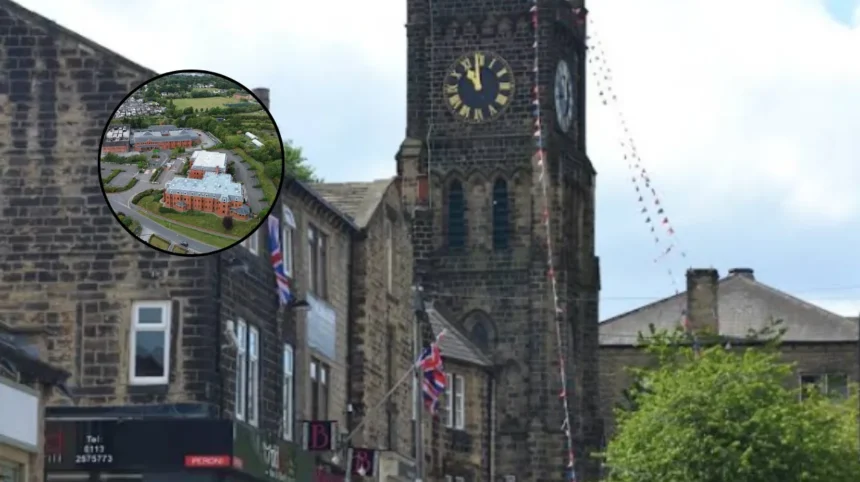
- Brownfield Location: Located on Cote Lane in Farsley, West Yorkshire, the plot sits in close proximity to the heavily trafficked Dawson’s Corner roundabout.
- Local Support and Objections: The public consultation period yielded eight formal representations, split evenly between four letters of objection and four letters of support.
- Demolition Scope: Existing commercial office infrastructure and associated call centre accommodation will be entirely cleared down to ground level before construction starts.
- Community Endorsement: Local ward councillor Craig Timmins publicly endorsed the approval, highlighting the critical demand for affordable housing over leaving brownfield land vacant.
Farsley (The Leeds Times) August 8, 2026 – Councillors on Leeds City Council’s plans panel have granted full planning permission for the comprehensive demolition of a vacant former banking call centre in Farsley, paving the way for the construction of 120 100% affordable homes.
The strategic brownfield development, brought forward through a joint venture between the Bank of Scotland and housebuilder Breck Homes, targets the complete clearance of the disused Lloyds Banking Group premises situated on Cote Lane, directly adjacent to the vital Dawson’s Corner transport node. The residential scheme is set to deliver a diverse visual mix of self-contained flats, multi-level maisonettes, and detached and semi-detached family dwellings designed to address severe local housing waiting lists.
What Do the Approved Demolition and Building Plans Entail for the Farsley Site?
The formal approval granted by Leeds City Council authorises the complete structural removal of the multi-storey corporate office space previously occupied by the Lloyds Banking Group. Having sat entirely vacant following corporate consolidation, the corporate campus on Cote Lane will be cleared to allow for broad ground remediation and structural base installation.
The replacement residential plan submitted by the Bank of Scotland and Breck Homes focuses on maximizing spatial density while providing an assortment of housing typologies.
The 120-unit masterplan is divided into three primary physical forms: low-rise apartment blocks containing individual flats, integrated maisonette housing, and multi-bedroom family homes with private garden allocations.
Situated directly off Cote Lane near the Dawson’s Corner roundabout, the site’s layout incorporates internal access roads, dedicated off-street parking bays, and integrated green space infrastructure.
Because the application was processed as a 100% affordable housing initiative, every dwelling built on the site will be made available through social rent, affordable rent, or shared ownership structures administered via registered social landlords.
How Did Local Representatives and Members of the Public React to the Application?
During the formal committee determination, members of the Leeds City Council plans panel evaluated feedback received throughout the statutory public consultation phase. The local authority recorded a total of eight written representations from surrounding residents and stakeholders, divided precisely into four formal letters of objection and four formal letters of support.
Objectors raised concerns regarding potential incremental pressure on local infrastructure, traffic congestion around the already busy Dawson’s Corner roundabout junction, and the overall loss of potential commercial employment space within the Farsley boundaries.
Conversely, supporters emphasized the urgent requirement for genuinely affordable residential units, praising the removal of an unused, decaying commercial footprint.
Elected representatives for the area spoke out in favour of the regeneration project during panel debates. Labour Councillor Craig Timmins, who represents the Farsley and Calverley ward, addressed the committee directly regarding the future of the vacant banking complex.
Councillor Craig Timmins stated that local residents did not want to see the former commercial premises “stand empty indefinitely.”
He further pointed directly to the escalating local demand for affordable family housing, arguing that returning a derelict brownfield site back into active, functional residential use was the most pragmatic resolution for the wider community.
Panel members ultimately aligned with this view, concluding that the strategic benefit of supplying 120 affordable living spaces outweighed potential local highway impacts, leading to a vote in favour of approving the application.
Explore More Local Leeds News
Ebony Stead Returns for Leeds Rhinos vs York Valkyrie Headingley 2026
Logical Personnel Solutions Takes Top Floor at Sovereign House Leeds 2026
Background of the Particular Development
The site on Cote Lane has a long-standing commercial history tied deeply to the financial services sector in West Yorkshire. For years, the facility functioned as an essential corporate operational hub and call centre for the Lloyds Banking Group (and its subsidiary, the Bank of Scotland).
Hundreds of administrative and customer service personnel worked out of the facility daily, contributing significantly to the immediate day-to-day economy of Farsley and the neighbouring district of Calverley.
However, widespread structural shifts across the UK financial sector—accelerated by digital banking adoption and flexible, hybrid workforce strategies—led financial institutions to downsize physical office assets across the country.
As part of broader operational consolidation programs, Lloyds Banking Group formally decommissioned and vacated the Cote Lane site, leaving the multi-million-pound administrative complex entirely unoccupied.
The vacancy posed a distinct risk to the surrounding area, with large brownfield sites often succumbing to vandalism, structural decay, and security vulnerabilities when left untended. Recognising the site’s redundancy for commercial banking purposes, the property owners sought a complete land-use change from commercial office space to residential use.
By partnering with Breck Homes—a specialist developer operating heavily in the affordable and social housing sectors—the owners formulated a masterplan aimed at addressing the severe, long-term deficit of affordable housing options across the Leeds Metropolitan Borough.
Prediction: How Will This Development Affect the Local Area and Residents?
The conversion of the former Cote Lane banking site will have far-reaching social, economic, and practical consequences for several distinct groups across Farsley and the broader Leeds region:
For low-to-middle-income families, young professionals, and individuals on the Leeds Housing Register, this development provides a vital, life-changing infusion of secure accommodation.
The delivery of 120 affordable homes helps alleviate long waiting lists in West Leeds, allowing local households who might otherwise be priced out of the private market to remain rooted within their existing community networks.
The re-activation of the site will alter local traffic flows around Dawson’s Corner—already a recognized congestion bottleneck connecting the A6110 Ring Road and the A647 Bradford Road.
While a residential development generates a different traffic distribution compared to a bustling corporate call centre (replacing peak shift-change traffic spikes with steady residential commuter journeys), local motorists can expect localized traffic adjustments during peak morning and evening hours.
The influx of up to 120 new households directly onto Cote Lane will inject sustained residential spending power into the local economy.
Shops, cafes, pubs, and independent retail outlets along Farsley Town Street and in nearby Calverley are set to benefit from increased footfall and long-term customer loyalty, helping offset the economic loss caused when the original call centre workforce moved away.
In the medium-to-long term, the arrival of dozens of new families will place additional demand on local community services, including primary school admissions, GP surgery registers, and public park amenities. Leeds City Council and local health providers will need to monitor service capacities closely to ensure local amenities scale effectively alongside this brownfield residential growth.