
Key Points
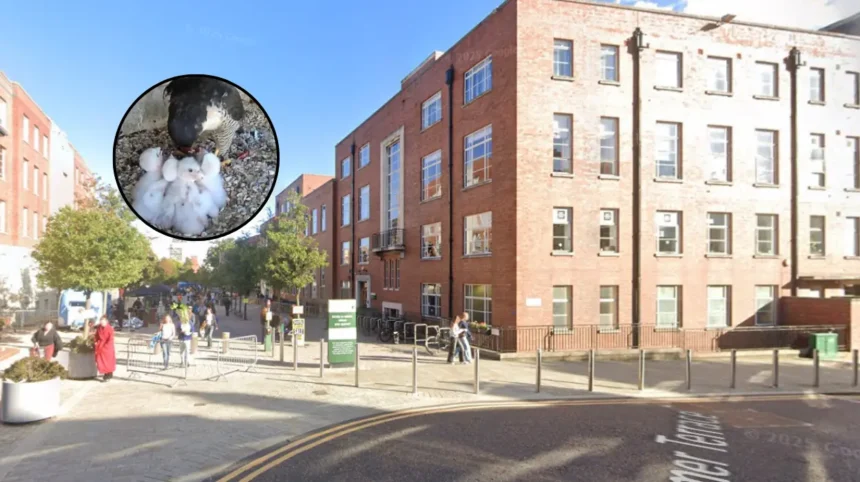
- Four peregrine falcon chicks have hatched in a nest on the University of Leeds Parkinson Building on Woodhouse Lane in Leeds.
- The chicks hatched between Wednesday and Friday last week, according to the university.
- The birds have nested intermittently on Parkinson Tower since 2018, with 18 successful hatchlings recorded by the university since then.
- The nest can be viewed through the university’s webcams, and the sustainability team monitors the birds.
- The university said the chicks will soon be ringed with help from the Yorkshire Wildlife Trust so their progress can be tracked.
- Michael Howroyd from the university said the eggs were laid on 21, 23, 26, and 28 March.
Leeds (The Leeds Times) May 4, 2026 – Four peregrine falcon chicks have hatched in a nest on the University of Leeds Parkinson Building, with the birds emerging between Wednesday and Friday last week, the university said. As reported by the University of Leeds sustainability service, the nest has been used intermittently since 2018, and the campus webcams allow the public to follow developments at the site.
What happened at Parkinson Tower?
The University of Leeds said the peregrines laid four eggs on 21, 23, 26, and 28 March, before the chicks hatched over the course of last week. The birds have become a regular feature on the Parkinson Tower, which sits on Woodhouse Lane in the city centre.
The university’s sustainability team monitors the nest and said the birds would soon be ringed with support from the Yorkshire Wildlife Trust.
As reported by the University of Leeds, peregrines began nesting intermittently on the tower in 2018, and the site has since recorded 18 successful hatchlings up to 2025.
The university’s pages also explain that the birds often return to tall urban structures because they resemble the cliff faces the species uses in the wild . This makes the Parkinson Tower one of the better-known urban nesting sites for the species in Leeds .
Who is monitoring the nest?
The university said its sustainability team is responsible for monitoring the nest and sharing updates on the birds’ progress .
It also said the chicks will be ringed soon with assistance from the Yorkshire Wildlife Trust, a step that helps conservation teams follow the birds after they leave the nest. The webcams linked to the nest have also made it possible for people to watch the breeding cycle remotely.
Michael Howroyd from the university gave the laying dates for the four eggs as 21, 23, 26, and 28 March. That timeline fits with the usual peregrine breeding pattern described by the university, which says incubation generally lasts 32 to 35 days and hatching often happens over two days. The university also says the chicks typically begin to fledge around 35 days later.
Why are peregrines on campus?
Peregrine falcons are large blue-grey birds of prey with pointed wings, and the University of Leeds describes them as the fastest animals recorded on earth, capable of diving at more than 200mph.
The university says the species is now often found in urban areas because tall buildings can offer suitable nesting ledges similar to sea cliffs and upland crags. That is one reason universities and other city buildings have become important nesting places for the species.
The university also notes that peregrines remain protected in the UK under the Wildlife and Countryside Act 1981 and have Green conservation status, although they still face risks, including illegal killing.
Its biodiversity pages show that Leeds has been running a long-term monitoring effort around the Parkinson Tower since the first nesting activity was recorded there in 2018. The latest hatching continues that pattern of seasonal return.
What have the university and wildlife teams said?
The University of Leeds has presented the nest as part of its wider biodiversity work, using webcams, monitoring, and ringing to track the birds.
The sustainability service says it works with conservation partners and shares updates for people following the nest online. The birds have therefore become both a wildlife feature and a monitored conservation project on campus.
As reported by the university, the ringed birds from earlier years have allowed staff and wildlife teams to track outcomes such as hatching and fledging.
The site’s records show that 2024 and 2025 both produced four chicks, while 2023 saw four eggs laid but no successful hatching. Those annual records underline why the current hatch is being watched closely.
What does the university record show?
The university’s peregrine history page shows that 2025 began with the first egg laid on 14 March, followed by four more on 17, 19, 21, and 24 March.
It then recorded the first chick hatching on 25 April, with the other three arriving over the next two days. The 2025 chicks were rung by the Yorkshire Wildlife Trust on 19 May.
For 2024, the first egg was laid on 21 March and three more followed on 24, 26, and 28 March, with the four chicks hatching from 1 May onwards. In 2023, four eggs were laid, but none hatched, while in 2022, three chicks successfully fledged after four eggs were laid in March.
The university’s records, therefore, show a mix of successful and unsuccessful breeding seasons, which is common in wildlife monitoring.
What makes this nest significant?
The Parkinson Tower nest is significant because it shows how peregrines have adapted to city life and how urban buildings can support protected wildlife.
The university’s live monitoring system has also turned the nest into a public wildlife watch point, allowing people to follow a breeding season that would otherwise be difficult to see. That combination of conservation and public engagement has made the site a recurring local interest story.
The birds are also a reminder of how quickly peregrines can move through urban landscapes, perching on high points around campus when they are not breeding. The university says they can often be spotted around the Emmanuel Centre spire outside the breeding season. In that sense, the nest is part of a wider year-round pattern rather than a one-off event.
Background of the development
Peregrine falcons have been nesting intermittently on the University of Leeds Parkinson Tower since 2018, after a gravel tray and live webcam were installed to support monitoring.
The university says the species has now produced a series of successful hatchings on the tower, with records showing several multi-chick broods across recent years. The birds are protected in the UK and are known for using tall urban structures as substitute cliff ledges .
The university’s biodiversity programme links the peregrines to broader conservation and education work on campus . Its records show routine monitoring, ringing by the Yorkshire Wildlife Trust, and public updates through webcams and social media . That long-running approach has made the Parkinson Tower nest one of the university’s most closely followed wildlife sites .
What could happen next?
For people following the nest, the next stage will be ringing and continued monitoring as the chicks grow . The university says the young birds typically fledge about 35 days after hatching, so the nest will remain active over the coming weeks . Viewers using the webcam can therefore expect further updates as the chicks develop .
For wildlife supporters, the hatching is likely to keep interest high in urban biodiversity and conservation monitoring on campus . For the University of Leeds community, it also means the nest will remain a visible seasonal feature on Woodhouse Lane, with staff and the public able to track the birds’ progress online .