

Key Points
- City-Wide Expansion Strategy: Leeds City Council has published its latest statutory register of comprehensive planning and listed building applications, encompassing transformative structural additions across urban, suburban, and rural sectors.
- Diversified Construction Matrix: The newly logged frameworks span critical infrastructural classifications, incorporating multi-million-pound industrial developments, residential conversions, public school overhauls, agricultural enhancements, and sensitive church preservation orders.
- Green Energy Influx: Conforming to municipal climate targets, a major 60MW Battery Energy Storage System (BESS) has been formally proposed for the West Leeds corridor to bolster regional grid efficiency.
- Strict Legal Protocols: All publicised documents have been formally submitted under the Town and Country Planning Act and prevailing conservation area regulations, triggering mandatory twenty-one-day civic consultation windows.
- Preservation vs. Progress: Heavy friction is emerging between commercial asset modernisation and heritage tracking, highlighted by multi-tiered structural assessments on listed churches, historic clubs, and local greenfield frameworks.
Leeds City Council (The Leeds Times) May 25, 2026 — Local administrative frameworks across West Yorkshire face a significant influx of structural transformations following the comprehensive publication of Leeds City Council’s latest planning and listed building applications register. The official documentation outlines an expansive suite of infrastructure proposals, property modernisations, and historic structural conversions affecting properties, academic complexes, commercial holdings, operational farms, and ecclesiastic grounds across the metropolitan center and its outlying towns and villages. Governed strictly by national planning frameworks and regional conservation regulations, this public release officially initiates the statutory review procedures, giving local residents, parish councils, and independent environmental bodies exactly three weeks to lodge formal technical representations before final planning panels convene.
- Key Points
- What Types of Residential Developments Are Being Proposed Across Leeds Suburbs?
- How Will the New 60MW Battery Energy Storage System Impact the West Leeds Infrastructure?
- Which Historical and Community Structures Face Major Demolition or Alteration?
- Background of the Local Development Framework
- Future Predictions and Societal Impact
What Types of Residential Developments Are Being Proposed Across Leeds Suburbs?
The residential sector forms the highest volume of submissions within the newly publicised municipal index, as domestic expansions and commercial property conversions continue to pace local demand.
As documented in the statutory registers verified by independent data monitoring platform PlanWatch, residential planning types comprise approximately 30 per cent householder applications and 39 per cent full structural plans within the wider Leeds local authority boundaries.
As reported by John Woodcock of the West Leeds Dispatch, a key residential application seeks the formal conversion of a former veterinary practice located at 132 Austhorpe Road, Leeds, LS15 8EJ.
The architectural plan requests a comprehensive change of use from its previous commercial function into a nine-bedroom House in Multiple Occupation (HMO).
The submission details necessary fenestration alterations, widespread rendering works, dedicated cycle and bin storage facilities, and localized landscape remodeling to satisfy high-density living standards.
Simultaneously, within suburban sectors, individual householder improvements continue to alter the existing urban fabric. Data compiled from the Leeds Council public access portal shows a significant number of certificate of proposed lawful development requests.
These include an application at 9 Woodhall Park Crescent West, Stanningley, which details plans to extend an existing structural gable, construct a rear dormer window, and insert frontline rooflights.
Furthermore, historical agricultural assets are being re-targeted for residential usage to satisfy municipal housing projections without breaking greenbelt constraints.
As tracked by the West Leeds Dispatch editorial team, a formal application has been lodged for Woodbottom Farm Cottages, situated on Rawdon Road. The proposal seeks a structural change of use to convert pre-existing agricultural outbuildings into two independent residential dwellings.
This project requires the installation of modern windows and doors, an entirely re-configured access layout, localized hardstanding to the front, and defensive landscaping boundaries to separate the private domestic units from adjacent agricultural operations.
How Will the New 60MW Battery Energy Storage System Impact the West Leeds Infrastructure?
Commercial and industrial applications within the latest registry focus heavily on clean energy infrastructure and technical adaptations for existing manufacturing sites. The most technically complex infrastructure project submitted to Leeds City Council involves a large-scale energy storage initiative proposed for the Armley Ward.
As reported by John Woodcock of the West Leeds Dispatch, the formal application requests the development of a 60MW Battery Energy Storage System (BESS).
The industrial blueprint details an array of battery skids fitted with self-contained energy modules, alongside dedicated electrical transformers, power conversion systems, structural control buildings, a localized metering cabinet, a main substation unit, and surrounding security protocols.
To minimize the localized auditory footprint, the developers have integrated comprehensive acoustic barriers, specialized weldmesh fencing, and secure access gates within the design parameters to isolate the high-voltage equipment from nearby public spaces.
Further out in the industrial corridors of Rawdon, established manufacturing firms are seeking structural modifications to enhance operational output. As recorded by the West Leeds Dispatch, Airedale International Air Conditioning has submitted an application for its Park Mills factory site on Leeds Road.
The firm requires the installation of new external electrical plant equipment protected by a compound palisade fence.
The technical plan also necessitates an extended Armco safety barrier, the removal of an existing roof vent, subsequent roof repairs, and the strategic repositioning of the main ventilation unit to the primary factory roof structure to satisfy modern building safety regulations.
Explore More Leeds City Council News
Leeds Station Sign Error Probed by Council: West Yorkshire 2026
Salma Arif Named Historic First Muslim Deputy Council Leader Leeds 2026
Which Historical and Community Structures Face Major Demolition or Alteration?
A major point of discussion within the published register centers on structural updates impacting heritage landmarks and historic community buildings protected by conservation area laws.
Balancing modern commercial needs with strict preservation mandates has drawn significant feedback from independent civic organizations.
According to technical reviews published by the Leeds Civic Trust executive board, Leeds City Council has maintained a firm stance on commercial preservation, recently refusing consent for a newly designed McDonald’s drive-through on the A64 at Seacroft due to concerns regarding tree loss, traffic safety, and historical context.
The Trust noted that multiple recent shopfront applications are being driven by corporate styling rather than responding contextually to the heritage buildings upon which they are to be displayed.
In the newly published listings, several community assets are slated for irreversible structural modifications. As reported by the West Leeds Dispatch, a conservation area application has been submitted for the partial demolition of the Armley Conservative Club, located on Armley Ridge Road.
The submission is undergoing rigorous assessment by local conservation officers due to its placement within a designated heritage zone.
Similarly, ecclesiastic assets are seeking structural maintenance permissions to mitigate structural subsidence caused by adjacent vegetation.
According to the PlanWatch registry, an application has been validated for the Holy Name of Jesus Catholic Church, located on Otley Old Road, Cookridge.
The church authorities have submitted an arboricultural report requesting the removal of two prominent Silver Birch trees to ground level, alongside the chemical treating of the stumps.
This action is deemed necessary to prevent further root influence on the church’s primary foundations and to preserve the main structural integrity of the building.
Background of the Local Development Framework
The publication of this planning registry follows an era of structural changes and evolving regulatory benchmarks within Leeds City Council’s administrative domain. Under national legislative mandates, Leeds has been required to conform to centrally imposed housing delivery targets exceeding 3,000 new residential units per year, a directive that prompted the council to initiate an extensive “Call for Sites” process.
This state mandate has forced the local planning authority to balance rapid commercial and residential growth against the strict preservation of the city’s extensive architectural heritage and greenbelt boundaries.
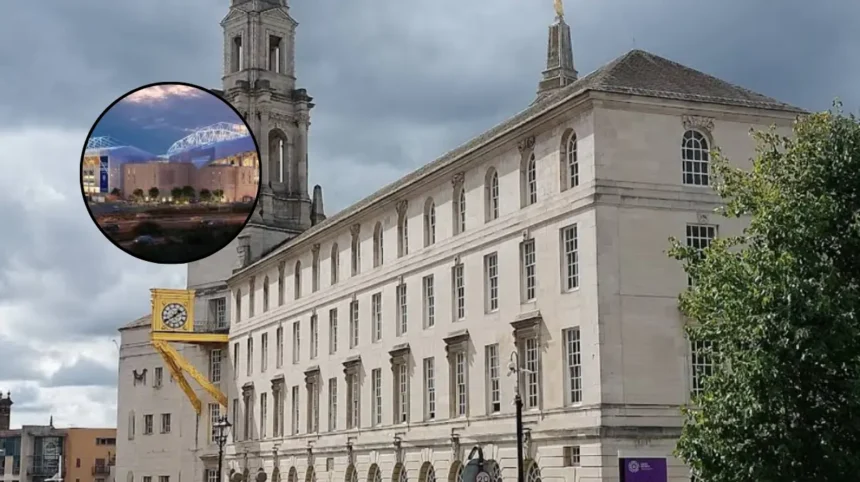
Historically, complex or controversial planning applications across Leeds—such as the expansion of Elland Road Stadium to a 53,000 capacity or housing allocations in Garforth—have faced intense public scrutiny at municipal Plans Panel meetings held at the Civic Hall.
This tension is further amplified by the active involvement of bodies like the Leeds Civic Trust and regional parish councils, which monitor the council’s Public Access portal to ensure developments adhere to Section 106 legal agreements, historic preservation mandates, and localized infrastructure capacities.
This established bureaucratic environment means that every newly published planning list represents a legal battlefield where environmental conservation, corporate development, and local community needs collide.
Future Predictions and Societal Impact
The approval or rejection of these diverse planning applications will directly impact Leeds residents, business owners, and rural communities over the coming decade. For suburban residents, particularly those living near high-density projects like the proposed nine-bedroom HMO in Austhorpe Road, the confirmation of these developments will likely influence local housing market dynamics and place increased pressure on shared neighborhood resources, including curbside parking and local utility networks.
Conversely, for property owners looking to maximize asset values, the steady approval of certificate of lawful development applications confirms a flexible approach by the council toward domestic modernization and multi-generational living arrangements.
For the wider industrial sector and business community, the integration of commercial schemes—most notably the 60MW Battery Energy Storage System in Armley—will directly affect regional grid reliability and support West Yorkshire’s transition toward net-zero manufacturing standards. However, communities located near these industrial zones will need to closely monitor technical compliance, as the introduction of heavy electrical plant installations and structural demolitions presents long-term noise and traffic management challenges.