
Key Points
- Wayne Kristian Powell, 51, of Morley, Leeds, died at the scene of a crash on the A64 near Crambeck, North Yorkshire, after failing to wear a seatbelt.
- An inquest at North Yorkshire Coroner’s Court concluded that Mr Powell died from severe neck injuries following a high-speed collision on 22 January 2025.
- North Yorkshire Police PC Benjamin Stevens reported that Mr Powell overtook his unmarked patrol vehicle at an estimated speed of 80 mph in a 50 mph zone prior to the crash.
- Paramedics officially confirmed Mr Powell deceased at 4:13 a.m. after his Vauxhall Corsa was discovered wedged in a tree.
- Forensic collision reports confirmed that the driver’s seatbelt was not engaged at the moment of impact, significantly contributing to the fatal outcome.
- Assistant Coroner Catherine Cundy recorded a formal verdict of death resulting from a road traffic collision.
Morley (The Leeds Times) October 7, 2026 – Wayne Kristian Powell, a 51-year-old resident of Morley, Leeds, was tragically pronounced dead at the scene of a crash near Crambeck in the early hours of January 22, 2025. Emergency services were unable to save him, and he was confirmed deceased by paramedics at 4:13 a.m. after being discovered in a tree by police. An inquest held this past week revealed that Mr Powell’s death was directly attributed to a road traffic collision, with neck injuries cited as the medical cause of death. The circumstances surrounding the incident unfolded shortly after 3:30 a.m. when Mr Powell, driving a Vauxhall Corsa along the A64 eastbound, was signaled to stop by a police officer.
- Key Points
- What Events Led to the Fatal Collision on the A64?
- How Did Emergency Services Locate the Vehicle?
- What Did the Medical and Forensic Investigations Reveal?
- What Was the Cause of Death Recorded by the Coroner?
- Was the Driver Wearing a Seatbelt During the Collision?
- What Was the Final Verdict of the Inquest?
- Background of Road Safety Concerns on the A64 Corridor
- Prediction: How This Development May Affect Motorists and Regional Road Authorities
PC Benjamin Stevens, who was in an unmarked police vehicle, recounted that Mr Powell overtook him as the dual carriageway transitioned to a single carriageway. The officer was traveling at 50 mph and estimated that Mr Powell was traveling at approximately 80 mph at the time of the overtaking maneuver. PC Stevens stated that he activated his blue lights but quickly lost sight of Mr Powell due to a dip in the road.
What Events Led to the Fatal Collision on the A64?
According to court testimony delivered during the formal inquest proceedings at North Yorkshire Coroner’s Court, the sequence of events commenced in the early hours of 22 January 2025 on a section of the A64 carriageway near Crambeck.
As detailed in police statements presented to the court, PC Benjamin Stevens was operating an unmarked police vehicle eastbound along the A64 at approximately 3:30 a.m. The officer testified that he was driving at 50 mph along a section where the dual carriageway narrows into a single carriageway. At this junction, a silver Vauxhall Corsa driven by Mr Powell initiated an overtaking maneuver. PC Stevens estimated the speed of the Corsa to be approximately 80 mph during the pass.
Upon observing the excessive speed, PC Stevens engaged his emergency blue lights to signal for the vehicle to pull over. However, owing to the undulating topography of the A64 and a prominent dip in the road surface, the officer lost visual contact with the Corsa almost immediately after initiating the signal.
How Did Emergency Services Locate the Vehicle?
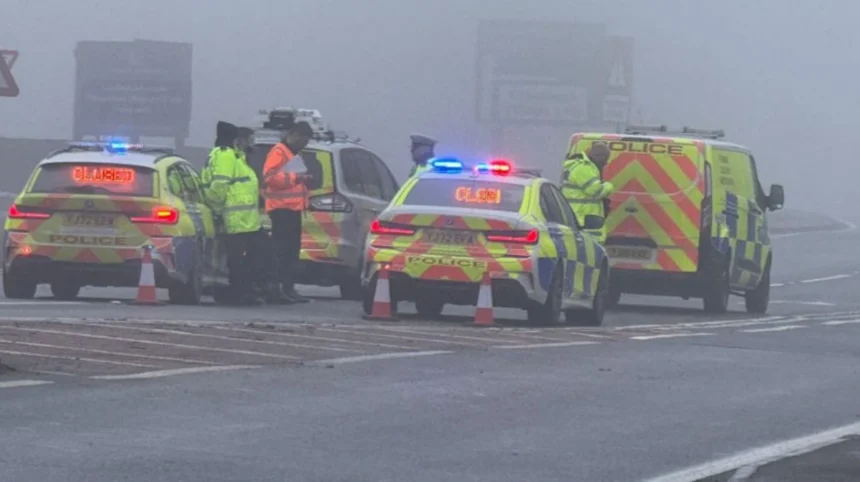
Following the loss of visual contact, PC Stevens continued along the eastbound route to locate the vehicle. Shortly thereafter, officers identified collision debris scattered across the carriageway near Crambeck.
A search of the immediate roadside revealed the silver Vauxhall Corsa off the main carriageway, wedged heavily into a roadside tree. Officers immediately requested emergency medical assistance from Yorkshire Ambulance Service and attempted to render aid.
Paramedics arrived shortly after the discovery. Following an evaluation of Mr Powell’s condition within the wreckage, life-saving measures were deemed unviable, and he was officially declared deceased at 4:13 a.m.
What Did the Medical and Forensic Investigations Reveal?
What Was the Cause of Death Recorded by the Coroner?
A post-mortem examination performed following the incident confirmed that Mr Powell sustained catastrophic neck injuries consistent with a high-velocity impact. Assistant Coroner Catherine Cundy officially recorded these injuries as the primary medical cause of death during the inquest summary.
Was the Driver Wearing a Seatbelt During the Collision?
Forensic collision investigators examined the vehicle wreckage to determine the mechanical state of the car and the physical circumstances of the impact. The investigation established that Mr Powell was not wearing his seatbelt at the time of the collision.
The physical analysis showed that the seatbelt mechanism remained retracted and was not deployed or tensioned during the crash sequence. Investigators concluded that the lack of restraint significantly increased the kinetic force experienced by the occupant during the primary impact with the tree.
No significant mechanical defects were identified on the Vauxhall Corsa that would have contributed to a loss of control prior to leaving the carriageway.
What Was the Final Verdict of the Inquest?
Concluding the formal proceedings at North Yorkshire Coroner’s Court, Assistant Coroner Catherine Cundy formally recorded a verdict that Wayne Kristian Powell died as a result of a road traffic collision. The coroner extended formal condolences to the family and relatives of Mr Powell present at the hearing.
Background of Road Safety Concerns on the A64 Corridor
The A64 is a major arterial trunk road in North Yorkshire, connecting the city of Leeds, the city of York, and the East Coast. The section passing through Crambeck, where the dual carriageway merges into a single carriageway, has historically been subject to monitoring by Highways England and North Yorkshire Police due to traffic speed transitions and rural road geometry.
Statistical data from the Department for Transport consistently underscores seatbelt compliance as a critical factor in occupant survival rates during rural collisions. According to national road casualty reports, unbelted vehicle occupants remain disproportionately represented in fatal collision statistics relative to overall traffic volume, particularly during single-vehicle impacts involving fixed roadside hazards such as trees and structures.
Prediction: How This Development May Affect Motorists and Regional Road Authorities
This inquest outcome is expected to impact several key areas regarding local traffic enforcement and driver safety awareness across North Yorkshire:
- Increased Targeted Speed Enforcement on the A64: North Yorkshire Police and the regional Road Policing Group are likely to increase high-visibility and unmarked patrols along the A64 corridor, specifically targeting sections where dual carriageways transition into single carriageways.
- Refocused Public Safety Campaigns on Seatbelt Use: Local casualty reduction partnerships, including the 95 Alive York and North Yorkshire Road Safety Partnership, are anticipated to renew public messaging regarding seatbelt compliance, particularly emphasizing the heightened risks associated with nighttime rural driving.
- Local Highway Infrastructure Reviews: The documented collision history near Crambeck may prompt National Highways to review signage, road markings, and speed mitigation measures at points where the dual carriageway tapers, aiming to reduce speed differentials between merging vehicles.