

Key Points
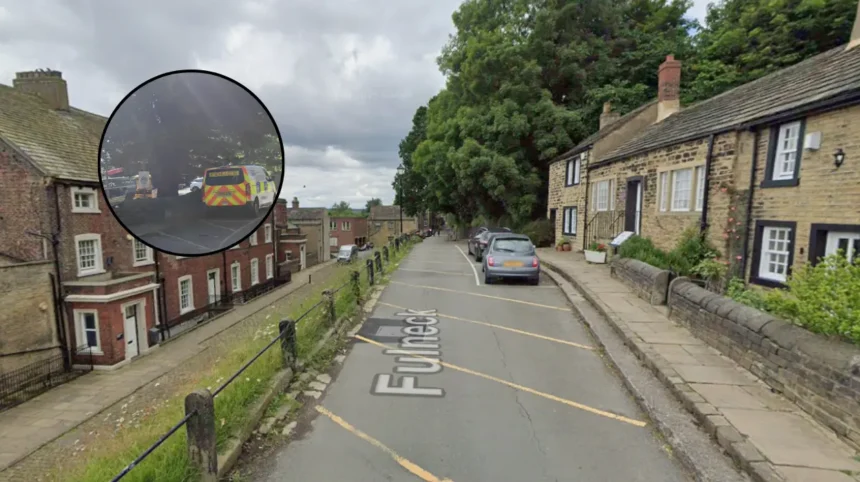
- West Yorkshire Police have launched a new forensic search at a site in Fulneck, Pudsey, regarding the 1992 disappearance of Patricia Hall.
- Officers from the Major Investigation Review Team are acting on newly received information to examine the land on a speculative basis.
- Law enforcement officials have clarified that there is no evidence linking the search to the Moravian Church, which owns the site.
- Patricia Hall went missing from her home in Moorland Drive, Pudsey, on 27 January 1992 at the age of 39.
- Her husband, Keith Hall, was tried for her murder in 1994, but was acquitted after a judge ruled a undercover police confession inadmissible.
- No trace of Patricia Hall, a mother of two, has ever been found despite decades of police investigations.
Pudsey (The Leeds Times) August 8, 2026 – West Yorkshire Police have commenced a forensic examination of land at Fulneck, Pudsey, in connection with the unresolved disappearance of Patricia Hall, who vanished from her Leeds home 34 years ago. Detectives attached to the force’s Major Investigation Review Team are currently executing a search of the location after receiving new intelligence concerning the case. Authorities have explicitly stated that the operational activity is being conducted on a speculative basis, confirming that there is no indication of any involvement or connection to the Moravian Church, which holds ownership of the land.
- Key Points
- Why Are West Yorkshire Police Currently Searching the Fulneck Site in Pudsey?
- What Are the Historical Circumstances Surrounding the Disappearance of Patricia Hall?
- What Legal Proceedings and Police Operations Have Taken Place Previously?
- Background of the Particular Development
- Prediction: How This Development Can Affect the Community and Key Stakeholders
Why Are West Yorkshire Police Currently Searching the Fulneck Site in Pudsey?
The renewed search effort represents the latest operational development in one of West Yorkshire’s most high-profile cold cases. Specialized search teams, accompanied by forensic officers, arrived at the Fulneck area of Pudsey following a re-assessment of information passed to the cold case unit.
According to official statements released by West Yorkshire Police, the Major Investigation Review Team is systematically working through the location to determine if any material evidence related to the 1992 disappearance remains buried or hidden on the terrain.
Police spokesperson personnel confirmed that while the line of inquiry required physical site intervention, officers are keeping an open mind regarding what, if anything, may be recovered during the ongoing operation.
Work at the site is expected to continue as officers conduct meticulous ground-penetrating analysis and manual searches.
The force emphasized that the landowner, the Moravian Church—which maintains a historic settlement in Fulneck dating back to the 18th century—is not implicated in the investigation and is assisting police by providing access to the grounds.
What Are the Historical Circumstances Surrounding the Disappearance of Patricia Hall?
Patricia Hall, a 39-year-old mother of two, vanished without a trace on the evening of Monday, 27 January 1992. She was last seen at the family home on Moorland Drive in Pudsey, a market town situated between Leeds and Bradford.
At the time of her disappearance, Mrs Hall was employed as an Avon cosmetics seller. On the night she vanished, reports noted that an argument had taken place between Mrs Hall and her husband, Keith Hall. Following the dispute, Mrs Hall reportedly left the residential property in the family’s blue delivery van.
The vehicle was subsequently located abandoned the following day, parked just a short distance away from the matrimonial home, on Moorland Drive itself.
Despite extensive searches launched across West Yorkshire in the immediate aftermath—including searches of nearby woods, waterways, and farmland—no physical trace of Mrs Hall, her belongings, or her clothing was ever recovered. She left behind her two young sons, Andrew and Graeme, who were aged nine and five respectively when she disappeared.
What Legal Proceedings and Police Operations Have Taken Place Previously?
The investigation into the disappearance of Patricia Hall subsequently shifted into a homicide inquiry when detectives concluded that she was unlikely to have left the area voluntarily without contacting her children or accessing her bank accounts.
In 1993, West Yorkshire Police conducted an undercover sting operation targeting Keith Hall. An undercover police officer, using the pseudonym “Hazel,” initiated a romantic relationship with Mr Hall in an attempt to gather information regarding his wife’s whereabouts.
During taped conversations recorded inside a hotel room, Mr Hall allegedly confessed to murdering his wife, claiming he had strangled her and burned her body in an incinerator at a local brickworks where he worked.
However, during the subsequent trial at Leeds Crown Court in 1994, the trial judge, Mr Justice Oliver Popplewell, ruled that the taped confession evidence was inadmissible.
The judge deemed that the undercover operation had breached police guidelines regarding the questioning of suspects and held that the statements had been obtained through unfair entrapment.
With the key prosecution evidence excluded, the jury found Keith Hall not guilty of the murder of Patricia Hall. Mr Hall has consistently maintained his innocence regarding his wife’s disappearance ever since his acquittal.
In the decades following the trial, the case was transferred to the West Yorkshire Police Major Investigation Review Team, a dedicated unit tasked with re-examining unsolved homicides and missing person cases utilizing modern forensic techniques and new lines of intelligence.
Explore More Pudsey News
Student Benjamin Taylor Sentenced For Abuse Images Pudsey 2026
McKendry and Randhawa Star in New Farnley Double Victory Leeds 2026
Background of the Particular Development
The decision to search the site at Fulneck comes after decades of periodic reviews by West Yorkshire Police. Cold case reviews frequently utilize advances in technology—such as high-resolution ground-penetrating radar, enhanced soil chemistry analysis, and modern digital mapping—that were unavailable to investigators in 1992.
Fulneck is a small, historic hamlet located south of Pudsey, characterized by steep valleys, dense woodland, and historic structures owned by the Moravian Church settlement established in 1744.
Its close geographic proximity to Moorland Drive—less than two miles away—makes it a logistically significant location within the search perimeter historically mapped by police investigators.
Over the last three decades, West Yorkshire Police have periodically received tip-offs regarding various potential burial sites across Leeds and Bradford.
The Major Investigation Review Team maintains a protocol wherein every incoming piece of information is vetted, categorized, and matched against historical timelines before physical resources are deployed.
The deployment of physical search teams to Fulneck indicates that the recently acquired information met the internal threshold required to justify a targeted field search.
Prediction: How This Development Can Affect the Community and Key Stakeholders
The initiation of a fresh search in the Patricia Hall case carries significant implications for several groups, most notably the family of the missing woman, the local community of Pudsey, and the broader legal and law enforcement landscape.
For the family of Patricia Hall—particularly her now-adult sons—this search represents a critical moment in a 34-year search for answers.
Even a speculative search can reopen intense emotional trauma while simultaneously offering a potential path toward closure. If physical evidence or human remains are recovered, it could definitively establish what happened on the night of 27 January 1992, allowing the family to finally perform a formal burial.
For the local community of Pudsey and the Moravian Church congregation at Fulneck, the police presence will inevitably bring heightened public scrutiny, media attention, and disruption to an otherwise quiet residential and historic conservation area.
Clear communication from law enforcement regarding the absence of any link to the church itself will be essential to preserve community relations and mitigate local distress.
Finally, for West Yorkshire Police and the criminal justice system, the outcome of the search could determine the future trajectory of the case. Should forensic evidence be uncovered, detectives may evaluate whether new scientific findings provide grounds to re-examine the case legally, considering exceptions to the double jeopardy law introduced in the UK under the Criminal Justice Act 2003 (which allows a person acquitted of a serious crime to be retried if new and compelling evidence emerges).
Conversely, if the search yields no material results, the case will remain open within the cold case directory, serving as a reminder of the challenges inherent in historical missing persons investigations.