Key Points
- Manchester-based property and investment firm AGHA Group, run by Agha Sameer Anwar, has purchased the historic Pudsey Town Hall building from Leeds City Council.
- The property was sold for a purchase price of £575,000, plus a 4% fee, bringing the total transaction to £598,000, following a competitive process that attracted five offers.
- The historic Victorian building has stood empty and closed to the public since 2016, previously seeing partial use by the Pudsey and District Civic Society.
- Local opposition councillors and community groups strongly criticised the sale, citing a rejected community asset transfer bid and a previous 1,000-signature petition opposing the disposal of the asset.
- Following Historic England’s decision not to list the building as a protected site, the council resumed negotiations and completed the handover, with the new owners now required to secure planning permission for any change of use within the conservation area.
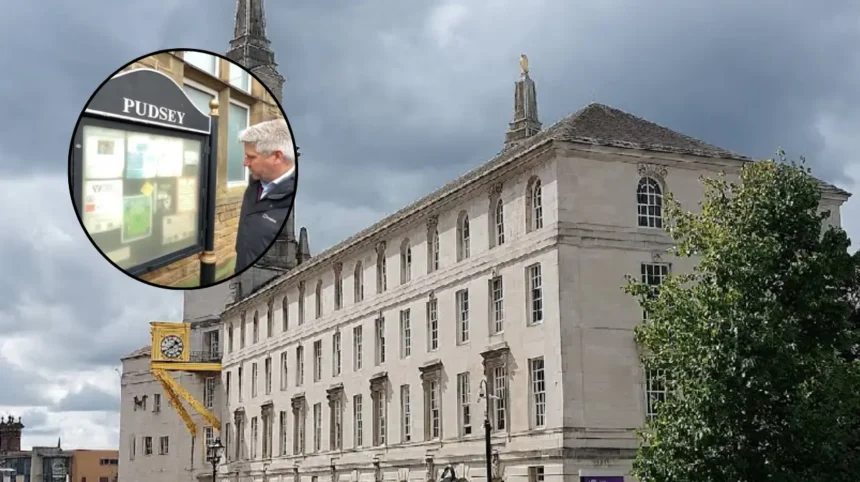
Pudsey (The Leeds Times) September 22, 2026 – Pudsey Town Hall has officially been sold to the Manchester-based property and investment company AGHA Group for £575,000, drawing mixed reactions from local politicians and community stakeholders. As reported by John Baron of West Leeds Dispatch, the property sale was confirmed following months of uncertainty regarding the future of the Victorian civic landmark. Leeds City Council decided to proceed with the transaction to balance its municipal books after receiving five separate bids for the property. The building, located within a conservation area, will require formal planning permission from the local authority for any future change of use.
Why was Pudsey Town Hall sold despite local opposition?
Leeds City Council defended the disposal of the asset by highlighting financial pressures and the lengthy period the building had sat vacant. As reported by Leeds Live, a Leeds City Council spokesperson stated:
“The council can confirm that the sale of Pudsey Town Hall has been completed to AGHA Group for £575,000.”
Furthermore, addressing the council’s financial rationale at a previous full council meeting in March, Deputy Council Leader and Executive Member for Communities Cllr Debra Coupar stated, as recorded by West Leeds Dispatch, that
“after six years of trying, we would have not done the right thing as a council [if we didn’t] try to protect tax payers’ money. We needed to move on with the sale of the building.”
Cllr Coupar added that she had worked for many hours to try to find a sustainable solution, noting her disappointment that a community-led alternative could not be finalised.
How did the community and local politicians react to the sale?
The completion of the sale sparked heavy criticism from opposition councillors and members of the Pudsey Town Hall Community Interest Company (CIC), who had fought to keep the building under local public stewardship. As reported by West Leeds Dispatch, Cllr Andrew Carter (Cons, Calverley & Farsley) condemned the decision in a sharp statement, saying:
“’Fire sale’ gone through today. Leeds City Council leadership, hang your heads in shame. Asset stripping madness, council tax payers [have been] fleeced again!”
Echoing this frustration, Cllr Trish Smith (Reform, Pudsey), who was involved in the Pudsey Town Hall CIC bid, stated to West Leeds Dispatch:
“It is such a shame to see Pudsey lose yet another part of its community heritage. Pudsey Town Hall CIC did everything the Council asked of us, in the way it asked us to do it.”
Cllr Smith added that the community group developed a business case and worked with officers, noting:
“What makes the outcome particularly difficult to accept is that the Town Hall has ultimately been sold for a figure only modestly above what the CIC was prepared to offer.”
Meanwhile, local representatives urged a constructive path forward. As reported by West Leeds Dispatch, Cllr Simon Seary (Cons, Pudsey) noted via social media:
“Following Historic England’s decision not to list Pudsey Town Hall, Leeds City Council resumed negotiations with the interested party and completed the sale of the building today. It is a sad day to see this important building pass out of public ownership. However, we must now look forward and hope that the new owners fully engage with the community and deliver something positive for Pudsey after the building has stood empty for far too long.”
What are the plans of the new owners for the building?
The new property owners, AGHA Group—managed by Agha Sameer Anwar—specialise in acquiring character buildings such as mills, workshops, and historic blocks to bring them back into functional use. As detailed by West Leeds Dispatch, the company’s official website outlines their mission to
“bring them back into use as places people actually want to work and live in.”
While AGHA Group declined to comment directly on the specific purchase price to regional media outlets like The Telegraph & Argus and Leeds Live, a company spokesperson released a statement saying:
“We are, however, very pleased to have acquired the building and are excited about the opportunity to carefully consider its future and how it can once again play a positive role within the local community.”
The spokesperson added:
“We fully appreciate the town hall’s importance and the strong connection that local residents have with the building and its heritage. As we develop our plans, we will be mindful of that history and the sentiments of the local community.”
Leeds City Council confirmed that no formal indication of the developer’s precise blueprint has been submitted yet.
Explore More Pudsey News
Pudsey Masonic Hall Air Conditioning Approved, Pudsey 2026
Pudsey Town Hall Sold to Manchester Developer: Pudsey 2026
Background of the particular development
The controversy surrounding Pudsey Town Hall spans over a decade of administrative decline and community campaigning. Built during the Victorian era, the town hall served as a central symbol of civic pride and local governance for Pudsey until the town’s municipal independence was restructured into Leeds City Council in 1974. The building subsequently functioned for various community and local government purposes until it was formally closed to the public in 2016.
Since its closure, the physical condition of the site deteriorated, with only partial occupancy maintained by groups like the Pudsey and District Civic Society.
As Leeds City Council faced tightening budgetary constraints, local leaders targeted surplus assets for disposal to alleviate financial burdens. This triggered intense local pushback, culminating in a petition signed by more than 1,000 residents demanding an immediate halt to the sale and a transparent community consultation.
Local stakeholders formed a Community Interest Company to formulate a viable asset transfer business case, mirroring successful community projects elsewhere in the region. However, after Historic England declined to grant the building official protected listed status, the local authority proceeded with commercial negotiations, ultimately accepting a private bid of £575,000 from AGHA Group.
Prediction
The transition of Pudsey Town Hall into private ownership is expected to significantly alter the urban landscape and civic identity of Pudsey. For local residents, community groups, and taxpayers, the development marks a definitive shift away from public control, extinguishing hopes for a community-led municipal hub. While the new owners have pledged to respect the architectural heritage of the building during the planning phase, residents and local councillors remain vigilant regarding potential commercial overdevelopment within a protected conservation area.
If AGHA Group successfully secures planning permission to convert the landmark into residential or mixed-use commercial spaces, it could inject fresh economic vitality and footfall into Pudsey town centre after years of emptiness. Conversely, any unsympathetic alterations risk alienating the local community further, cementing local grievances regarding the loss of historic public assets to external property developers.