
Key Points
- The Pepper Road railway bridge in Hunslet, Leeds, is set to be partially demolished and rebuilt as part of an improvement project tied to wider rail‑upgrade works.
- The bridge will be closed for a significant period while the partial demolition and reconstruction take place, affecting local traffic and access routes in the area.
- The work is being carried out under the Transpennine Route Upgrade (TRU) programme, which aims to modernise the rail corridor between major northern cities, including Leeds.
- Engineers state that the existing bridge structure is too low to accommodate planned overhead line equipment needed for future electric services.
- Traffic‑management measures, including advance signage and agreed diversion routes, will be put in place to minimise disruption to motorists and residents.
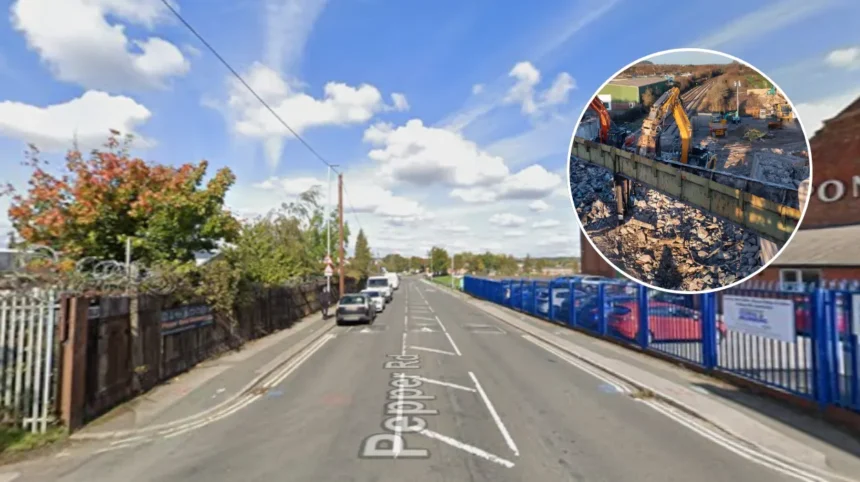
HunsletThe (The Leeds Times) April 15, 2026 is to be partially demolished and rebuilt as part of an improvement project aimed at enabling major rail‑upgrade works on the Transpennine Route. As reported by a spokesperson for the Transpennine Route Upgrade (TRU) in a BBC News article on 13 February 2025, the existing bridge is described as “too low” to support the overhead line equipment that will be used to power electric trains on the route in the future. The project is therefore being treated as a necessary engineering intervention to allow electrification and future‑proof train services.
- Key Points
- What will the work involve and when will it take place?
- How will local traffic and access be affected?
- What is the Transpennine Route Upgrade and why does it matter for Leeds?
- What are residents and local authorities saying about the plans?
- Background of the development
- Prediction: How this development can affect the particular audience
The overall initiative falls under the broader Transpennine Route Upgrade, which is designed to increase capacity, speed, and reliability on the busy rail corridor running through Leeds and other northern hubs. In explaining the rationale, Lucy Grogan, the TRU sponsor quoted by BBC News, said the improvements would “significantly enhance rail travel” by better linking towns and cities across the north of England.
What will the work involve and when will it take place?
The Pepper Road project will follow a phased pattern similar to other bridge‑reconstruction schemes in the Leeds area, including the nearby Station Road bridge in Cross Gates, which is also being demolished and rebuilt as part of the same upgrade programme.
Work on that bridge is scheduled to run from 31 March to 25 November, with southbound lanes and one northbound lane closed for much of the period, and full closures during specific demolition and replacement phases. Although the exact dates for Pepper Road have not been set out in the same level of detail in published sources, local authorities and the TRU team indicate that the Hunslet bridge will also require a “significant” closure window while the partial demolition and reconstruction are completed.
During the main construction stages, part of the existing bridge deck and supports will be taken down, after which a new, higher‑level structure will be installed to clear the overhead wires. Temporary railway closures or adjusted timetables are also expected during key weekend phases, as seen on the Cross Gates line, where the rail route is temporarily shut while the bridge frame and deck are replaced.
At those times, train services on the affected section are rerouted or replaced with bus links, with timetables adjusted in advance and communicated to passengers.
How will local traffic and access be affected?
The closure of the Pepper Road bridge is expected to cause notable disruption to motorists and local residents in Hunslet, prompting planners to agree diversionary routes with Leeds City Council.
As outlined in the TRU documentation referenced by the BBC, advance signage and variable‑message signs will be deployed at key junctions to guide drivers around the closure and to encourage the use of alternative routes. The project team has stated that it “appreciates” that the road closure will cause “inconvenience” but stresses that the diversions have been designed to keep traffic moving where possible.
The impact on pedestrians and cyclists has also been a consideration, with local‑authority‑level traffic‑management plans typically including temporary footpaths or shared‑use routes where space allows.
However, specific details of segregated crossings or cycle‑route adjustments on Pepper Road have not been set out in the same clarity as on other TRU‑linked schemes, suggesting that more information may be published closer to the start of works.
What is the Transpennine Route Upgrade and why does it matter for Leeds?
The Transpennine Route Upgrade is a multi‑year, multi‑billion‑pound infrastructure programme aimed at modernising the line that runs between Liverpool and Hull, via Manchester, Leeds, and York.
Along this corridor, upgrading bridges, tracks, signalling, and power supplies is intended to allow longer, faster, and more frequent electric trains, which in turn supports economic growth and reduced journey times for passengers.
Within the Leeds area specifically, the TRU overlaps with wider High‑Speed Two (HS2)‑related planning documents, which note that the northern section of the HS2 Leeds spur and associated rolling‑stock depot will run through parts of the city, including near Hunslet.
That context means that bridge‑height and clearance requirements are being coordinated across several rail‑modernisation projects, not just TRU alone. Journalists covering the Station Road bridge works in Cross Gates have therefore described those schemes as part of a “suite of interventions” tied to the broader electrification and capacity‑boosting goals for the Leeds corridor.
What are residents and local authorities saying about the plans?
Local‑authority statements and scheme summaries emphasise the long‑term benefits of the upgrade, while acknowledging the short‑term impact on communities. In describing the Station Road project, TRU and Leeds City Council communications stress that the bridge is “historic” and has been altered several times since its original construction in the early 1830s, with later widenings in 1936 and 1953. Engineers argue that the current deck and arches are no longer compatible with modern clearance standards, necessitating full or partial reconstruction.
Residents and local‑interest groups have raised concerns about congestion and the duration of closures, echoing similar complaints seen with other bridge works in Leeds and the wider north of England.
In response, the project team and council have promised to keep communication channels open, including regular updates through local media and council websites, and to adjust diversion routes if unforeseen bottlenecks arise.
Background of the development
The Pepper Road railway bridge in Hunslet sits within a long‑established freight and passenger‑rail corridor that has underpinned industry and transport in Leeds since the 19th century.
The wider Beeston Junction–Hunslet Goods railway, authorised in the 1890s, illustrates how the Hunslet area was historically wired into a dense network of freight‑only lines serving canals and industrial yards. Over time, many of these routes were rationalised or repurposed, but the core rail path through Hunslet has remained a key segment of the national network.
The current round of bridge‑reconstruction works, including the Pepper Road and Station Road projects, is framed as a continuation of earlier infrastructure‑modernisation efforts such as the 1936 and 1953 widenings. Today’s engineers are responding to a different set of technical constraints:
the need for sufficient vertical clearance for overhead electrification, modernised signalling, and higher‑speed, longer‑frequency services. In this sense, the Pepper Road intervention is less an isolated local project and more one node within the larger Transpennine Route Upgrade and HS2‑linked planning framework for Leeds.
Prediction: How this development can affect the particular audience
For local residents and commuters in Hunslet and surrounding parts of Leeds, the Pepper Road bridge works are likely to mean extended periods of altered traffic flows, potential delays, and the need to follow prescribed diversion routes. Those who rely on the bridge for daily journeys—drivers, cyclists, and pedestrians—should expect to plan extra time around peak‑hour periods and to monitor Leeds City Council and TRU channels for any changes to closure dates or temporary‑route layouts.