

Key Points
- Leeds Rhinos sit top of the Betfred Super League table after eight rounds of the 2026 season.
- Head coach Brad Arthur has stated that the club’s ultimate aim this campaign is to return to Old Trafford and challenge for a Super League title.
- Leeds are due to host Catalans Dragons at AMT Headingley in round‑nine action, with the club treating the fixture as part of a week‑by‑week process rather than a “one‑off” moment.
- Arthur has emphasised that being top of the table after eight rounds is a “starting point”, not an end in itself, and has stressed the need for consistency right through to round 27.
- Leeds have won six of their opening eight games this season, with one of those victories coming in Las Vegas against Hull KR, which Arthur cited as evidence the squad is “good enough” to compete at the top end of the competition again.
- The Rhinos have not lifted a Super League Grand Final trophy for nine years, the longest such drought since their so‑called “Golden Generation” era began in 2004.
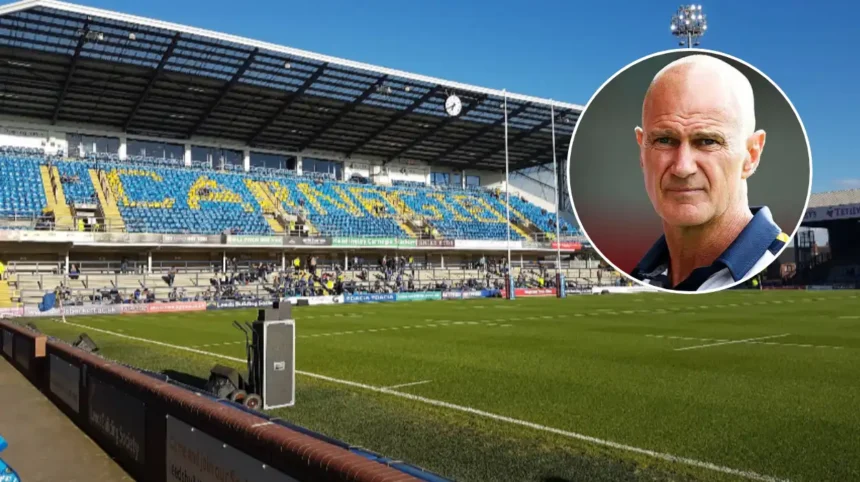
Leeds (The Leeds Times) April 24, 2026– Leeds Rhinos are top of the Betfred Super League after eight rounds – and head coach Brad Arthur intends to stay there. The Rhinos travel into Friday night’s hosting of Catalans Dragons at AMT Headingley with ambitions of returning to Old Trafford in October and putting themselves back in contention for a Super League title, a feat that has eluded the club for nine years.
- How have Leeds Rhinos reached the top of Super League?
- Why does being top after eight rounds not satisfy Brad Arthur?
- What is the Rhinos’ mindset ahead of the Catalans Dragons fixture?
- How long has it been since Leeds last won Super League?
- What does Arthur’s ambition mean for the Rhinos’ supporters?
- How does this fit into Arthur’s broader tenure?
How have Leeds Rhinos reached the top of Super League?
Leeds Rhinos moved to the summit of the 2026 Betfred Super League table after securing six wins from their opening eight fixtures.
Among those victories was a notable away win in Las Vegas over Hull KR, whom Arthur described as world‑champion‑level opposition, which he has pointed to as proof the squad has the quality to challenge at the top end of the competition again.
Writing for All Out Rugby League, journalist Tom Robinson reported that Arthur said:
“We are going to be tough to beat, but we’ve got to keep our eye on the prize.”
Robinson added that Arthur believes Leeds “are good enough to reach those heights again” provided they maintain the correct attitude and stick to their process on a week‑to‑week basis.
Why does being top after eight rounds not satisfy Brad Arthur?
Despite occupying pole position after eight rounds, Arthur has been at pains to downplay the significance of the early‑season table snapshot.
“It’s great for the club (being top), but I want to be there in round 27, not round eight,”
Arthur told All Out Rugby League, as relayed by Tom Robinson.
Arthur emphasised that the current position is a “starting point”, not a finished product, and that a “lot of hard work” still lies between now and the end of the regular season.
He also underlined that the club – which won the Super League title as recently as 2017 – has endured a nine‑year spell without a Grand Final victory, the longest such barren run since the “Golden Generation” era began in 2004.
What is the Rhinos’ mindset ahead of the Catalans Dragons fixture?
Leeds Rhinos are set to host Catalans Dragons at AMT Headingley in the upcoming round‑nine fixture, and the club’s internal messaging has been that each game must be treated as part of a broader, week‑by‑week process. According to a match‑preview article published on the official Leeds Rhinos website, the club is preparing for back‑to‑back home games over the next fortnight, with the Catalans contest forming the first of those fixtures.
Speaking to All Out Rugby League, coach Arthur expanded on this incremental approach, explaining:
“We’ve got aspirations for the end of the season, but you need to do that week in week out.”
Robinson’s report notes that Arthur described the upcoming period as a “mentality test” for his squad, as the Rhinos seek to maintain their lofty league position while continuing to implement the patterns of play and defensive structures that have underpinned their early‑season results.
How long has it been since Leeds last won Super League?
The last time Leeds Rhinos lifted the Super League trophy was in 2017, when they overcame Salford in the Grand Final at Old Trafford.
Since that victory, the club has repeatedly reached the top six and made the play‑off rounds, but has not managed to navigate all the way back to the Grand Final and claim the title again.
In the All Out Rugby League piece, Tom Robinson notes that the nine‑year gap without a Grand Final success is the longest such stretch since the Rhinos’ “Golden Generation” period began in 2004, when the club embarked on a run of multiple titles and Challenge Cup triumphs.
Arthur’s comments about aspiring to return to Old Trafford can therefore be read against the backdrop of both recent near‑misses and a wider club‑history narrative of sustained success that has, for the past decade, been interrupted by this title drought.
What does Arthur’s ambition mean for the Rhinos’ supporters?
For Leeds Rhinos fans, the message from Arthur is one of cautious optimism rather than over‑hype. By stressing that being top after eight rounds is merely a “starting point” and that the real target is to remain in that position at the end of the regular season, Arthur is attempting to manage expectations while still signalling that the squad has the wherewithal to push for a title shot.
The possibility of a return to Old Trafford in October would carry particular emotional weight for long‑standing supporters, given the nine‑year gap since their last Grand Final triumph and the club’s strong record in major finals over the past two decades.
At the same time, Arthur’s repeated emphasis on process and consistency suggests the organisation is keen to avoid the perception that early‑season table‑topping is being treated as a definitive marker of success rather than a temporary snapshot.
Background of the particular development
Leeds Rhinos have been a dominant force in British rugby league since the mid‑2000s, winning the Super League title 11 times in the club’s history and lifting the Challenge Cup 14 times. Their “Golden Generation” era, which began in 2004, saw the Rhinos collect multiple league championships, Challenge Cups and World Club Challenge trophies, establishing AMT Headingley as one of the sport’s key northern venues.
In recent years Leeds have continued to be competitive in the top flight, regularly making the Super League play‑offs and even returning to a Grand Final in 2017, but the club has not managed to replicate that level of domestic success in the subsequent seasons.
The current push to stay at the top of the table in 2026, under the management of Brad Arthur, can therefore be seen as the latest chapter in a longer‑running effort to re‑establish the Rhinos as consistent title‑contenders after the post‑2017 lull.
How does this fit into Arthur’s broader tenure?
Brad Arthur’s tenure at Leeds Rhinos has been framed around squad‑rebuilding and a shift in playing style, with the Australian coach bringing in a number of new signings and attempting to install a more structured, defensively‑disciplined approach.
His side’s 2026 campaign has featured both high‑powered attacking displays – such as Maika Sivo’s hat‑trick in a hard‑fought win over Warrington Wolves – and more controlled, grind‑out performances that have helped Leeds accumulate points in tight encounters.
Arthur’s comments about being “tough to beat” and his focus on process‑driven consistency reflect a broader coaching philosophy that prioritises week‑to‑week improvement over short‑term narratives. That approach appears to be aligning with on‑field results, as evidenced by Leeds’ six wins from eight games and their current position at the top of the Super League ladder.
Prediction: How this development can affect the particular audience
For Leeds Rhinos supporters, the combination of being top of the table and Arthur’s public ambition to reach Old Trafford can act as a catalyst for higher levels of attendance and engagement at AMT Headingley, particularly as the season progresses and the top‑of‑the‑table position is tested. If the club sustains its current trajectory, fans may increasingly treat home fixtures as “must‑see” events, with the prospect of a Grand Final run beginning to feel tangible rather than speculative.