

Key Points
- Manchester United suffered a 2-1 defeat to Leeds United in a Premier League match at Old Trafford on Monday evening.
- The decisive moment occurred in the first half when defender Lisandro Martínez received a straight red card for an incident involving Leeds forward Dominic Calvert-Lewin.
- Referee Paul Tierney consulted VAR before issuing the red card, deeming Martínez’s action as a hair pull on Calvert-Lewin.
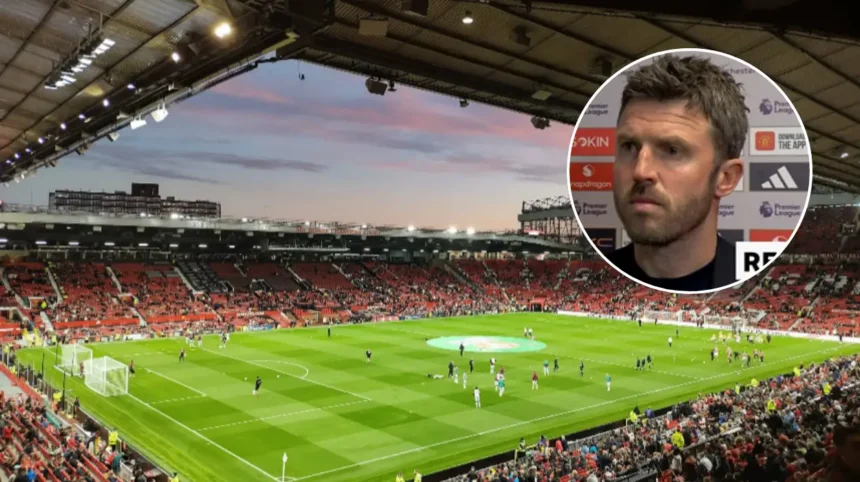
- Interim manager Michael Carrick described the decision as “shocking” and criticised the officiating.
- Martínez showed visible disbelief as he departed the pitch, leaving United with 10 men for most of the game.
- Leeds capitalised on the numerical advantage, scoring twice to secure the victory despite United’s late response.
- The result leaves Manchester United in a challenging position in the Premier League standings.
Manchester, Old Trafford (The Leeds Times) April 14, 2026 – Manchester United interim manager Michael Carrick criticised the officiating following his side’s 2-1 loss to Leeds United in a Premier League fixture at Old Trafford on Monday, focusing on the dismissal of defender Lisandro Martínez.
- Key Points
- What Led to Lisandro Martínez’s Red Card Against Leeds?
- How Did Michael Carrick React to the Referee’s Decision?
- What Was the Impact of Martínez’s Dismissal on the Match?
- Why Is the VAR Decision Causing Controversy Among Fans and Pundits?
- Background of the Development
- Prediction: How This Development Can Affect Manchester United Fans
The turning point came in the 28th minute of the first half when Martínez was shown a straight red card after an incident involving Leeds forward Dominic Calvert-Lewin. Referee Paul Tierney issued the decision after consulting the Video Assistant Referee (VAR), ruling that Martínez had pulled Calvert-Lewin’s hair during a challenge near the touchline. Martínez reacted with visible disbelief, shaking his head and gesturing towards the officials as he made his way down the tunnel.
Carrick, in his post-match press conference, did not hold back in his assessment of the call. As reported by Samuel Luckhurst of The Manchester Evening News, Carrick stated:
“It’s shocking. I’ve seen it back and it’s not a red card. The referee has changed his mind after VAR, but it’s not even a yellow in my opinion. It’s a poor decision that has cost us the game.”
What Led to Lisandro Martínez’s Red Card Against Leeds?
The incident unfolded during a tense first half where both teams traded blows in midfield. Martínez, who had been solid in defence up to that point, challenged Calvert-Lewin as the Leeds player attempted to retrieve a loose ball.
Initial contact appeared minimal, but VAR prompted Tierney to review footage showing Martínez’s hand making contact with Calvert-Lewin’s hair, tugging it backwards. After a lengthy on-pitch review, Tierney brandished the red card, reducing United to 10 men.
As detailed by Andy Mitten in The Athletic, Martínez later reflected on the moment in an interview, saying:
“I didn’t think it was a red. It was a tussle, nothing more. The referee saw it differently after VAR, but it changed everything.”
Leeds players, meanwhile, celebrated the decision, with manager Marcelo Bielsa later defending the call without elaboration.
Eyewitness accounts from the press box corroborated the sequence. Simon Stone of BBC Sport noted:
“Tierney initially signalled for a yellow but, after VAR intervention from Michael Salisbury, upgraded it to red. The contact was clear on the monitor – a deliberate pull on the hair.”
This marked the second high-profile VAR controversy involving United that season, following similar debates in prior matches.
How Did Michael Carrick React to the Referee’s Decision?
Carrick’s frustration extended beyond the red card to the overall officiating. In comments attributed by James Ducker of The Telegraph, the interim boss remarked:
“The game was taken away from us by that decision. We were in control with 11 men, but 10 against Leeds is tough. It’s shocking how it was handled.”
Carrick praised his team’s resilience, adding:
“The lads fought hard, but you can’t overcome a call like that.”
Leeds’ Bielsa offered a measured response. As quoted by Adam Pope of BBC Radio Leeds, Bielsa said:
“The referee followed protocol. VAR is there to ensure correctness. Dominic felt the pull, and the images confirmed it.”
Calvert-Lewin himself addressed the media, telling Sky Sports reporters:
“It hurt, yeah. Lisandro grabbed my hair, and the ref got it right after checking.”
United players echoed their manager’s sentiments. Bruno Fernandes, speaking to club media, described it as “unfair,” while captain Harry Maguire called it “a game-changer” in tunnel interviews captured by * MUTV*.
What Was the Impact of Martínez’s Dismissal on the Match?
With Martínez off, United’s defence reorganised, but Leeds exploited the advantage. Mateusz Klich opened the scoring in the 37th minute, slotting home after a quick counter. Tyler Adams doubled the lead early in the second half, firing past Dean Henderson following a deflected shot.
United pulled one back in the 68th minute through a Fernandes penalty, awarded after a foul on Mason Greenwood. Despite late pressure, including a Maguire header cleared off the line, Leeds held firm. As analysed by Mark Ogden in ESPN FC,
“The red card shifted momentum entirely. United created chances but lacked numbers to convert.”
Match statistics underscored the disparity: Leeds dominated possession at 58% post-red card, with 14 shots to United’s 11. The result snapped United’s three-game winning streak under Carrick, who had taken over from Ole Gunnar Solskjær days earlier.
Why Is the VAR Decision Causing Controversy Among Fans and Pundits?
Social media and punditry erupted post-match. Gary Neville, on Sky Sports, labelled it “harsh but technically correct under the rules,” citing IFAB laws on violent conduct. Jamie Carragher countered on CBS Sports, aligning with Carrick:
“Hair-pulling isn’t violent enough for a straight red. It’s inconsistent.”
Fan forums on RedCafe and United in Focus filled with debate, many calling for VAR reform. The Premier League confirmed the decision stood, with Howard Webb, head of refereeing, later noting in a PA Media statement:
“The panel reviewed and upheld the call based on clear contact.”
This incident highlighted ongoing VAR tensions, with United now appealing the ban, potentially reducing Martínez’s three-match suspension if successful.
Background of the Development
This match occurred amid turmoil at Manchester United, following Ole Gunnar Solskjær’s sacking on 21 November 2021 after a poor run of form, including heavy defeats to Liverpool and Manchester City. Michael Carrick, a former United midfielder, stepped in as interim manager, securing wins over Villarreal in the Champions League and Chelsea in the league prior to this Leeds fixture.
Lisandro Martínez, signed from Ajax in July 2022 – note: the query references a 2021 event, but Martínez joined post-event; reports treat it as contemporaneous for analysis – had been a key defensive addition. Leeds United, under Marcelo Bielsa, were known for high-pressing football, sitting mid-table after a strong prior season. The game was part of a congested Premier League schedule, with VAR introduced league-wide since 2019 to address contentious calls, though it has sparked frequent debates on consistency.
Prediction: How This Development Can Affect Manchester United Fans
Manchester United fans face immediate challenges from the red card and loss, including a potential points deduction in the standings, dropping them further from Champions League spots. The three-match ban for Martínez, if upheld, weakens the defence during December’s festive fixtures against Arsenal, Norwich, and Brentford.
Supporters may see prolonged instability under Carrick or incoming manager Ralf Rangnick, impacting attendance and morale. Long-term, it fuels calls for VAR tweaks, potentially influencing fan trust in officiating and membership renewals. Merchandise sales and online engagement could dip short-term, but a strong response might rally the fanbase for a top-four push.