
Key Points
- Leeds United have requested and successfully secured an away fixture against Nottingham Forest to start their 2026/27 Premier League campaign.
- The strategic request to the Premier League was designed to maximize the off-season timeframe available for major structural work on the Elland Road stadium expansion.
- Construction crews initiated preparatory and demolition works immediately following the final home match of the 2025/26 season.
- Demolition milestones already completed include the tearing down of the old ticket office, the removal of the LUTV studio, the dismantling of older floodlights, and the knocking down of traditional banqueting suites.
- The redevelopment primarily focuses on a brand-new, enhanced West Stand, which marks the first stage of a comprehensive, multi-phase transformation project.
- The multi-million-pound project aims to elevate the total seating capacity of the historic stadium from 37,645 to approximately 53,000 spectators.
- Planning permission for this significant infrastructure project was formally granted by Leeds City Council’s Plans Panel earlier this year via an 11–1 majority vote.
- The structural changes will upgrade Elland Road to a UEFA Category 4 stadium, making the ground eligible to host elite international football tournaments and major showcase events.
- Following the season opener at the City Ground on August 22, Leeds United will play their first home game against Brentford at Elland Road on August 29.
- The club’s 2026/27 Premier League fixture schedule will conclude with an away game against Crystal Palace at Selhurst Park.
Leeds United (The Leeds Times) June 23, 2026 – In a calculated logistical move aimed at safeguarding the timeline of their extensive stadium infrastructure project, Leeds United have intentionally structured the opening of their upcoming domestic campaign to buy crucial development time. As reported by club media and local regional journalists covering the fixture releases, the West Yorkshire club requested that the Premier League hand them an away fixture for Matchday 1 of the 2026/27 season. The league compliance authorities duly granted the request, assigning the Whites a trip to Nottinghamshire to face Nottingham Forest at the City Ground on Saturday, August 22
- Key Points
- What Structural Changes Are Currently Taking Place at Elland Road?
- Who Approved the Major Expansion of the Leeds United Stadium?
- Background of the Elland Road Redevelopment Plan
- Prediction: How the Expansion and Fixture Request Will Affect the Fanbase and the Team
- Impact on the Supporters and Ticket Access
By scheduling the opening competitive fixture away from West Yorkshire, Leeds United have effectively extended the secure window for heavy machinery and structural construction teams to operate without the logistical complications of hosting tens of thousands of matchday supporters.
The additional week will prove instrumental in advancing the foundational work on the brand-new West Stand before Elland Road reopens its gates to the public for the first home match of the season against Brentford on Saturday, August 29.
What Structural Changes Are Currently Taking Place at Elland Road?
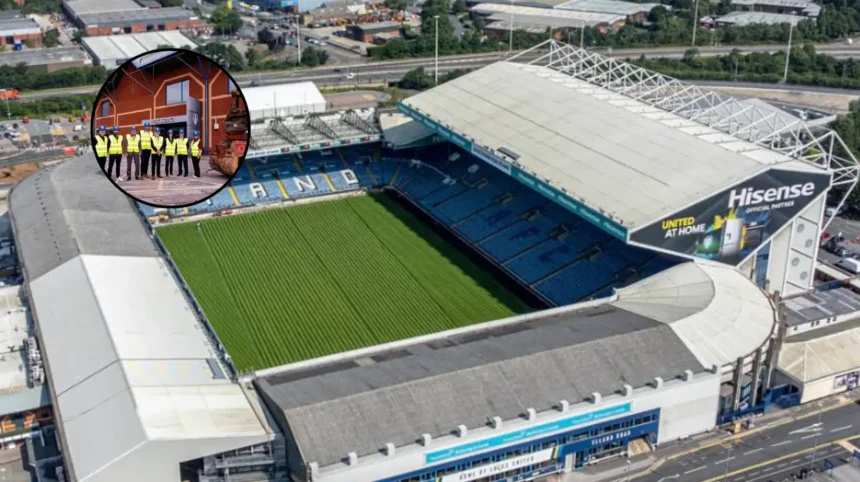
The visual landscape of LS11 has shifted dramatically since the conclusion of the 2025/26 home campaign. As reported by structural updates from the architectural planning brief, major construction teams moved into the stadium footprint almost immediately after the final whistle of the last home match against Brighton & Hove Albion.
The initial phase of construction requires extensive clearing of older external and internal buildings attached to the decades-old West Stand.
Journalists tracking the construction progress have confirmed that several prominent pieces of club infrastructure have already been completely dismantled or demolished.
Among these are the old stadium ticket office and the long-standing LUTV television studio. Furthermore, engineers have overseen the removal of several traditional floodlight pylons to clear overhead airspace for heavy crane operations, alongside the total knocking down of the stadium’s older banqueting suites.
Who Approved the Major Expansion of the Leeds United Stadium?
The rapid acceleration of work on-site follows a definitive legal milestone reached earlier this calendar year. As reported by municipal correspondents covering Leeds City Council, the local authority’s Plans Panel voted heavily in favour of the club’s comprehensive modernization blueprints.
The panel passed the application with a decisive 11–1 majority vote, legally clearing the path for the club to transform its century-old home.
Following the receipt of the formal planning permission, senior leadership at the club expressed their long-term vision for the sporting franchise. As recorded in public council documentation, Leeds United Chairman Paraag Marathe stated that:
“We are delighted to have secured planning permission for the expansion of Elland Road Stadium. This is a historic day for Leeds United Football Club. As custodians of this great club, we are committed to its long-term success, and today’s decision supports our ambition to establish Leeds in the Premier League and continue progressing over the years to come.”
Similarly detailing the community integration and extensive public consultation, Leeds United Chief Business Officer Morrie Eisenberg noted that:
“From setting out our initial ambitions for Elland Road in late September 2024 to receiving planning approval today, the progress we have made is something we are immensely proud of. This has been a truly collective effort, with Leeds City Council, our local communities in Holbeck and Beeston, National Highways, our expert advisers and, most importantly, our supporters all pulling together to reach this milestone.”
Eisenberg further emphasized that public feedback showed an overwhelming 98% approval rating from local respondents, underscoring the city’s shared desire to see the stadium modernised.
Background of the Elland Road Redevelopment Plan
The drive to expand Elland Road has remained a central priority for the club’s ownership group, 49ers Enterprises, since they initially acquired minority stakes in the club in 2018, before taking full operational control.
For years, the stadium’s physical capacity of 37,645 has acted as a financial bottleneck for the club. Demand for matchday tickets has vastly outstripped supply, evidenced by a documented, stagnant season ticket waiting list that exceeds 26,000 hopeful supporters.
Financially, sports business reports indicate that Leeds United generated roughly £30 million in matchday revenue during prior top-flight campaigns, averaging close to £1.5 million per home game.
By increasing the capacity to 53,000 seats through the systematic reconstruction of both the West and North Stands, sports finance experts project that the club can significantly increase its yearly matchday income, while injecting roughly £29 million annually into the wider Leeds City Region economy.
Architecturally, the project is being handled by KSS Group and BDP Pattern—the same design minds responsible for the successful multi-phased expansion of Liverpool’s Anfield stadium.
The development is deliberately split into distinct segments to ensure that the stadium can continue to remain open and safely host matchday crowds throughout the multi-year build cycle.
Phase one centers entirely on the high-capacity West Stand, while phase two will eventually pivot to modernizing the North Stand and making targeted alterations to the South Stand.
Prediction: How the Expansion and Fixture Request Will Affect the Fanbase and the Team
The short-term and long-term impacts of this development will create distinct waves across the club’s primary audiences, particularly the travelling matchday squad and the broader local fan community.
In the immediate short term, starting the season at the City Ground places an enhanced physical and psychological demand on Daniel Farke’s squad. Beginning a grueling Premier League campaign away from home robs the team of an opening-day atmospheric advantage at Elland Road.
Furthermore, because the season concludes with a trip to South London against Crystal Palace, the team will bookend their entire year on the road, meaning any critical final-day relegation fight or European qualification push must be secured on away turf.
However, if the squad can navigate the opening fixture against Nottingham Forest successfully, returning to a partially updated Elland Road against Brentford on Matchday 2 could provide a massive psychological lift.
Impact on the Supporters and Ticket Access
For the vast fan community, the temporary discomfort of waiting an extra week for a home game will be heavily outweighed by the long-term benefits of the expansion.
Once the new West Stand is fully integrated and the total capacity scales toward the 53,000 threshold, thousands of fans who have spent years locked out on the 26,000-person season ticket waiting list will finally secure regular access to matches.
The introduction of state-of-the-art general admission concourses, improved sightlines, upgraded corporate hospitality suites, and enhanced accessibility options will fundamentally modernize the matchday experience, all while the architectural team works to retain the signature, acoustic roar that makes Elland Road one of the most intimidating destinations in English football.