

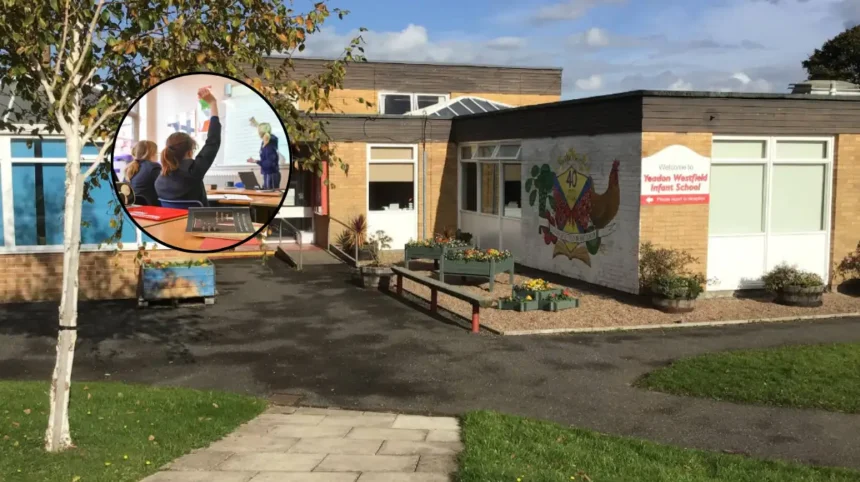
Key Points
- Two schools in Yeadon, Leeds – Yeadon Westfield Infant School and Westfield Junior School – are set to be merged if a proposal is approved by Leeds City Council leaders.
- The governing body of Yeadon Westfield Infant School proposes extending its age range from three to seven years to three to 11 years, effectively turning it into a primary school.
- Westfield Junior School, on New Road, would close from 31 August, with pupils transferred to the existing infant site on Westfield Grove from September.
- The proposal will be discussed by Leeds City Council’s executive board on 17 June.
- A statutory consultation is underway, with views being sought from parents, head teachers, ward councillors and trade unions, as reported by the Local Democracy Reporting Service and reproduced by outlets including Yahoo News and local coverage.
Yeadon (The Leeds Times) April 23, 2026Yeadon Westfield Infant School students could be taught alongside their former junior‑school peers in one re‑formed primary school from next September if Leeds City Council’s executive board approves a merger proposal later this year. Under the plan, pupils from Westfield Junior School would move to the existing infant school on Westfield Grove when the junior site on New Road closes on 31 August.
As reported by the Local Democracy Reporting Service, the governing body of Yeadon Westfield Infant School has submitted a proposal to Leeds City Council that would change the infant school’s age range from three to seven years to three to 11, effectively converting it into a full primary school. The draft council report notes that
“the infant school would become a primary school whilst Westfield Junior School would discontinue with effect from 31 August”,
with the new arrangement set to take effect from 1 September.
The reorganisation is being put forward as a statutory change, meaning the council must formally consider and decide on the merger. A council executive report, quoted by Yahoo News and local outlets, states that the move would maintain a single school site in Yeadon serving pupils aged three to 11, while the existing junior school would cease operating. Officials have framed the proposal as a way of reshaping provision to match projected pupil numbers and long‑term planning for the area’s education estate.
How the proposal came about
The Local Democracy Reporting Service, which syndicates coverage of local councils across England and Wales, notes that the governing body of Yeadon Westfield Infant School initiated the proposal and that the plans were formally notified to parents and the community via a statutory notice.
Under the Local Government and Public Involvement in Health Act 2007, school reorganisations of this scale require a formal consultation and council authorisation before they can proceed.
A notice published on the Public Notice Portal for the area near LS19 7NQ states that Westfield Junior School proposes to discontinue (close) with effect from 31 August 2026, and that “the infant school would become a primary school” as part of the same statutory process.
The notice also confirms that the consultation is being conducted in accordance with the prescribed regulations, including the requirement to seek views from local stakeholders such as parents, head teachers from nearby secondary schools, ward councillors and trade unions.
What the consultation is asking
According to the Local Democracy Reporting Service, the consultation is asking parents, staff and other key groups to comment on the proposed merger, including how it might affect class sizes, school transport, the built environment, and the capacity of the infant‑school site to host the enlarged roll.
The council’s report notes that the governing body believes the infant‑school site has the physical and staffing capacity to accommodate the extended age range, though this is one of the points being tested in the consultation.
The report, as cited by Yahoo News and local coverage, emphasises that the consultation is being conducted in line with statutory guidance. It lists that responses will be considered by the school governors and then by Leeds City Council’s executive board when deciding whether to approve the merger.
The council has also stressed that the consultation includes trade unions, reflecting the statutory requirement to consult on staff implications such as redeployment and potential redundancies.
What the closure and transfer would mean for pupils
If the proposal is approved, pupils currently at Westfield Junior School would leave the New Road site at the end of August and transfer to the infant‑school site on Westfield Grove from the start of the new term in September.
The council’s report, quoted by Yahoo News, states that the existing infant school would “become a primary school” while the junior school “would discontinue”.
Local parents have been told there would be no immediate change to class structures beyond the re‑roll‑over of the junior‑school cohort onto the infant site, but precise arrangements for timetabling, staffing and facilities sharing will depend on the consultation findings and the council’s final decision.
The Local Democracy Reporting Service notes that the governing body has indicated it expects the merger to help stabilise pupil numbers and create a single, more resilient primary school for the Yeadon community.
What happens next and who makes the decision
The formal decision on whether to approve the merger will rest with Leeds City Council’s executive board, which is scheduled to discuss the proposal on 17 June.
The council’s report, as referenced by Yahoo News and other outlets, states that the board “will consider the governing body’s proposals and the consultation responses” before deciding whether to permit the change in age range and the discontinuance of Westfield Junior School.
If the board approves the plan, the council will then publish a formal decision notice and, where required, give notice of any impact on staff under the Transfer of Undertakings (Protection of Employment) Regulations (TUPE).
The consultation period is designed to ensure that families, staff and local representatives have had a chance to raise concerns before the executive board meets.
Background of the development
Reorganisations of infant and junior schools into combined primary schools are not uncommon in areas where local authority projections show falling or uneven pupil numbers across separate key‑stage sites. In recent years, several councils in England have moved to consolidate schools or reconfigure age ranges to match changing demographics and available funding.
In Yeadon, Westfield Infant and Westfield Junior have operated as separate institutions serving different age bands, with the infant school taking pupils from three to seven and the junior school covering seven to 11. The current proposal marks a shift from that two‑school model to a single primary‑school structure, which the governing body says would streamline governance, reduce overheads and offer a more consistent experience for pupils moving through the school system.
The statutory notice framework being used – including the explicit statement that the infant school “would become a primary school” while the junior school “would discontinue” – follows established procedures for school reorganisation in England.
The framework is designed to ensure that any closure or merger is subject to independent scrutiny, stakeholder feedback, and, ultimately, a formal council decision.
Prediction and impact on the audience
For parents of pupils at both Yeadon Westfield Infant and Westfield Junior Schools, the merger could mean a change in where their children are taught from the autumn term, with all pupils moving to the Westfield Grove site. If the proposal proceeds, families may need to adjust to new drop‑off and pick‑up patterns, as well as any changes to the school’s after‑school provision or facilities layout.
For staff at Westfield Junior School, the proposal raises questions about redeployment within the enlarged primary school or potential redundancies, depending on the council’s final decision and how staffing levels are rebalanced. Trade unions, which are being consulted as part of the process, are likely to monitor how the council and governing body manage any impact on jobs and working conditions.