Key Points
- Underage Arrest: A 14-year-old child was arrested by West Yorkshire Police on school grounds in Leeds for the possession of a bladed weapon.
- Escalating National Concern: The incident comes amid newly released official data showing that juveniles aged 10 to 17 account for 18% of all knife possession cautions or convictions across the United Kingdom.
- Multi-Agency Response: Educational institutions across Leeds are strengthening collaborations with the National Health Service (NHS) and local police to deliver active preventative initiatives, including Project Shield and the Junior Detective Programme.
- Safeguarding Focus: School leaders and healthcare professionals emphasise that root causes are heavily tied to socio-economic vulnerabilities, exploitation, and peer anxieties rather than direct criminal intent.
Leeds (The Leeds Times) June 6, 2026 — A 14-year-old pupil has been taken into police custody following an arrest for possessing a bladed weapon on a school ground in Leeds. The incident, which has renewed intense local scrutiny over youth safety, coincides with the publication of broad regional and national figures tracking the prevalence of sharp instruments within educational environments. In response to the discovery, headteachers, emergency medical consultants, and West Yorkshire Police have accelerated early-intervention measures across the city, aiming to balance robust security enforcement with multi-agency pastoral care to preserve classrooms as safe environments.
- Key Points
- What are the Specific Details Surrounding the Leeds School Ground Arrest?
- How are Local Authorities and Emergency Services Reacting to the Disclosed Statistics?
- What Statements Have Been Issued by Educational Leaders Regarding Classroom Safety?
- What Strategic Projects are Currently Operating Across Leeds to Deter Weapon Carrying?
- Background of Youth Knife Possession and School Safeguarding Policies
- Prediction: How these Developments May Affect Local Communities, Parents, and Pupils
What are the Specific Details Surrounding the Leeds School Ground Arrest?
As documented by regional police logs, West Yorkshire Police officers were dispatched directly to a local educational property after staff identified a pupil carrying a bladed object. The 14-year-old suspect, whose identity remains protected under strict UK legal provisions for minors, was apprehended without any physical injuries being reported on the scene.
According to official briefings provided by West Yorkshire Police, the arrest forms part of an ongoing operational pattern where sharp articles are discovered during routine school monitoring or via peer-to-peer disclosures.
The police have reaffirmed that their primary objective remains defensive intervention. Local authorities noted that while the event caused immediate concern among parents and the local community, internal safeguarding protocols were successfully activated by school staff to isolate the danger before any escalation occurred.
How are Local Authorities and Emergency Services Reacting to the Disclosed Statistics?
The arrest has brought city-wide anti-violence strategies back into focus. Writing on the implementation of specialized educational workshops, West Yorkshire correspondent Dr Helen Mollard, a Children’s Emergency Department Consultant at Leeds Teaching Hospitals NHS Trust, stated that clinical staff are becoming increasingly concerned about the rising numbers of knife crime incidents encountered in young people under 16 years of age.
Mollard explained that by delivering proactive classroom sessions, emergency medics hope to educate young people about the severe risk of stab wounds while teaching important life-saving techniques, such as Cardiopulmonary Resuscitation (CPR) and accurate emergency 999 reporting.
The initiative works in direct alignment with West Yorkshire Police’s Integrated Offender Management 6th Prison Hub Team.
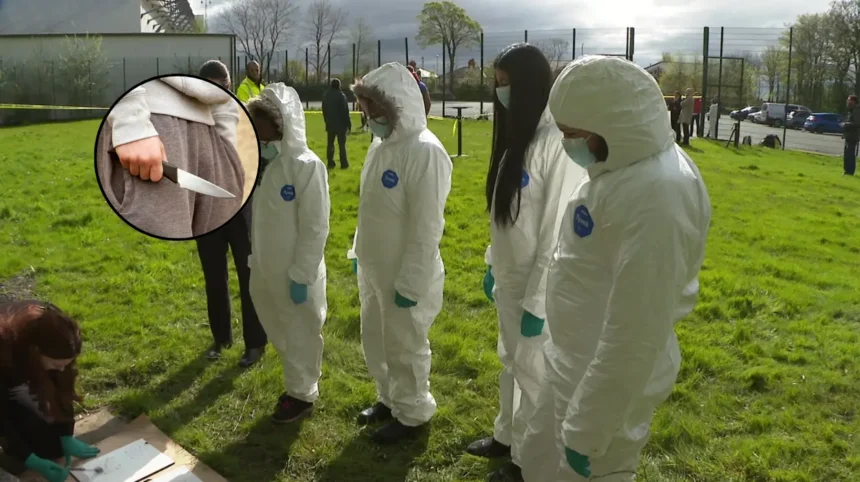
Specialist officers have initiated immersive instructional scenarios, such as the Junior Detective Programme, at institutions including Ralph Thoresby School and Leeds City Academy. These interventions allow Year 8 and Year 9 pupils to follow a fictionalized weapon investigation, tracing the impact of weapon possession from forensic discovery up to a simulated trial at Leeds Crown Court.
What Statements Have Been Issued by Educational Leaders Regarding Classroom Safety?
School administrators have firmly rejected the idea that schools are becoming hostile environments, instead highlighting their ongoing status as secure hubs for youth development. As reported by communications officers from the Leeds Rhinos Foundation—a key partner in distributing knife-prevention resources—the community response has focused heavily on peer leadership.
Tom Dennett, Head of Religious Studies and Citizenship at Ralph Thoresby School, stated that
“education is the key to shaping the future.”
Dennett further remarked that by working directly with hospital staff and West Yorkshire Police, schools are giving students real-life insights into the structural impact of knife crime while teaching vital first-aid skills that could save lives. He observed that these programmes empower students to act as positive ambassadors within their own neighbourhoods.
Similarly, during a broader evaluation of youth safety campaigns in West Yorkshire, Chief Inspector Lucy Leadbeater of the Leeds District Partnerships stated that
“tackling knife crime remains a key priority for the police and our partner agencies.”
Leadbeater emphasized that the voices of young people carry more significant weight within their immediate peer groups than external figures, meaning early intervention and student-led advocacy are essential to safeguarding vulnerable minors from criminal exploitation.
What Strategic Projects are Currently Operating Across Leeds to Deter Weapon Carrying?
To address the issue structurally, Leeds has integrated its separate educational policies into a unified strategy known as Project Shield.
Backed directly by Safer Leeds and the West Yorkshire Violence Reduction Partnership, Project Shield operates on the premise that knife possession cannot be solved via punitive policing alone.
The scheme incorporates charitable input from organizations like St Giles Trust. Reflecting on the implementation of preventative measures, Iain Hadley, the St Giles Head of Service for Yorkshire, stated that their teams are dedicated to creating a safe space for young people to see all angles and consequences of serious youth violence and exploitation linked to gangs.
Hadley highlighted that utilizing personnel with lived experience helps provide young people with the foresight required to make safer decisions when facing peer pressure outside the school gates.
Academic institutions are also dedicating long-term research assets to the issue. Professor Sonia Kumar, Professor of Medical Education at the University of Leeds, stated that
“there is an urgent need to turn the tide against knife crime.”
Kumar confirmed that the university’s School of Medicine and School of Law are actively partnering with local emergency services to maximize the societal impact of these preventative school programmes.
Background of Youth Knife Possession and School Safeguarding Policies
The challenge of managing bladed articles in modern British schools reflects a decade-long shift in how youth violence is categorized by the Home Office, the Department for Education, and the broader Criminal Justice System (CJS).
According to statistical reviews published in Hansard from the UK Parliament, juveniles aged 10 to 17 account for nearly a fifth of all weapon possession infractions nationwide. Historically, the response to these findings relied heavily on exclusion and criminal processing; however, contemporary safeguarding research has altered this trajectory.
Analyses compiled by the Youth Endowment Fund (YEF) and Ofsted demonstrate that the vast majority of minors found with weapons fall into highly specific categories of vulnerability.
National data indicates that 65% of children who admitted to carrying a weapon had been victims of physical violence themselves within the preceding 12 months, while a significant percentage were navigating systemic challenges such as criminal exploitation, local gang rivalries, domestic instability, or severe poverty.
Consequently, over the past five years, the UK educational sector has transitioned toward a “public health model” of violence reduction.
This background context explains the design of Project Shield in Leeds, which treats weapon carrying as a symptom of external social pressures rather than an isolated disciplinary failure. By treating the school environment as a critical zone for early intervention, current policies prioritize weapon detection alongside trauma-informed mentorship, seeking to break the cycle of fear that frequently drives teenagers to carry weapons for self-defence.
Explore More Leeds Crime News
Leeds Drug Dealer Jailed After Throwing £14k Stash at Police (Leeds, 2026)
Police Hunt Recalled Sex Offender Zain Alabdeen Osman: Leeds 2026
Prediction: How these Developments May Affect Local Communities, Parents, and Pupils
The release of these latest arrest figures, combined with the visible expansion of joint police-medical programmes in classrooms, is expected to influence the daily experiences of families, educational staff, and children across Leeds in several distinct ways:
- For Parents and Guardians: Families will likely encounter more formal communication from schools detailing updated zero-tolerance weapon policies and mandatory search protocols. While these disclosures may initially increase parental anxiety regarding local safety, the standardized transparency is designed to build long-term confidence in institutional security. Parents will also be increasingly expected to monitor digital footprints, as modern youth data proves a strong correlation between weapon exposure on social media and physical knife carrying.
- For Pupils and the Youth Demographics: Students will see a noticeable shift from passive assemblies to highly interactive, mandatory safety training. As peer-ambassador programmes expand under Project Shield, the social dynamics within school corridors may alter, making the carrying of objects socially unacceptable among peer groups. For the vulnerable minority of students facing external exploitation, these developments mean an increased likelihood of early identification by trained staff, potentially redirecting them toward social services rather than the criminal court system.
- For Educators and School Staff: Teachers and pastoral teams will face higher administrative demands regarding safeguarding compliance. Training sessions will increasingly require staff to identify the early indicators of exploitation. Schools will continue to navigate the complex boundary of maintaining an open, supportive learning environment while enforcing strict legal security boundaries on school grounds.