
Food insecurity requires immediate, structural intervention. In Headingley, a suburban area within the city of Leeds, individuals facing financial crises can access emergency nutritional support through localized infrastructure. Navigating this network effectively necessitates understanding the distinction between independent providers, municipal frameworks, and referral systems. This comprehensive guide outlines exactly how to secure emergency food provisions safely, legally, and rapidly within the LS6 postcode and surrounding West Yorkshire regions.
- What Is the System for Emergency Food Provision in Leeds?
- Definition and Operational Framework
- The Historical Evolution of Food Aid in West Yorkshire
- Key Organizational Components
- How Do You Get a Food Bank Voucher in Headingley?
- Where Are the Nearest Food Banks to Headingley?
- Geographic Distribution of Aid in LS6 and Surrounding Areas
- Right Choices Food Bank (Headingley Central)
- Burley Foodbank Centre (Leeds North and West Network)
- Woodhouse Foodbank Centre (Leeds North and West Network)
- How Does the Leeds Local Welfare Support Scheme Work?
- What Do You Receive in a Standard Emergency Food Parcel?
- Dietary Composition and Nutrition Standards
- Inventory Breakdown of a Standard Allocation
- Provisions for Specific Household Subcategories
- What Are the Implications and Long-Term Support Options?
What Is the System for Emergency Food Provision in Leeds?
Emergency food provision in Leeds operates via a structured ecosystem of independent charities, the Trussell Trust network, and municipal crisis grants. Individuals access these resources through either direct drop-in services or formal voucher referrals issued by frontline professional agencies.
Definition and Operational Framework
The emergency food network is designed to mitigate immediate nutritional deprivation. In Leeds, this system is divided into two operational models: closed-access systems and open-access systems.
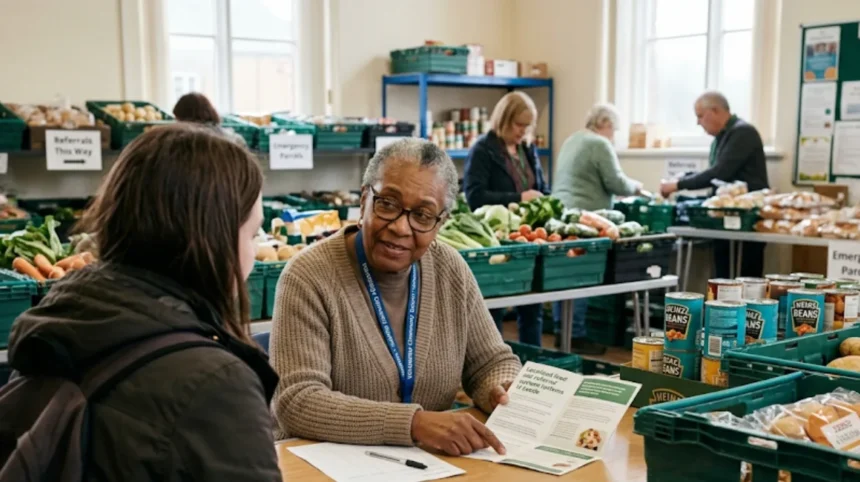
Closed-access systems require an external assessment by a verified professional who confirms the individual faces genuine financial destitution. Open-access systems, often referred to as community pantries, social supermarkets, or food drop-ins, allow self-referral or direct walk-ins, though they may charge a nominal membership fee or restrict usage geographically.
The Historical Evolution of Food Aid in West Yorkshire
Modern third-sector food distribution grew significantly following the 2008 global financial crisis and the subsequent implementation of the Welfare Reform Act 2012. This legislation altered national welfare structures, introducing universal credit and shifting crisis support to local authorities.
To prevent systemic gaps, the Leeds Food Aid Network (LFAN) formed to coordinate independent providers, faith groups, and municipal hubs. In 2025 alone, Leeds North and West Foodbank distributed 18,503 three-day emergency food supplies to individuals in crisis, highlighting the permanent structural nature of these interventions.
Key Organizational Components
The emergency food landscape near Headingley comprises three primary components:
- The Trussell Trust Network: A national network of food banks operating under a strict voucher system. In this sector, the Leeds North and West Foodbank operates multiple distribution centers near Headingley, such as the Burley Foodbank Centre at St Matthias Church Centre and the Woodhouse Foodbank Centre at Gateway Church.
- Independent Grassroots Projects: Organizations that operate outside national franchises, providing flexible entry requirements. An example is the Right Choices Food Bank, which operates directly out of the HEART Centre on Bennett Road in Headingley.
- Municipal Support Frameworks: Local government initiatives designed to provide financial and physical aid during acute emergencies. This includes the Leeds City Council Local Welfare Support Scheme (LWSS).
How Do You Get a Food Bank Voucher in Headingley?
To get a food bank voucher in Headingley, you must contact a registered referral agency—such as Citizens Advice Leeds, a local GP surgery, or a social worker—who assesses your financial crisis and issues an electronic or paper voucher code.
The Verification Mechanism
The voucher system ensures that emergency food resources are directed to individuals experiencing absolute financial crisis. Food banks managed by the Trussell Trust cannot distribute parcels directly to walk-in applicants without this document.
The voucher acts as a referral form, detailing the size of the household, specific dietary requirements, and the underlying cause of the crisis, such as benefit delays, low income, or unexpected debt.
Authorized Referral Gatekeepers
Vouchers are issued by professional entities who are in regular contact with vulnerable populations. In Leeds, authorized gatekeepers include:
- Citizens Advice Leeds: A central provider of free, confidential advice. Residents can contact the national Trussell Trust helpline at 0808 2082138 or the local office to complete an assessment over the telephone.
- Leeds City Council Community Hubs: Local authority centers combining library, housing, and registrar services. The nearest location for Headingley residents is the Woodhouse Lane Community Hub or the Reginald Centre in Chapeltown.
- Healthcare Professionals: Health visitors, district nurses, and General Practitioners (GPs) operating within local NHS practices, such as the Headingley Medical Centre or Kirkstall Lane Medical Centre.
- Social Services and Education Providers: Social workers, housing support officers, and family support workers attached to local primary schools, such as Shire Oak Primary School or Headingley Methodist Primary School.
Step-by-Step Referral Process
The process of acquiring and redeeming a voucher follows a precise sequence to maintain auditable tracking:
1.Contact an Authorized Agency:Immediate.
Call Citizens Advice on 0808 2082138 or visit a Leeds City Council Community Hub to speak with an adviser.
2.Complete the Financial Assessment:10-15 Minutes.
Provide details regarding your household income, fixed expenditures, benefit status, and immediate crisis factors.
3.Receive the Voucher Code:Instant upon approval.
The adviser issues a unique data code via text, email, or physical paper, specifying your household size (e.g., single, couple, or family).
4.Locate the Assigned Distribution Centre:Same day or next open session.
Identify the nearest operating food bank branch and verify its opening hours before traveling.
Where Are the Nearest Food Banks to Headingley?
The nearest food banks to Headingley are the Right Choices Food Bank at the HEART Centre, the Burley Foodbank Centre at St Matthias Church Centre, and the Woodhouse Foodbank Centre at Gateway Church on St Marks Road.
Geographic Distribution of Aid in LS6 and Surrounding Areas
Headingley sits within the LS6 postcode, bordered by Burley (LS4), Kirkstall (LS5), and Woodhouse (LS2). Because food bank distribution centers operate on specific days for restricted hours, residents must utilize the center that matches their immediate availability and referral criteria.
Right Choices Food Bank (Headingley Central)
The Right Choices Food Bank is an independent service operating within the HEART (Headingley Enterprise and Arts Centre) complex on Bennett Road, Leeds, LS6 3HN. This project is entirely volunteer-led and runs every Monday between 11:00 AM and 1:00 PM.
In addition to its static site, Right Choices operates a specialized delivery service tailored explicitly for vulnerable, isolated, or mobility-impaired individuals residing within the LS2, LS3, LS4, LS5, and LS6 sectors. Referrals and direct service inquiries are managed via telephone at 07505 865317.
Burley Foodbank Centre (Leeds North and West Network)
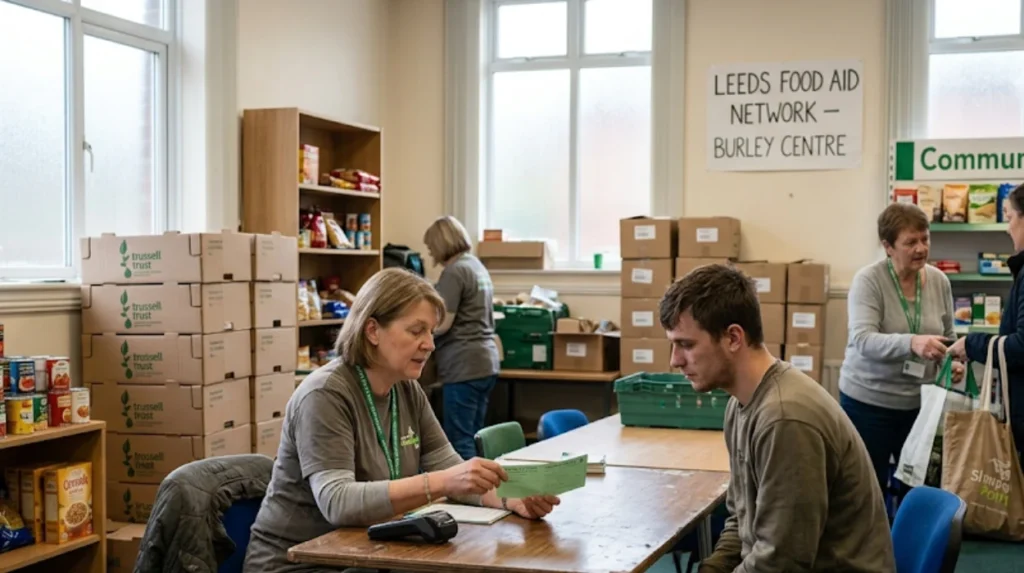
Located at the St Matthias Church Centre on St Matthias Street, Burley, Leeds, LS4 2DZ, this site is an official branch of the Leeds North and West Foodbank network. It serves individuals who possess a valid Trussell Trust voucher. The location provides geographical proximity for residents living in South Headingley and the Cardigan Road corridor.
Woodhouse Foodbank Centre (Leeds North and West Network)
Situated at Gateway Church within St Marks Church, St Marks Road, Leeds, LS2 9AF, this center represents another vital hub for the LS6 population. It requires a formal voucher referral and connects service users with broader advice frameworks, including fuel grant applications and debt management pathways.
How Does the Leeds Local Welfare Support Scheme Work?
The Leeds Local Welfare Support Scheme is a municipal emergency fund operated by Leeds City Council that provides direct, non-repayable assistance—including emergency food parcels and fuel vouchers—to residents facing immediate severe crises.
Statutory Framework and Eligibility
The Local Welfare Support Scheme (LWSS) acts as a safety net of last resort under local authority control. To qualify for emergency food or fuel assistance through this route, applicants must fulfill specific institutional criteria:
- The applicant must be a resident of Leeds aged 16 years or older.
- The household must possess fewer than £150 in accessible liquid capital or savings.
- The applicant must be in receipt of, or actively applying for, qualifying non-contributory benefits. Examples include Universal Credit, Income Support, Jobseekers Allowance (JSA), Employment and Support Allowance (ESA), or Guaranteed Pension Credit.
Application Processing Protocols
Applications are completed online or via telephone through the dedicated municipal team at 0113 3760330 (Freephone 0800 9532303). The service operates Monday through Friday from 9:00 AM to 4:00 PM, with a delayed opening on Wednesdays at 10:00 AM.
The council conducts rigorous checks, including direct verification of benefit data with the Department for Work and Pensions (DWP). Applicants must submit bank statements from the previous 30 days via digital upload to prove financial distress. The standard institutional processing target is four working days from data submission to final award distribution.
Restrictions and Accountability
The scheme enforces strict anti-duplication parameters. The council explicitly states that approximately 80% of independent applications are refused due to a failure to meet the strict eligibility thresholds.
If an applicant has received an emergency food or energy award within the previous 12 months, subsequent applications undergo enhanced scrutiny. Exceptions are made for individuals fleeing domestic violence or those who are victims of recent disasters, such as a house fire or flash flooding.
Explore More Help & Resources
How to complain about First Bus delays in Garforth
How to report a pothole on Yeadon roads
What Do You Receive in a Standard Emergency Food Parcel?
A standard emergency food parcel contains a minimum of three days of nutritionally balanced, shelf-stable food items designed by dietitians to sustain an individual or family without access to alternative cooking resources.
Dietary Composition and Nutrition Standards
Trussell Trust and major independent parcels adhere to structural dietary guidelines developed in conjunction with the British Dietetic Association (BDA). The items are predominantly non-perishable to prevent spoilage and ensure ease of storage.
A standard allocation provides breakfast, lunch, and dinner options, emphasizing protein density and complex carbohydrates.
Inventory Breakdown of a Standard Allocation
A typical three-day crisis parcel contains a specific distribution of grocery items:
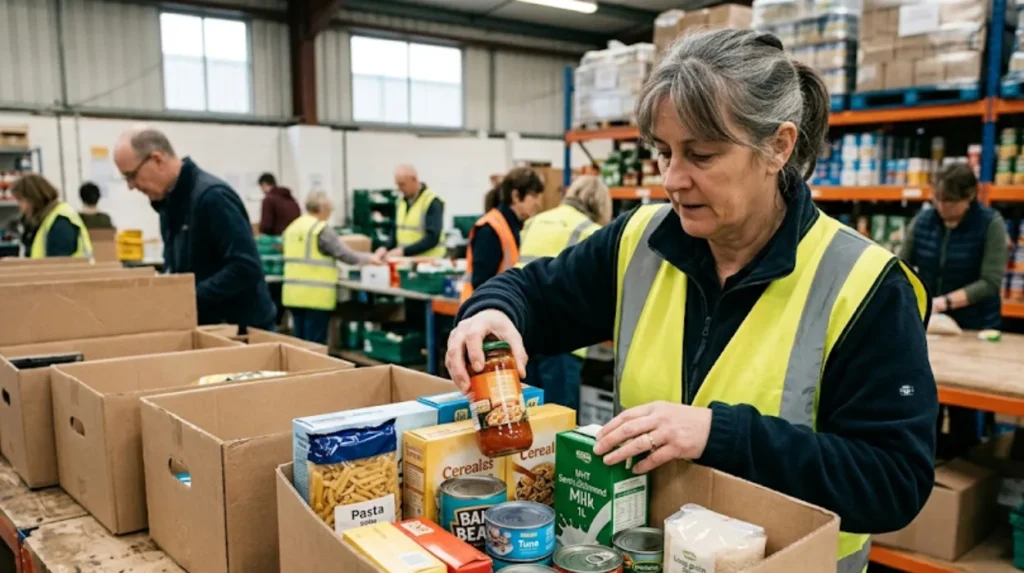
- Core Carbohydrates: Packets of dried pasta (usually 500g or 1kg depending on family size), long-grain rice, instant mashed potato, and boxes of breakfast cereals.
- Proteins and Pulses: Tinned meats (such as chopped pork, corned beef, or chicken tinned meals), tinned fish (tuna or sardines), tinned baked beans, and pulses like red lentils or chickpeas.
- Vegetables and Fruits: Tinned chopped tomatoes, tinned garden peas, tinned sweetcorn, and tinned fruits in light syrup.
- Dairy and Liquids: UHT long-life milk (semi-skimmed or whole), cartons of long-life fruit juice, and jars of instant coffee or boxes of tea bags.
- Condiments and Accompaniments: Jars of pasta sauce, savory biscuits, sweet biscuits, and jars of jam or honey.
Provisions for Specific Household Subcategories
Food banks accommodate distinct dietary profiles, health requirements, and cultural beliefs. When redeeming a voucher, users can request adjustments for specific subcategories:
Medical and Religious Exemptions: Centers maintain dedicated inventory streams for vegetarians, vegans, individuals requiring gluten-free products due to Coeliac disease, and Halal-compliant diets for the local Muslim population.
Furthermore, centers frequently supply non-food essentials based on donor availability. These items encompass infant supplies (baby formula and size-specific nappies), menstrual hygiene products (tampons and sanitary towels), and basic household cleaning reagents.
What Are the Implications and Long-Term Support Options?
The long-term implication of relying on emergency food banks is the risk of chronic nutritional instability. To transition away from crisis aid, individuals must engage with holistic debt, benefit, and housing support services across Leeds.
Transitioning From Emergency Aid to Sustainable Models
Food banks are designed strictly for short-term crisis mitigation, typically limiting voucher issuance to a maximum of three allocations within a rolling six-month period. To avoid long-term dependency, users are systematically routed toward sustainable food structures known as social supermarkets, food pantries, or food clubs.
In Leeds, initiatives like FoodWise Leeds promote the transition to community-led grocery schemes. These schemes allow members to pay a small weekly fee (typically £3.50 to £5.00) in exchange for a significantly higher value of fresh produce, chilled items, and ambient surplus stock.
Integrated Debt and Financial Advice Frameworks
Because food poverty is invariably a symptom of wider financial or structural insolvency, local support networks integrate advice directly into food distribution days. Resolving the root causes of food bank usage requires targeting three primary financial areas:
| Financial Focus Area | Core Intervention Strategy | Local Executing Organization |
| Debt Management | Formal debt relief orders, breathing space schemes, and structured repayment plans. | StepChange Debt Charity / Citizens Advice Leeds |
| Benefit Maximization | Welfare audits to ensure full entitlement to personal independence payments or housing allowances. | Leeds City Council Welfare Rights Team |
| Energy Affordability | Draught-proofing installations, green doctor audits, and utility trust fund applications. | Groundwork Yorkshire (Green Doctor Scheme) |
Targeted Welfare Initiatives for Families and Expectant Mothers
For households with young children, specific statutory mechanisms exist to supplement nutritional intake outside standard food bank channels. The NHS Healthy Start scheme provides digital payment cards for pregnant women (past 10 weeks) and families with children under the age of four.
This mechanism injects £4.25 per week during pregnancy, £8.50 per week per child from birth to one year old, and £4.25 per week per child aged between one and four. These funds are legally restricted to the purchase of fresh cow’s milk, infant formula, fresh or frozen fruit, and vegetables at registered commercial retailers.
Additionally, during school holiday periods, Leeds City Council executes the Healthy Holidays program. This initiative guarantees free, nutritious meals alongside physical activity sessions for school-aged children who qualify for income-based free school meals, preventing seasonal nutritional deficits across the city.
How can I get emergency food support in Headingley?
You can access emergency food support in Headingley through local food banks, community pantries, or Leeds City Council support schemes. Some services allow walk-ins, while others require a referral voucher.