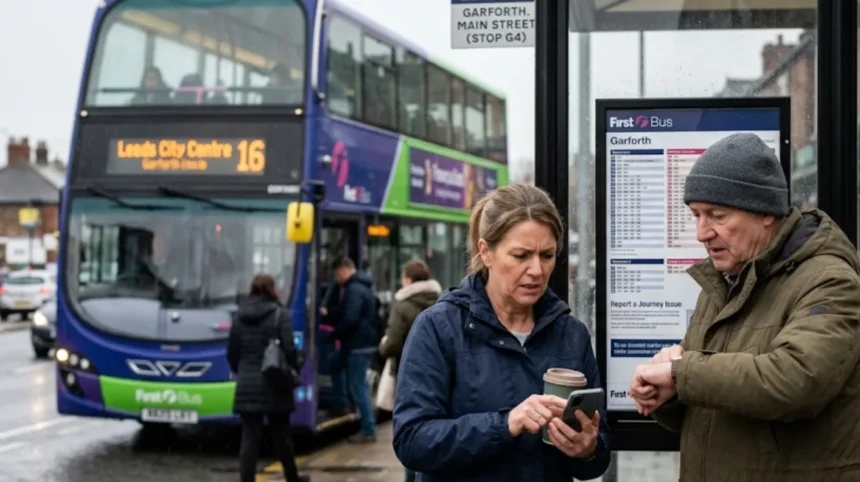
Delays on First Bus services in Garforth are usually handled first by the operator, then escalated to the national bus dispute body if needed. The main route for a formal complaint is to record the journey details, contact First Bus, and then allow 14 working days for a response.
- What counts as a First Bus delay complaint?
- Who should you complain to first?
- What details should you include?
- How do you send the complaint?
- What response should you expect?
- Can you report the delay elsewhere?
- What is the best complaint wording?
- Why does this matter for Garforth passengers?
- What should you do next?
What counts as a First Bus delay complaint?
A delay complaint covers a bus that arrives late, leaves early, does not stop, or does not turn up at all on a scheduled service in Garforth. The complaint should focus on one journey, one route, and one clear problem, such as a missed connection or repeated lateness.
A delay complaint is different from a general service comment. It concerns a specific transport failure on a specific date and time. For Garforth passengers, that can include services serving local stops, links into Leeds, or any First Bus route running through the area. The key issue is whether the service failed to match the published timetable.
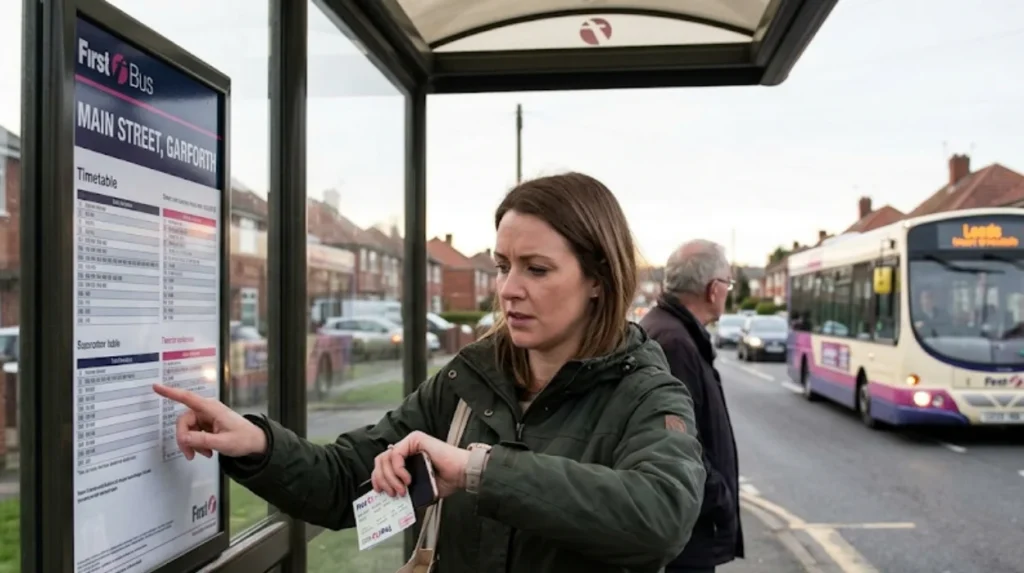
The strongest complaints include exact facts. Write down the date, time, route number, direction of travel, stop name, and what happened. If the bus was early, late, skipped your stop, or never arrived, say that clearly in one sentence. Transport complaint guidance also recommends keeping supporting evidence such as tickets and notes.
Who should you complain to first?
The first complaint should go directly to First Bus, because the operator is the organisation responsible for the service, its timetable performance, and any refund, apology, or compensation decision. If you are unhappy with the reply, you can take the complaint further.
First Bus lists a customer service phone number for enquiries: 0345 646 0707, with lines open 9am to 5pm, Monday to Friday. That gives passengers a direct contact route for service issues and follow-up questions.
A written complaint is usually better than a phone call because it creates a record. Use the First Bus complaint form or customer contact route where available, and keep a copy of everything you send. Complaint guidance for transport users says web forms are often the fastest route and should be concise and specific.
If First Bus does not resolve the issue or does not reply, the next step in England and Wales is Bus Users UK, the approved alternative dispute resolution body for bus and coach services. That gives passengers an independent escalation stage after the operator has been given a fair chance to respond.
What details should you include?
Include the date, time, location, route number, destination, and what the delay caused you to miss or lose. Add ticket details, photos, or notes if they support your case, and say exactly what outcome you want, such as an apology, refund, or explanation.
Strong complaints are specific. For example, “First Bus route 19 from Garforth to Leeds was 22 minutes late at 08:10 on Monday 12 May and I missed my connection” is much more useful than “the bus was bad.” That level of detail helps the operator check tracking data and timetable logs. Guidance from transport complaint bodies recommends short, direct complaints with supporting documents attached.
If you paid for a single journey, day ticket, or connected travel and the delay caused loss, include that information. If the disruption created extra costs, list them clearly and attach copies of receipts where possible. Keep the original documents for your own records.
If the same issue happens repeatedly on the same Garforth route, mention the pattern. Repeated delays matter because they show a timetable or operational problem rather than a one-off incident. That kind of evidence is useful when passengers want the operator to review service reliability.
How do you send the complaint?
Send the complaint through First Bus customer service channels, ideally in writing. Use the contact form if available, or call 0345 646 0707 for guidance, then follow up in writing so there is a clear record of the issue and your requested outcome.
A good complaint message has four parts. First, identify the journey. Second, describe the failure. Third, explain the impact on you. Fourth, state the remedy you want. That structure makes the complaint easy to process and reduces back-and-forth.
Keep the tone factual. Say what happened, not how angry you feel. Complaint guidance for transport users says the strongest submissions are short, clear, and supported by evidence. That applies whether the delay happened once or on several journeys across Garforth.
If you submit by email or form, save a copy and any reference number. If you submit by post, keep proof of postage and copies of all documents. Those records become important if you later escalate the issue beyond First Bus.
What response should you expect?
First Bus should respond to a complaint within 14 working days, according to official UK bus complaint guidance. If the operator does not respond in that period, or the response does not solve the problem, you can escalate the issue to Bus Users UK.
The response can include an explanation, an apology, a refund, or another form of resolution. The exact outcome depends on the ticket type, the disruption, and the operator’s policy. A passenger with a delayed journey normally has the strongest case when the bus failed completely, left early, or caused a missed connection.
If you are still waiting after the deadline, chase the complaint using the reference number. Mention the original journey details again and attach the original complaint copy. Clear follow-up often speeds up handling because the operator can locate the case more easily.
If the response is unsatisfactory, keep all correspondence. A full paper trail makes escalation easier and shows that you followed the normal process first. Transport complaint guidance consistently recommends retaining messages, receipts, and copies of supporting evidence.
Can you report the delay elsewhere?
Yes. In England outside London, passengers can report a late, early, missed, or non-stopping bus to DVSA as well as complain to the operator. DVSA handles reporting of service failures, while the operator handles customer redress such as refunds or apologies.
This creates two different routes. The operator route is for fixing your individual complaint. The DVSA route is for reporting the service problem itself. That means a Garforth passenger can pursue both if the issue is serious or part of a wider pattern.
The DVSA report form asks for details such as where you got on and off and the bus company running the service. That is useful for building a record of unreliable routes. It does not replace the operator complaint if you want direct compensation or an explanation.
For most passengers, the best order is simple: complain to First Bus first, then escalate if needed, and report to DVSA if the problem involved a route failure in England outside London. That sequence matches the standard guidance for bus complaints.
What is the best complaint wording?
The best complaint wording is direct, dated, and specific. State the journey, the route, the exact problem, and the result you want in one short paragraph before adding evidence or extra detail.
A strong opening line looks like this: “I am complaining about a delayed First Bus journey in Garforth on [date], route [number], because the bus arrived [minutes] late and caused me to miss [event, connection, appointment].” That sentence gives the operator all the core facts at once.
Then add the evidence. Include ticket numbers, screenshots of journey tracking if you have them, and any receipts linked to extra costs. If you were left at a stop because the bus did not stop, say so plainly and name the stop. The more precise the complaint, the easier it is to verify.
Avoid long background explanations. Keep the issue focused on one trip unless you are describing repeated delays on the same route. If you are reporting a pattern, give two or three dated examples rather than a vague statement that the service is often bad.
Explore More Help & Resources
How to get an autism assessment for your child in Guiseley
How to find affordable housing near Garforth now
Why does this matter for Garforth passengers?
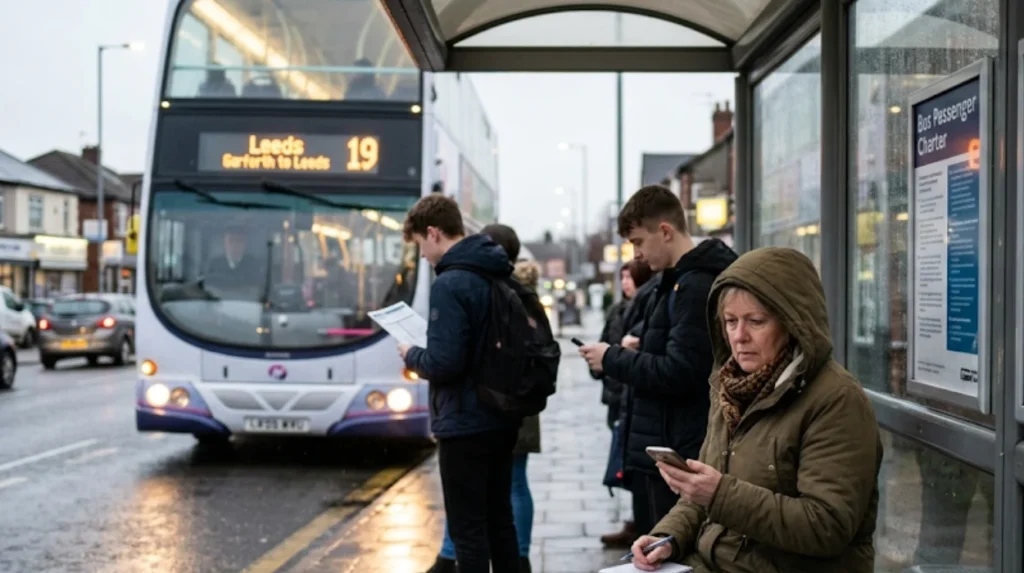
Reliable bus links matter in Garforth because delays affect access to Leeds, work, education, shopping, and connecting services. A clear complaint process helps passengers challenge poor punctuality and gives the operator evidence for service improvement.
Public transport complaint systems are designed to create accountability. When passengers submit dated, route-specific reports, operators can compare those reports with timetable data and vehicle tracking. That matters because repeated delay reports often point to scheduling issues, congestion, or operational problems.
For local passengers, the practical value is immediate. A successful complaint can secure a refund or apology, while repeated complaints can support wider service review. Even when the individual case is small, the record contributes to a stronger evidence base for route reliability.
That is why passengers in Garforth should keep every complaint factual and complete. A short, evidence-led complaint is more useful than a long emotional message, and it is more likely to be processed efficiently.
What should you do next?
Start by writing down the journey details, then send a written complaint to First Bus with your requested outcome. If the reply is missing or unsatisfactory, escalate to Bus Users UK, and report the service failure to DVSA if the route ran in England outside London.transportfocus.
Use the complaint to ask for one clear result, such as a refund, apology, or explanation. Attach supporting evidence and keep copies of everything. If you are dealing with repeated delays on the same Garforth route, include every dated example in one message so the pattern is visible.
The process is straightforward: document the problem, contact the operator, wait for a response, and escalate only if needed. That gives passengers the strongest chance of a fair outcome and helps build a record of service quality on local routes.
How do I complain about a delayed First Bus service in Garforth?
You should first contact First Bus directly by submitting a written complaint with your journey details, including the date, time, route number, and description of the delay.