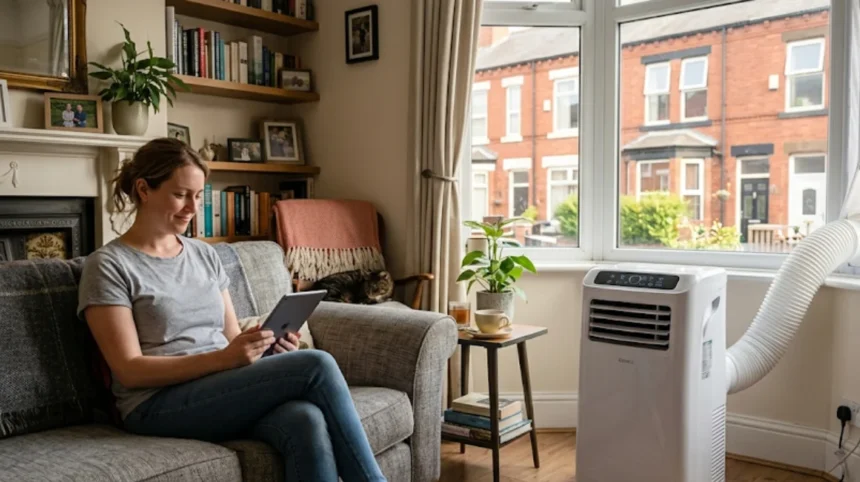
Portable air conditioning units are self-contained cooling appliances designed to cool one room at a time without permanent installation. For Leeds households, they offer a practical response to warmer summers, rented homes, and spaces where fixed air conditioning is not suitable.
- What is a portable air conditioning unit?
- Why do people in Leeds use portable air conditioning?
- How does a portable air conditioning unit work?
- What types of portable air conditioning units exist?
- How do you choose the right size for a room?
- What features matter most when buying one?
- How much electricity does it use?
- How can you use one efficiently?
- What are the main limitations?
- What regulations and efficiency rules apply?
- What is the best use case in Leeds?
- Why does it matter for the future?
What is a portable air conditioning unit?
A portable air conditioning unit is a movable cooling appliance that removes heat from indoor air and exhausts it outside through a hose. It cools one room, uses a window kit for venting, and needs access to a power socket and drainage or condensation management.
A portable air conditioning unit combines the compressor, evaporator, condenser, and fan in one cabinet. That makes it different from split air conditioning systems, where indoor and outdoor units are separate. Portable models suit flats, rented homes, offices, and bedrooms because they do not require wall-mounted installation.
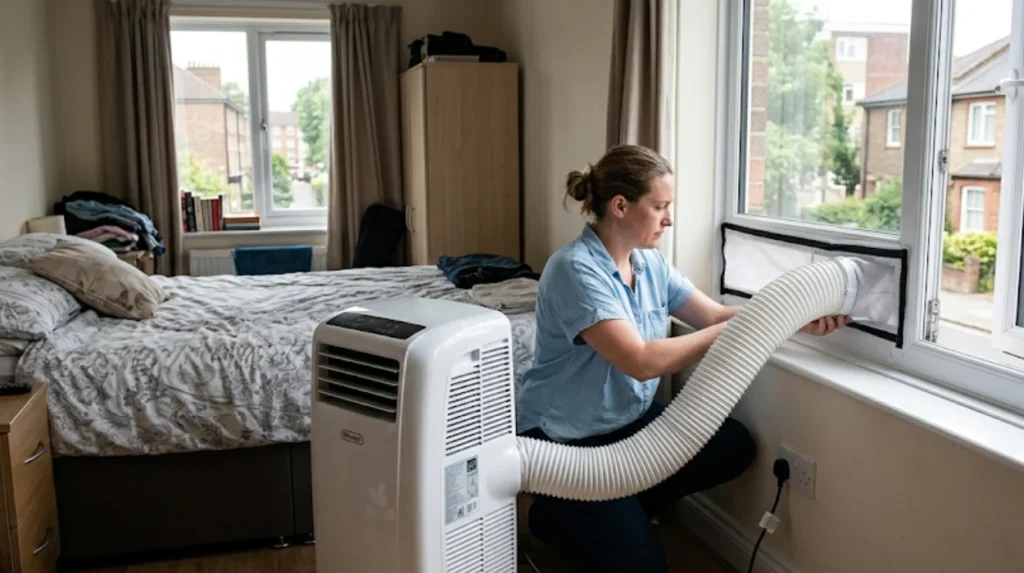
The core purpose is simple. The unit draws in warm room air, removes heat and moisture, and returns cooler air to the room. Hot air leaves through an exhaust hose, which usually fits into a window seal panel or window kit.
Why do people in Leeds use portable air conditioning?
People in Leeds use portable air conditioning for flexible, room-by-room cooling in homes that need fast relief from heat without permanent building work. It is especially relevant in flats, rentals, bedrooms, and home offices where installation rules, budgets, or space limit fixed systems.
Leeds has a mix of terraced housing, apartments, Victorian homes, student accommodation, and newer developments. That housing mix creates demand for cooling that is affordable, removable, and suitable for short-term or rented use. Portable units meet that need because they can move from room to room and store away when not needed.
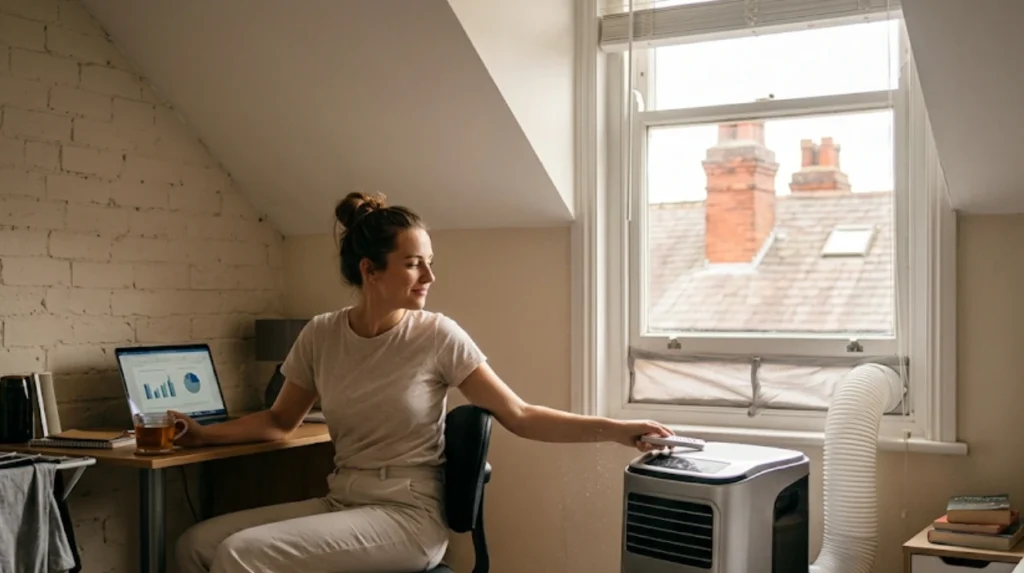
The local use case is practical rather than luxury-based. A portable unit helps during warm spells, in top-floor bedrooms, in south-facing rooms, and in spaces with multiple heat sources such as computers or kitchen appliances. It also supports home workers who need steady indoor temperatures during summer.
How does a portable air conditioning unit work?
A portable air conditioning unit works by pulling warm air from a room, cooling it through refrigerant-based heat exchange, and expelling hot air through an exhaust hose. The process also removes moisture, so the unit acts as both a cooler and a dehumidifier.
The cooling cycle starts when the fan draws warm air into the unit. The refrigerant absorbs that heat, and the cooled air is blown back into the room. The absorbed heat moves to the condenser side of the machine and exits through the hose as hot air.
Most portable units also collect water from condensation. Some drain it automatically through evaporation, while others need manual emptying or continuous drainage depending on humidity and model design. Because the machine removes moisture, it often makes a room feel less sticky even before the temperature drops sharply.
What types of portable air conditioning units exist?
Portable air conditioning units fall into several clear types, including single-hose units, dual-hose units, and units with heating or dehumidifying functions. Examples include compact bedroom units, higher-capacity family-room units, and multifunction models with heat-pump settings.
Single-hose models take indoor air, cool it, and send heat out through one hose. They are common and generally simpler, but they can create some negative pressure in a room because they expel indoor air outdoors. Dual-hose models use one hose for intake and one for exhaust, which supports more efficient operation in larger or hotter rooms.
Some portable air conditioners include a heating mode for colder months. Others focus purely on cooling and moisture removal. For Leeds homes, the right type depends on room size, insulation, window access, and how often the unit will be moved.
How do you choose the right size for a room?
The right size depends on room area, heat load, and insulation. BTU rating measures cooling power, and examples include about 7,000 to 9,000 BTU for small bedrooms, 12,000 BTU for medium rooms, and 18,000 BTU for larger rooms.
BTU means British Thermal Unit. It is the standard measure used to describe air conditioner cooling output. A smaller room needs less cooling power, while a larger, sunnier, or poorly insulated room needs more. Oversizing or undersizing reduces comfort and efficiency.
Room conditions matter as much as floor area. A south-facing room, a loft room, a room with many people, or a kitchen with heat-producing appliances needs more cooling capacity. For best results, users should match the BTU rating to room size and round up for difficult spaces.
What features matter most when buying one?
The most important features are cooling capacity, energy use, noise level, timer controls, thermostat accuracy, and the quality of the window vent kit. Examples include programmable timers, remote controls, sleep modes, washable filters, and smart app control.
Cooling capacity determines whether the unit actually cools the space. Energy use affects running cost, which matters in the UK where electricity prices remain a major factor for households. Noise level is especially important in bedrooms and home offices, and manufacturers often publish decibel ratings for comparison.
A timer and thermostat improve control because the unit runs only when needed. A good filter supports air quality by trapping dust and lint. A proper window kit also matters because poor sealing allows warm air to return and reduces performance.
How much electricity does it use?
Portable air conditioners use enough electricity to affect household bills, and running cost depends on wattage, time used, and tariff rate. An average UK unit can draw around 1,050 to 1,176 watts while running, which means several hours of daily use adds noticeable cost.
Wattage tells you how much power the unit consumes. To estimate hourly use, divide watts by 1,000 to convert to kilowatts. A 1,050-watt unit uses 1.05 kWh for each hour of operation, before tariff pricing is applied.
EDF’s UK example shows how that can translate into real-world expense, with average running estimates based on 2023 electricity prices and common daily usage patterns. That makes efficiency features, insulation, and sensible temperature settings important in Leeds homes where the unit may run during several warm afternoons or evenings.
How can you use one efficiently?
Efficient use depends on correct sizing, sealed ventilation, clean filters, reduced heat gains, and sensible temperature control. Examples include closing curtains, keeping doors shut, cleaning filters, and placing the hose so hot air escapes with minimal resistance.
Place the unit near a window so the exhaust hose stays short and straight. Seal the window opening properly, because leaks let outdoor heat return inside. Keep curtains or blinds closed during the hottest part of the day, and avoid placing the unit beside appliances that generate heat.
Cleaning matters as well. Dust reduces airflow and forces the compressor to work harder. Regular filter maintenance supports both cooling performance and indoor air quality. In practice, this is one of the simplest ways to keep running costs under control over a summer season.
What are the main limitations?
The main limitations are noise, limited coverage, hose management, energy use, and the need to manage condensation. Examples include louder operation than split systems, weaker performance in large open-plan rooms, and the need for window access for exhaust venting.
Portable units are practical, not perfect. They usually cool one room best, and they often work harder than fixed systems to achieve the same result. Noise is a common concern because the compressor stays inside the room, unlike split systems that place the noisy part outdoors.
The exhaust hose also creates a setup requirement. A unit without proper venting cannot remove heat effectively. In humid conditions, water collection and drainage also become part of regular use. These limits do not remove the value of portable cooling, but they define where it performs best.
What regulations and efficiency rules apply?
Portable air conditioning products sold in England, Scotland, and Wales are covered by energy labelling and ecodesign standards. These rules support clearer product comparison and minimum efficiency requirements for air conditioners and fans.
Government guidance on designated standards covers air conditioners and comfort fans in relation to ecodesign and energy labelling. That matters because consumers need consistent product information when comparing cooling appliances. It also helps the market distinguish between lower-efficiency and better-designed products.
For buyers in Leeds, this means product labels are useful, not decorative. They provide a first look at energy performance, capacity, and compliance-related details. Those labels should be checked alongside room size, noise, and hose configuration before purchase.
Explore More Help & Resources
How to get NHS dental care near Horsforth for free
How to complain about First Bus delays in Garforth
What is the best use case in Leeds?
The best use case in Leeds is a single hot room that needs temporary cooling, especially a bedroom, spare room, studio flat, or home office. Examples include top-floor flats, rented homes, and rooms where a permanent installation is not allowed or not worth the cost.
Leeds homes often combine older construction with modern occupation patterns, including remote work and shared living. That makes portable air conditioning attractive because it solves a focused problem without building work. It suits summer use, temporary accommodation, and households that need flexibility rather than whole-home cooling.
The best results come when the user treats it as a room appliance. It performs well when the room is closed, the hose is installed correctly, and the unit matches the space. Used that way, it becomes a practical seasonal tool for comfort and sleep.
Why does it matter for the future?
Portable air conditioning matters because warmer summers, more home working, and more rented accommodation increase demand for flexible cooling. Examples include bedrooms that overheat at night, compact city flats, and work-from-home spaces that need stable temperatures.
As cooling demand rises, buyers pay more attention to efficiency, noise, and product labelling. That encourages better designs, smarter controls, and easier maintenance. For Leeds households, the strongest long-term trend is not permanent whole-house cooling but targeted comfort in the rooms that need it most.
Portable air conditioning will remain relevant because it answers a specific housing reality. It suits people who need cooling now, need it in one room, and need the option to move or remove the appliance later. That combination keeps the product useful across changing weather and changing housing needs.
Do portable air conditioners need to be vented through a window?
Yes. Most portable air conditioners require an exhaust hose that vents hot air outside through a window or another suitable opening. Without proper ventilation, the unit cannot cool the room effectively.