

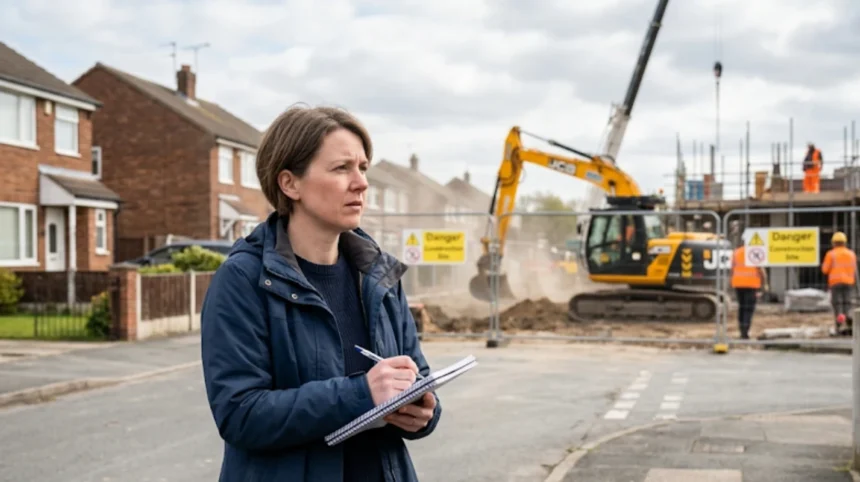
Garforth residents report noisy construction sites by contacting Leeds City Council’s Environmental Health Team through the online noise complaint form during daytime hours (8am to 5pm) or calling the out-of-hours service on 0113 376 0337 for noise occurring between 5pm and 3:30am. The council requires complainants to keep a detailed noise diary documenting times, dates, duration, and impact of the noise. Construction noise complaints fall under statutory nuisance provisions in the Environmental Protection Act 1990, giving Leeds City Council legal powers to investigate and enforce noise control measures.
- What defines a noisy construction site as a statutory nuisance in Garforth?
- Which legal powers does Leeds City Council have to control construction noise?
- How do you formally report construction noise to Leeds City Council in Garforth?
- What evidence must you collect to support a construction noise complaint in Garforth?
- When can construction sites legally operate in Garforth and Leeds?
- What penalties can construction companies face for violating noise regulations in Leeds?
- How does Leeds City Council investigate and enforce construction noise complaints?
- What alternatives exist if Leeds City Council cannot resolve your Garforth construction noise complaint?
- How can Garforth residents prevent construction noise problems before they occur?
What defines a noisy construction site as a statutory nuisance in Garforth?
A noisy construction site becomes a statutory nuisance in Garforth when it unreasonably and substantially interferes with the use or enjoyment of your home or injures health, as defined under Section 79 of the Environmental Protection Act 1990. Leeds City Council must investigate complaints meeting these criteria and can serve abatement notices requiring noise reduction.
The Environmental Protection Act 1990 establishes the legal framework for statutory nuisances across England and Wales. Section 79(1) identifies noise emitted from premises as a statutory nuisance when it prejudicially affects health or creates a nuisance. For construction sites specifically, this means the noise must be more than occasional or minor disturbance. The noise must reach a level that a reasonable person would find unacceptable given the circumstances.
Leeds City Council applies these statutory criteria when assessing construction noise complaints in Garforth and across the LS25 postcode area. The council’s Environmental Health Team evaluates whether the noise unreasonably interferes with residential amenity. Factors considered include the time of day, duration, frequency, and intensity of the noise. Night-time noise between 11pm and 7am receives particular scrutiny due to heightened sensitivity during sleeping hours.
Garforth falls within Leeds City Council’s jurisdiction for environmental health enforcement. The council maintains authority over all construction sites operating within the LS25 postcode, including residential developments, commercial projects, and infrastructure works. Environmental Health Officers have powers to enter premises, measure noise levels, and gather evidence when investigating complaints.
Which legal powers does Leeds City Council have to control construction noise?
Leeds City Council exercises noise control powers under Section 60 and Section 61 of the Control of Pollution Act 1974, plus abatement notice powers under the Environmental Protection Act 1990. These laws enable the council to impose working hour restrictions, specify permitted equipment types, and require noise mitigation measures.
Section 60 of the Control of Pollution Act 1974 provides the primary mechanism for controlling construction noise. Under this section, Leeds City Council can serve notices on developers or contractors imposing specific restrictions. These restrictions may include limiting operating hours, specifying the type of plant that can be employed, or setting maximum noise levels permissible from the site. Non-compliance with a Section 60 notice constitutes a criminal offence punishable by unlimited fines.
Section 61 of the Control of Pollution Act 1974 allows developers to apply for prior consent before commencing works. When granted, Section 61 consent protects contractors from Section 60 notices provided they operate according to the approved specifications. This process requires submission of detailed noise assessments and mitigation plans two to three months before works commence. Leeds City Council’s Planning Department reviews these applications alongside the Environmental Health Team.
The Environmental Protection Act 1990 provides complementary enforcement powers. When a statutory nuisance exists, the council must serve an abatement notice requiring the responsible party to stop or restrict the noise. Abatement notices can be delayed for up to seven days while the council attempts to negotiate voluntary compliance. Failure to comply with an abatement notice allows the council to prosecute or seize equipment causing the nuisance.
Leeds City Council’s Planning Consultation Guidance on Noise and Vibration, published in 2019, outlines additional expectations for construction projects. This guidance requires developers to demonstrate best practicable means of noise control during the planning application stage. The guidance covers baseline noise monitoring, community engagement plans, and mitigation measures such as site screening or acoustic hoarding.
How do you formally report construction noise to Leeds City Council in Garforth?
Formal reporting requires submitting an online noise complaint form on Leeds.gov.uk during daytime hours (8am to 5pm) or calling 0113 376 0337 for out-of-hours complaints between 5pm and 3:30am. Complainants must provide their contact details, the construction site address, and agree to keep a detailed noise diary for evidence collection.
The online noise complaint form is accessible through Leeds City Council’s website under the Antisocial Behaviour and Crime section. The form requires complainants to specify the type of noise, its frequency, and its impact on daily life. Leeds City Council prioritises complaints based on vulnerability and risk factors due to high volumes of noise nuisance reports. Complainants should record times, dates, duration, and type of noise to help the council assess cases when officers make contact.
Daytime complaints receive processing during standard office hours: Monday, Tuesday, Thursday, and Friday from 9am to 5pm, and Wednesday from 10am to 5pm. If the council has not contacted you within one week of submitting an online complaint, you can call 0113 222 4402 to follow up. This main council number connects to the Anti-Social Behaviour Team handling noise complaints.
Out-of-hours complaints operate between 5pm and 3:30am via the dedicated hotline 0113 376 0337. The out-of-hours team discusses complaint severity, takes your details, and arranges site visits when possible. Officers visit high-priority cases in residential areas where multiple residents complain. During visits, officers ask noise-makers to reduce volume or end activities if safe to do so.
Garforth residents can also contact their local Community Hub for support with noise complaints. The nearest Community Hub provides additional assistance and can escalate persistent issues to the Environmental Health Team. Private renters should report construction noise to their landlord first before approaching the council directly.
What evidence must you collect to support a construction noise complaint in Garforth?
Evidence collection requires maintaining a detailed noise diary documenting dates, times, duration, noise type, and impact on your daily activities for at least two weeks. The diary must show the noise occurs regularly and substantially interferes with home enjoyment to meet statutory nuisance thresholds.
A noise diary serves as the primary evidence tool for Leeds City Council investigations. Each entry must record the exact date and time when noise starts and stops. Complainants should note the type of construction activity causing the noise, such as drilling, excavation, or heavy vehicle movements. The diary should describe how the noise affects specific activities, such as sleeping, working from home, or children’s homework.
Audio recordings strengthen complaints when they capture noise levels at different times of day. Recordings should include timestamps and reference to known sound sources. Video footage showing construction activities alongside noise levels provides additional context for Environmental Health Officers. Multiple residents maintaining separate diaries for the same construction site significantly increases complaint credibility.
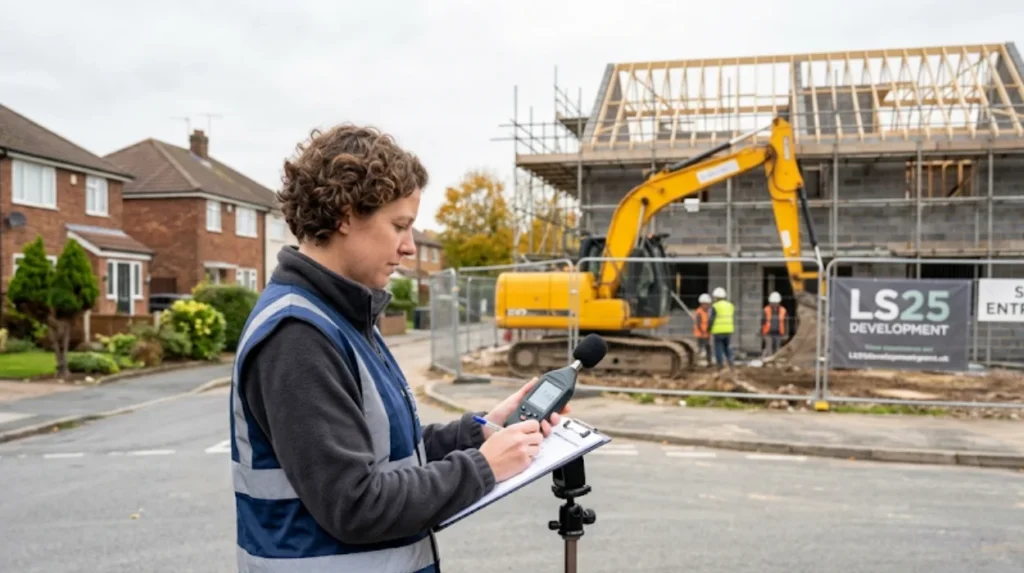
Leeds City Council’s Environmental Health Team may deploy professional noise monitoring equipment during investigations. Officers measure noise levels in decibels at complainant properties to establish objective data. These measurements compare against British Standard BS 4142:2014 methodology for rating and assessing industrial and commercial sound affecting the environment. Baseline noise levels before construction commencement help establish whether the site exceeds acceptable increases.
Complainants should escalate the situation if noise patterns change or intensify during the complaint process. Updated diary entries reflecting increased frequency or intensity prompt faster council response. Photographic evidence of construction site activities, vehicle movements, or working outside permitted hours strengthens enforcement cases.
When can construction sites legally operate in Garforth and Leeds?
Construction sites in Garforth and Leeds typically operate between 7am or 8am and 6pm on weekdays, with restricted hours on Saturdays (8am to 1pm) and no Sunday or bank holiday working unless specifically permitted. These standard hours derive from Leeds City Council’s Planning Guidance on Noise and Vibration and the Control of Pollution Act 1974.
Leeds City Council’s planning guidance establishes baseline expectations for construction working hours. Standard weekday operations commence no earlier than 7am or 8am depending on the site’s proximity to residential properties. Evening work typically concludes by 6pm to minimise impact on residents returning home. Saturday working, when permitted, receives stricter limitations with earlier finish times around 1pm.
Sunday and bank holiday working faces the strongest restrictions. Most construction sites in Garforth cannot operate on these days without explicit consent from Leeds City Council. Exceptions apply to emergency works, infrastructure projects requiring continuous operation, or sites with Section 61 consent permitting extended hours. Night-time operations between 11pm and 7am face particular scrutiny due to sleep disturbance risks.
The Control of Pollution Act 1974 allows local authorities to impose site-specific hour restrictions through Section 60 notices. Leeds City Council can require contractors to limit particularly noisy activities to specific time windows. For example, pile-driving or concrete pouring might be restricted to mid-morning and mid-afternoon slots to avoid peak residential disturbance times.
Garforth’s LS25 postcode area includes residential zones with heightened sensitivity to construction noise. Sites near schools, care homes, or medical facilities receive additional hour restrictions. The council’s Planning Consultation Guidance requires developers to consider vulnerable populations when proposing working hours.
What penalties can construction companies face for violating noise regulations in Leeds?
Construction companies violating noise regulations in Leeds face unlimited fines, equipment seizure, and prosecution under the Environmental Protection Act 1990 and Control of Pollution Act 1974. Leeds City Council can also halt construction entirely through abatement notices and Section 60 enforcement.
Fines for statutory nuisance violations under the Environmental Protection Act 1990 carry no upper limit in Crown Court proceedings. Magistrates’ Courts can impose fines up to £5,000 for summary offences, though unlimited fines apply to ongoing violations. Each day the nuisance continues after conviction constitutes a separate offence, multiplying potential penalties.
Section 60 of the Control of Pollution Act 1974 creates criminal liability for non-compliance with noise control notices. Magistrates’ Courts handle these offences with fines determined by offence severity and company turnover. Large construction firms face substantially higher penalties than small contractors due to sentencing guidelines requiring proportionate punishment.
Leeds City Council can seize equipment causing excessive noise when abatement notices are ignored. Officers may remove power tools, generators, or heavy machinery from construction sites. Equipment seizure causes immediate project delays and rental costs continue while machinery remains in council custody.
Abatement notices can halt construction entirely until compliance is achieved. Work stoppages cause significant financial losses through idle labour, delayed project completion, and penalty clauses in development contracts. Repeated violations damage contractor reputations, affecting future bidding opportunities and Considerate Constructors Scheme accreditation.
How does Leeds City Council investigate and enforce construction noise complaints?
Leeds City Council investigates construction noise complaints through Environmental Health Officers who conduct site visits, noise monitoring, and evidence gathering before deciding on enforcement action. The investigation follows a structured process from initial complaint assessment through to potential prosecution if voluntary compliance fails.
Initial complaint assessment occurs within seven days of submission for daytime complaints. Environmental Health Officers review the noise diary, complaint details, and site location to determine statutory nuisance likelihood. High-priority cases involving vulnerable residents or multiple complainants receive expedited investigation. Officers contact complainants to clarify details and request additional evidence if needed.
Site visits form the core of council investigations. Officers visit construction sites during reported noise periods to observe activities firsthand. Officers measure noise levels at complainant properties using calibrated sound level meters. Measurements compare against British Standard BS 4142:2014 assessment methodology. Officers document construction activities, equipment types, and working hours during visits.
The council attempts informal resolution before formal enforcement. Environmental Health Officers contact site managers to discuss complaints and request voluntary noise reduction. This approach succeeds in most cases where contractors operate under the Considerate Constructors Scheme. Officers may issue advisory letters outlining noise control expectations without formal notices.
Formal enforcement begins when informal approaches fail. Leeds City Council serves abatement notices requiring specific noise reductions within defined timeframes. Section 60 notices impose detailed operational restrictions on construction activities. The council monitors compliance through follow-up visits and continued noise monitoring.
Appeals against enforcement notices must be filed with magistrates’ courts within 21 days of service. Appeals suspend notice enforcement until court determination, potentially delaying projects for months. Most contractors comply with notices rather than risk appeal costs and project delays.
Explore More Help & Resources
How to access carer support near Pudsey for free
How to appeal a school exclusion decision in Otley
What alternatives exist if Leeds City Council cannot resolve your Garforth construction noise complaint?
Alternatives include contacting the Health and Safety Executive for workplace safety concerns, pursuing private legal action for common law nuisance, or escalating to Leeds City Council’s complaints procedure if council response proves inadequate. These routes provide additional enforcement mechanisms when standard council processes fail to achieve satisfactory outcomes.
The Health and Safety Executive (HSE) investigates construction noise when it creates workplace health risks for nearby residents. HSE operates under the Control of Noise at Work Regulations 2005, which protect individuals from excessive noise exposure. Complaints to HSE require demonstrating that noise levels exceed safe thresholds for prolonged exposure. HSE can issue improvement notices and prosecution independent of council action.
Private legal action for common law nuisance provides another avenue. Property owners can seek injunctions requiring noise reduction and damages for loss of amenity. This route requires instructing solicitors specialising in environmental law and funding litigation costs. Success depends on proving the noise unreasonably interferes with property rights. Group actions by multiple residents reduce individual costs and strengthen cases.
Leeds City Council’s formal complaints procedure addresses dissatisfaction with the council’s handling of noise complaints. Stage one complaints receive responses within 10 working days from the service manager. Stage two escalates to senior officers if stage one proves unsatisfactory. The final stage involves the Local Government and Social Care Ombudsman, which can order remedies including compensation.
Garforth residents can also contact their local councillor to raise construction noise concerns at committee level. Councillors can question council officers about enforcement priorities and resource allocation. Ward councillors represent Garforth and LS25 areas on Leeds City Council, providing direct political pressure channels.
How can Garforth residents prevent construction noise problems before they occur?
Garforth residents prevent construction noise problems by monitoring council planning applications for nearby sites, attending pre-construction community meetings, and establishing direct contact with site managers before works commence. Early engagement allows residents to raise concerns and negotiate noise mitigation measures before disturbances begin.
Leeds City Council publishes all planning applications on its website, including construction site proposals. Residents can search applications by postcode or address to identify upcoming developments in Garforth. The planning portal shows application references, site plans, and proposed working hours. Residents can submit objections during the 21-day consultation period highlighting noise concerns.
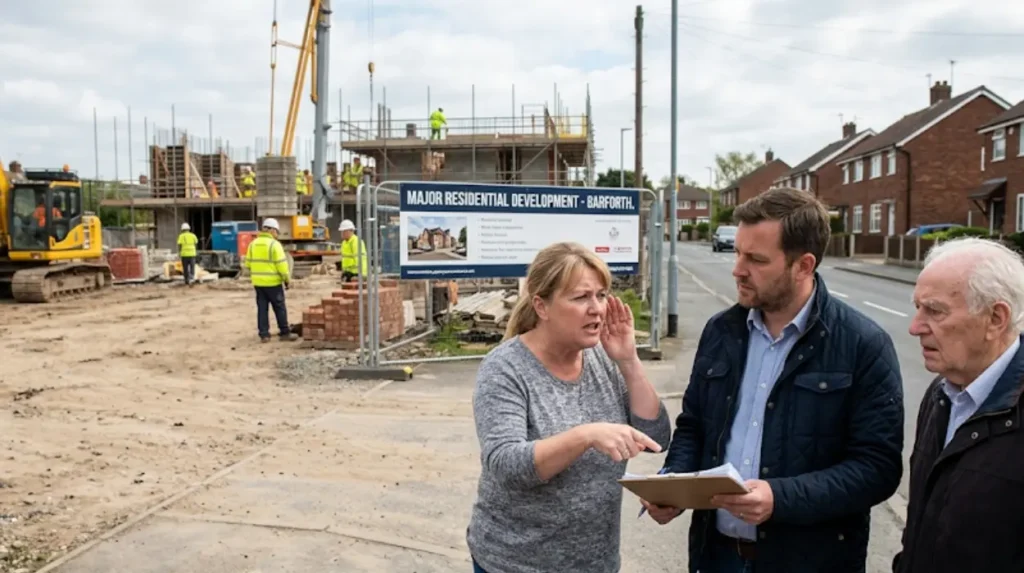
Developers often hold pre-construction community meetings for large projects. These meetings introduce site managers, outline construction programmes, and discuss noise mitigation strategies. Attending these meetings allows residents to establish direct communication channels before noise becomes problematic. Site managers can provide contact numbers for immediate noise complaints during construction.
The Considerate Constructors Scheme requires participating sites to implement community engagement plans. These plans include neighbour notification letters, site noticeboards with contact details, and regular progress updates. Garforth residents can request that developers join the scheme as a condition of planning approval. Scheme membership signals commitment to minimising neighbourhood disruption.
Residents can also request noise monitoring data from developers during the planning stage. Baseline noise surveys establish pre-construction ambient levels against which construction noise gets measured. This data proves crucial if complaints later require statutory nuisance assessments. Early requests for this information demonstrate serious intent to monitor compliance.
What is considered a noisy construction site in Garforth?
A construction site may be considered a statutory nuisance if the noise unreasonably and substantially interferes with the use or enjoyment of your home or affects your health. Leeds City Council assesses complaints based on the time of day, duration, frequency, and intensity of the noise.