
Key Points
- Public Consultation Approved: Leeds City Council’s executive board has voted to launch a comprehensive review and public consultation regarding town centre parking charges introduced last October.
- Communities Affected: The review focuses on fees implemented at council-owned sites in Wetherby, Horsforth, Rothwell, Garforth, and Guiseley, costing drivers up to £3.65 per day.
- Political Opposition: Conservative group leader Councillor Alan Lamb labelled the initial implementation a “mistake,” warning that halved car park usage and displacement parking on residential streets are harming local trade and employment access.
- Council Administration Defence: Labour Councillor James Gibson defended the introduction of fees, attributing the decision to 15 years of severe central government funding cuts to the local authority.
- Specific Locations Included: Car parks in the scope of the review include Wilderness and Station Gardens (Wetherby), Fink Hill (Horsforth), Barleyhill Road (Garforth), Marsh Street (Rothwell), and Netherfield Road (Guiseley). Otley has been excluded.
Wetherby (The Leeds Times) July 23, 2026 –As reported by Don Mort of the Local Democracy Reporting Service (LDRS), Leeds City Council’s executive board has formally voted to initiate a public consultation assessing the impact of town centre parking fees across five key West Yorkshire communities.
The consultation will evaluate the controversial pay-and-display schemes introduced last October across car parks in Wetherby, Horsforth, Rothwell, Garforth, and Guiseley. Residents, business owners, and local visitors will be invited to submit feedback on tariffs that cost motorists up to £3.65 a day.
According to an official council report cited by the LDRS, the review will conduct a dual assessment examining both the financial performance of the sites and overall usage rates since the fees were enacted.
The council leadership initially introduced the charges to generate critical municipal revenue and cover ongoing operational maintenance for parking infrastructure.
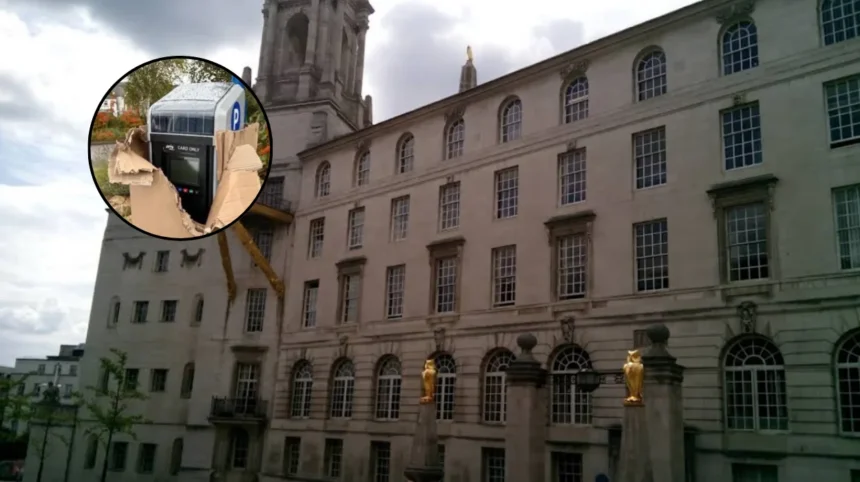
However, following widespread feedback from traders and residents regarding diminished footfall, the executive board agreed at its Civic Hall meeting on Wednesday to re-evaluate the local impact.
What Arguments Were Raised By Political Leaders During The Executive Board Meeting?
During the debate at Civic Hall, political leaders presented sharp differences regarding the necessity and consequences of the parking tariffs.
As reported by Don Mort of the Local Democracy Reporting Service, Councillor Alan Lamb, leader of the Conservative group on Leeds City Council and representative for Wetherby, strongly condemned the charges during the meeting, stating:
“This was a mistake to start with.”
Councillor Lamb highlighted several unintended consequences in the affected outer towns. He noted that daily parking fees were creating barriers for jobseekers and local workers, stating that some individuals were struggling to take up employment opportunities due to the added daily commuting expense.
Detailing the physical impact on local streets, Councillor Lamb observed:
“I can see that the car parks are now half-full instead of full, as they were. I can see people parking on residential streets.”
During the proceedings, Councillor Lamb formally requested that parking charges in Otley be incorporated into the upcoming review. However, council officers and board members informed him that Otley fell outside the specified geographic scope of this particular consultation.
In response to the criticism, Labour’s executive member for environment, Councillor James Gibson, defended the original policy by pointing to broader systemic financial pressures on local government. As reported by Don Mort of the Local Democracy Reporting Service, Councillor Gibson stated:
“Let’s not forget why we had to introduce car park charges. It came off the back of 15 years of huge cuts to Leeds City Council.”
Which Specific Car Parks Are Covered By The Consultation?
The scope of the forthcoming public review applies directly to designated municipal parking locations that saw pay-and-display meters installed in late 2025.
According to official council documentation, the review covers the following car parks:
- Wetherby: Wilderness Car Park and Station Gardens Car Park
- Horsforth: Fink Hill Car Park
- Garforth: Barleyhill Road Car Park
- Rothwell: Marsh Street Car Park
- Guiseley: Netherfield Road Car Park
Other locations across the Leeds metropolitan district, including Otley, remain excluded from this review phase.
Background Of The Particular Development
The implementation of parking charges in outer market towns and suburban centres across Leeds has been a long-standing source of policy debate in West Yorkshire.
For decades, council-owned car parks in areas like Wetherby, Garforth, and Guiseley operated free of charge to encourage local shopping and support independent high-street businesses.
In response to sustained central government budget reductions over the past 15 years, local authorities across the United Kingdom have increasingly turned to parking services as a crucial income-generating stream to subsidise statutory obligations, such as social care and public waste management.
When Leeds City Council formally proposed extending pay-and-display charges to these previously free outer-town car parks, the move faced pushback from opposition councillors, trade associations, and parish councils, who argued that suburban town centres face distinct economic pressures compared to city-centre shopping districts.
Despite these objections, the council enacted the charges up to £3.65 per day in October 2025 to meet budget targets. The current decision by the executive board to approve a formal review represents the first systematic assessment of the financial returns versus the local economic disruption caused since the policy was implemented.
Prediction: How This Development Can Affect Motorists, Business Owners, And Local Residents
The outcome of this public consultation and financial review holds direct consequences for three main groups across the affected West Yorkshire communities:
If the review reveals a marked drop in footfall corresponding with the introduction of parking fees, traders may gain leverage to push for reduced tariffs, temporary free-parking windows (such as the first two hours free), or a complete rollback.
A reversal or mitigation of charges would likely help restore convenience shopping, helping independent retailers compete against out-of-town retail parks that offer free parking.
Conversely, if the council maintains current tariffs due to revenue dependency, high-street businesses may need to adjust by offering customer validation schemes or digital loyalty incentives to offset parking costs.
For local workers, shoppers, and visitors, the review offers an official pathway to voice concerns regarding commuting affordability.
A reduction in daily fees would directly ease financial pressures on low-income workers and part-time staff in suburban town centres who rely on personal vehicles due to limited public transport connections.
Residents living on streets adjacent to the affected car parks stand to see significant environmental and traffic changes.
If parking charges remain at current levels, vehicle displacement into nearby residential roads is likely to persist, leading local authorities to consider introducing residential permit zones to curb commuter parking. Conversely, if the consultation leads to lower off-street parking tariffs, traffic is expected to return to designated car parks, easing congestion and parking friction in suburban neighborhoods.