
Key Points
- Safety Campaign: A 23-year-old stable manager is campaigning for official warning signs on Bayton Lane in Horsforth, Leeds, to urge drivers to reduce their speed near equestrians.
- Dangerous Incidents: Charlie Rea Nelson, who operates Whetstone livery yard alongside her mother, reported multiple falls onto the road after horses were spooked by vehicles passing too fast or too close.
- Disparate Signage: Campaigners highlighted that a neighbouring golf course possesses dedicated road-crossing signs for golfers, whereas horse riders along the same stretch lack comparable safety warnings.
- Vehicle Concerns: While some motorists drive responsibly, heavy goods vehicles, lorries, and vans frequently fail to slow down, passing riders at high speeds.
- Council Review Underway: Leeds City Council is finalising an assessment of current signage along Bayton Lane before determining whether alterations or new signs will be introduced.
- Legal Obligation: Municipal authorities reminded drivers that motorists possess an existing legal responsibility to pass equestrians safely and at appropriate speeds.
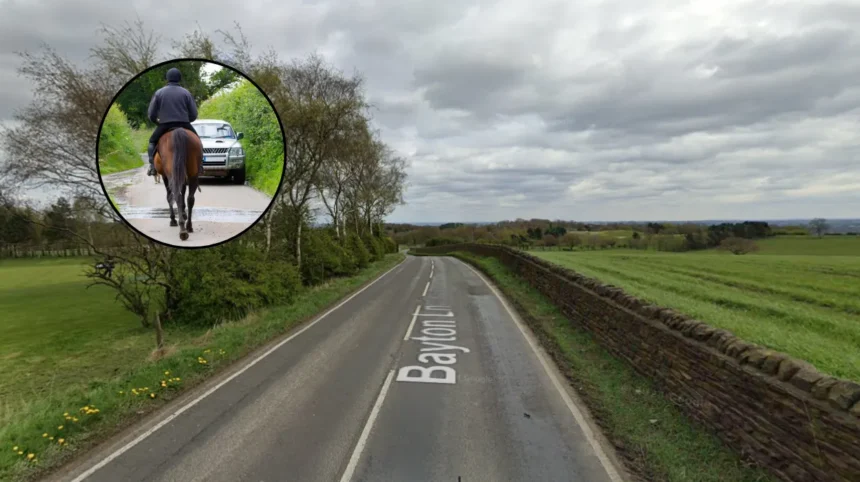
Horsforth (The Leeds Times) August 10, 2026 – A local stable manager in Horsforth has initiated a public campaign requesting Leeds City Council install clear traffic warning signs along a prominent Leeds thoroughfare to protect horse riders from high-speed traffic. Charlie Rea Nelson, 23, who manages Whetstone livery yard with her mother, stated that frequent encounters with fast-moving vehicles on Bayton Lane have compromised the safety of local equestrians during routine exercise rides. The appeal follows multiple near-misses and incidents where riders were unseated due to vehicles driving too close or at excessive speeds. In response, Leeds City Council confirmed that an assessment of existing road signage along the specified route is approaching completion, after which potential highway modifications will be considered.
- Key Points
- Why Are Horse Riders Calling for Urgent Traffic Signage on Bayton Lane?
- What Has the Livery Yard Manager Experienced Whilst Hacking in Horsforth?
- How Has Leeds City Council Responded to the Demands for Improved Road Safety?
- What Legal Duties Do Motorists Have When Approaching Horses on Public Roads?
- Background
- Prediction
Why Are Horse Riders Calling for Urgent Traffic Signage on Bayton Lane?
Equestrians utilizing the rural and semi-rural road network around Horsforth frequently rely on Bayton Lane for hacking—a term referring to recreational horseback riding conducted along public roads and bridleways. However, local riders report that the volume and speed of vehicular traffic on this particular stretch have created increasingly hazardous conditions for both horses and their handlers.
Charlie Rea Nelson explained that while certain motorists display caution when encountering equestrians, a significant proportion of drivers fail to adjust their speed.
In particular, commercial vehicles such as lorries and transport vans have been observed passing horses without slowing down. According to Rea Nelson, heavy commercial vehicles often proceed past riders “flat out”, generating substantial noise and air displacement that can startle horses.
The campaign highlights a contrast in safety provisions along the same roadway. Directly across from the equestrian routes, a local golf course features explicit warning signage advising drivers to watch for golfers crossing the highway.
Campaigners argue that similar proactive safety measures should be extended to horse riders, who face comparable or greater risks when navigating live traffic.
What Has the Livery Yard Manager Experienced Whilst Hacking in Horsforth?
The motivation behind the campaign stems from direct physical risks experienced by riders operating out of Whetstone livery yard. Managing the facility jointly with her mother, Charlie Rea Nelson regularly accompanies clients on road hacks to exercise their animals. Over recent months, aggressive or reckless driving behaviour along Bayton Lane has resulted in several dangerous incidents.
Rea Nelson confirmed that she has been thrown from her horse onto the tarmac on multiple occasions after her mount was frightened by passing vehicles.
In those instances, serious injuries were narrowly avoided because the horse remained stationary alongside her on the roadway rather than bolting into oncoming traffic.
Equestrian safety specialists note that horses are prey animals weighing upwards of 500 kilograms, capable of unpredictable reactions when startled by sudden loud noises or fast-moving objects.
When a driver passes too close or at high speed, the risk of a horse rearing, kicking out, or plunging into the path of traffic increases substantially, endangering the rider, the animal, and the vehicle occupants alike.
How Has Leeds City Council Responded to the Demands for Improved Road Safety?
Leeds City Council has acknowledged the concerns raised by the local equestrian community regarding Bayton Lane. The local authority stated that highway engineers are currently concluding a formal review evaluating the effectiveness and placement of existing road signs along the route.
Once the assessment concludes, council officials will review the findings to determine whether introducing new warning signs or altering current traffic management provisions is warranted.
However, representatives for the council emphasized that traffic signage alone does not relieve drivers of their primary duties under statutory road regulations.
The council reiterated that all motorists hold an absolute legal obligation to exercise due care and attention when encountering vulnerable road users, including horse riders, cyclists, and pedestrians.
What Legal Duties Do Motorists Have When Approaching Horses on Public Roads?
Under national traffic regulations and the updated Highway Code guidelines, horses are classified as vulnerable road users. Drivers are legally required to reduce speed and maintain adequate physical separation when overtaking or approaching equestrians.
Official guidelines stipulate specific driving protocols when encountering horses:
- Speed Reduction: Motorists should slow down to a maximum speed of 10 miles per hour when approaching equestrians.
- Passing Distance: Drivers must allow a minimum clearance distance of 2 metres (6.5 feet) when passing a horse and rider.
- Patient Navigation: Drivers are instructed not to sound their horn, rev their engine, or accelerate rapidly away once past the animal.
- Queueing Behind: If conditions do not permit a safe pass with required clearances, drivers are obligated to remain patient behind the horse until the road ahead is clear.
Failure to adhere to these standards can result in prosecution for careless or inconsiderate driving, carrying penalties including financial fines, penalty points on driving licences, or potential driving disqualifications in severe cases.
Explore More Horsforth News
Roundhay Park Installs 125 Boulders To Stop Nuisance Drivers Roundhay 2026
Leeds Council Refuses Historic Coach House Redevelopment Plan: Leeds 2026
Background
The issue of road safety for equestrians on semi-rural roadways across the United Kingdom has attracted growing scrutiny from transport authorities and road safety organizations. Semi-rural routes such as Bayton Lane in Leeds often serve a dual function:
functioning as connector roads for commercial transport and commuting traffic while simultaneously providing access to rural bridle paths, agricultural land, and equestrian centers.
According to statistical data compiled by national equestrian bodies, hundreds of road incidents involving horses are reported annually across the UK, a notable proportion of which result in severe injuries or fatalities to horses and riders.
A substantial percentage of these incidents occur on roads with speed limits of 30 to 60 miles per hour, where driver speed and close proximity are cited as primary contributing factors.
In recent years, local councils across the country have faced increasing pressure to harmonize warning signage for all vulnerable road users.
While traditional warning signs commonly denote pedestrian crossings, farm machinery, or specialized facilities like golf courses, dedicated horse warning signs remain discretionary for local highway authorities, leading to inconsistent application across neighboring regions.
Prediction
The outcome of Leeds City Council’s ongoing signage assessment on Bayton Lane is poised to directly influence traffic safety dynamics for several distinct groups across the Horsforth community:
- For the Local Equestrian Community: The installation of high-visibility horse warning signage would significantly raise driver awareness, likely reducing the frequency of high-speed passes. Improved signage would enhance safety for riders from Whetstone livery yard and surrounding stables, encouraging safer recreational usage of local road links. Conversely, if signage modifications are rejected, equestrians may be forced to curtail their reliance on Bayton Lane, restricting access to established riding routes.
- For Motorists and Commercial Transport: Clear signage will provide explicit notice to drivers—particularly heavy commercial operators unfamiliar with the area—prompting earlier speed adjustments before reaching bends or blind crests where horses frequently travel. This proactive warning reduces the likelihood of sudden braking and potential vehicular collisions.
- For Local Municipal Policy: A decision by Leeds City Council to approve enhanced signage along Bayton Lane could set a precedent for similar rural and semi-rural corridors throughout the Leeds metropolitan district. Other equestrian businesses facing similar traffic challenges may utilize this outcome to lobby for expanded warning infrastructure across West Yorkshire’s road network.