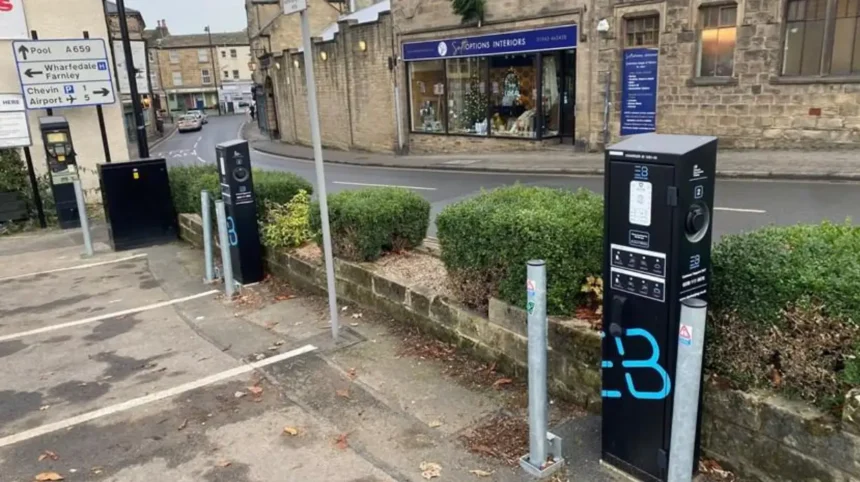
Headingley is a popular residential and leisure district in north-west Leeds, West Yorkshire. Visitors travel to the area for cricket and rugby at AMT Headingley Stadium, independent shops along Otley Road, cafés, restaurants and nearby green spaces. Electric vehicle (EV) charging facilities support drivers who want to explore the neighbourhood without making a separate journey into Leeds city centre.
- Where can you find electric vehicle charging points in Headingley?
- How can visitors check live EV charger availability in Headingley?
- What types of EV chargers are available around Headingley?
- How much does EV charging cost in Headingley?
- How long does it take to charge an electric car in Headingley?
- Where can you charge an electric car when visiting Headingley Stadium?
- Which EV charging locations are suitable for longer visits to Headingley?
- How do you pay for public EV charging in Headingley?
- How should you plan an EV journey to Headingley?
- What should drivers know about parking and EV charging rules in Headingley?
- How is Headingley developing its electric vehicle charging infrastructure?
- How does Headingley’s history influence its modern travel infrastructure?
- What should you check before using an EV charging point in Headingley?
Public charging infrastructure includes destination chargers, residential-area charging points and facilities within the wider Leeds network. Drivers can identify suitable locations through live charging maps, compare charging speeds and check payment requirements before parking.
Where can you find electric vehicle charging points in Headingley?
Headingley has public EV charging locations on Headingley Lane, at AMT Headingley Stadium and at The Spool House on Spinning Acres Lane. These sites provide charging options for visitors and residents, although access, availability and payment conditions require checking before arrival.
Headingley has several identifiable charging locations within the LS6 postcode district. Their suitability depends on the destination, the time available for charging and whether the driver has permission to use the associated parking facilities.
Headingley Lane charging point
The Headingley Lane charging location, postcode LS6 1PF, is listed on the EV Charge.Online network. Its published listing identifies four charging devices, eight connectors and Type 2 connections rated at 7kW. The listing was updated on 30 September 2026.
This location is relevant to drivers visiting central Headingley, travelling along Headingley Lane or exploring nearby shops and hospitality businesses. A 7kW charger is generally suitable for a longer parking session rather than a brief stop.
The published listing gives a price of £2.22 per hour. Drivers should check the live listing before travelling because prices, access conditions and charging status change. The hourly rate also differs from a price charged per kilowatt-hour.
AMT Headingley Stadium charging point
AMT Headingley Stadium has a listed charging facility on St Michael’s Lane, Headingley, Leeds, LS6 3BR. The charging location is associated with the ICS network and has three devices, six connectors and a published power rating of 22kW.
The location is particularly relevant to visitors attending cricket matches, rugby fixtures and other events at the stadium. However, a stadium charging point does not automatically provide unrestricted access to every visitor. Check the current access rules and parking arrangements before planning to charge during an event.
The published listing gives a rate of 60p per kilowatt-hour plus a £1.50 connection fee. These charges are subject to change, so drivers should verify the current tariff before starting a session.
The Spool House charging point
The Spool House charging location is listed on Spinning Acres Lane, Headingley, Leeds, LS6 4FN. Its published details identify two charging devices, four connectors and Type 2 connections rated at 7kW. It is associated with the Pod network.
The listed payment options include the Pod Point app and Zap-Pay, with a published rate of 40p per kilowatt-hour. Drivers should confirm the current price, parking permissions and site access arrangements before arriving.
This option is relevant to drivers travelling through the wider Headingley residential area. As with other destination chargers, its practical value depends on how long the vehicle can remain parked.

How can visitors check live EV charger availability in Headingley?
Visitors can check live charging information through Zapmap and other charging-network apps before travelling to Headingley. These services help identify connector types, charging speeds, prices and reported availability, reducing unnecessary detours when a charger is occupied, unavailable or incompatible.
The most effective approach is to search by postcode, destination or current route. For Headingley, useful search terms include LS6 1PF, LS6 3BR and LS6 4FN. Entering the postcode helps distinguish local facilities from charging points elsewhere in Leeds.
Before setting off, check the following information:
- Live status: Determine whether the charging device is available, occupied or reported out of service.
- Connector compatibility: Confirm that the charging cable or connector matches the vehicle.
- Charging speed: Compare the available power rating with the vehicle’s charging capability.
- Price: Check the energy rate, connection fee and any additional charges.
- Access: Verify opening hours, parking restrictions and any restrictions for non-customers.
- Payment: Identify whether the charger accepts contactless payment, an app or a network account.
Live information reduces uncertainty but does not guarantee that a charger remains available until arrival. Drivers should identify a backup location when their remaining battery range is limited.
What types of EV chargers are available around Headingley?
EV chargers differ by power output, connector and the time required to supply energy. Headingley’s listed facilities include 7kW destination charging and 22kW charging at AMT Headingley Stadium. Drivers should select a charger compatible with their vehicle and planned parking duration.
Charging speed is measured in kilowatts (kW), while the energy supplied to the vehicle is measured in kilowatt-hours (kWh). A charger rated at 22kW does not guarantee that every vehicle will charge at that rate. Vehicle limits, battery temperature and battery management affect the actual power delivered.
Slow and standard destination charging
A 7kW charger typically suits drivers who park for several hours. It is common in residential settings, workplaces and destination car parks where vehicles remain stationary while people work, shop or visit local attractions.
Faster destination charging
The stadium listing identifies charging devices rated at 22kW. This power rating offers a higher potential charging rate than a 7kW unit, although the vehicle must support the relevant AC charging power to benefit fully.
A vehicle with a lower onboard AC charging limit receives energy at that lower rate. Parking duration and the amount of energy required remain important factors.
Rapid and ultra-rapid charging
Rapid and ultra-rapid chargers are designed for shorter stops, especially on longer journeys. These facilities generally use DC charging and require a compatible vehicle connector, commonly CCS on modern UK-market electric cars.
The three identified Headingley listings above do not establish that those particular sites offer rapid or ultra-rapid charging. Drivers who need a fast battery top-up should search the wider Leeds network for a suitable DC charger and verify its current status before leaving.
How much does EV charging cost in Headingley?
Public EV charging prices in Headingley depend on the operator, charger type and payment method. Published listings identify hourly pricing on Headingley Lane and per-kilowatt-hour pricing at the stadium and Spinning Acres Lane. Always confirm the live tariff before connecting your vehicle.
The published prices for the three identified locations provide a starting point for comparing costs. They are listing snapshots rather than guaranteed current tariffs.
How is the charging cost calculated?
An energy-based tariff multiplies the electricity supplied in kilowatt-hours by the price per kilowatt-hour. A connection fee, where applicable, is added to that amount.
For example, supplying 20kWh at a rate of 40p/kWh costs £8 before any additional charges. At the published stadium rate of 60p/kWh, the same quantity costs £12, plus the listed £1.50 connection fee, giving a total of £13.50.
Hourly pricing works differently. At £2.22 per hour, a two-hour session costs £4.44 before any additional parking or other fees, assuming the published hourly tariff applies throughout the session.
These examples illustrate the calculation rather than guarantee a current price or a particular quantity of energy delivered.
What other charges should drivers check?
Parking charges can apply separately from charging fees. A driver who pays for electricity at a public car park must also follow its parking terms, payment rules and maximum stay.
Check for connection fees, idle fees, parking tariffs and any time limits. An idle fee is a charge that some operators apply when a vehicle remains connected after charging has finished. The applicable conditions depend on the operator and site.
How long does it take to charge an electric car in Headingley?
Charging time depends on the energy required, the charger’s power rating and the vehicle’s charging limits. A 7kW charger typically supports longer visits, while a compatible vehicle connected to a 22kW charger receives energy faster when the vehicle can accept that power.
A useful starting calculation divides the energy required by the charging power. Actual charging sessions take longer than the simplest calculation when power is reduced by vehicle limits, conversion losses or battery-management controls.
For example, supplying 14kWh at a constant 7kW takes approximately two hours. Supplying the same energy at 22kW takes approximately 38 minutes if the vehicle can accept that rate throughout the session.
These are mathematical estimates, not guaranteed charging times. Many electric cars cannot accept 22kW AC charging, and the battery’s state of charge affects the charging rate.
Drivers should also consider the battery percentage needed for the next journey. Charging from a low battery level to a moderate level generally takes less time than filling the battery completely, particularly where the vehicle reduces charging power near full capacity.
Where can you charge an electric car when visiting Headingley Stadium?
Visitors attending events at AMT Headingley Stadium can investigate the listed stadium charging facility on St Michael’s Lane. The location has three devices rated at 22kW, but drivers must confirm access permissions, event-day parking arrangements, availability and payment requirements before relying on it.
The stadium hosts cricket and rugby events that attract visitors from across Leeds and beyond. Charging during an event is practical only when the charging point is accessible to the driver and the vehicle can remain parked for the required period.
Event-day traffic and parking restrictions also influence the journey. Drivers should check the event organiser’s parking guidance and allow additional time for arriving and leaving.
If the stadium charging facility is unavailable, consult a live charging map for alternatives in Headingley and the surrounding Leeds districts. Select a backup that fits the vehicle’s range and the time remaining before the event.
Do not assume that a stadium’s public charging listing includes a reserved parking space or guarantees access during every fixture.
Which EV charging locations are suitable for longer visits to Headingley?
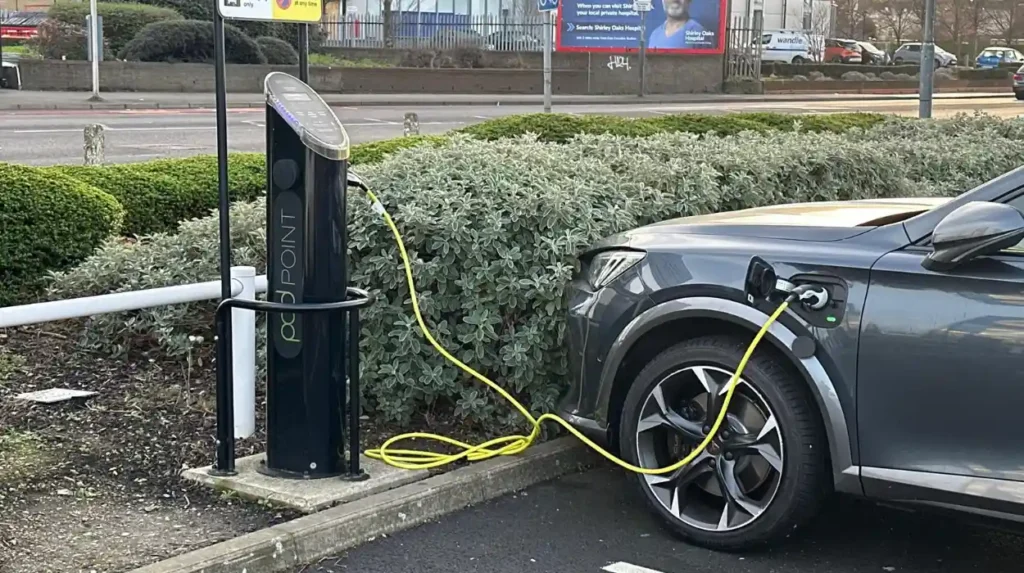
Destination charging is most useful when the driver has time to leave the vehicle parked while completing another activity. Headingley Lane and Spinning Acres Lane offer listed 7kW charging, while the stadium location provides a listed 22kW alternative subject to access conditions.
The appropriate location depends on the purpose of the visit. A driver spending several hours exploring the neighbourhood benefits from a charger within walking distance of the planned destination. A driver attending a short appointment requires a different arrangement from someone staying for an afternoon.
Visiting shops and cafés
Drivers exploring Otley Road and central Headingley’s independent businesses should search for charging points that permit parking for the full duration of the visit. A charger several minutes’ walk from a café is useful only if the parking conditions support the planned stay.
Do not assume that a nearby shop offers public charging. Verify the charger location and whether the parking area is restricted to customers, residents or permit holders.
Visiting Headingley Stadium
The stadium listing provides a named charging location for visitors to investigate before a fixture. Check the event schedule, parking arrangements and charging availability together rather than treating them as separate decisions.
Staying overnight
Visitors staying in accommodation should ask the hotel, guesthouse or holiday rental whether it provides EV charging. Confirm whether the charger is operational, whether advance booking is necessary and whether electricity or parking carries a separate charge.
A private charger is not necessarily open to the public, even when its location appears on a mapping service.
How do you pay for public EV charging in Headingley?
Payment methods vary between charging networks and individual locations. Some public chargers support network apps or roaming payment services, while other facilities offer contactless payment or additional options. Check the exact payment instructions displayed on the charger and in its live listing before beginning a session.
The Spinning Acres Lane listing identifies the Pod Point app and Zap-Pay as payment options. The stadium listing identifies the ICS network, while the Headingley Lane listing is associated with EV Charge.Online. Drivers should consult the latest instructions for each network rather than assume that one account works everywhere.
Before travelling, download any required application and create an account if the operator requires one. Check that the account accepts the intended payment method.
When arriving at a charging bay, follow the displayed instructions. Some charging sessions require the driver to start the session through an app or payment terminal. Others require a contactless card or another supported payment method.
Retain the transaction confirmation until the session ends. If charging fails to start, check the connector, payment status and operator instructions before attempting another session.
How should you plan an EV journey to Headingley?
A reliable EV journey plan combines the destination, remaining battery range, charging requirements and parking arrangements. Drivers should identify a suitable charger before arrival, check live availability and save a backup location. This approach reduces unnecessary mileage and avoids dependence on one charging device.
Start by estimating the energy required for the journey to Headingley and the return trip. Consider motorway driving, cold weather, heating or air conditioning, passenger loads and elevation changes, because these factors affect real-world efficiency.
Next, compare the planned energy requirement with the battery charge available on arrival. Drivers who have sufficient range for the return journey do not necessarily need to charge during the visit. Drivers with limited remaining range should arrange charging before reaching a low battery level.
A practical journey plan should include the following steps:
- Check the vehicle’s estimated range and battery level.
- Search for compatible chargers close to the destination.
- Compare prices and expected parking duration.
- Confirm live availability shortly before departure.
- Save an alternative charging location.
- Check the parking rules and payment method.
- Allow additional time for a busy or unavailable charger.
Drivers travelling from outside Leeds should also check charging options along their route. This is especially important for longer journeys where arriving in Headingley with a low battery would limit the available alternatives.
What should drivers know about parking and EV charging rules in Headingley?
Public charging bays remain subject to the parking conditions of their site. Drivers must check signs, payment requirements, time limits and access restrictions before leaving a vehicle connected. A charging point’s appearance on a public map does not guarantee unrestricted access or free parking.
Headingley contains residential streets, commercial premises, event venues and public parking areas. Each setting can have different rules. A charger within private premises can be restricted to authorised users, while a public charging bay can operate under a separate parking tariff.
Do not park in an EV charging bay unless the vehicle is eligible to use it and the driver intends to follow the site’s charging requirements. Check whether the parking fee is separate from the electricity price.
Drivers should also avoid blocking pavements with charging cables. Leeds City Council states that residents must not run a private charging cable across a public footpath or install an unauthorised charging point on the public highway. The council’s approved cross-footway charging channel pilot, launched on 5 December 2025, provides a specific route for eligible residents without driveways.
These rules are particularly relevant in residential areas where footways need to remain accessible to wheelchair users, people with mobility aids and parents using pushchairs.
How is Headingley developing its electric vehicle charging infrastructure?
Leeds City Council is expanding public charging provision through partnerships, new installations and wider infrastructure planning. The programme includes on-street and off-street facilities, with the aim of making charging more accessible to residents, visitors and businesses across Leeds, including neighbourhoods beyond the city centre.
Leeds has been developing charging infrastructure to support the transition towards lower-emission transport. The council’s EV guidance describes public charging availability, its approach to council car parks and plans for further provision.
In February 2026, Leeds City Council announced that the city’s first public on-street EV charge point had gone live on St Paul’s Street in the city centre. The installation had four bays, with a wider rollout of additional charge points planned for 2026 through a partnership with Believ.
The council’s 2026–2030 plan also identifies the Local Electric Vehicle Infrastructure programme, including 30 new EV charging sites in 2026 and further expansion across Leeds.
These city-wide developments demonstrate the direction of local charging policy. They do not establish that every planned charger is already operational in Headingley. Drivers should use live maps and current council information to distinguish installed facilities from proposed locations.
Why does this matter for visitors?
A wider charging network provides more opportunities to combine vehicle charging with shopping, leisure activities and overnight stays. It also improves travel planning for drivers who do not have access to private charging at home or at their accommodation.
However, the usefulness of new infrastructure depends on its location, charging speed, pricing and availability. A charger near a destination is more convenient when its operating hours and parking arrangements match the visitor’s plans.
Explore More Area Guide
Headingley Recycling Centres and Household Waste Services Guide
Headingley Public Toilets and Accessible Facilities in Leeds
How does Headingley’s history influence its modern travel infrastructure?
Headingley developed from a historic settlement into a major residential and leisure district within Leeds. Its established streets, local businesses, sporting venues and residential neighbourhoods shape how visitors move around the area and where modern transport facilities fit into the existing urban environment.
Headingley has a long history as a settlement outside the historic core of Leeds. Its development as a residential district and sporting destination created a mix of older streets, commercial areas, educational institutions and recreational venues.
Today, visitors experience that historic landscape alongside modern travel infrastructure. Charging locations serve drivers arriving for leisure, work and local appointments, while the surrounding streets remain part of a neighbourhood with established pedestrian routes and parking demands.
For a deeper understanding of how the district developed, explore the [History of Headingley: From Historic Village to Leeds Suburb]. This is the single historical-background anchor placeholder for the wider local content hub.
Understanding Headingley’s urban development also helps explain why charging access varies between locations. A destination charger at a stadium, a residential charging point and a facility near a shopping area serve different travel patterns and parking needs.
Modern EV infrastructure therefore forms part of the district’s ongoing development rather than replacing its established transport and land-use patterns.
What should you check before using an EV charging point in Headingley?
Before using a public charger, verify its location, live status, connector, power rating, current price and access conditions. Confirm the payment method and parking rules, then identify a backup charger nearby. These checks help visitors avoid unnecessary delays and plan a reliable journey around Headingley.
The most useful preparation takes place before departure. A driver who checks only the location risks arriving at a charger that is occupied, incompatible or restricted to authorised users.
Use the following final checklist:
- Confirm the exact address and postcode.
- Check the charger’s reported availability.
- Match the connector to the vehicle.
- Compare the charging speed with the time available.
- Verify the electricity tariff and additional fees.
- Check parking restrictions and site access.
- Prepare the required app or payment method.
- Save a backup charging point.
- Allow enough battery range to reach an alternative location.
Headingley offers identifiable public charging options for visitors, including facilities on Headingley Lane, at AMT Headingley Stadium and at The Spool House. Checking live information before travelling remains essential because charging availability, prices and access conditions can change.
For tourists and leisure travellers, the most practical approach is to match charging with the purpose and duration of the visit. For residents and business travellers, reliable access depends on finding compatible chargers and understanding local parking conditions. Careful planning helps drivers explore Headingley while keeping their electric vehicle ready for the next stage of the journey.
Where can I charge an electric car in Headingley, Leeds?
Identified locations include Headingley Lane (LS6 1PF), AMT Headingley Stadium on St Michael’s Lane (LS6 3BR), and The Spool House on Spinning Acres Lane (LS6 4FN). Check live availability and access conditions before travelling.