
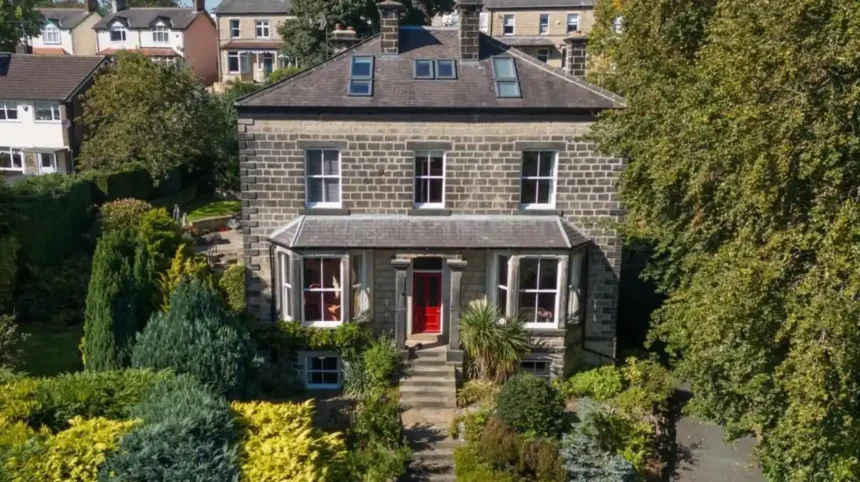
Horsforth architecture is defined by the widespread use of locally quarried millstone grit and sandstone, commonly known as Horsforth stone, which shapes the structural profile of its historic 18th- and 19th-century residential terraces, civic buildings, and industrial remnants.
The built environment of Horsforth, a civil parish and ward within the metropolitan borough of the City of Leeds in West Yorkshire, England, displays an architectural evolution dictated by local geology and industrial expansion. The National Heritage List for England records 44 listed structures within the parish. These include one Grade II* structure and 43 Grade II structures. The geological composition of the area relies heavily upon coarse-grained sandstone extracted from medieval and post-medieval quarries such as the Golden Bank Quarry. This material yields a distinctive weathered grey hue and high durability.
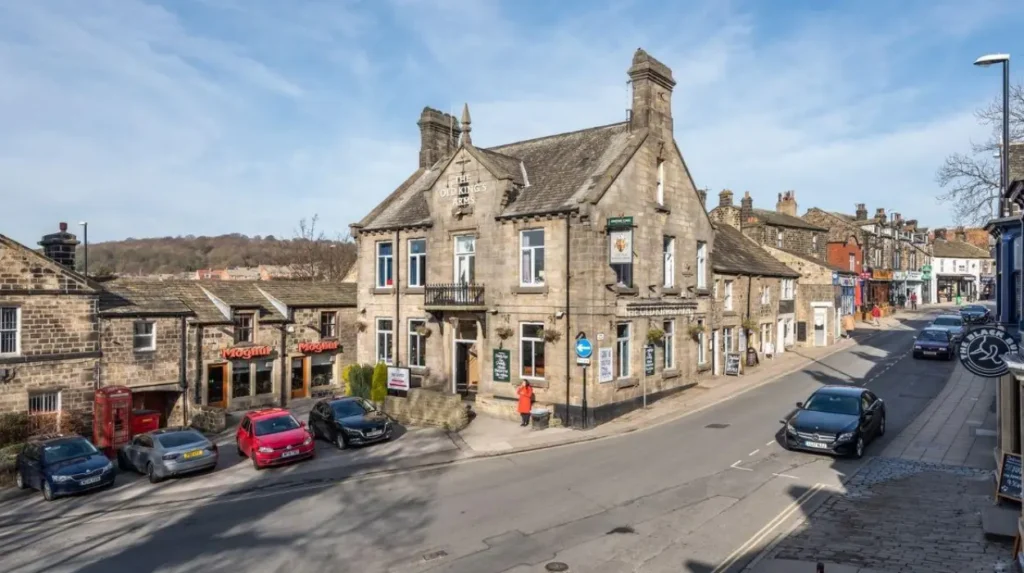
Buildings within the locality feature coursed masonry walls, heavy stone slate roofs, and detailed ashlar dressings. The structural typology shifts from early timber-framed cores encased in later stonework, such as the late-16th-century New Laithes Manor House, to rigid Victorian urban forms. Industrialisation during the 19th century introduced functional vernacular structures, including corn mills, mechanics’ institutes, and workers’ stone cottages. The spatial layout of the settlement relies on linear development along ancient routes such as Town Street, where domestic dwellings integrate directly with commercial storefronts.
As you explore the modern site, you are crossing land with a deep heritage. Read about the full [Insert Anchor Text for History Article Here] to understand its origins.
The urban morphology reflects a transition from an agricultural community dominated by Kirkstall Abbey prior to the 1539 dissolution of the monasteries into a thriving commuter suburb accelerated by the arrival of the railway in the 19th century. Architectural preservation is formally managed via designated conservation areas, specifically the Town Street and Newlay zones, which enforce strict material controls on roof extensions, cladding, and boundary walls to safeguard the historic streetscape.
Where can you find the most historically significant buildings in Horsforth?
The highest concentration of historically significant buildings in Horsforth is located along Town Street, Cragg Hill, and the Newlay conservation area, featuring 18th-century civic sites, Victorian villas, and medieval manorial remnants.
Town Street serves as the historical spine of the settlement, containing a dense cluster of protected buildings that demonstrate vernacular Yorkshire construction techniques. Among these, the Horsforth Village Museum at 5 The Green occupies a structural asset built in 1789 that formerly housed the Horsforth Urban District Council. The building exhibits traditional multi-pane sash windows, structural brick and stone detailing, and a symmetrical double-fronted facade typical of late-18th-century civic architecture in West Yorkshire. Directly opposite this museum site lies the archaeological footprint of the Bell Chapel, a chapel of ease originally established in the 16th century and reconstructed in 1757 before its demolition in 1885. The surviving stone floor plan and relocated grave markers delineate a vital ecclesiastical spatial layout.
Moving southward toward the River Aire, the architectural profile shifts toward high-status Victorian residential design. The Newlay conservation area, designated by Leeds City Council, contains detached and semi-detached Victorian villas constructed primarily between 1870 and 1890. These properties display prominent decorative bargeboards, gabled slate roofs, terracotta ridge tiles, and deep bay windows designed to maximize natural light. Boundary treatments across these zones incorporate coursed stone walling constructed from local sandstone blocks, maintaining visual continuity between private gardens and public thoroughfares.
Further architectural variety appears at New Laithes Manor House, situated off New Laithes Lane. This domestic structure incorporates a timber-framed core dating to the late 16th century, later encased in sandstone with mullioned windows and a roof combining stone slate and modern slate. The structural integration of timber framing with heavy stone jack arches illustrates a transitional building phase prior to the standardisation of masonry construction across the region.
What industrial and infrastructure architecture remains in Horsforth?
Horsforth retains critical industrial and infrastructure architecture, including the Grade II-listed Newlay Bridge, former corn mills, local stone-built toll houses, and historic weir systems along the River Aire valley.
The industrial heritage of Horsforth is intrinsically linked to the River Aire and the raw material demands of the West Yorkshire textile trade. Infrastructure projects from the early 19th century remain intact, most notably Newlay Bridge. Built in 1819 and designated as a Grade II-listed structure, this pedestrian-only bridge spans the River Aire using ashlar masonry arches and robust cutwaters designed to withstand high seasonal river flows. The engineering approach emphasizes functional durability, utilizing local gritstone ashlar blocks tied with lime mortar.
Water management architecture is also prominent along the valley floor. Surviving structures include historic weir systems and retaining walls engineered to divert water power toward industrial mills. While many of the original textile mills have undergone residential conversion or demolition, associated structures such as former corn mills and canal-adjacent transit buildings survive within the municipal boundaries. These industrial buildings typically feature multi-storey brick and stone load-bearing walls, small-paned cast-iron window frames designed for industrial illumination, and internal timber king-post roof trusses.
Transportation infrastructure is further represented by surviving toll houses and milestone markers. Toll houses were strategically positioned along arterial turnpike roads to collect tariffs for road maintenance. These buildings are characterised by compact, single-storey or two-storey square footprints, observation windows commanding views of the approach roads, and durable stone slate roofs. The survival of these disparate infrastructural elements demonstrates the systematic transformation of Horsforth from an isolated rural township into an integrated component of the Northern industrial economy.
Explore More Area Guide
Explore the Best Short Walks and Historic Trails in Horsforth
Best Places for Reading and Relaxing in Horsforth | Local Guide
How do Victorian residential villas and terraces shape the local streetscape?
Victorian residential architecture shapes the Horsforth streetscape through uniform stone-built terrace rows designed for industrial workers alongside expansive suburban villas featuring prominent Gothic and Italianate design influences.
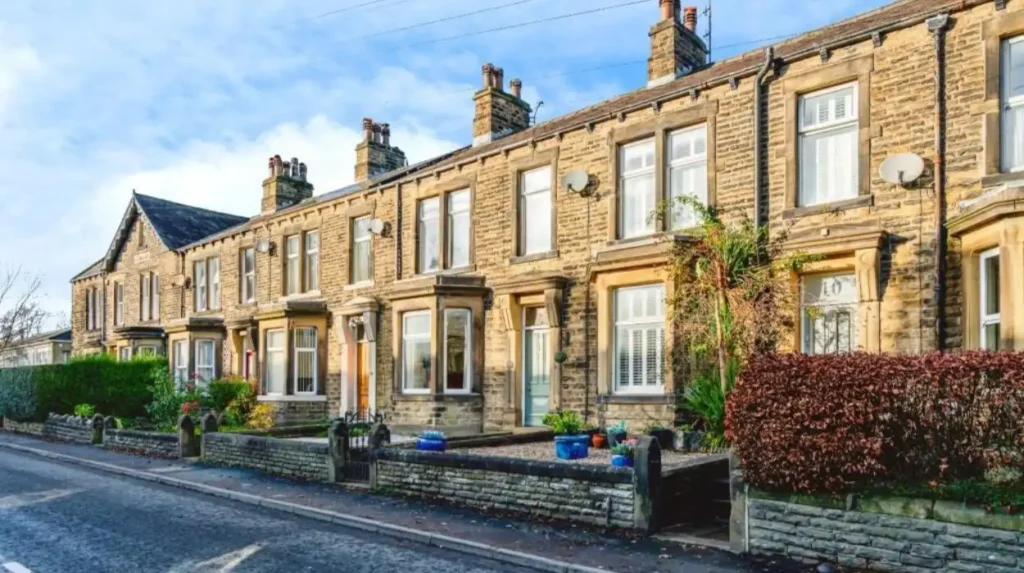
Residential expansion during the Victorian era produced two distinct architectural typologies that continue to define the urban geography of Horsforth. Worker housing is exemplified by model back-to-back terrace arrangements, such as those historically documented and replicated at the Horsforth Village Museum, which date to approximately 1850. These terrace rows utilize load-bearing local sandstone walls, slate roofs, and shared party walls to maximize housing density within minimal footprints. Fenestration is strictly utilitarian, featuring vertically proportioned timber sash windows and recessed single-door entries.
Conversely, high-status residential developments built for the rising managerial and merchant classes exhibit greater stylistic ambition. Located predominantly in areas such as Cragg Hill, Woodside, and Newlay, these properties manifest as large detached or semi-detached villas. Architectural styles draw from Victorian Gothic Revival and Italianate traditions, characterized by asymmetrical floor plans, steeply pitched gable roofs, decorative terracotta ridge crests, and projecting stone porches. Chimney stacks are particularly elaborate, often built as clustered, tall brick or ashlar shafts with decorative corbelling.
Streetscapes in these residential quarters are further defined by hard landscaping elements. Properties feature stone boundary walls ranging from 1 to 2 metres in height, capped with rounded or peaked coping stones, alongside mature trees planted during the initial 19th-century suburban layout phase. Local planning guidelines strictly regulate these frontages, prohibiting the removal of historic stone boundary walls and restricting modern cladding materials to maintain the visual coherence of the conservation zones.
What role did local stone quarries play in shaping regional architecture?
Local quarries, operating from the medieval period through to the 19th century, supplied high-grade millstone grit that not only constructed Horsforth’s buildings but also built prominent regional landmarks including Kirkstall Abbey and Scarborough seafront.
The architectural identity of Horsforth is inextricably bound to its geology. The extraction of sandstone and millstone grit from local excavations—most notably the Golden Bank Quarry—provided an abundant, high-quality building medium that influenced construction standards across West Yorkshire. During the medieval period, stone quarried in Horsforth was transported via packhorse routes to supply building materials and millstones to nearby monastic institutions, specifically Kirkstall Abbey. This stone is characterised by a high quartz content and uniform grain size, rendering it exceptionally resistant to acid rain and frost weathering.
As industrial demand escalated, quarrying operations expanded to supply large-scale civic and marine projects. Sandstone extracted from Horsforth quarries was transported via developing canal and railway networks to destinations as distant as the North Yorkshire coast, where it was utilized in the construction of Scarborough’s seafront infrastructure, and even exported internationally to Egypt. Within the local parish, this stone formed the primary structural material for every major building phase, eliminating the need to import expensive brick or foreign stone.
The physical properties of Horsforth stone dictated structural engineering capabilities. Its high compressive strength allowed masons to construct load-bearing walls without internal steel framing, utilize heavy stone lintels over wide window spans, and carve intricate decorative details—such as drip moulds, corbels, and ashlar quoins—that remain crisp and legible centuries after installation. Modern conservation policies implemented by Leeds City Council mandate that any repair work on listed buildings within the parish must utilize matching reclaimed local sandstone or approved geologically compatible quarried stone to preserve this heritage.
What makes Horsforth architecture unique?
Horsforth architecture is distinctive because it uses locally quarried millstone grit and sandstone, known as Horsforth stone. This material defines the appearance of historic terraces, civic buildings, industrial structures, and conservation areas across the settlement.