
Horsforth is a historic settlement in north-west Leeds with heritage stretching from its Domesday-era origins to medieval monastic landholding, farming, weaving, Victorian expansion and modern suburban growth. Its historic buildings, churches, former farms, public spaces and memorials provide a detailed record of how the community developed.
- What is the historical background of Horsforth?
- How did Kirkstall Abbey influence Horsforth’s heritage?
- Which historic buildings in Horsforth are most important?
- What can visitors discover at the former Horsforth Hall?
- Why is St Margaret’s Church important to Horsforth history?
- What does New Laithes Manor House reveal about Horsforth?
- What is the story behind Horsforth’s Station House?
- How did weaving and industry change Horsforth?
- Which community buildings reveal Horsforth’s religious and social history?
- What historic stories can visitors discover around Horsforth today?
- How can you explore Horsforth’s heritage responsibly?
- Why does Horsforth’s heritage remain important today?
Located between Leeds and the Aire Valley, Horsforth retains a strong historic character despite substantial urban growth. The area contains listed buildings, historic streets, former farmsteads and religious sites that reveal different stages of local development.
The story begins long before Horsforth became part of the wider Leeds urban area. Its name derives from Old English terms associated with a horse ford, reflecting the landscape and movement across the Aire Valley. Horsforth also appears in the Domesday Survey of 1086, providing one of its earliest documentary references.
For visitors, Horsforth heritage is particularly valuable because many historical features remain integrated into ordinary streets and neighbourhoods. A walk through the area can connect medieval landholding with later country houses, farms, chapels, churches, schools, transport infrastructure and twentieth-century remembrance.
What is the historical background of Horsforth?
Horsforth developed from an early settlement associated with the Aire Valley into a medieval agricultural community, a post-Reformation township, an industrial settlement and finally a suburban district of Leeds. Its surviving buildings record these successive stages of development.
Horsforth’s documented history reaches back to the Domesday Survey commissioned in 1086 following the Norman Conquest. The Leeds conservation assessment records that Horsforth was worth 30 shillings in the Domesday account, distinguishing it from several nearby settlements described as waste or unproductive.
Before Norman rule, the settlement was associated with three Anglo-Saxon thegns, or landholding nobles. Following the Conquest, William the Conqueror retained control of much of the land before it was subsequently transferred through the developing feudal system.
The landscape was very different from today’s urban environment. The Aire Valley contained wetland areas, and the location of the original ford associated with Horsforth’s name cannot now be established with certainty. The place-name itself remains evidence of the relationship between settlement and landscape.
Medieval Horsforth became increasingly connected with Kirkstall Abbey, the Cistercian monastery founded in 1152. A significant area of land on the northern edge of the township was transferred to the abbey and developed as a grange, or monastic farm. The land was worked by local people, while the profits supported the monastery.
This connection is important when interpreting Horsforth’s surviving agricultural heritage. Historic farms and field patterns are not isolated remnants. They relate to a much larger medieval landholding system centred on Kirkstall.
The medieval period therefore established two important characteristics of Horsforth’s heritage: agricultural land use and links with a major religious institution.
How did Kirkstall Abbey influence Horsforth’s heritage?
Kirkstall Abbey shaped Horsforth through medieval landownership, agricultural management and settlement development. Its former monastic lands included a grange in Horsforth, linking the township directly with one of Yorkshire’s most significant Cistercian monasteries.
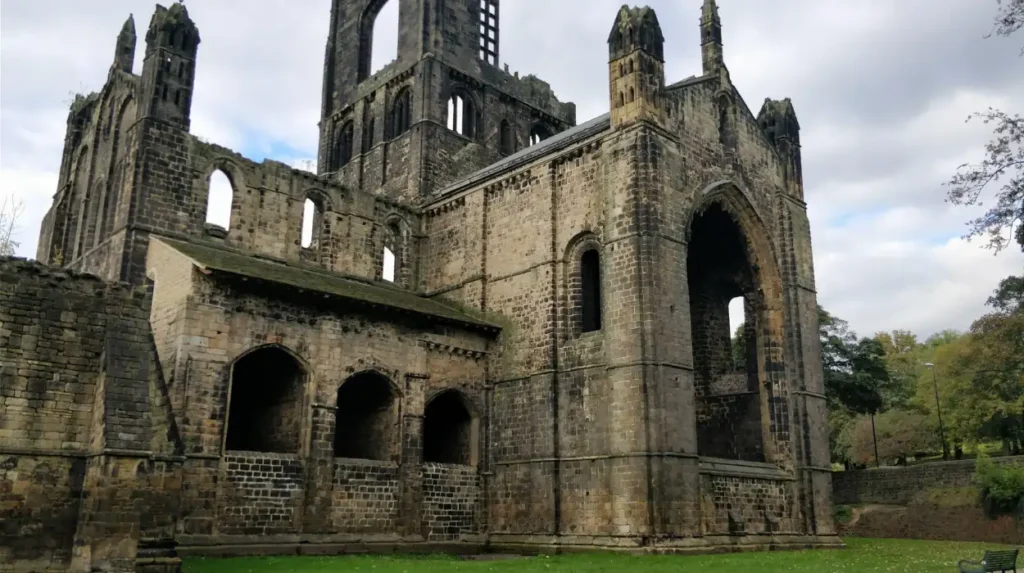
Kirkstall Abbey was founded in 1152 and became an important Cistercian monastery in the Aire Valley. Its influence extended beyond the surviving abbey ruins into surrounding agricultural territory.
The Horsforth conservation assessment identifies a monastic grange on the northern edge of the township. The site is associated with the present Dean Grange Farm, although no medieval structures survive above ground. Earthworks in nearby fields are identified as possible evidence of the former monastic farm buildings.
A grange was an agricultural estate operated for a religious house. Such sites produced crops, livestock and other resources needed to support monastic communities. Their existence demonstrates the scale of medieval land management.
Kirkstall Abbey itself remains one of the strongest physical reminders of this period. Leeds Museums and Galleries describes it as one of Britain’s most complete Cistercian monasteries. It is both a Grade I listed building and a Scheduled Ancient Monument.
Although the abbey lies in neighbouring Kirkstall rather than central Horsforth, it is essential to understanding Horsforth’s medieval story.
The monastery was dissolved in 1539 during the reign of Henry VIII, ending its religious function. Abbey lands in Horsforth were subsequently sold to private landowners. This transfer changed local landownership and helped establish the conditions for the development of later estates and prominent families.
Visitors exploring Horsforth therefore gain more historical context by viewing its heritage as part of the wider Kirkstall landscape rather than treating each building as an isolated attraction.
As you explore the modern neighbourhood, you are crossing land shaped by centuries of ownership and settlement. Read about the full to understand its origins.
Which historic buildings in Horsforth are most important?
Horsforth’s historic buildings include Low Hall, the former Horsforth Hall stable block, Low Fold, New Laithes Manor House, Station House and Woodside Methodist Sunday School and Hall, representing several centuries of domestic, agricultural, religious and transport history.
One of the most significant surviving buildings is Low Hall on Low Hall Road. Historic England lists it as a Grade II listed building. The building combines a manor house and farmhouse, with parts dating from the mid-to-late sixteenth century and later seventeenth-century alterations.
Low Hall is particularly valuable because it demonstrates the connection between domestic architecture and agricultural activity. Historic houses in Horsforth were often associated with farms, landholdings and local estates rather than existing as isolated residential properties.
Nearby historic agricultural structures reinforce this interpretation. A former barn approximately 30 metres south-west of Low Hall Farmhouse is also Grade II listed. Historic England identifies it as a probable early seventeenth-century aisled barn constructed from coursed squared sandstone.
The surviving barn demonstrates the practical side of Horsforth’s agricultural past. Its form reflects traditional farming requirements, while its stone construction connects it visually with other historic buildings in the district.
Another important building is Low Fold on New Road Side. Historic England records it as a Grade II listed former farmhouse. The building dates from the seventeenth century and was later enlarged and altered. Its sandstone construction and surviving architectural details provide evidence of earlier rural settlement.
These buildings are particularly useful for visitors interested in architectural history because they reveal how Horsforth looked before twentieth-century suburban development transformed the surrounding landscape.
What can visitors discover at the former Horsforth Hall?
The former Horsforth Hall estate survives through historic features including its Grade II listed stable block and Horsforth Hall Park. Together, these remains demonstrate the importance of estate architecture, landownership and later public commemoration in Horsforth.
Horsforth Hall was an important local estate, and its surviving stable block remains a protected historic building.
Historic England lists the Stable Block to Former Horsforth Hall as Grade II. The structure dates primarily from the later eighteenth century but incorporates a datestone marked 1707. It is built from coursed squared sandstone and retains a number of architectural features associated with its former agricultural and estate function.
The building contains eight bays and two storeys. Its surviving features include doorways, windows and a wall sundial. The 1707 datestone provides a particularly useful chronological marker for understanding the development of the estate.
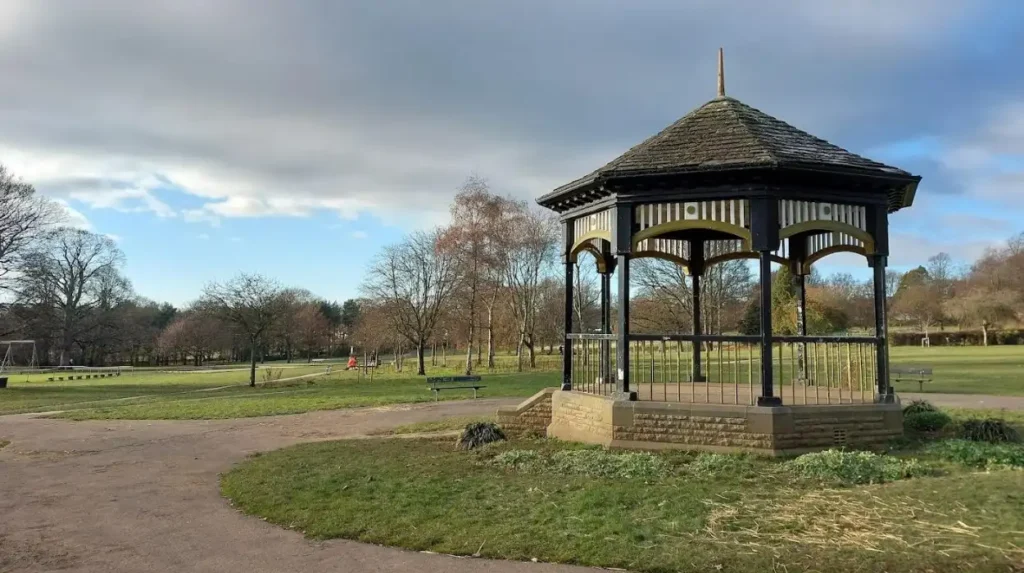
Today, the wider area associated with Horsforth Hall includes Horsforth Hall Park, which provides an accessible setting for understanding the relationship between the historic estate and the modern community.
The site also contains a war memorial at the junction with Fink Hill and Broadway. Historic England lists the memorial as Grade II. The principal memorial dates from 1920, with additions made in 1947. It commemorates the First World War and reflects later remembrance of those who served and died.
This creates an important chronological connection. Horsforth Hall represents earlier estate history, while the war memorial represents twentieth-century community memory.
Visitors should therefore consider Horsforth Hall Park as more than a green space. Its historic features connect landownership, architecture, public recreation and remembrance.
Why is St Margaret’s Church important to Horsforth history?
St Margaret’s Church represents Horsforth’s Victorian expansion and changing religious needs. Built between 1877 and 1883 to replace an earlier chapel, the Grade II listed church reflects the growth of the local population during the nineteenth century.
The present Church of St Margaret was designed by architect John Loughborough Pearson, a major nineteenth-century British church architect. The church was designed in 1874–76 and constructed between 1877 and 1883.
Its construction followed the expansion of an earlier eighteenth-century chapel known as the Bell Chapel. Despite repeated modifications and enlargement, the earlier chapel became too small for the growing congregation.
This provides an important insight into Victorian Horsforth. Population growth was not simply changing the number of houses. It also increased demand for religious, educational and community infrastructure.
The location of St Margaret’s Church is historically significant. When it was constructed, the church stood relatively detached from the main settlement on the lower slopes of the Hunger Hills. The location reflected expectations that Horsforth would continue expanding towards it.
That prediction became significant as suburban development extended across the area.
The church is listed at Grade II and forms part of Horsforth’s architectural heritage. Its association with Pearson also places the building within a wider national history of Victorian ecclesiastical architecture.
For visitors interested in architecture, St Margaret’s offers a direct way to understand how nineteenth-century population growth influenced the physical structure of Horsforth.
What does New Laithes Manor House reveal about Horsforth?
New Laithes Manor House preserves evidence of Horsforth’s earlier landed estates and agricultural economy. Its building fabric includes seventeenth-century or earlier elements, followed by eighteenth- and nineteenth-century remodelling.
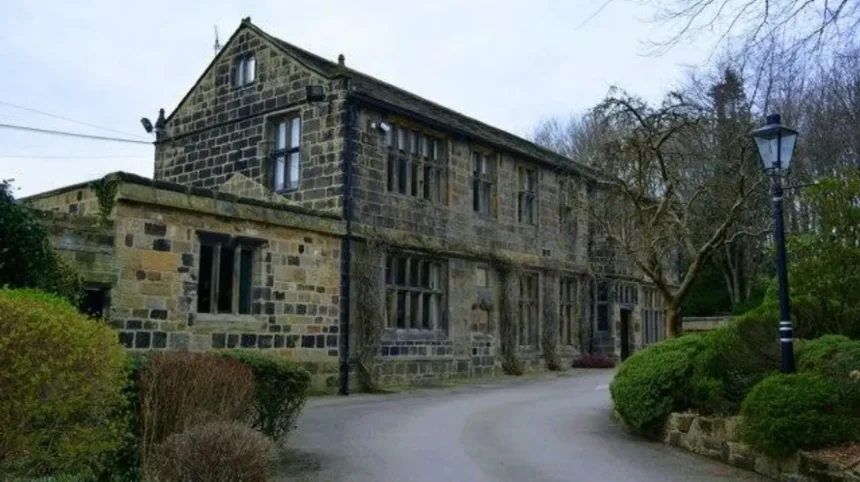
New Laithes Manor House stands on New Laithes Road and is listed Grade II by Historic England. The building is recorded as a seventeenth-century or earlier manor house that was remodelled and extended during the eighteenth and nineteenth centuries.
Its construction uses coursed sandstone rubble with stone detailing and a combination of stone slate and slate roofing. Some internal timber framing also survives.
The building has a long-range form that reflects incremental development rather than a single construction phase. This is characteristic of many historic rural buildings that were adapted as household requirements and economic circumstances changed.
The former name New Laithes Grange also reinforces the area’s agricultural associations. The term “grange” has strong historical connections with agricultural estates, particularly in medieval and post-medieval Yorkshire.
New Laithes therefore helps visitors understand that Horsforth’s heritage is not limited to churches and public monuments. Private houses, farmsteads and estate buildings also preserve evidence of historic land use.
What is the story behind Horsforth’s Station House?
Horsforth Station House connects the area’s agricultural and domestic past with the development of railway transport. The building began as a farmhouse with a barn and cottage before becoming associated with the railway as a station master’s residence.
Station House on Station Road is identified by Historic England as a Georgian-period historic building. Its origins are agricultural, with a farmhouse, attached barn and cottage forming the earlier complex.
The barn dates from the late seventeenth century. The main house was constructed in the early to mid-eighteenth century and enlarged during the nineteenth century. The cottage belongs to the mid-to-late eighteenth century.
Historic England records that the first floor of the house is said to have been used as a weaving workshop. This provides evidence of another important aspect of Horsforth’s economic history.
The building was later used as the station master’s house, demonstrating how existing buildings were incorporated into changing transport infrastructure.
The railway changed Horsforth’s relationship with Leeds and the surrounding region. Improved transport supported commuting, commercial activity and residential expansion.
For modern visitors, the station area therefore offers an opportunity to understand the transition from rural settlement to connected suburb.
How did weaving and industry change Horsforth?
Weaving formed part of Horsforth’s pre-industrial and industrial economy, while later transport connections and urban expansion changed the settlement’s economic structure. Historic buildings preserve evidence of domestic production, farming and the transition towards suburban employment.
Horsforth’s industrial history developed alongside its agricultural economy rather than replacing it immediately.
The Station House evidence of a former weaving workshop demonstrates the importance of textile production within domestic buildings. Household-based production was an established feature of Yorkshire communities before industrialisation transformed textile manufacturing.
Horsforth’s location near Leeds also influenced its development. As transport improved and Leeds expanded, the settlement became increasingly integrated into the city’s economic geography.
The nineteenth century brought stronger population growth. The Horsforth conservation assessment records a population of 2,018 in 1795, demonstrating that the township was already a substantial settlement before the major expansion of the Victorian period.
The 1672 Hearth Tax assessment recorded 215 chimneys in Horsforth. While chimney counts are not direct population figures, they provide evidence of the number and scale of households recorded for taxation purposes.
These figures help place the surviving buildings in context.
Historic farmhouses, weaving-related buildings and later railway infrastructure collectively show how Horsforth moved from a rural economy towards a more diversified settlement connected closely with Leeds.
Which community buildings reveal Horsforth’s religious and social history?
Woodside Methodist Sunday School and Hall is an important Grade II listed community building that records nineteenth-century religious education and social organisation. Its school dates from the early nineteenth century and its attached chapel from 1839.
The Woodside Methodist Sunday School and Hall on Outwood Lane is Grade II listed. Historic England records the school as early nineteenth century and the attached chapel as dating from 1839.
The building is constructed from coursed squared sandstone with slate and stone-slate roofs. Its design includes round-headed windows and a symmetrical schoolroom frontage.
Sunday schools were important institutions in nineteenth-century British communities. They combined religious teaching with education and community organisation.
Woodside therefore provides evidence of Horsforth’s social history as well as its architectural history.
Its survival also demonstrates that heritage is not confined to elite buildings. Schools, chapels and meeting halls played a central role in everyday community life.
When viewed alongside St Margaret’s Church, Woodside provides evidence of the changing scale and organisation of religious life during Horsforth’s expansion.
What historic stories can visitors discover around Horsforth today?
Visitors can trace Horsforth’s history through a combination of listed buildings, historic roads, former farms, churches, public parks and transport sites. These places collectively reveal medieval landholding, farming, weaving, Victorian growth, railway development and community remembrance.
The strongest approach is to explore Horsforth as a connected historic landscape.
Town Street and surrounding areas retain associations with the older settlement. Historic farmhouses and stone buildings show how agricultural communities were organised. Low Hall and Low Fold provide particularly strong architectural evidence.
The former Horsforth Hall estate demonstrates the influence of landed families and estate management. Its stable block preserves an eighteenth-century structure incorporating a 1707 datestone.
St Margaret’s Church represents Victorian population growth and architectural ambition. Woodside Methodist buildings provide evidence of nineteenth-century education and religious community life.
Station House adds another dimension by connecting earlier rural buildings with railway development. Its evolution from farmhouse to station master’s residence illustrates how infrastructure changed the function of historic buildings.
The war memorial in Horsforth Hall Park extends the historical record into the twentieth century. Its 1920 construction and 1947 additions provide evidence of community remembrance following the First and Second World Wars.
These locations are most meaningful when considered together. Each represents a different stage in Horsforth’s development.
Explore More Area Guide
Garforth Scenic Areas, Views and Landscapes Guide 2026
Garforth Morning Visits: Best Early Starts in Leeds 2026
How can you explore Horsforth’s heritage responsibly?
Horsforth’s heritage is best explored by respecting listed buildings, private property, memorials, places of worship and historic landscapes. Visitors should use public routes, check access arrangements and avoid entering protected or privately occupied buildings without permission.
Many historic buildings in Horsforth remain in active use or private ownership. A Grade II listing recognises architectural or historic significance, but it does not automatically mean that a building is open to the public.
Historic England’s National Heritage List for England records nationally protected buildings, monuments and other heritage assets. The listing system helps identify important historic structures and provides information about their significance.
Visitors should therefore distinguish between seeing a heritage building and entering a heritage building.
Public roads and open spaces provide opportunities to appreciate external architecture without disturbing residents or occupants. Churches and community buildings can have their own opening arrangements, services and events.
Kirkstall Abbey offers a more formal heritage experience nearby. Leeds Museums and Galleries currently operates the abbey as a visitor attraction and provides an audio guide covering ten locations around the ruins.
The abbey grounds and visitor centre are also designed with accessibility in mind, although some historic areas contain cobbles and uneven surfaces.
A responsible heritage visit therefore combines historical curiosity with respect for the people who live, work and worship in these historic places.
Why does Horsforth’s heritage remain important today?
Horsforth’s heritage remains important because surviving buildings and landscapes provide physical evidence of the area’s transformation from an early settlement into a modern Leeds suburb. They preserve information about landownership, religion, agriculture, industry, transport and community life.
Heritage gives Horsforth a physical record of change.
The settlement’s earliest documented history is connected with Domesday. Medieval development brought the area into the economic sphere of Kirkstall Abbey. The Dissolution of the Monasteries transferred former ecclesiastical lands into private ownership. Later estates, farms and houses reflected changing patterns of wealth and landholding.
The eighteenth and nineteenth centuries introduced further changes. Weaving contributed to household economies. Population increased. Religious institutions expanded. Railway infrastructure connected Horsforth more closely with Leeds.
The twentieth century brought further suburban growth while introducing new layers of public memory, including war memorials.
This chronology makes Horsforth particularly valuable for heritage tourism. Its history does not depend on one isolated monument. It survives through a network of buildings and landscapes that represent different periods.
The historic environment also contributes to local identity. Listed buildings such as Low Hall, Low Fold, New Laithes Manor House, the Horsforth Hall stable block and Woodside Methodist buildings preserve architectural evidence that would otherwise disappear beneath modern development.
For tourists and leisure travellers, Horsforth provides a quieter heritage experience within the wider Leeds area. For residents, the same buildings provide a direct connection with the settlement’s earlier communities. For visitors with limited time, the concentration of historic sites allows several centuries of history to be explored without travelling far from Leeds.
Horsforth’s heritage is therefore best understood as a continuous historical landscape. The horse ford suggested by its Old English name, the medieval grange, the later manor houses, Victorian churches, railway buildings and twentieth-century memorials all form part of the same story.
Exploring these sites reveals how Horsforth developed from a rural settlement into a modern Leeds district while retaining substantial evidence of its earlier identity.
What is Horsforth famous for historically?
Horsforth is known for its long history as an agricultural settlement, its links with Kirkstall Abbey, historic manor houses, weaving heritage, Victorian churches and railway development. Its surviving buildings provide evidence of the area’s transformation from a rural township into a Leeds suburb.