
Horsforth offers a different side of Leeds for visitors who want to slow down without leaving the city. The area combines green spaces, woodland, historic streets, local cafés, community facilities and practical transport links.
- What makes Horsforth suitable for a slower local experience?
- Why is Horsforth Hall Park a good place to start?
- What can visitors find around Hunger Hills Woods?
- How can visitors explore Horsforth’s historic character at a slower pace?
- Is the Leeds and Liverpool Canal suitable for a relaxed walk?
- Which Horsforth places suit a quiet café and local break?
- How can visitors combine parks, heritage and cafés in one slow day?
- How accessible is Horsforth for visitors without a car?
- Why does Horsforth work for digital nomads and business travellers seeking downtime?
- What should visitors know before planning a slower Horsforth itinerary?
- Why is Horsforth relevant for visitors seeking a slower Leeds experience?
Located around six miles north-west of Leeds city centre, Horsforth has a distinct village character within the metropolitan area. Horsforth Town Council describes it as an ancient settlement recorded in the Domesday Book, with three busy high streets, local businesses, cafés, restaurants, parks and walking routes.
The area suits a slower itinerary because its attractions are spread across manageable distances. A visitor can start with a walk in Horsforth Hall Park, continue towards Hunger Hills, explore historic streets and finish with food or coffee in one of the local centres.
Horsforth also provides useful connections for visitors staying elsewhere in Leeds. Horsforth railway station sits on the Harrogate Line, providing rail connections towards Leeds, Harrogate and York. The station has step-free access to its platforms, although access involves ramps rather than lifts.
A change of pace in Horsforth therefore does not require a specialised retreat. The experience comes from choosing slower activities within an established Leeds neighbourhood.
What makes Horsforth suitable for a slower local experience?
Horsforth offers a slower visitor experience through community parks, woodland paths, historic streets, independent cafés and canal-side walking. Its compact local centres support unhurried mornings, short walks, quiet breaks and flexible itineraries without requiring a full day away from Leeds.
The defining feature of Horsforth is its mixture of urban convenience and accessible green space. Visitors do not need to travel into the Yorkshire countryside to find woodland, open views or walking routes.
Leeds City Council manages Horsforth Hall Park as a community park. The council’s wider parks service manages thousands of hectares of public parks and green space across Leeds, alongside hundreds of kilometres of public rights of way.
Horsforth also contains designated woodland areas including Hunger Hills, Cragg Wood, Swaine Wood and The Outwood. Leeds City Council’s parks byelaw records identify these areas within the Horsforth landscape.
This combination creates several ways to slow an itinerary. A visitor can walk for an hour, spend time in a garden, explore historic buildings or sit in a local café without following a tightly scheduled attraction-to-attraction route.
The area is also suitable for different visitor profiles. Leisure travellers can use Horsforth as a half-day destination. Residents can explore less familiar paths and heritage sites. Digital workers can combine a café stop with a walk. Business travellers can use the area for downtime between appointments.
Why is Horsforth Hall Park a good place to start?
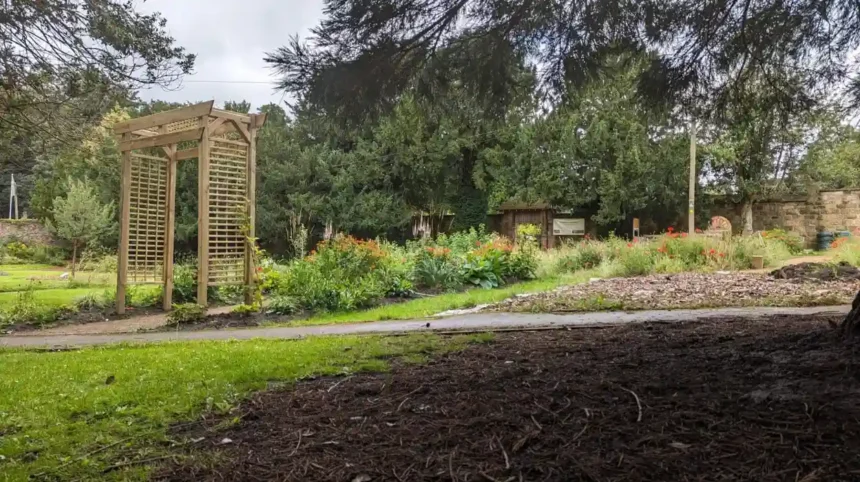
Horsforth Hall Park is a starting point for a change of pace because it combines paths, a Japanese garden, cricket facilities, play areas and accessible routes. Leeds City Council classifies it as community park six miles from Leeds city centre.
Horsforth Hall Park is one of the area’s most practical spaces for a relaxed visit. Leeds City Council lists scenic walks, a cricket pitch, summer entertainment, a trim trail, Japanese garden, skate park and integrated play facilities among its attractions.
The park also has accessibility features that support a wider range of visitors. Leeds City Council states that its paths are suitable for wheelchair users and that all entrances are wheelchair accessible. Two disabled parking bays are available in the main car park off Hall Lane.
The Japanese garden provides a distinct landscape within the wider park. It gives visitors a quieter section for observation and short walks rather than requiring active recreation.
The cricket pitch adds another layer to the park’s identity. Horsforth Hall Park has a long association with local sporting activity. Leeds Libraries records that a cricket field was established in the park in the nineteenth century, with Horsforth Hall Park Cricket Club leasing the ground from 1896. Famous Yorkshire cricketers including Hedley Verity, Herbert Sutcliffe, Bill Bowes and Len Hutton played there.
The park’s history also connects directly with the former Horsforth Hall. The hall was begun by John Stanhope IV in 1699 and completed in 1707. The Stanhope family remained closely associated with Horsforth for generations.
The present public park therefore combines recreation with historic landscape. Visitors walking through the site are using land connected to a former estate that shaped the development of Horsforth.
What can visitors find around Hunger Hills Woods?
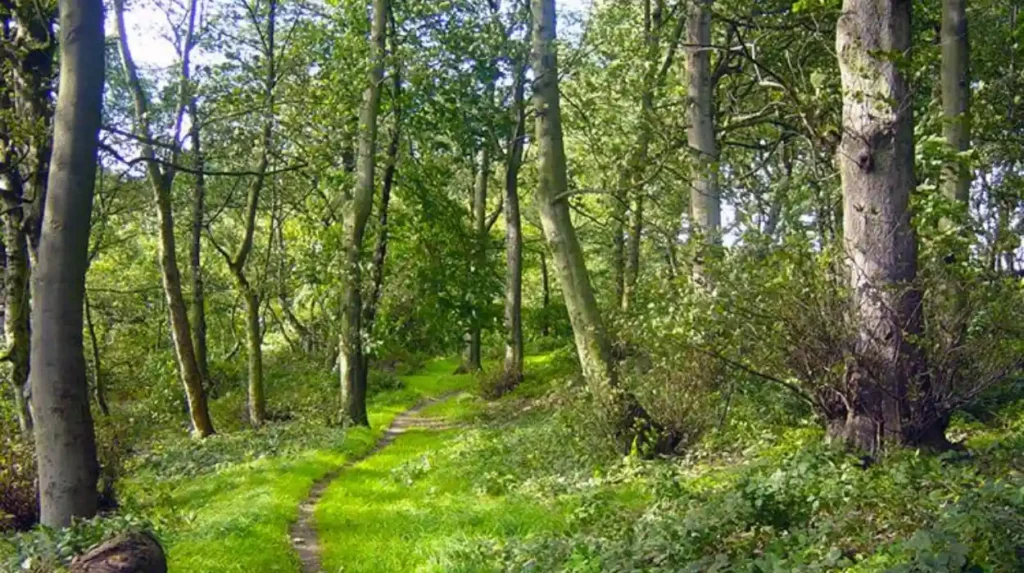
Hunger Hills Woods provides a woodland setting for slower walking, local views and heritage observation. Leeds planning documents identify quarry and bell-mining remains, while the woodland sits within a landscape of fields, paths, mature trees and local historic land uses.
Hunger Hills is particularly useful for visitors who want a quieter outdoor setting. Leeds City Council identifies Hunger Hills as a woodland area and part of a broader green landscape within Horsforth.
The landscape has significant industrial history. Leeds planning documentation records coal, ganister and fireclay mining and quarrying remains in the Hunger Hills area. The documentation states that 26 of Horsforth’s 37 shallow and deep bell coal mines were located at Hunger Hills.
Bell mining involved shallow shafts and associated workings. The surviving landscape includes spoil heaps and ground depressions connected with former extraction. Some of these features are now incorporated into the woodland environment.
Ganister quarrying also formed part of the area’s industrial history. Ganister is a hard silica-rich sandstone used in industrial applications, including furnace construction. Leeds documentation records quarrying by the Horsforth Ganister Company until 1936.
This history changes the way visitors understand the landscape. The woodland is not simply an area of trees. Its ground formations and surrounding fields preserve evidence of former industrial activity.
The wider Hunger Hills landscape also provides elevated views. Leeds planning documents identify Hunger Hills viewpoint and describe the area’s high scenic quality, woodland, hedgerows, water bodies and field structure.
Visitors should remain on established paths and follow local access guidance. Woodland terrain can contain uneven ground, particularly around former quarry and mining features.
The Friends of Hunger Hills Woods also support the site through volunteer activity and regular action days. Leeds City Council records the group as meeting at Hunger Hills Woods and working to promote the small urban woodland on the edge of Horsforth.
How can visitors explore Horsforth’s historic character at a slower pace?
Horsforth’s streets and historic buildings create a slower urban experience because visitors can combine architecture, local history and cafés within a compact area. St Margaret’s Church, The Green, Town Street and surviving estate buildings reveal different stages of Horsforth’s development.
Horsforth has a documented history extending well beyond its modern suburban identity. Leeds City Council heritage material records the settlement in the Domesday period and traces its development through medieval landholding, the influence of Kirkstall Abbey, industrial activity and later suburban growth.
The Stanhopes became particularly important to Horsforth’s development. After the Dissolution of the Monasteries in the sixteenth century, former Kirkstall Abbey lands were sold to private landholders, including the Stanhope family. Their connection with Horsforth continued for more than two centuries.
Horsforth Hall represented this landed history. Although the main hall was eventually demolished, its stable block survives. Leeds Libraries records that the stable structure dates from 1707 and remains as part of the historic landscape.
As you explore the modern site, you are crossing land with a deep heritage. Read the full [Insert Anchor Text for History Article Here] to understand its origins.
St Margaret’s Church provides another important historical landmark. Historic England lists the Church of St Margaret on Church Lane as a Grade II listed building. The main church was built between 1877 and 1883 to designs by J. L. Pearson, while the spire was completed in 1902 by J. B. Frazer.
The church replaced the earlier Bell Chapel because the older building had become too small for Horsforth’s growing congregation. Historic England’s associated research records the church’s relationship with nineteenth-century population growth and expansion.
The Green and Town Street provide further context. These streets connect the modern settlement with its older village structure. A visitor can therefore explore the area without treating heritage as a separate museum experience.
This is particularly suitable for a slower itinerary because the emphasis is on observation. Architectural details, street layouts, historic buildings and local businesses become the main points of interest.
Is the Leeds and Liverpool Canal suitable for a relaxed walk?
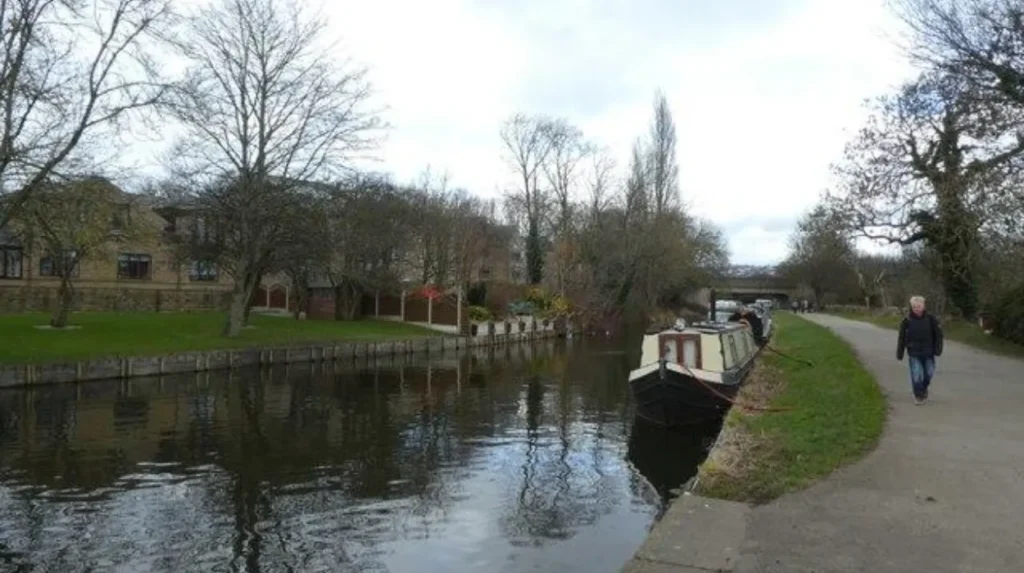
The Leeds and Liverpool Canal offers a linear walking environment where visitors can follow the towpath, watch waterway activity and connect with surrounding neighbourhoods. The Canal and River Trust describes the canal as a 127-mile waterway linking Leeds with Liverpool.
The Leeds and Liverpool Canal is one of the major historic waterways serving the wider Leeds area. The Canal & River Trust describes the waterway as stretching 127 miles between Leeds and Liverpool. It supports walking, boating, wildlife watching and other leisure activities.
For visitors seeking a change of pace, canal walking provides a simple structure. Instead of travelling between several attractions, visitors can follow the towpath for a chosen distance and turn the walk into the main activity.
The canal also provides a connection between built-up neighbourhoods and wider countryside landscapes. Its route passes through different settlements and landscapes before reaching Leeds.
Canal walking is particularly useful when the visitor does not want an intensive sightseeing schedule. The activity requires no timed admission and does not depend on a sequence of attractions.
The wider waterway also has substantial engineering and industrial heritage. Its original purpose was to connect important commercial centres, helping transport goods between Lancashire and Yorkshire.
Visitors should check current towpath conditions and follow Canal & River Trust guidance before setting out. Weather affects surfaces, and towpaths remain working environments shared by walkers, cyclists and waterway users.
A canal walk also pairs well with other Horsforth activities. A visitor can begin in a local centre, walk towards the waterway, continue for a comfortable distance and return for food or coffee.
Which Horsforth places suit a quiet café and local break?
Horsforth’s local centres support slower breaks through cafés, restaurants, shops and community facilities. The town council identifies three busy high streets, while the area’s village character makes it practical to combine food, coffee, shopping and short walks.
Horsforth has a substantial local commercial network. Horsforth Town Council identifies three busy high streets within the parish, with local shops, cafés, restaurants and other businesses serving residents, visitors and students.
This commercial structure matters for visitors looking for a slower experience. A café stop can become part of the itinerary rather than simply a place to refuel between major attractions.
The area’s cafés also suit different patterns of use. Leisure visitors can take a longer break. Remote workers can use an appropriate café for a short working session where facilities and house policies permit. Business travellers can use local food and coffee venues during free periods.
Visitors should distinguish between working in a café and visiting a café. Seating, Wi-Fi, sockets and laptop policies vary between businesses and change over time. Checking current arrangements directly with the venue is therefore important for anyone planning to work.
The local high streets also make Horsforth useful for low-intensity browsing. Independent businesses provide opportunities to explore local retail without the scale and crowds associated with Leeds city centre.
The village character identified by Horsforth Town Council is central to this experience. The area has retained a network of local services while remaining closely connected to Leeds.
For visitors, this creates a useful middle ground. Horsforth is not isolated, but it also does not require the pace of a major city-centre itinerary.
How can visitors combine parks, heritage and cafés in one slow day?
A slow Horsforth day works best when visitors combine one green-space activity, one heritage area and one local food break. Hall Park, Hunger Hills, St Margaret’s Church, historic streets and local cafés provide enough variety without creating a tightly scheduled itinerary.
A practical route starts at Horsforth Hall Park. The park provides paths, gardens, sport facilities and accessible entrances. Visitors can spend as much time there as their schedule allows rather than following a fixed attraction timetable.
The next stage can focus on Hunger Hills and its surrounding landscape. This changes the setting from managed parkland to woodland and open countryside. Visitors interested in history can also observe the landscape evidence associated with former mining and quarrying.
The itinerary can then move towards Horsforth’s historic core. The Green, Town Street and St Margaret’s Church provide opportunities to understand the settlement’s architectural and social development.
A café or restaurant stop completes the central part of the day. Because Horsforth has several local commercial centres, visitors can select food around their walking route instead of returning to Leeds city centre.
The sequence can also be reversed. A visitor arriving later in the day can begin with lunch or coffee, continue towards the historic area and finish with a park or woodland walk.
This flexibility is important for a change-of-pace itinerary. The objective is not to maximise the number of attractions visited. It is to reduce unnecessary travel between activities while keeping the day varied.
How accessible is Horsforth for visitors without a car?
Horsforth is well connected to Leeds and surrounding destinations through rail and bus services, while its local attractions provide options for walking once visitors arrive. Horsforth railway station sits on the Harrogate Line and offers step-free platform access.
Horsforth railway station is managed by Northern and sits on the York–Harrogate–Leeds route. Northern’s published 2026 timetable identifies Horsforth on the Harrogate Line.
National Rail records step-free access to all platforms, although the station has no lifts. Access uses long or steep ramps or streets. Passenger assistance is available.
The station also has bicycle storage and a 68-space car park, according to Northern’s station information.
Public transport makes Horsforth suitable for visitors who do not want to drive. It also supports visitors staying in Leeds who want to spend part of a day outside the city centre without making a long journey.
Walking conditions vary between locations. Hall Park has accessible paths and entrances, while woodland and heritage routes include more varied surfaces and gradients. Visitors with specific mobility requirements should therefore match the route to the conditions of the individual site.
The practical advantage is that Horsforth does not depend on a single attraction. If one walking route is unsuitable, visitors can spend more time in an accessible park, explore local streets or use the commercial centres instead.
Why does Horsforth work for digital nomads and business travellers seeking downtime?
Horsforth works for digital nomads and business travellers seeking a quieter base because cafés, local centres, green spaces and rail connections support flexible downtime. Horsforth station provides access on the Harrogate Line, while nearby parks provide non-work spaces for walks.
Digital nomads need places that support both productivity and breaks. Horsforth provides a combination of local cafés, transport connections and green spaces within a residential urban setting.
The key advantage is separation between work time and leisure time. A visitor can spend part of a morning working in a suitable venue, then leave the commercial area and walk through Hall Park or Hunger Hills.
Business travellers also benefit from the railway connection. Horsforth station connects the area with Leeds and destinations on the Harrogate Line, making it practical to combine meetings with a local afternoon or evening.
Work facilities should be checked directly with individual cafés. Public Wi-Fi, electrical sockets, table availability and laptop policies are not uniform across venues.
For non-working downtime, the area’s green spaces provide more predictable alternatives. Leeds City Council identifies Hall Park as a community park and Hunger Hills as woodland, creating options for outdoor breaks.
This makes Horsforth particularly relevant to visitors who do not want every free hour to involve another major attraction.
Explore More Area Guide
Horsforth Guide: Local Places Worth Revisiting in Leeds
Horsforth Weekend Morning: Best Cafés, Parks and Heritage
What should visitors know before planning a slower Horsforth itinerary?
Visitors should plan around walking distances, weather, opening arrangements and local access conditions. Parks and outdoor routes provide the greatest flexibility, while churches, cafés, museums and other indoor venues operate according to their own opening times and visitor arrangements.
Horsforth’s slower attractions are not all managed in the same way. Public parks offer open access, while heritage buildings and commercial venues have separate arrangements.
Hall Park has published access information from Leeds City Council, including wheelchair-accessible paths and entrances.
St Margaret’s Church is a functioning place of worship rather than simply a visitor attraction. Visitors should respect services, worshippers and any restrictions on access.
Historic England’s listing confirms that the church is Grade II listed. Listed-building status recognises the building’s special architectural or historic interest and places it within England’s statutory heritage framework.
Woodland routes require different preparation. Hunger Hills contains evidence of former quarrying and bell mining, so visitors should stay on established routes and avoid climbing unstable ground or entering former workings. Leeds planning documentation records the archaeological significance of these remains.
Canal walks also require awareness of other users and changing weather conditions. The Canal & River Trust manages a large operational waterway network, so visitors should follow current local guidance.
The most effective approach is therefore simple. Choose a small number of activities, allow time between them and use the local cafés, parks and streets as part of the experience rather than as spaces between attractions.
Why is Horsforth relevant for visitors seeking a slower Leeds experience?
Horsforth provides a slower alternative to intensive city-centre sightseeing through accessible parkland, woodland, historic buildings, local businesses and transport connections. Its combination of natural and built heritage creates a flexible destination for short visits, relaxed afternoons and low-pressure days.
Horsforth’s value lies in its variety within a relatively compact area. Visitors can experience public parkland, woodland, historic architecture, local commerce and transport infrastructure without travelling across multiple parts of Leeds.
Its historical depth also strengthens the experience. The settlement’s documented development includes medieval landholding, the influence of Kirkstall Abbey, the Stanhope family, coal mining, quarrying, Victorian expansion and twentieth-century suburban growth.
The modern landscape retains evidence of those different periods. Horsforth Hall Park occupies the former setting of an important estate. Hunger Hills preserves traces of industrial extraction. St Margaret’s Church represents nineteenth-century population growth. The local high streets show the continuing role of neighbourhood commerce.
The area also has practical relevance. Rail connections support access without a car, while accessible park facilities make Hall Park suitable for a broad range of visitors.
For leisure travellers, this creates a destination that fits naturally into a slower Leeds itinerary. For residents, it provides opportunities to explore familiar surroundings differently. For digital nomads and business travellers, it offers a useful separation between work and downtime.
A change of pace in Horsforth therefore comes from using the area as a local landscape rather than treating it as a checklist of attractions. Parks, woodland, heritage, food, walking and transport all contribute to the same experience: spending time in Leeds at a less intensive rhythm.
What are the best places in Horsforth for a slower day?
Horsforth Hall Park, Hunger Hills Woods, the historic streets around Town Street, St Margaret’s Church and the Leeds & Liverpool Canal are suitable for a slower day. These places combine green space, heritage, walking and local amenities.