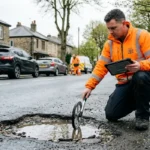

The fastest way to report a broken pavement in Headingley is through Leeds City Council’s online “Report a problem with a pavement” form, available 24/7, or by calling the highways emergency line for urgent defects posing immediate danger.
- Who is responsible for maintaining pavements in Headingley?
- How do I identify if a pavement defect qualifies for repair?
- What information must I provide when reporting a broken pavement?
- How does Leeds City Council prioritize pavement repair requests?
- Can I track the status of my pavement repair report?
- What happens if my reported pavement causes an accident?
- Are there alternative channels to report pavement issues beyond the council website?
- How long does it typically take to fix a reported broken pavement in Headingley?
- What preventive measures exist to reduce future pavement damage in Headingley?
- Where can I find historical data on pavement repairs in Headingley?
- What legal framework governs pavement maintenance obligations in England?
- How do seasonal changes affect pavement condition and reporting urgency in Headingley?
- What role do local businesses and institutions play in pavement upkeep around Headingley?
- How can residents organize community-driven pavement improvement campaigns in Headingley?
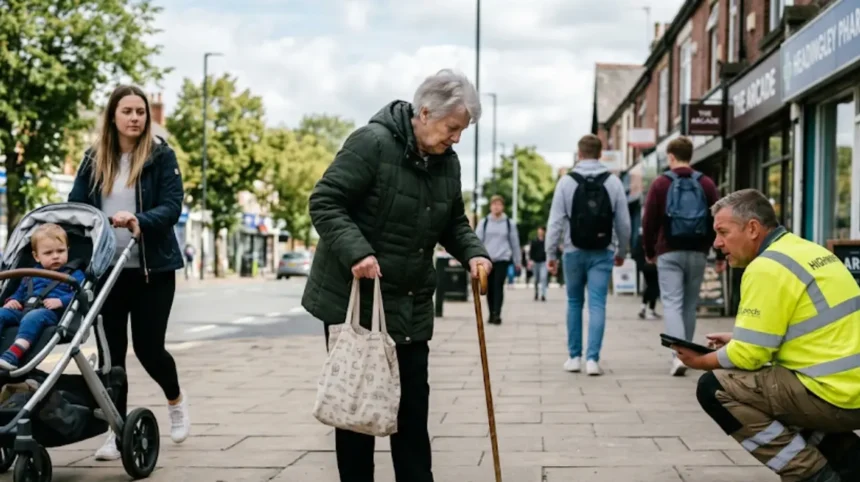
Broken or uneven pavements present trip hazards and accessibility barriers, particularly for older residents, parents with prams, and people with disabilities. In Headingley—a densely populated suburb of Leeds with high foot traffic near shops, schools, and public transport routes—prompt reporting ensures faster repairs and reduced liability risks. Leeds City Council assesses each report and assigns a priority: urgent (fixed by next working day), non-urgent (within 28 days), or planned works (scheduled with other local repairs).
Who is responsible for maintaining pavements in Headingley?
Leeds City Council maintains the majority of public pavements in Headingley, including replacing broken slabs, removing weeds, and clearing obstructions, unless the pavement lies on a private road or development not adopted by the council.
Headingley falls under the jurisdiction of Leeds City Council, which holds statutory responsibility for highway maintenance under the Highways Act 1980. This includes all adopted roads and their associated footways. Residents can verify whether a street is council-maintained using the council’s Street Register tool. Private estates, new housing developments, or commercial complexes may have unadopted pavements managed by managing agents or residents’ associations. In such cases, reports should go directly to the responsible party, not the council.
How do I identify if a pavement defect qualifies for repair?
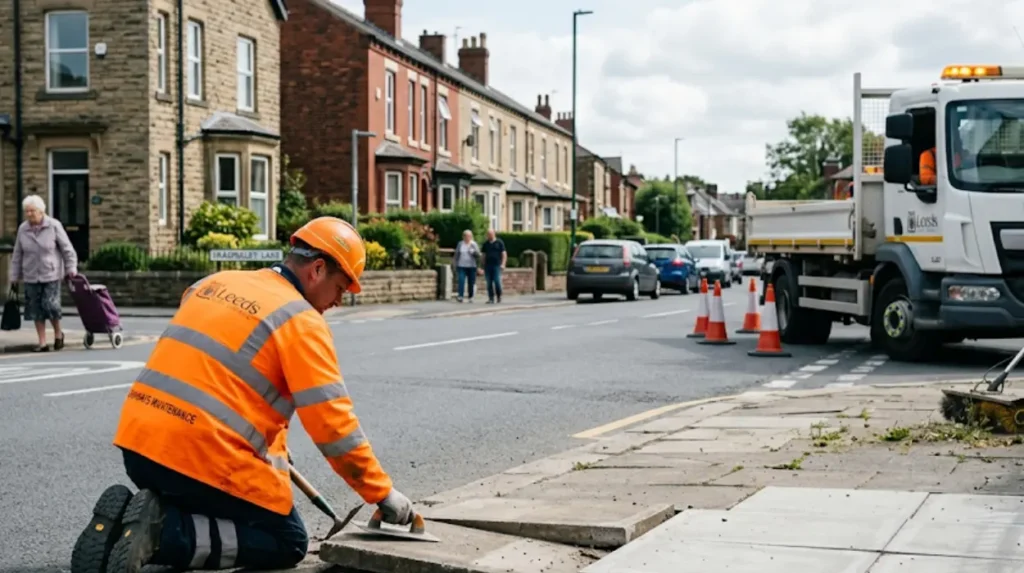
A pavement defect qualifies for repair if it presents a tripping hazard—typically a vertical displacement of 25mm (1 inch) or more—or if slabs are loose, missing, or obstructed by vegetation, debris, or structural damage.
Leeds City Council uses inspection criteria aligned with national guidance to determine whether a defect requires action. Key indicators include vertical lip or height difference between adjacent slabs exceeding 25mm, loose or rocking slabs that shift underfoot, missing slabs exposing underlying soil or utilities, overgrown tree roots lifting or cracking surface material, and obstructions such as fallen signage, bollards, or accumulated litter blocking passage. Defects below this threshold may be monitored but not immediately repaired unless part of a scheduled resurfacing program. Reporting precise measurements and clear photos improves assessment accuracy and speeds up response times.
What information must I provide when reporting a broken pavement?
When reporting, you must provide the exact location (street name, nearest landmark or house number), description of the defect, its approximate size, and any photos showing the hazard from multiple angles.
The online form requires specific fields to ensure efficient processing. Location details should include full street name, postcode (for example, LS6 3HW), and optional reference points like “outside Sainsbury’s on Otley Road” or “near Headingley Stadium.” Defect type selection comes from dropdowns including “broken slab,” “uneven surface,” “missing slab,” “tree root damage,” or “other.” Dimensions should be estimated in length, width, and depth in centimeters or inches. Photographs should show the defect close-up and in context with surrounding pavement and street signs. Contact details are optional but recommended for follow-up; email or phone number allows the council to request clarification or notify of repair status. Incomplete submissions delay prioritization. Including GPS coordinates via smartphone mapping apps further accelerates identification.
How does Leeds City Council prioritize pavement repair requests?
Leeds City Council categorizes reports into three priority groups: urgent (attended by end of next working day), non-urgent (within 28 days), and planned works (added to future area-wide repair schedules).
Priority assignment depends on risk level. Urgent defects pose immediate danger—such as large holes, exposed utility covers, or severe instability near pedestrian crossings or school zones—and are flagged for emergency intervention. Non-urgent hazards like cracked slabs or minor unevenness are scheduled within four weeks based on available resources and geographic clustering. Low-risk issues or those requiring extensive reconstruction are bundled with other local improvements during cyclical maintenance programs, often announced quarterly. Emergency cases involving imminent threat to life or property can bypass standard forms by calling the dedicated emergency line directly. This line operates 24/7 for critical infrastructure failures.
Can I track the status of my pavement repair report?
Yes, after submitting your report online, you receive a unique reference number enabling you to track progress via email updates or by contacting Leeds City Council’s Highways Department.
Upon submission, the system generates an automated confirmation email containing a case reference ID, assigned priority level, expected timeframe for inspection or repair, and a link to view real-time status updates. Residents may also call the contact centre or email the highways team with their reference number to inquire about delays or changes. Public dashboards displaying recent repairs by ward are occasionally published on the council website, though individual tracking remains the most reliable method.
What happens if my reported pavement causes an accident?
If someone suffers injury due to a reported but unrepaired pavement defect, they may file a public liability claim against Leeds City Council, provided negligence or failure to act within reasonable timeframes can be demonstrated.
To pursue compensation, download and complete the official Claim Form from the council website. Submit it electronically or by post to the insurance department along with supporting evidence: medical records, witness statements, photographs of the defect, and proof of prior reporting with reference number. The council’s insurers review claims within 28 days, potentially requesting additional documentation or site inspections. Claims succeed only if the council knew—or should have known—about the hazard and failed to address it within statutory guidelines. Prompt reporting strengthens legal standing and demonstrates civic diligence.
Are there alternative channels to report pavement issues beyond the council website?
Yes, residents can also report pavement defects via phone for emergencies or general inquiries, email, or through third-party platforms like FixMyStreet or local community forums linked to council monitoring systems.
While the online form remains the primary channel, alternatives serve specific needs. Phone reporting is ideal for elderly residents without internet access or for urgent verbal descriptions requiring immediate dispatch. Email submissions are useful for attaching large files or detailed written accounts with embedded images. Community reporting tools like FixMyStreet aggregate user reports and forward them to relevant authorities, sometimes triggering faster responses due to public visibility. Local councillors in Headingley can escalate persistent issues through internal council networks. All channels feed into the same central database, ensuring consistent tracking regardless of entry point.
How long does it typically take to fix a reported broken pavement in Headingley?
Most non-urgent pavement repairs in Headingley are completed within 28 days of reporting, while urgent cases are addressed by the end of the next working day; complex reconstructions may take longer depending on contractor availability and weather conditions.
Repair timelines vary by classification. Urgent repairs see crews dispatched within 24 hours for hazards like deep potholes or collapsed sections near crossings. Standard repairs are scheduled within four weeks, often grouped with neighboring fixes to optimize labor and materials. Major reconstructions involving full resurfacing or utility coordination may require weeks to months, especially if tendering or planning permissions are involved. Delays occur during extreme weather such as frost or heavy rain, or during staffing shortages. Residents receiving no update beyond 28 days should contact the highways team with their reference number for escalation.
What preventive measures exist to reduce future pavement damage in Headingley?
Preventive measures include regular tree root management, improved drainage installation, use of flexible paving materials, and community reporting initiatives that flag early signs of deterioration before major failures occur.
Leeds City Council employs several strategies to mitigate recurrence. Cyclical tree root pruning beneath pavements prevents uplift without harming trees. Drainage upgrades through clearing gullies and installing permeable surfaces reduce water infiltration causing subsidence. Material innovation such as rubber-modified asphalt and interlocking concrete blocks offers greater flexibility under stress. Public engagement encourages residents to report minor cracks or loose slabs, enabling proactive intervention before hazards develop. Headingley-specific efforts include partnership with local businesses to maintain frontage areas and collaboration with university campuses on shared pathway maintenance. Community-led “Adopt-a-Path” schemes also supplement council resources.
Where can I find historical data on pavement repairs in Headingley?
Historical pavement repair records for Headingley are accessible via Leeds City Council’s Open Data Portal, freedom of information requests, or archived minutes from Highways and Transportation Committee meetings held quarterly.
Available datasets typically include annual repair volumes by ward, average response times per category, budget allocations for footway maintenance, and maps highlighting high-frequency defect zones. Freedom of Information requests submitted through the council website yield customized extracts, though processing takes up to 20 working days. Committee transcripts, published online, occasionally discuss trending issues in Headingley such as Otley Road congestion impacts or stadium event-related wear. Academic researchers and journalists frequently utilize these sources for longitudinal analysis.
What legal framework governs pavement maintenance obligations in England?
Pavement maintenance in England is governed primarily by the Highways Act 1980, which imposes a duty on local authorities to keep adopted highways safe for public use, supplemented by the New Roads and Street Works Act 1991 regulating utility excavations.
Key provisions include Section 41, which requires highway authorities to maintain public ways “in such repair as to ensure they are safe for users.” Section 58 provides statutory defense if the authority proves it took reasonable care to prevent danger—for example, through documented inspection regimes. Section 130 empowers councils to issue notices requiring adjacent landowners to remove obstructions or encroachments. Utility companies must reinstate surfaces to original standards post-excavation, backed by financial bonds. Failure to comply triggers enforcement actions and potential fines. These laws apply uniformly across England, including Headingley, ensuring consistent accountability regardless of locale.
How do seasonal changes affect pavement condition and reporting urgency in Headingley?
Seasonal changes significantly impact pavement integrity: winter frost heave and salt corrosion accelerate cracking, spring thaw reveals hidden subsidence, summer heat expands joints, and autumn leaf accumulation masks emerging defects—making year-round vigilance essential.
Seasonal patterns influence both defect formation and reporting behavior. During winter, freeze-thaw cycles cause rapid expansion of micro-cracks and de-icing salts corrode concrete edges, causing urgent reports to spike during cold snaps. Spring melting exposes sunken slabs and eroded bases, while increased rainfall highlights drainage-related failures. Summer thermal expansion widens gaps between slabs, and heavy foot traffic from festivals and markets exacerbates wear. Autumn leaf accumulation obscures trip hazards, and wet conditions make slippery moss growth more dangerous. Council inspection frequency increases seasonally, particularly ahead of major events like Headingley Carnival or rugby matches at Emerald Headingley Stadium. Residents are encouraged to adjust reporting thresholds accordingly—for instance, flagging smaller defects in winter when risks multiply.
Explore More Help & Resources
How to get free activities for older people in Headingley
How to get affordable childcare near Guiseley
What role do local businesses and institutions play in pavement upkeep around Headingley?
Local businesses and institutions in Headingley contribute to pavement upkeep through frontage maintenance agreements, sponsorship of public realm enhancements, and participation in joint initiatives like the Headingley Business Improvement District proposal.
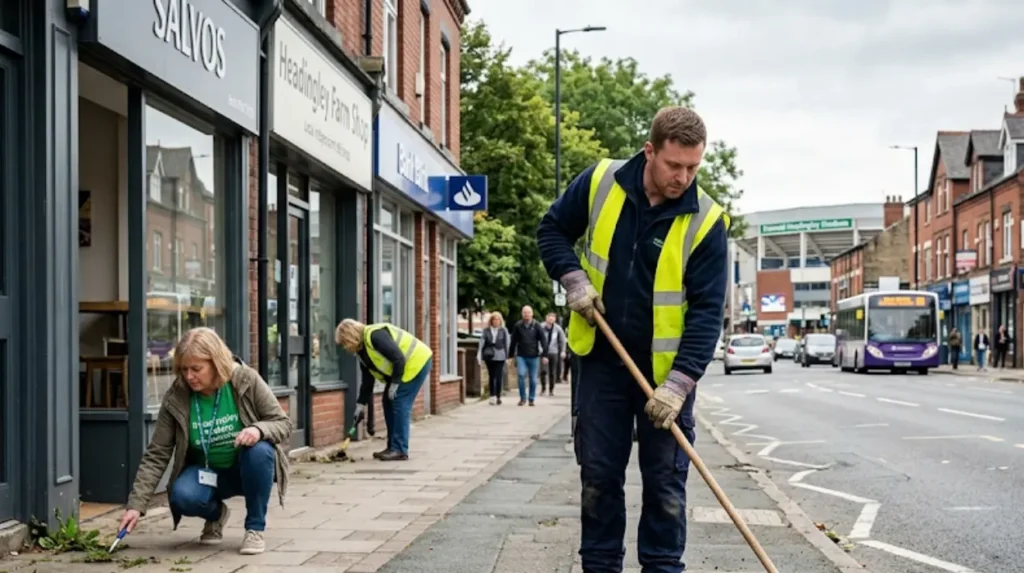
Examples include retailers on Otley Road, many of whom voluntarily sweep, weed, and report defects outside their premises under informal “adopt-a-footway” arrangements. Universities such as the University of Leeds and Leeds Beckett University fund improvements along student-heavy routes like St Michael’s Lane and Cliff Road. Sports venues like Emerald Headingley Stadium collaborate with the council on pre-event pathway inspections and post-event cleanup crews. Business associations such as Headingley Traders Association advocate for coordinated investment and occasionally pool funds for cosmetic upgrades. These partnerships extend council capacity and foster communal ownership of public space quality. Formalized structures like Business Improvement Districts remain under discussion but reflect growing recognition of shared responsibility.
How can residents organize community-driven pavement improvement campaigns in Headingley?
Residents can organize community-driven pavement improvement campaigns by forming neighborhood action groups, petitioning local councillors, leveraging social media awareness drives, and applying for small grants via Leeds City Council’s Community Grants Programme.
Effective campaign steps begin with forming a group by recruiting neighbors via WhatsApp, Facebook groups, or door-to-door flyers. Document issues by photographing and mapping all defective segments using free tools like Google My Maps. Engage officials by presenting findings to ward councillors or attending Area Committee meetings. Apply for funding by submitting proposals for matching grants covering up to £5,000 for local environmental projects. Mobilize volunteers to coordinate clean-up days, tree planting, or temporary marking of hazards pending official repairs. Success stories elsewhere in Leeds—such as Hyde Park’s “Safe Streets” initiative—demonstrate how organized pressure yields tangible results, including accelerated repair schedules and enhanced lighting installations.
Reporting a broken pavement in Headingley is straightforward, time-sensitive, and civically vital. By leveraging Leeds City Council’s digital infrastructure, understanding statutory frameworks, and engaging proactively with local stakeholders, residents ensure safer, more accessible streets for everyone. Whether acting individually or collectively, every report contributes to sustained urban resilience and community well-being.
Who is responsible for maintaining pavements in Headingley?
Leeds City Council is responsible for maintaining most adopted public pavements in Headingley. Private roads and unadopted developments are usually maintained by landowners, developers, or management companies.