
Reporting a pothole on Guiseley roads is straightforward through Leeds City Council’s online reporting system or by calling 0113 222 4444. Most residential and local streets in Guiseley fall under council maintenance, with urgent defects targeted for repair by the end of the next working day and non-urgent issues within 28 days.
- Who is responsible for maintaining Guiseley roads?
- What is the correct way to report a pothole in Guiseley?
- What information must be included in a pothole report?
- How does Leeds City Council prioritise pothole repairs?
- What happens after a pothole is reported in Guiseley?
- Are there alternative ways to report road defects in Guiseley?
- What are the most common pothole locations in Guiseley?
- How can residents prevent potholes from worsening?
- What are the legal implications of unreported potholes?
- How often does Leeds City Council inspect Guiseley roads?
- What should Guiseley residents do if a pothole causes vehicle damage?
- How can Guiseley communities advocate for better road maintenance?
- What resources exist for tracking pothole repairs in Leeds?
- Why is reporting potholes in Guiseley important for road safety?
Who is responsible for maintaining Guiseley roads?
Leeds City Council maintains most local and residential roads in Guiseley, while National Highways looks after motorways and major A-roads such as the A65. Residents should report potholes to the council for ordinary streets and to National Highways for trunk roads.
Guiseley sits within the City of Leeds metropolitan area in West Yorkshire. Road maintenance responsibilities are split between local authorities and national bodies depending on road classification. Local streets, residential roads, and many B-classified routes fall under Leeds City Council’s Highways service. This includes routine inspections, surface repairs, drainage, and pothole remediation.
Major routes such as motorways (M1, M62) and certain primary A-roads (for example A1(M)) are managed by National Highways, an executive agency of the Department for Transport. The A65, which runs through Guiseley toward Otley and beyond, is maintained by Leeds City Council as a local authority road, not by National Highways.
If unsure whether a road is council-maintained, use the council’s online Street Register. This tool confirms whether a specific street is adopted (publicly maintained) or private. Only adopted highways are eligible for council-led pothole repairs.
What is the correct way to report a pothole in Guiseley?
Use Leeds City Council’s online “Report a pothole or damaged road surface” form, providing location details, measurements, and photos if possible. Alternatively, call the council Contact Centre on 0113 222 4444 during office hours.
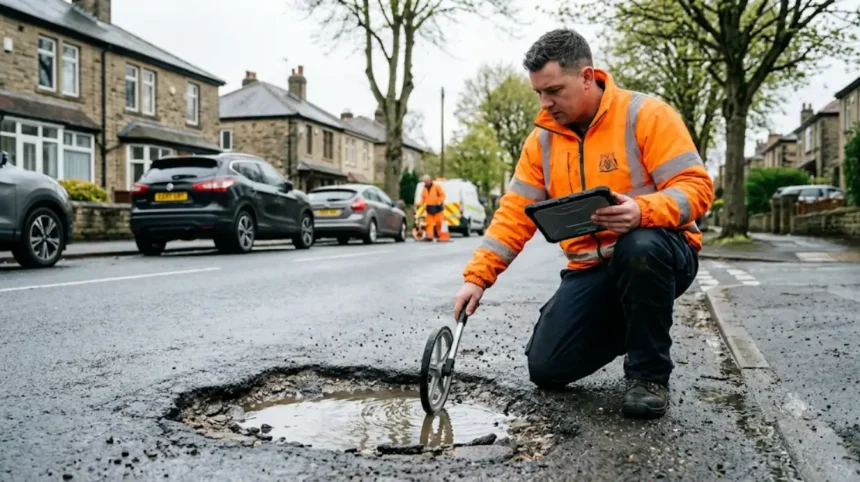
The primary reporting channel for Guiseley residents is the council’s dedicated online form for potholes and surface damage. The form captures essential data: exact location (street name, nearest house number or landmark), approximate dimensions (depth and width), and whether the defect poses immediate danger. Upload clear photographs showing scale (for example, a coin or ruler beside the pothole) to support assessment.
Phone reporting is available via the Leeds City Council Contact Centre at 0113 222 4444. Operators log the report into the same highways management system used for online submissions. This option suits residents without internet access or those needing immediate assistance for hazardous defects.
For emergencies presenting immediate danger—such as a large, deep pothole on a busy junction, a missing manhole cover, or a significant obstruction—call the highways emergency line on 0113 222 4407. This 24/7 service dispatches rapid-response teams to mitigate risks to people and property.
What information must be included in a pothole report?
Provide precise location, measurements (depth and width), photos, and any safety concerns when reporting a pothole to ensure accurate assessment and prioritisation. Missing details delay inspection and repair scheduling.
Accurate location data is critical. Include the full street name, nearest house number or business, and notable landmarks (for example, “outside 42 Kyoto Street, near the bus stop”). If the pothole lies at a junction or on a bend, specify this clearly. GPS-enabled smartphones automatically embed coordinates in photos, which can be attached to the report.
Measurements guide prioritisation. Council guidelines state that a pothole typically qualifies for repair if it exceeds 40 millimetres in depth and 150 millimetres in width on local roads, or 30 millimetres deep and 150 millimetres wide on principal roads. Use a ruler or tape measure to record depth and width accurately.
Photographic evidence strengthens the case. Capture images from multiple angles, including a close-up with a scale reference (coin, key, or measuring tape). Avoid obstructing traffic while photographing. Mention any observed vehicle damage, near-miss incidents, or recurring complaints from neighbours to highlight community impact.
How does Leeds City Council prioritise pothole repairs?
Leeds City Council classifies reported defects into three priority groups: urgent (next working day), non-urgent (within 28 days), and planned works (scheduled later). Classification depends on severity, location, and risk level.
Urgent defects pose immediate danger to road users. Examples include deep potholes on high-speed roads, defects near pedestrian crossings, or damage causing significant vehicle hazard. These receive temporary or permanent repair by the end of the next working day after reporting.
Non-urgent defects present lower risk but still require attention. These include moderate-sized potholes on low-traffic residential streets or surface cracking without immediate hazard. The council targets completion within 28 calendar days. Delays may occur due to weather, resource constraints, or material availability.
Planned works cover defects suitable for integration into larger resurfacing schemes. Minor potholes in areas scheduled for future maintenance may be temporarily patched or left until comprehensive works commence. This approach optimises resource allocation and reduces repeated interventions on the same stretch of road.
What happens after a pothole is reported in Guiseley?
After submission, the council logs the report, assigns a priority level, and schedules inspection or repair based on urgency and available resources. Reporters receive reference numbers for tracking.
Upon receipt, the highways team validates the report against existing records and inspection data. If the defect is already known, it may be added to an existing work order. New reports trigger site visits by highways inspectors who verify dimensions, assess structural integrity, and confirm classification.
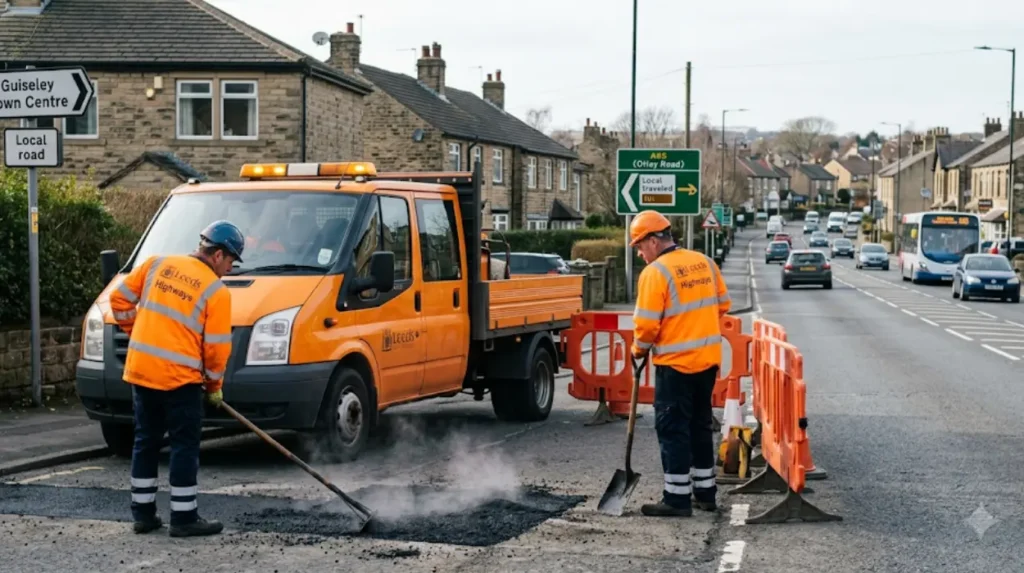
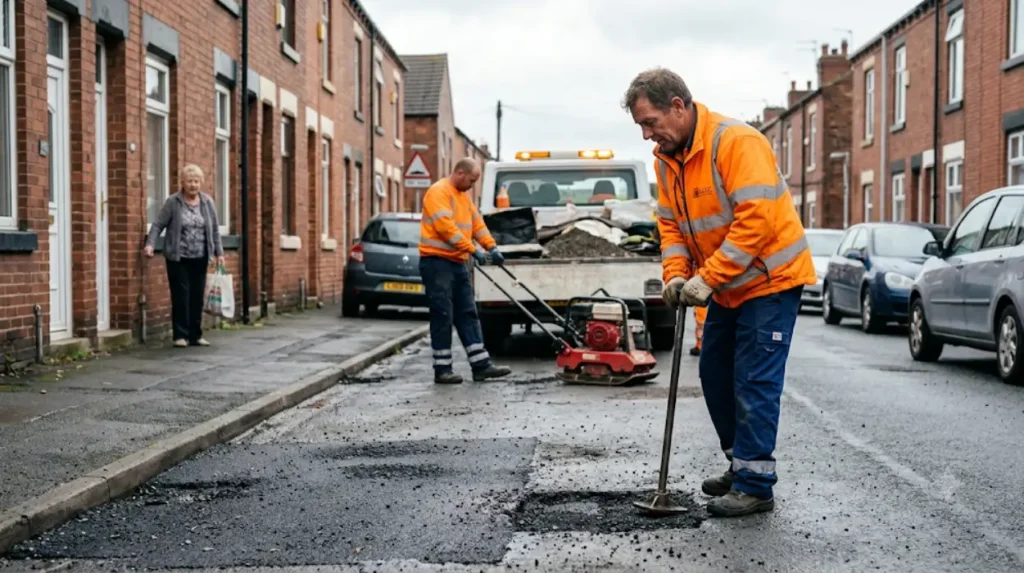
Temporary repairs often use cold-lay asphalt to stabilise the defect quickly, especially in wet or cold conditions preventing permanent fixes. Permanent repairs involve hot-lay materials and proper compaction, typically scheduled during favourable weather. Seasonal constraints affect timelines; winter months see higher pothole volumes and longer repair queues.
Reporters can track progress using the reference number provided at submission. The council does not routinely notify individuals upon completion unless follow-up is required. Persistent or worsening defects should be re-reported with updated photos and measurements.
Are there alternative ways to report road defects in Guiseley?
Besides the council’s online form and phone line, residents can use third-party apps, contact local councillors, or report via the GOV.UK pothole portal for cross-referencing. These channels supplement official reporting but do not replace it.
Third-party mobile applications like Pothole UK allow users to log defects with GPS tagging and photos. These apps map community-reported potholes and raise awareness but do not directly notify the council. Users must still submit formal reports via Leeds City Council’s system to trigger official action.
Local councillors, including those representing Guiseley wards, often collate resident concerns and escalate recurring issues to highways teams. Emailing or calling a councillor’s office can expedite attention for persistent problems, though the formal reporting process remains mandatory for logging and tracking.
The GOV.UK “Report a pothole” portal redirects users to the appropriate authority based on postcode. For Guiseley, this leads back to Leeds City Council’s reporting interface. The national portal serves as a centralised entry point but does not bypass local procedures.
What are the most common pothole locations in Guiseley?
Potholes frequently appear on high-traffic routes, older residential streets, and areas with poor drainage in Guiseley, especially after winter freeze-thaw cycles. Known hotspots include Main Street, Otley Road, and junctions near schools.
High-traffic roads experience accelerated wear due to constant vehicle loading. Main Street (A65) and Otley Road (B6157) endure heavy bus, car, and freight movement, leading to surface fatigue and cracking. Junctions and braking zones accumulate additional stress, promoting pothole formation.
Older residential streets with thin surfacing layers or historical construction methods are vulnerable. Areas with inadequate drainage allow water infiltration, weakening the road base. Freeze-thaw cycles in winter expand trapped water, fracturing the surface and creating potholes.
Locations near schools, bus stops, and commercial centres see concentrated stopping and starting, increasing shear forces on the road surface. Examples include stretches near Guiseley Primary School, the bus station on Lawnswood Road, and retail zones on Walton Lane. Regular inspection focuses on these zones due to elevated risk.
How can residents prevent potholes from worsening?
Residents cannot repair potholes themselves but can mark hazards safely, avoid driving through them, and report deterioration promptly to minimise escalation. Unofficial repairs risk liability and injury.
Marking a pothole with a visible, non-damaging indicator (such as a traffic cone or reflective marker) alerts other road users temporarily. Ensure markers comply with highway safety regulations and do not obstruct traffic flow. Remove markers once the defect is reported or repaired.
Avoid driving through potholes whenever possible. Sudden impacts damage vehicles and exacerbate road defects. Encourage neighbours and delivery drivers to take alternative routes around known hazards until repairs occur.
Report worsening conditions immediately. A small pothole can expand rapidly under continued traffic and weather exposure. Updated reports with new photos and measurements help the council reassess priority and allocate resources accordingly.
What are the legal implications of unreported potholes?
Unreported potholes delay repairs and increase accident risks, potentially leading to liability claims against the council if negligence is proven. Timely reporting protects both road users and the authority.
Local authorities hold statutory duties under the Highways Act 1980 to maintain adopted highways in a safe condition. Failure to address known defects within reasonable timeframes may constitute negligence if an accident occurs. However, councils are not liable for every pothole unless they knew or should have known about it and failed to act.
Residents who suffer vehicle damage or personal injury due to a pothole may pursue compensation claims. Success depends on proving the council had prior knowledge (through previous reports or inspections) and did not respond appropriately. Detailed reporting creates an auditable record supporting such claims.
Conversely, residents attempting unofficial repairs assume liability for any resulting accidents or damage. Only authorised contractors may undertake highway works. Unauthorized interventions violate highway regulations and expose individuals to legal and financial consequences.
Explore More Help & Resources
How to report dangerous parking near Morley schools
How to find a food bank open near Horsforth now
How often does Leeds City Council inspect Guiseley roads?
Leeds City Council conducts routine inspections of local roads at intervals ranging from monthly to quarterly, depending on traffic volume and road classification. High-traffic routes receive more frequent checks.
Inspection frequency follows a risk-based model. Principal roads and busy urban streets undergo monthly visual assessments. Residential and low-traffic areas are inspected quarterly or biannually. Inspectors use standardized criteria to identify surface defects, drainage issues, and structural weaknesses.
Seasonal factors influence inspection intensity. Winter months see increased monitoring due to freeze-thaw damage and salting effects. Spring inspections focus on assessing cumulative winter damage and planning resurfacing programs.
Residents can request additional inspections for persistent problems by submitting detailed reports with evidence. Repeated complaints from multiple households often trigger prioritised reviews.
What should Guiseley residents do if a pothole causes vehicle damage?
Document the incident thoroughly, report the pothole immediately, and contact Leeds City Council’s claims department with evidence to pursue compensation for vehicle damage. Prompt action strengthens the case.
At the scene, photograph the pothole with scale references, capture vehicle damage, and note exact location and time. Gather witness statements if available. Avoid moving the vehicle until documentation is complete unless it poses a safety hazard.
Report the pothole via the council’s online form or phone line, referencing the incident. Obtain a report reference number. Submit a formal claim to the council’s liabilities or insurance team, including photos, repair invoices, and the pothole report number.
Councils assess claims based on maintenance records, inspection logs, and response times. If the pothole was previously reported and unaddressed beyond target timelines, compensation is more likely. Legal advice may be necessary for complex or high-value claims.
How can Guiseley communities advocate for better road maintenance?
Organise resident groups, compile collective evidence, and engage local councillors to pressure Leeds City Council for improved maintenance schedules and funding allocations. Unified action amplifies impact.
Form neighbourhood associations or online groups focused on highway issues. Share photos, maps, and incident reports to build a comprehensive dossier of problem areas. Collective documentation demonstrates systemic rather than isolated defects.
Engage local councillors representing Guiseley wards. Councillors escalate constituent concerns to highways departments and can influence budgetary priorities. Present data-driven cases showing frequency, severity, and community impact of potholes.
Participate in council consultations on transport and highways budgets. Attend public meetings, submit written feedback, and collaborate with cycling, walking, and motoring organisations to advocate for sustained investment in road surfaces.
What resources exist for tracking pothole repairs in Leeds?
Leeds City Council provides no real-time public tracker, but residents can monitor progress via reference numbers, councillor updates, and community-mapped platforms like Pothole UK. Transparency remains limited.
The council does not operate a live dashboard showing repair status for individual potholes. Reporters receive reference numbers but must proactively follow up for updates. Some councillors publish periodic summaries of resolved issues in their wards via newsletters or social media.
Community-driven platforms like Pothole UK aggregate user-submitted reports into interactive maps. While not official, these tools visualise problem density and repair timelines based on crowd-sourced data. They serve as supplementary monitoring aids rather than authoritative sources.
Freedom of Information requests can obtain historical repair data and inspection logs from the council. Journalists, researchers, and campaigners use this route to analyse performance trends and hold authorities accountable.
Why is reporting potholes in Guiseley important for road safety?
Reporting potholes prevents accidents, reduces vehicle damage, and ensures timely repairs by creating an official record that triggers council action under statutory duties. Silence allows hazards to persist.
Potholes cause swerving, loss of control, and collisions, especially for cyclists and motorcyclists. Deep defects can rupture tyres or damage suspension systems, leading to breakdowns in dangerous locations. Early reporting mitigates these risks before incidents occur.
Official reports activate the council’s legal obligation to inspect and repair. Without notification, defects may remain undetected until routine inspections—potentially weeks or months later. Proactive reporting accelerates intervention and protects vulnerable road users.
Community-wide reporting fosters a culture of shared responsibility. Neighbourhoods with high reporting rates often see faster response times due to demonstrated demand and documented need. Collective vigilance enhances overall road safety standards.
Who is responsible for maintaining roads in Guiseley?
Leeds City Council maintains most local and residential roads in Guiseley, while National Highways is responsible for motorways and certain trunk roads. Residents should report potholes to the appropriate authority depending on the road.