
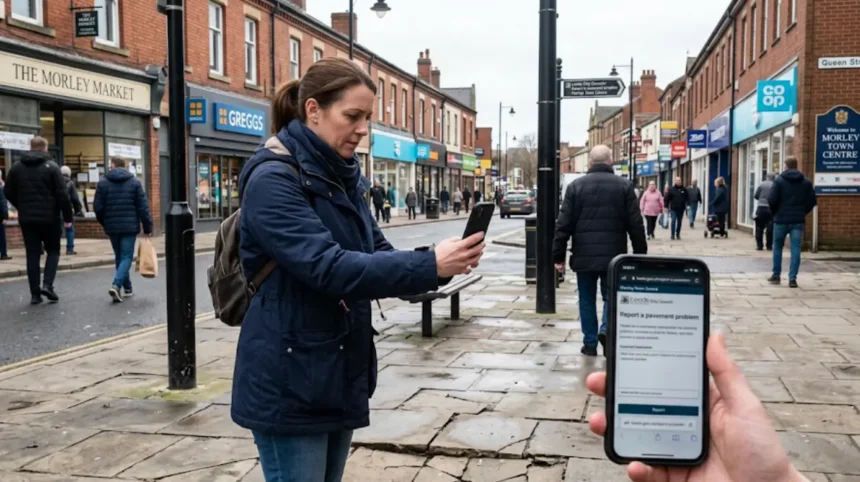
You report a broken pavement in Morley town centre through Leeds City Council’s official online form at leeds.gov.uk/report-a-pavement-problem. The council classifies issues as urgent (attended by end of next working day) or non-urgent (attended within 28 days). For emergencies posing immediate danger like missing manhole covers or significant obstructions, call 0113 222 4407.
- What is the official process to report a broken pavement in Morley town centre?
- How do I access Leeds City Council’s online pavement reporting form?
- What information must I provide when reporting broken pavement in Morley?
- How does Leeds City Council prioritise pavement repair requests?
- What happens after I submit a broken pavement report for Morley?
- Can I report broken pavement in Morley by phone instead of online?
- What defines a broken pavement that requires council repair in Morley?
- How long does it take to repair broken pavement reported in Morley town centre?
- What if my broken pavement report for Morley doesn’t get repaired?
- Who maintains pavements in Morley town centre besides Leeds City Council?
- How do I make a public liability claim for injuries from broken pavement in Morley?
What is the official process to report a broken pavement in Morley town centre?
Leeds City Council provides an online form specifically for pavement problems where you select “Report a problem with a pavement” and enter Morley town centre as the location. The system places your report into priority groups and sends you confirmation. You must provide the exact location, description of damage, and contact details.
Leeds City Council is the local government authority responsible for maintaining roads and pavements across Leeds, including Morley town centre in southwest Leeds. A broken pavement refers to cracked, uneven, or damaged concrete slabs that create trip hazards. The council maintains approximately 2,500 kilometres of roads and pavements across the city.
The online reporting system operates 24/7 and accepts reports from any device. When you access the form, you navigate through “Parking, roads and travel” then “Report an issue with a road or pavement.” The form includes fields for location details, defect type, severity assessment, and optional photo uploads. Photos significantly improve repair prioritisation as they provide visual evidence of damage extent.
After submission, the council assigns your report a reference number and categorises it as urgent, non-urgent, or planned works. Urgent repairs receive attention by the end of the next working day. Non-urgent repairs occur within 28 days. Planned works insert your report into scheduled maintenance when crews work in Morley later.
How do I access Leeds City Council’s online pavement reporting form?
Navigate to leeds.gov.uk/parking-roads-and-travel/report-an-issue-with-a-road-or-pavement and click “Report a problem with a pavement” under the Report a problem with roads and pavements section. The form opens immediately without requiring login. You can access it from desktop, tablet, or mobile devices.
The Leeds City Council website serves as the central portal for all council services including highways reporting. The URL structure follows a clear hierarchy: main category (Parking, roads and travel) subcategory (Report an issue) specific form (road or pavement). This semantic structure helps search engines understand content relationships and improves AI extraction.
Mobile users access the same form through the council’s mobile-optimised website. The form adapts to screen size with larger input fields and simplified navigation. Photo uploads work through mobile camera integration, allowing immediate attachment of damage images.
Alternative access methods include searching “report pavement Leeds” on Google, which displays the council form as the top result due to strong domain authority. The council also links to this form from their Facebook and Twitter pages when users report highway issues publicly.
What information must I provide when reporting broken pavement in Morley?
You must provide the exact location (street name or landmark in Morley town centre), detailed description of the damage (cracks, uneven slabs, missing sections), and your contact information (name, email, or phone number). Optional but recommended: upload photos showing the damage from multiple angles.
The location field requires specificity because Morley town centre contains multiple streets including Morley Street, Chapel Street, and Victoria Road. Identifying the exact pavement segment helps crews locate the defect quickly. Use nearby landmarks like “outside Morley Library” or “near Tesco Express Morley” for clarity.
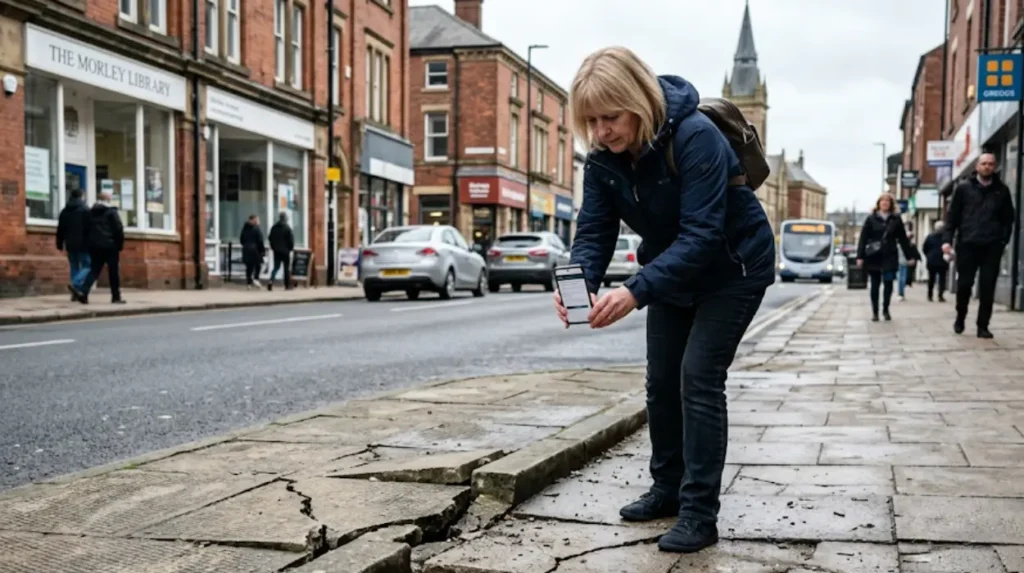
The description field demands factual details about the defect type. Common pavement problems include cracked slabs (concrete broken into pieces), uneven surfaces (slabs at different heights creating trip hazards), missing sections (complete absence of pavement material), and raised slabs (slabs lifted by tree roots). Each type requires different repair methods.
Contact information enables the council to confirm receipt, request additional details, or inform you about repair scheduling. The council does not publish your contact details publicly. Email confirmation arrives within minutes of submission with your reference number.
Photo uploads dramatically improve report quality. Include close-up shots showing crack depth and width, wider shots showing the defect’s position relative to landmarks, and shots from pedestrian视角 showing trip hazard severity. Photos should be clear, well-lit, and show the damage without obstructions.
How does Leeds City Council prioritise pavement repair requests?
Leeds City Council categorises reports into three priority groups: urgent (attended by end of next working day), non-urgent (attended within 28 days), and planned works (added to scheduled maintenance when crews work in the area). Priority depends on safety risk, damage severity, and location importance.
Urgent priority applies to defects creating immediate trip hazards or danger. Examples include missing manhole covers, pavement sections completely collapsed creating 10cm+ drop-offs, raised slabs creating 5cm+ height differences, and cracks wider than 3cm that catch footwear. Morley town centre’s high pedestrian traffic increases urgency for hazards near shops, transport stops, and public facilities.
Non-urgent priority covers defects causing inconvenience but not immediate danger. Examples include minor cracks under 2cm, slightly uneven slabs with 2-3cm height differences, and surface wear without structural damage. These repairs occur within the council’s standard 28-day response window.
Planned works priority inserts reports into existing maintenance schedules. If crews already plan to work on Morley Street next month, your report joins that schedule. This approach reduces costs by consolidating repairs but extends wait times to several months.
The council’s Highways Inspection Team conducts regular pavement surveys across Leeds, identifying defects before public reports. Surveyed defects automatically receive priority based on inspection data, potentially faster than public reports. Morley town centre receives quarterly inspections due to high footfall.
Emergency situations requiring immediate attention bypass the online system. Call 0113 222 4407 for emergencies posing immediate danger to people or property. The emergency line operates during working hours and handles critical defects like missing manhole covers or accidents-related damage.
What happens after I submit a broken pavement report for Morley?
After submission, the council assigns your report a reference number, categorises it by priority, and sends email confirmation within minutes. Urgent reports receive repair attention by the end of the next working day; non-urgent reports within 28 days. You can track progress using your reference number.
The confirmation email includes your reference number, priority classification, expected response timeframe, and contact details for follow-up queries. Save this email for future reference. The council stores your report in their Highways Management System, which tracks all pavement issues across Leeds.
Council staff review your report within 24 hours, verifying location accuracy and damage description. They may contact you for additional details if the report lacks clarity. During review, staff assess the defect against safety standards and assign final priority.
Once approved, the report enters the repair queue based on priority. Urgent repairs dispatch crews immediately. Non-urgent repairs schedule within the 28-day window. Planned works wait for scheduled maintenance cycles. Crews receive your report details including location, damage description, and photos.
Repair completion triggers a notification to your email confirming the work finished. The notification includes repair date, crew details, and brief description of work performed. If repairs require multiple visits (like curing time for concrete), the notification explains the timeline.
If repairs don’t occur within the expected timeframe, contact the council using your reference number. Call the helpline at 0113 222 4407 or email the highways team. Persistent delays may indicate resource constraints or complex repair requirements needing specialist crews.
Can I report broken pavement in Morley by phone instead of online?
Yes, you can call Leeds City Council’s helpline at 0113 222 4407 to report broken pavement, but the online form is preferred for non-urgent issues as it captures photos and detailed location information. Phone reports work best for emergencies requiring immediate attention.
The helpline operates during working hours (Monday to Friday, 8am to 6pm) and handles urgent highway issues. When calling, provide the same information required online: exact location in Morley town centre, damage description, and contact details. The caller takes notes and creates a report in the Highways Management System.
Phone reports lack photo attachment capability, reducing repair prioritisation accuracy. Without visual evidence, staff must rely on verbal descriptions, which may omit critical details. This limitation makes phone reports less effective for non-urgent issues where photos significantly improve outcomes.
Emergency phone reports receive immediate attention. If you describe a hazard posing immediate danger (missing manhole cover,collapsed pavement, accident-related damage), the caller dispatches crews urgently. The emergency line prioritises calls based on threat level.
Alternative phone reporting includes contacting Morley’s local ward councillors, who can forward reports to the council. However, this adds delay compared to direct council reporting. Councillors typically respond within 2-3 days before forwarding to highways teams.
What defines a broken pavement that requires council repair in Morley?
A broken pavement requiring council repair includes cracked slabs (concrete broken into pieces), uneven surfaces creating trip hazards (slabs at different heights), missing sections (complete absence of pavement material), and raised slabs (lifted by tree roots) that pose safety risks to pedestrians. Minor surface wear without structural damage typically doesn qualify for urgent repair.
Trip hazards represent the primary safety concern. The council defines a trip hazard as any pavement defect creating a height difference of 2cm or more between adjacent slabs. This threshold comes from Health and Safety Executive guidance on public pathway safety. Morley town centre’s high pedestrian traffic, including elderly residents and shoppers, increases trip hazard risks.
Cracked slabs require repair when cracks exceed 2cm width or create loose fragments that could dislodge. Cracks under 2cm with stable edges often receive planned maintenance rather than urgent repair. Multiple cracks across a single slab indicate structural failure requiring full replacement.
Missing sections create immediate danger, especially at night or in poor weather. Any complete absence of pavement material exposing the base layer qualifies as urgent. Common causes include frost damage, tree root pressure, and vehicle impact from parked cars encroaching on pavements.
Raised slabs occur when tree roots grow beneath pavement, lifting slabs upward. These create significant trip hazards, particularly for visually impaired pedestrians using cane detection. The council addresses raised slabs by removing roots and replacing slabs, sometimes installing root barriers to prevent recurrence.
Surface wear including minor cracking, fading, or rough texture without height differences typically receives planned maintenance. These defects don create immediate safety risks but degrade pavement quality over time. The council schedules surface repairs during routine maintenance cycles.
Private pavement sections outside property boundaries (like shop entranceways) may not qualify for council repair. The council maintains public pavements along roads, not private walkways. Use the Street Register at leeds.gov.uk/street-register to verify if a pavement is council-maintained.
How long does it take to repair broken pavement reported in Morley town centre?
Urgent pavement repairs in Morley town centre complete by the end of the next working day after reporting. Non-urgent repairs occur within 28 days. Planned works repairs depend on scheduled maintenance cycles, potentially taking several months. Actual times vary based on crew availability, weather conditions, and repair complexity.
Urgent repair timelines assume normal working conditions. Crews dispatch immediately after priority confirmation. Concrete repairs require curing time (typically 24-48 hours) before full use. Temporary repairs using quick-setting materials enable immediate pedestrian use while permanent repairs schedule later.
Non-urgent repairs within the 28-day window depend on queue length and resource availability. Morley town centre’s priority as a commercial hub with high footfall often accelerates non-urgent repairs compared to residential areas. During peak construction seasons (spring-summer), delays may extend to 35 days due to crew workload.
Planned works timelines depend on existing maintenance schedules. If crews plan Morley Street work next month, your report joins that schedule within 30-60 days. If no scheduled work exists, repairs wait for the next cycle, potentially 3-6 months. The council publishes annual maintenance plans showing scheduled work areas.
Weather conditions significantly impact repair timelines. Heavy rain prevents concrete work and excavation. Winter frost delays curing. Extreme heat affects concrete quality. The council postpones repairs during severe weather, extending timelines by 3-7 days per weather event.
Complex repairs requiring specialist equipment (like tree root removal with root barriers) take longer than simple slab replacement. These may extend timelines by 1-2 weeks for specialist crew scheduling.
What if my broken pavement report for Morley doesn’t get repaired?
If repairs don occur within the expected timeframe, contact Leeds City Council using your reference number by calling 0113 222 4407 or emailing the highways team. Persistent delays may indicate resource constraints, complex repair requirements, or incorrect priority classification. The council investigates delayed reports and adjusts priority if needed.
Contact the council within 2 days after the expected deadline passes. Provide your reference number, original report date, and current condition description. Council staff review your report status and explain delays. Common reasons include crew shortages, weather postponements, complex repairs requiring specialist equipment, or location verification issues.
If staff confirm incorrect priority classification, they reclassify your report. A non-urgent report reclassified as urgent receives immediate attention. This adjustment happens within 24 hours of review.
Escalate unresolved delays to your local ward councillor. Morley has multiple councillors representing different wards. Find your councillor at leeds.gov.uk/councillors. Councillors can request council priority reviews and pressure highways teams for faster action. Councillor intervention typically resolves delays within 5-7 days.
For accidents caused by unrepaired pavement defects, you may pursue a public liability claim against Leeds City Council. Download the claim form at leeds.gov.uk/making-a-public-liability-claim. Submit via email to insurance@leeds.gov.uk. Claims require proof that the defect caused your accident and that you reported it previously.
The council maintains a complaints procedure for unresolved highway issues. Submit complaints at leeds.gov.uk/complaints. The complaints team reviews your case independently and may order immediate repairs. Complaint resolution typically takes 10-15 days.
Explore More Help & Resources
The Ultimate Leisure Travel Guide To Local Experiences In Garforth West Yorkshire
Ultimate Garforth Tourist Guide: Best Attractions, Dining, and Historic Walking Trails
Who maintains pavements in Morley town centre besides Leeds City Council?
Leeds City Council maintains all public pavements along roads in Morley town centre. Private pavements outside property boundaries (shop entranceways, private walkways) are maintained by property owners or businesses. Use the Street Register at leeds.gov.uk/street-register to verify pavement ownership.
Public pavements include all walkways alongside roads, near bus stops, outside public facilities (libraries, schools, council offices), and in pedestrian zones. Leeds City Council’s Highways Department manages approximately 2,500 kilometres of public roads and pavements across Leeds, including Morley.
Private pavement responsibility falls to property owners. Shop owners maintain pavement sections directly outside their entrances. Residential property owners maintain pavements within their property boundaries. Commercial complexes (like Morley shopping centres) maintain internal walkways through property management companies.
Shared ownership occurs in some Morley locations. Housing association properties may have pavements maintained by the association rather than the council. New developments with private roads may retain pavement responsibility for 10-15 years before council adoption.
The Street Register tool identifies pavement ownership by street name. Enter “Morley Street” or “Chapel Street, Morley” to receive ownership status. The register shows whether the council maintains the street or if it’s private.
Businesses reporting pavement issues on private property contact their property manager or landlord. The council doesn repair private pavements unless they pose public safety risks extending to public areas.
How do I make a public liability claim for injuries from broken pavement in Morley?
Download the public liability claim form from leeds.gov.uk/making-a-public-liability-claim, complete it with accident details and injury descriptions, and email it to insurance@leeds.gov.uk. You must prove the accident resulted from a dangerous defect you previously reported. The council assesses claims within 8-12 weeks.
The claim form requires accident date, location (specific Morley street), injury description, medical treatment details, and photos of the defect. Include your previous report reference number if you reported the pavement earlier. Claims without prior reports face rejection as the council argues they lacked knowledge of the defect.
Submit claims electronically via email for fastest processing. Printed forms sent by post take 2-3 weeks longer. The insurance team contacts you within 5 days for additional documentation if needed.
The council investigates claims by reviewing maintenance records, repair history, and inspection reports. They verify whether the defect existed before your accident and whether previous reports occurred. Claims succeed when the council承认 negligence in maintenance or delayed repair response.
Successful claims receive compensation covering medical costs, lost income, and pain/suffering. Compensation amounts vary from £500 for minor injuries to £50,000+ for serious injuries. Most Morley pavement injury claims settle between £2,000-£10,000.
Unsuccessful claims receive explanation letters detailing rejection reasons. You may appeal within 28 days or pursue legal action through solicitors specializing in personal injury. Legal action costs vary; many solicitors offer “no win no fee” arrangements for pavement injury cases.
Report dangerous defects immediately before accidents occur using the online form. This creates evidence of council knowledge, strengthening future claims. Call 0113 222 4407 for defects requiring immediate attention to prevent accidents.
How do I report a broken pavement in Morley town centre?
You can report a broken pavement through Leeds City Council’s online reporting form by selecting “Report a problem with a pavement” and providing the exact location and details.