
Key Points
- Rare Celestial Event: Skygazers across the United Kingdom and Ireland, including residents in Leeds, are set to witness a deep partial solar eclipse on the evening of Wednesday, 12 August 2026.
- Significant Obscuration: The Moon will cover between 90% and 96% of the Sun’s face across the UK, making it the most significant solar coverage visible from the country since the total solar eclipse of 11 August 1999.
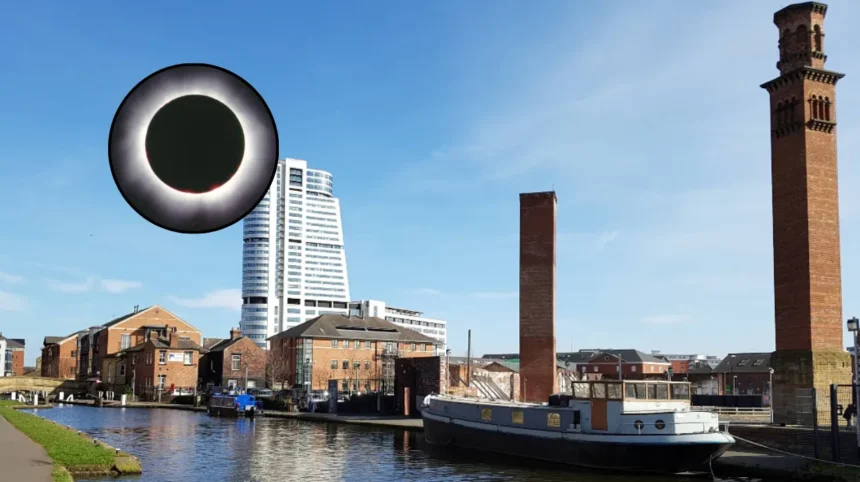
- Specific Leeds Timings: In Leeds, the partial eclipse begins at 6:12 pm BST, reaches maximum obscuration of 92% at 7:09 pm BST, and concludes at 8:03 pm BST as the Sun sits low on the western horizon.
- Decades-Long Gap: Astronomical agencies, including NASA and Royal Museums Greenwich, have confirmed that an eclipse of this magnitude will not be visible from the UK again until 2081.
- Eye Safety Warnings: Health officials from the UK Health Security Agency (UKHSA) have advised the public to use ISO 12312-2 certified solar eclipse glasses or indirect projection methods to prevent irreversible retinal eye damage.
Leeds (The Leeds Times) August 12, 2026 – Skygazers across the United Kingdom and Ireland are preparing to witness the most dramatic solar eclipse visible from British skies in twenty-seven years this evening, as the Moon passes directly between the Earth and the Sun. The rare astronomical phenomenon will see between 90% and 96% of the solar disk obscured across the UK, offering the deepest solar coverage since the total eclipse of August 1999. In Leeds and across West Yorkshire, the Moon will cover approximately 92% of the Sun, creating a striking solar crescent during the early evening hours. Officials from NASA and Royal Museums Greenwich have confirmed that this celestial event represents the single best opportunity for UK residents to view a major solar eclipse until 2081, prompting widespread interest from amateur astronomers, local council organizers, and members of the public.
- Key Points
- What Time Will The Solar Eclipse Reach Its Peak Coverage In Leeds?
- How Much Of The Sun Will Be Covered Across Different Regions Of The UK?
- What Are The Safest Methods To View The Partial Solar Eclipse Without Damaging Eye Sight?
- Where Are The Best Viewing Locations In Leeds For A Clear Horizon?
- What Is The Background To This Solar Eclipse Event?
- How Will This Celestial Event Impact The Audience And Future Astronomical Observations?
What Time Will The Solar Eclipse Reach Its Peak Coverage In Leeds?
Astronomical data provided by global observatories confirms that the timing of the partial eclipse varies slightly depending on geographic location, though the entire sequence across the British Isles will unfold over approximately one hour and fifty minutes.
As reported by science correspondent Jonathan Amos of BBC News, Dr Robert Massey of the Royal Astronomical Society stated that
“the timing of this eclipse in the early evening means the Sun will be positioned low in the western sky, requiring observers to seek out high elevated positions or clear western horizons”.
In Leeds, the astronomical event will adhere to the following schedule:
- 18:12 BST (First Contact): The outer edge of the Moon makes initial contact with the limb of the Sun, marking the official start of the partial eclipse phase.
- 19:09 BST (Maximum Obscuration): The eclipse reaches its peak depth in Leeds, with 92% of the Sun’s surface covered by the Moon. The Sun will sit at an altitude of approximately 12.2 degrees above the horizon in a west-north-westerly direction (279 degrees).
- 20:03 BST (Final Contact): The Moon moves entirely away from the solar disk, ending the partial eclipse as the Sun drops to just 4.6 degrees above the horizon ahead of sunset.
As reported by space writer Robin McKie of The Observer, Dr Edward Bloomer of Royal Museums Greenwich stated that
“because the maximum phase occurs shortly after 7:00 pm BST when the Sun is relatively low, local topography and tall structures will play a significant role in visibility for observers in urban centres”.
How Much Of The Sun Will Be Covered Across Different Regions Of The UK?
While the entire United Kingdom will experience a deep partial solar eclipse, the degree of coverage increases progressively towards the south-west of the country. The path of totality—where the Moon completely covers the Sun—stretches across Greenland, Iceland, and northern Spain, leaving the British Isles just outside the central shadow line.
As reported by environment reporter Fiona Harvey of The Guardian, Dr Greg Brown of the Royal Observatory Greenwich stated that
“although the UK lies outside the narrow zone of totality, an obscuration exceeding 90 percent across the country will cause a noticeable dimming of daylight and a distinct drop in ambient temperature during the peak phase”.
Regional variations in maximum solar coverage across the UK include:
- Cornwall and Scilly Isles: 95% to 96% coverage, with Land’s End experiencing the maximum obscuration recorded on mainland Britain.
- Devon and South-West England: 94% to 95% coverage.
- Wales (Cardiff and Pembrokeshire): 93% to 94% coverage.
- Northern England (Leeds, Manchester, Liverpool): 91% to 92% coverage.
- London and South-East England: 90% to 91% coverage.
- Scotland (Edinburgh and Glasgow): 91% coverage.
What Are The Safest Methods To View The Partial Solar Eclipse Without Damaging Eye Sight?
Health authorities and optical specialists have issued stringent warnings to the public regarding the severe risks associated with viewing the Sun directly. Even when 92% of the solar disk is covered, the remaining crescent of light is sufficiently intense to cause permanent thermal damage to the retina, a condition known as solar retinopathy.
As reported by health editor Eleanor Hayward of The Times, Dr Mary Ramsay of the UK Health Security Agency stated that
“looking directly at the Sun during a partial eclipse without specialized eye protection can cause irreversible damage to optical nerves without causing any immediate pain, as the retina lacks pain receptors”.
As reported by technology editor Alex Hern of The Guardian, optical safety experts at the College of Optometrists stated that “standard sunglasses, photographic filters, smoked glass, and dark plastic materials do not offer adequate protection against infrared and ultraviolet radiation”.
Health authorities recommend two primary safe viewing methods:
Direct Viewing With Certified Solar Glasses
Observers must use ISO 12312-2 certified eclipse glasses that feature specialized optical filters designed to block 99.999% of visible light alongside harmful ultraviolet and infrared radiation. Viewers are instructed to check lenses for scratches, tears, or punctures prior to use and to fit the glasses securely over their eyes before looking up at the sky.
Indirect Projection Techniques
For those without certified eyewear, indirect projection allows safe viewing by casting an image of the Sun onto a surface:
- Pinhole Projector: Puncturing a small hole in a piece of card to project an inverted image of the eclipsed Sun onto a second piece of card placed on the ground.
- Household Colander: Holding a kitchen colander over a sheet of white paper to project dozens of tiny solar crescents simultaneously.
- Optics with Filters: Binoculars and telescopes must never be used to view the Sun unless fitted with professionally manufactured, front-mounted solar filters.
Where Are The Best Viewing Locations In Leeds For A Clear Horizon?
Because the eclipse takes place when the Sun is positioned approximately 12 to 20 degrees above the horizon in the west-north-west (267 to 289 degrees), finding an elevated location with an unobstructed skyline is critical for viewers in Leeds.
As reported by regional reporter Victoria Preston of Yorkshire Post, local astronomical societies in West Yorkshire stated that “viewers in low-lying city streets or areas surrounded by high-rise architecture will likely have their view blocked by buildings as the eclipse approaches its 7:09 pm peak”.
Recommended public viewing locations across Leeds include:
- Otley Chevin Forest Park: Situated north-west of the city centre, the Surprise View at Otley Chevin offers expansive, high-altitude panoramic views across the Wharfe Valley towards the western horizon.
- Woodhouse Moor (Hyde Park): Elevated sections of the park near the monument provide clear sightlines facing west, making it a popular choice for local university students and families.
- Roundhay Park: Elevated open fields near Hill 60 and the Park Lodge area offer clear views above the tree line towards the west-north-west.
- Baildon Moor and Ilkley Moor: Located just outside the immediate city perimeter, these high-altitude moorlands provide completely unobstructed 360-degree views of the horizon.
What Is The Background To This Solar Eclipse Event?
Solar eclipses occur when the Moon passes directly between the Sun and the Earth during its orbital path, casting a shadow across sections of the terrestrial surface. A total solar eclipse occurs when the Moon’s apparent diameter is larger than the Sun’s, completely blocking all direct sunlight and turning daylight into darkness. A partial solar eclipse occurs when the alignment is off-centre, resulting in the Moon obscuring only a portion of the solar disk.
The UK has a rich history of solar eclipse observations, but major events remain exceptionally rare due to the relatively small geographic footprint of the Moon’s shadow. The last total solar eclipse visible from mainland Britain occurred on 11 August 1999, when the path of totality swept across Cornwall and parts of Devon, drawing over one million visitors to the South West. During that 1999 event, Leeds experienced approximately 85% coverage.
Subsequent solar eclipses visible from the UK have offered considerably lower levels of coverage. On 20 March 2015, a deep partial eclipse reached 85% to 90% coverage across northern England and Scotland. More recently, on 10 June 2021 and 29 March 2025, partial eclipses obscured only 20% to 40% of the Sun from West Yorkshire.
The event of 12 August 2026 is part of Solar Saros 126, a series of eclipses that repeat every 18 years and 11 days. The current alignment provides the deepest solar coverage visible from British soil in 27 years. Astronomers note that the next total solar eclipse visible directly from the United Kingdom will not take place until 23 September 2090, while the next partial eclipse of comparable magnitude (over 90%) will not occur until 2081.
Explore More Local Leeds News
What It Takes to Sign Rafael Leao: Leeds United 2026
12 Criminals Jailed as Environment Agency Issues Drought Warning Leeds 2026
How Will This Celestial Event Impact The Audience And Future Astronomical Observations?
The partial solar eclipse of August 2026 is projected to have wide-ranging operational, social, and economic impacts across the United Kingdom, particularly for local authorities, public safety bodies, energy operators, and the tourism sector.
Impact On Public Safety and Transport Networks
With the eclipse coinciding with early evening commute times (6:12 pm to 8:03 pm BST), transport authorities in West Yorkshire and across the UK anticipate potential traffic disruptions. Highways officers have warned motorists against looking up at the sky while driving or pulling over illegally on motorway hard shoulders to view the event. The sudden dimming of natural sunlight during peak hours may also require automatic street lighting systems to activate early across urban road networks.
Impact On Renewable Energy Grids
The dramatic reduction in solar radiation between 6:00 pm and 8:00 pm poses a brief operational challenge for National Grid ESO. With solar power accounting for a significant share of the UK’s daytime electricity generation during summer months, grid operators have scheduled alternative generation reserves—such as hydroelectric pumped storage and battery storage facilities—to compensate for the temporary loss of solar output during the eclipse curve.
Boost To Local Tourism and Scientific Literacy
Hospitality and tourism providers in high-elevation regions and coastal locations have reported surge bookings for accommodation and outdoor events. In West Yorkshire, science museums, university physics departments, and local astronomical societies are utilizing the event to promote public engagement in science, technology, engineering, and mathematics (STEM) fields. Educational institutions hope the spectacle will inspire a new generation of student astronomers and space scientists across the region.