

Key Points
- Planning Application Details: Leeds Bradford Airport (LBA) has submitted a planning application to Leeds City Council seeking to vary 30-year-old operating conditions by introducing a Quota Count System (QCS).
- Proposed Operational Hours: The airport proposes condensing its defined night-time hours from 23:00–07:00 to 23:30–05:59.
- Noise Insulation Scheme: LBA proposes introducing a Night Noise Insulation Scheme targeting up to 750 eligible properties, offering funding for glazing, ventilation, and bedroom air conditioning.
- Campaign Group Opposition: Campaigners from the Group for Action on Leeds Bradford Airport (GALBA) claim the changes could permit a 75% increase in summer night flights, raising total movements to at least 7,500.
- Public and Council Responses: Leeds City Council’s planning portal records 1,182 objections against 168 supporting comments. Neighboring town committees have voiced “significant concerns,” while the public consultation deadline has been extended to 15 October 2026.
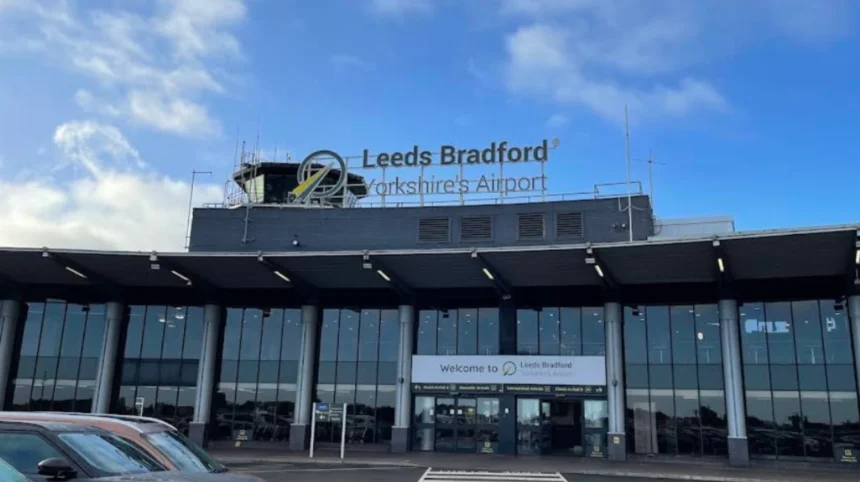
Leeds (The Leeds Times) September 25, 2026 — Fresh concerns have been raised over proposed updates to night flight rules at Leeds Bradford Airport (LBA), following the submission of a planning application to Leeds City Council seeking to overhaul three-decade-old operating restrictions. The airport proposes replacing its existing movement-based flight cap with a Quota Count System (QCS) designed to regulate cumulative noise output rather than the total number of aircraft movements. Alongside this system, LBA intends to shift its designated night-time operating window from 23:00–07:00 to 23:30–05:59 and establish a Night Noise Insulation Scheme to assist nearby households. However, environmental advocacy groups and local representatives warn that the framework could facilitate a significant increase in early-morning and late-night aircraft activity.
- Key Points
- What is the airport proposing under the new rules?
- Why are environmental campaigners and residents opposing the plan?
- What measures are included in the proposed noise insulation scheme?
- How have local authorities and the public responded to the application?
- Background of the particular development
- Prediction: How this development can affect local residents and the regional economy
What is the airport proposing under the new rules?
As reported by aviation correspondents covering the application, Leeds Bradford Airport aims to modernise planning conditions that have governed night-time flying since the 1990s. Under the existing system, the airport operates under strict numeric movement limits during the eight-hour period between 11:00pm and 7:00am.
The proposed Quota Count System assigns points to individual aircraft types based on certified noise characteristics. Quieter, modern aircraft consume less of the allocated seasonal noise quota, whereas noisier legacy aircraft consume more. The airport contends that this framework will incentivize airlines to base modern fleet types at LBA.
Vincent Hodder, Chief Executive Officer of Leeds Bradford Airport, stated:
“Leeds Bradford Airport is transforming into a modern gateway for Yorkshire and a catalyst for regional growth. Through significant private investment, industry-leading sustainability initiatives and a commitment to supporting local communities, we are building an airport that is fit for the future.”
Addressing concerns regarding potential flight increases, Mr Hodder added:
“This is about creating a stronger, more sustainable and better-connected Yorkshire for the decades ahead. This is not the ‘thousands more night flights’ some would claim. The QCS LBA is applying for would match the existing noise footprint. The same noise limits, allocated differently.”
Why are environmental campaigners and residents opposing the plan?
As detailed by news outlets covering the community response, campaign group Group for Action on Leeds Bradford Airport (GALBA) has raised serious objections regarding the potential impact on public health and sleep disruption.
Nick Hodgkinson, Chair of GALBA, stated that the transition from a movement cap to a noise quota could allow a sharp rise in total flights, particularly during peak holiday months.
As reported by local media, Mr Hodgkinson stated:
“To be clear, GALBA is not saying the airport should be closed down. We simply say it should not be allowed another big increase in night flights. In May, LBA was allowed 941 more night flights – that’s a 77 per cent increase over the peak summer season – and now they want another 75 per cent increase of summer season night flights. That’s not fair to local people.”
Addressing the economic arguments put forward in favor of the development, Mr Hodgkinson noted:
“LBA’s PR material talks about economic growth. However, their planning application very clearly claims that growth will occur anyway, regardless of this planning application. They say there will be seven million passengers a year in 2030, with or without changing the night flight rules.”
Mr Hodgkinson further highlighted health implications linked to night-time aviation noise, adding:
“There’s a wealth of medical research linking frequent night-time noise to heart disease. The key point about LBA’s application is that it wants permission for far more frequent flights at night and between 6 and 7 in the morning. The health impacts would be serious.”
What measures are included in the proposed noise insulation scheme?
To mitigate local disturbance, LBA’s application incorporates a Night Noise Insulation Scheme targeting up to 750 households situated within specified noise contours. The initiative offers property owners financial contributions toward acoustic double glazing, upgraded acoustic ventilation, and bedroom air conditioning units.
However, GALBA and local residents have questioned the scale and execution of the mitigation package. Critics point out that grant funding will only cover partial insulation costs for approximately 100 homes per year, leaving many neighboring properties without immediate relief.
In addition, civic feedback reflected on local planning forums highlights skepticism regarding the timing of aircraft upgrades. As noted in local council committee submissions, public comments indicate that modeled noise contours do not reflect a rapid reduction in noise levels between 2025 and 2030, raising questions over how quickly quieter aircraft will be deployed across airline schedules.
How have local authorities and the public responded to the application?
Leeds City Council has confirmed receipt of the application, emphasizing that the proposal will be evaluated strictly in accordance with national planning frameworks. A council spokesperson stated that because the determination process is ongoing, it would be inappropriate for the authority to comment on specific outcomes.
Meanwhile, regional consultative committees have submitted representations expressing “significant concerns” regarding the redefinition of night-time hours. Committee members have recommended that the current 23:00–07:00 window remain intact to prevent increased flight movements between 06:00 and 07:00.
Public representations submitted via the Leeds City Council planning portal show 1,182 formal objections against 168 comments in support. Due to the high volume of public engagement, the consultation window for public submissions has been formally extended to 15 October 2026.
Background of the particular development
Leeds Bradford Airport’s night flying operations have been a subject of regulatory scrutiny and legal debate for several years. Under existing planning conditions established in the 1990s, the airport is permitted a fixed number of night aircraft movements during the summer and winter scheduling seasons.
Between 2022 and 2024, disputes arose between community action groups and airport management regarding the interpretation of night flight limits. In 2022, Leeds City Council issued a breach of condition enforcement notice after LBA exceeded its permitted summer movement allowance. LBA subsequently submitted Certificate of Lawful Existing Use or Development (CLEUD) applications seeking to clarify how specific flight movements were categorized under historical permissions.
Concurrently, LBA is undertaking a broader £200 million infrastructure regeneration programme, known as LBA:REGEN. This redevelopment included a major terminal extension completed in 2025, alongside planned terminal modernisations running through 2027. The airport has targeted Net Zero carbon emissions from its ground operations by 2030 and maintains Level 4 Airport Carbon Accreditation. The latest planning submission represents LBA’s attempt to align its operational planning conditions with standard Quota Count Systems used across other regional UK hubs.
Prediction: How this development can affect local residents and the regional economy
If approved, the proposed night flight rule changes will directly affect nearby residents, regional leisure travellers, and the wider Yorkshire economy.
1. Direct Impact on Local Residents
For residents living beneath flight paths in communities such as Horsforth, Yeadon, Rawdon, and Ilkley, the outcome of the planning application will determine their night-time noise environment. If the Quota Count System allows a higher volume of flights using modern, slightly quieter aircraft, residents may experience an increased frequency of flyovers between 23:30 and 07:00, particularly during the 06:00 to 07:00 early-morning shoulder period. While eligible property owners may receive grant funding for insulation and air conditioning, the limited rollout rate of approximately 100 homes per year means full physical mitigation across affected communities will take several years to complete.
2. Impact on Passengers and Regional Business
For outbound travellers and regional businesses, the adoption of a Quota Count System could increase operational flexibility for base airlines such as Jet2 and Ryanair. Modernizing operating hours to align with standard European aviation patterns permits earlier morning departures and later evening arrivals, improving aircraft utilization for commercial carriers. This operational efficiency can support broader regional air connectivity and preserve short-haul holiday routes out of West Yorkshire. However, because the airport’s own Vision 2030 projections indicate passenger growth to seven million annually is attainable under current framework permissions, the approval or rejection of this specific night flight application is unlikely to alter overall long-term passenger capacity.