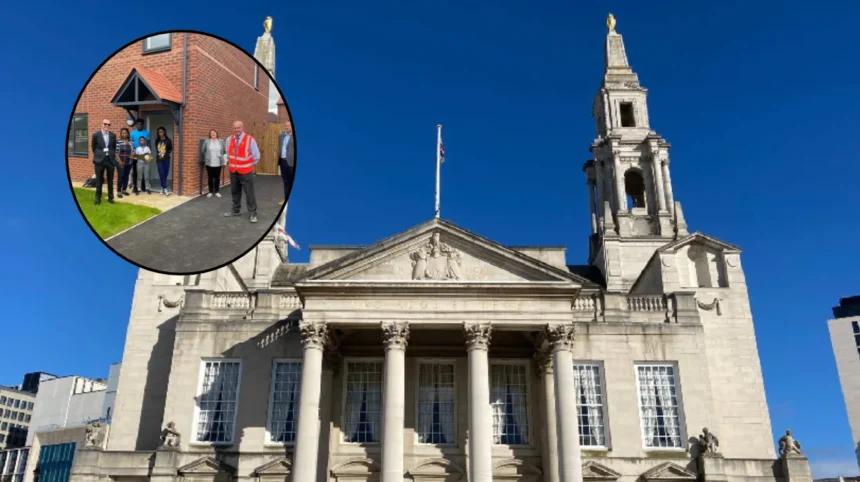
Key Points
- Major Milestone: Leeds City Council’s Council Housing Growth Programme (CHGP) has officially built or acquired a total of 1,116 energy-efficient and affordable properties.
- Annual Delivery Rate: More than 200 of these council properties were successfully delivered over the final 12 months leading up to the milestone announcement.
- Thirty-Year Record: When combining the council’s output with housing association schemes and developer contributions, Leeds delivered 943 affordable homes during the 2025/26 period, marking the highest annual total seen in the city in three decades.
- Composition of Delivery: Around 43 per cent of the homes delivered through the CHGP to date are direct council new-builds, while the remainder have been strategically acquired from private developers and previous owners.
- Funding and Future Investment: The primary funding for the initial phase derived from the local authority’s housing service via Right to Buy receipts and borrowing, with an additional £200 million committed by the executive board for a second phase running from 2026 to 2031.
Leeds (The Leeds Times) September 23, 2026 – A flagship municipal housing initiative across West Yorkshire has officially surpassed a major infrastructural threshold, crossing the 1,000-home milestone after successfully constructing and acquiring a total of 1,116 energy-efficient and affordable properties.The landmark achievement has been driven primarily through the local authority’s dedicated Council Housing Growth Programme (CHGP), which aims to supply secure, high-standard housing options for individuals and families registered on the municipal housing list.
As detailed in reports by local municipal correspondents, the overall programme total has climbed to 1,116 homes, with over 200 of those properties completed and handed over during the final 12-month window alone.
When factoring in wider contributions from registered housing associations and private developer obligations across the wider metropolitan district, the total delivery of affordable homes reached 943 units over the 2025/26 annual period. According to regional data, this represents the highest annual output of affordable housing recorded in Leeds across a span of 30 years.
What Are the Key Components of the Council Housing Growth Programme?
The structured makeup of the CHGP relies heavily on a dual-track approach involving direct municipal construction and tactical property acquisitions. New-build council developments currently account for approximately 43 per cent of all properties brought forward through the initiative, while the remaining proportion consists of acquired properties sourced from private housebuilders.
Recent strategic acquisitions include 41 homes secured from Yorkshire-based housebuilder Persimmon as part of their wider Morwick Green development, situated off York Road across the Cross Gates & Whinmoor and Harewood council wards. Further projects currently progressing through construction include a 65-apartment extra care scheme in Armley on the former site of the Middlecross Day Centre, alongside an 82-home development located at Hough Top in Swinnow, near Pudsey.
What Have Local Leaders Stated Regarding the Housing Expansion?
The acceleration of affordable housing has drawn praise from municipal leaders who emphasize the importance of sustainable community investment during periods of economic pressure.
Leeds City Council leader Councillor James Lewis emphasized the broader significance of the housing strategy, stating:
“By delivering good quality, energy efficient and affordable homes, our Council Housing Growth Programme has a vital role to play in helping us achieve that goal.”
Furthermore, Councillor Lewis noted:
“The Leeds Council Housing Growth Programme has shown what can be achieved with bold, ambitious thinking allied to a carefully planned and strategic way of working. Building houses alone isn’t enough. We are also ensuring that new homes in Leeds meet a range of needs and, crucially, are in suitable and sustainable locations.”
Highlighting the importance of cross-sector cooperation, Councillor Lewis added:
“Collaboration is vital. Our work alongside registered providers and other partners in the last year has driven affordable housing delivery in the city to its highest level in 30 years. This joined-up approach will bring continued success in the years to come, not least through the preparation of a new Leeds Local Plan with a flexible and responsive suite of policies that can support further affordable housing growth.”
Explore More Leeds City Council News
Leeds Affordable Housing Programme Passes Milestone, Leeds 2026
Former Leeds City Council Leader Keith Wakefield Dies at 78 in Leeds 2026
Background of the Particular Development
The expansion of the Council Housing Growth Programme forms part of a long-term strategic evolution within Leeds City Council to address historical shortfalls in social and affordable housing stock. Over recent decades, municipal housing delivery across the United Kingdom experienced significant slowdowns due to legislative shifts, restrictions on local authority borrowing, and the decanting of housing stock via historical policies such as Right to Buy.
To counteract mounting waiting lists and growing housing precarity, Leeds City Council formulated the CHGP as an aggressive, self-sustaining mechanism. By leveraging internal housing revenue accounts, capital receipts from ongoing Right to Buy sales, and prudential borrowing, the local authority systematically re-entered the housing construction market.
The initial phase of the programme established a robust framework for acquiring stalled or vacant brownfield sites—such as former educational facilities and civic day centres—and transforming them into modern, highly insulated properties designed to combat fuel poverty and reduce long-term maintenance overheads for tenants.
Prediction
The successful completion of the 1,116-home milestone and the concurrent injection of a £200 million commitment for the upcoming 2026 to 2031 phase are projected to have a profound stabilizing effect on families and individuals currently navigating the Leeds housing register. For households caught in the private rental squeeze or facing extended waiting times for secure social tenure, the continuous pipeline of energy-efficient, low-cost homes offers a tangible pathway to long-term financial security.
Furthermore, because these properties are explicitly engineered to meet demanding energy efficiency benchmarks, incoming tenants will likely experience lower domestic utility bills, directly mitigating cost-of-living pressures.
Regionally, the sustained collaboration between the local authority, housing associations, and private developers is expected to stimulate localized supply chains and construction employment across West Yorkshire while steadily reducing the administrative and social pressures on emergency temporary accommodation services.