Key Points
- Safety Barriers: Concerns regarding safety after dark and a tangible fear of crime serve as the primary barriers preventing residents from visiting parks in Leeds and Bradford more frequently.
- Widespread Avoidance: Approximately half of all surveyed park users admit to actively avoiding their local green spaces at specific times of the day or week due to these anxieties.
- Infrastructure Deficits: Park visitors specifically highlight a critical lack of adequate lighting as a major factor contributing to their vulnerability during evening hours.
- High Maintenance Praise: Despite prevalent safety fears, the physical condition of the parks remains highly rated, with 90% of Leeds respondents and 85% of Bradford respondents describing their most-visited spaces as “good” or “very good”.
- Council Commitments: Both Leeds City Council and Bradford Metropolitan District Council have publicly re-stated their long-term commitment to improving and securing public green spaces for all demographics.
Leeds (The Leeds Times) July 14, 2026 – Widespread public anxieties regarding personal safety after dark and the underlying fear of criminal activity have emerged as the leading obstacles preventing residents from utilizing urban green spaces across West Yorkshire. According to a comprehensive new study conducted by academic researchers at the University of Leeds, security apprehensions directly restrict how and when communities interact with their local environment. The empirical data reveals a stark fragmentation in park usage, establishing that approximately 50% of all individuals surveyed felt compelled to avoid their local parks during specific times of the day or week, with the onset of nightfall acting as the primary catalyst for exclusion.
- Key Points
- Why are safety fears deterring residents from visiting West Yorkshire parks?
- How do physical maintenance standards compare with public safety perceptions?
- What do Bradford residents say about park conditions?
- What are local councils doing to resolve these safety anxieties?
- Background of urban park safety initiatives in West Yorkshire
- Prediction: How will these findings affect local park users and urban communities?
The investigation, which sought to evaluate both the physical quality and the social dynamics of municipal recreational areas, highlights a sharp contrast between high satisfaction regarding park maintenance and low confidence regarding personal protection.
While the vast majority of local citizens praise the cleanliness and aesthetic upkeep of these spaces, a significant proportion of the population feels effectively locked out of these public assets once daylight fades. In response to the academic findings, both Leeds and Bradford local authorities have issued statements pledging to address these systemic barriers, aiming to reassure an increasingly anxious public.
Why are safety fears deterring residents from visiting West Yorkshire parks?
The core findings of the University of Leeds research team suggest that public parks are failing to provide a universal sense of security, particularly for vulnerable demographics during off-peak hours.
The study indicates that the psychological barrier of crime fear influences community behavior far more strictly than the actual physical condition of the parks themselves.
For many residents, the transition from dusk to night transforms these highly valued community hubs into zones associated with isolation and potential danger.
As reported by the BBC editorial team covering the regional release of the academic paper, firsthand accounts from park users validate these statistical trends.
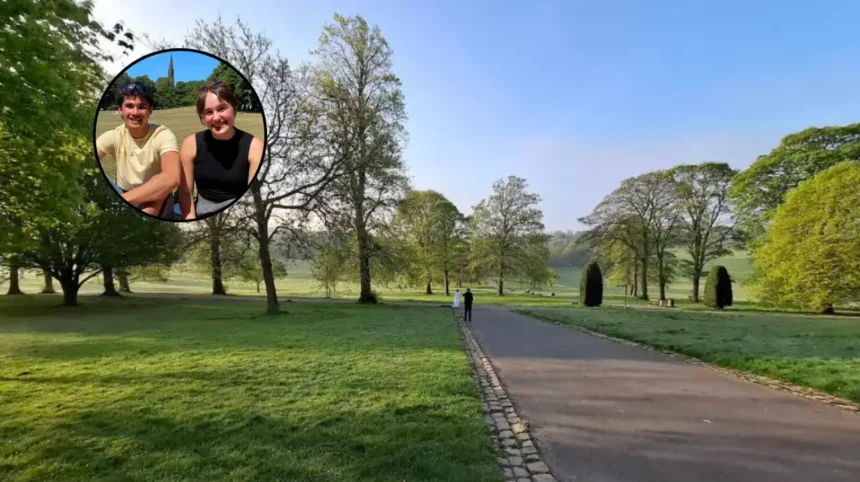
Speaking directly to the broadcaster, a park visitor identified as Ella, who was sharing a picnic on Woodhouse Moor in Leeds, explained the rationale behind her own restricted usage patterns. Ella stated that:
“I don’t really go to parks at night mainly because I feel like there’s not lots of lighting in them.”
This specific testament highlights a recurring theme within the research: structural and infrastructural deficiencies, such as inadequate illumination along major pathways, directly feed into public vulnerability and dictate the hours during which women, students, and elderly residents feel comfortable occupying public spaces.
How do physical maintenance standards compare with public safety perceptions?
In terms of pure environmental quality and municipal upkeep, the data collected by the University of Leeds presents an overwhelmingly positive outlook. The researchers discovered that despite deep-seated anxieties regarding evening security, the physical infrastructure of the green spaces is exceptionally well-managed by local authorities.
Within the Leeds municipal boundary, an impressive 90% of the individuals surveyed categorised their most-visited local park as being in either a “good” or “very good” overall condition.
This quantitative praise aligns closely with the qualitative observations of international students residing within the city’s academic corridors. Rylan, a Canadian student who was interviewed alongside Ella on Woodhouse Moor, offered a highly favorable assessment of the space’s daytime presentation. As recorded by the BBC, Rylan stated that:
“The park is really well-maintained. I feel really safe in it. It’s really clean, there’s not anything I’ve wanted to avoid.”
This duality underscores the primary paradox facing urban planners: daytime visitors experience a clean, welcoming, and ostensibly safe environment, yet the exact same geographical space becomes intimidating and inaccessible to half the population under the cover of darkness.
What do Bradford residents say about park conditions?
A similar statistical trend was observed within the neighboring City of Bradford district, confirming that high maintenance standards are a regional characteristic rather than an isolated success story.
The University of Leeds researchers documented that 85% of surveyed participants in Bradford viewed their primary parks as well-kept, clean, and structurally sound.
The high marks for physical presentation across both cities suggest that the prevailing barriers to entry are not rooted in systemic municipal neglect, vandalism, or dereliction. Instead, the issues are distinctly behavioral and environmental, tied directly to how spaces are illuminated, monitored, and perceived after normal working hours.
What are local councils doing to resolve these safety anxieties?
In light of the data published by the University of Leeds, the administrative bodies governing both metropolitan districts have moved to reassure the public that their concerns are being integrated into future urban planning strategies. Representatives from both Leeds City Council and Bradford Metropolitan District Council have issued formal acknowledgments of the report’s insights.
According to official correspondence reviewed by regional media outlets, spokespersons for Leeds and Bradford councils affirmed that they
“remained committed to improving green spaces for everyone.”
Local authority representatives have indicated that future capital allocations will look beyond mere cosmetic maintenance to actively address structural security, exploring methods to enhance visibility, modernise path networks, and foster inclusive environments that naturally deter anti-social behavior without compromising the ecological value of the parklands.
Background of urban park safety initiatives in West Yorkshire
The relationship between urban green space design, public safety, and gender-inclusive planning has been a subject of escalating debate across West Yorkshire for several years.
Woodhouse Moor, located adjacent to a dense student population and inner-city residential zones in Leeds, has historically stood at the center of localized campaigns demanding improved public infrastructure.
Local community groups, student unions, and safety advocates have consistently argued that large open areas require specialized architectural approaches to safety—such as emergency contact points, low-level atmospheric lighting, and clearer sightlines—to prevent them from becoming hostile environments after dark.
Historically, municipal strategies across the United Kingdom have prioritized daytime utility and ecological preservation when managing budgets for public parks. However, high-profile national campaigns surrounding violence against women and girls in public spaces have forced a paradigm shift.
Academic institutions, including the University of Leeds, have increasingly focused research resources on mapping how “fear of crime” alters human geography, proving that a lack of perceived safety effectively creates a form of spatial inequality, restricting free movement and impacting public health.
Prediction: How will these findings affect local park users and urban communities?
The insights provided by the University of Leeds study are highly likely to accelerate a structural overhaul in how West Yorkshire authorities manage public assets, directly impacting local park users, student populations, and nearby residents.
In the immediate short term, park visitors can expect to see local councils facing intensified political pressure to convert these academic findings into tangible infrastructure deployments.
This will likely result in targeted funding bids aimed at the central government’s Safer Streets Fund to install high-efficiency LED lighting networks and enhanced CCTV monitoring along primary commuter routes through parks like Woodhouse Moor.
For the particular audience of local residents—especially women, shift workers, and students—this development will likely mark the beginning of more inclusive urban design consultations. However, if municipal budgets fail to meet the capital requirements needed for extensive lighting and security overhauls, the spatial division highlighted in the report will intensify.
This could result in a scenario where public parks become entirely privatized by circumstance after dark, left vacant by law-abiding citizens and occupied exclusively by anti-social elements, thereby worsening the cycle of fear and further reducing the evening well-being of the urban community.