

Key Points
- Multiple Concurrent Incidents: A vehicle fire combined with an earlier stray livestock incident created severe disruption along key stretches of the M62 motorway in West Yorkshire.
- Significant Travel Delays: Motorists faced delays exceeding 70 minutes, with tailbacks extending for several miles towards Leeds, Brighouse, and adjacent junctions.
- Emergency Service Deployment: Firefighters from West Yorkshire Fire and Rescue Service and traffic officers from National Highways were deployed to extinguish the vehicle blaze and secure the carriageway.
- Rolling Roadblocks and Closures: Traffic was temporarily brought to a standstill to allow emergency crews to contain the fire and safely herd loose sheep off the live lanes.
- Widespread Regional Congestion: Residual congestion spilled over onto surrounding arterial routes, including the A627(M), A58, and local roads around Huddersfield, Halifax, and Bradford.
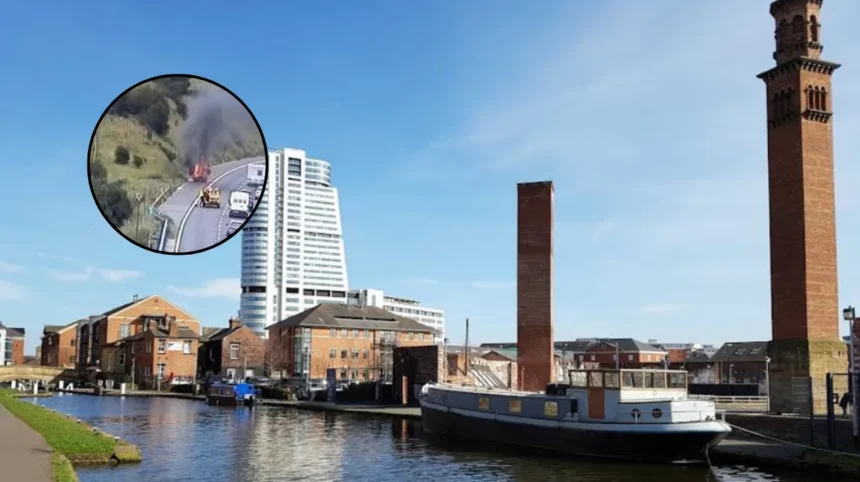
West Yorkshire (The Leeds Times) August 11, 2026 – Motorists travelling across West Yorkshire faced severe travel disruption following back-to-back incidents on the M62 motorway, where an earlier stray livestock intrusion was quickly compounded by a dramatic vehicle fire, resulting in queueing traffic and delays of more than 70 minutes. The dual emergency situations forced National Highways and West Yorkshire Police to implement rolling road closures and lane restrictions across critical junctions heading eastbound and westbound towards Leeds, leaving thousands of commuters and commercial hauliers stuck in multi-mile gridlock during peak traffic periods. Emergency responders, including crews from West Yorkshire Fire and Rescue Service, worked at the scene to suppress the vehicle blaze and ensure the safety of the carriageway before recovery operations could commence.
- Key Points
- What Caused the 70-Minute Delays on the M62 in West Yorkshire?
- How Did Emergency Services Respond to the Vehicle Fire and Animal Chaos?
- Which Junctions and Surrounding Routes Were Most Affected by the Congestion?
- What Is the Background to These Repeated M62 Incidents?
- How Will This Development Affect Motorists, Haulage Services, and the Regional Economy?
What Caused the 70-Minute Delays on the M62 in West Yorkshire?
The initial disruption began when livestock escaped onto the motorway premises, necessitating an immediate emergency response to prevent high-speed collisions. According to reports from regional traffic monitoring service Inrix, traffic was brought to a halt as highways officers and local police established a temporary rolling roadblock to locate and safely remove loose sheep wandering near live traffic lanes.
The presence of animals on a high-speed trans-Pennine route presents an immediate hazard to road users, forcing authorities to prioritize containment before releasing held vehicles.
Before traffic flow could fully normalize following the animal retrieval, a secondary and more severe incident occurred further along the corridor when a vehicle caught fire on the live carriageway.
As documented by duty officers from National Highways, the vehicle fire required the immediate shutdown of multiple lanes to allow fire appliances safe access to the scene.
The combined effect of the held traffic from the livestock incident and the subsequent lane closures for the vehicle fire created an immediate bottleneck, rapidly swelling tailbacks to over six miles and driving delay times past the 70-minute mark for drivers heading eastbound towards Leeds and surrounding West Yorkshire districts.
How Did Emergency Services Respond to the Vehicle Fire and Animal Chaos?
The response to the dual incidents involved coordinated multi-agency operations between National Highways Traffic Officers, West Yorkshire Police, and the West Yorkshire Fire and Rescue Service.
Fire crews dispatched to the scene of the vehicle blaze arrived to find the vehicle heavily engulfed on the hard shoulder and outer lane, creating dense smoke plumes that impaired visibility across opposing lanes.
As stated by emergency response representatives from West Yorkshire Fire and Rescue Service, specialized hose reel jets and breathing apparatus teams were deployed immediately to suppress the flames and prevent the fire from spreading to adjacent embankment foliage.
Firefighters remained on site for a prolonged period to damp down the burnt-out frame and cool down volatile components, ensuring no risk of reignition before vehicle recovery contractors could safely winch the burnt structure onto flatbed transports.
Simultaneously, National Highways officers managed traffic filtering and diversion routes. Traffic officers worked to clear debris, fluid spillages, and damaged tarmac resulting from the intense heat of the blaze.
Officers used overhead gantries and variable message signs (VMS) miles ahead of the incident site to advise oncoming drivers to reduce speed, seek alternative routes, or prepare for sudden stops.
Which Junctions and Surrounding Routes Were Most Affected by the Congestion?
The geographical layout of the M62 through West Yorkshire—spanning steep gradients across the Pennines and passing densely populated urban corridors such as Huddersfield, Halifax, Brighouse, and Leeds—magnified the impact of the lane closures.
The heaviest congestion was concentrated between Junction 22 (Rishworth Moor / Saddleworth), Junction 23 (Outlane), Junction 24 (Ainley Top), and Junction 26 (Chain Bar).
As traffic backed up, alternative trans-Pennine and regional arterial highways experienced severe secondary congestion. As logged by traffic analysis groups, drivers attempting to bypass the M62 closure diverted onto the A629, A62, and A58 roads through Huddersfield, Elland, and Halifax.
The sudden influx of heavy goods vehicles and passenger cars onto single-carriageway routes led to gridlock across local town centres, delaying public bus services and local delivery networks throughout Calderdale and Kirklees.
Explore More Local Leeds News
Roundhay Park Installs 125 Boulders To Stop Nuisance Drivers Roundhay 2026
120 Affordable Homes Approved for Former Lloyds Site in Farsley 2026
What Is the Background to These Repeated M62 Incidents?
The M62 motorway is the primary east-west strategic road artery across Northern England, linking the major economic hubs of Liverpool, Greater Manchester, West Yorkshire, and Humberside. Carrying tens of thousands of vehicles daily—including a high proportion of heavy freight—the route operates near capacity during daytime hours.
Because the motorway traverses rural upland terrain in West Yorkshire, particularly around Scammonden Bridge and Saddleworth Moor, the carriageway directly borders extensive agricultural land and sheep grazing farms.
Historically, livestock breaching perimeter fencing has been a recurring vulnerability along upland stretches of the M62.
Despite ongoing fencing maintenance programs conducted by National Highways, agricultural animals occasionally find gaps or navigate damaged boundary structures, leading to sudden live-lane incursions that necessitate immediate police intervention.
Furthermore, the physical geography of the M62 includes long, steep gradients—such as the climb to the highest point on the UK motorway network near Junction 22. These extended ascents put substantial mechanical strain on heavy goods vehicles, vans, and aging passenger
cars, significantly elevating the risk of mechanical failure, engine overheating, and thermal ignition events. When a vehicle fire occurs on these gradient stretches, the lack of immediate physical space and challenging access for emergency vehicles frequently leads to extended motorway closures.
How Will This Development Affect Motorists, Haulage Services, and the Regional Economy?
The repeated disruption along the M62 corridor carries direct consequences for multiple groups of road users, commercial transport providers, and the wider Northern economy.
For logistics operators and road haulage firms, unexpected 70-minute delays jeopardize strict delivery windows and drive up operational costs.
Freight hauliers operating between the ports of Liverpool and Hull or navigating between West Yorkshire logistics hubs face increased fuel consumption from idle engines, disrupted driver shift schedules, and potential financial penalties for late supply-chain deliveries.
Repeated incidents force logistics planners to build larger buffer times into trans-Pennine routes, decreasing overall fleet efficiency and raising freight costs across the supply network.
Local commuters travelling between Greater Manchester, Huddersfield, Halifax, Bradford, and Leeds face significant routine uncertainty. When major arterial highways experience severe blockages, local urban roads become choked with diverted vehicles, disrupting bus schedules and delaying workers.
Commuters may increasingly turn to rail services along the TransPennine route, putting additional demand on regional train networks during peak transit hours.
For transport authorities and National Highways, these ongoing vulnerabilities highlight the need for enhanced perimeter monitoring, robust farm fence maintenance along upland motorways, and faster incident-resolution protocols.
Future investments may focus on deploying additional smart motorways monitoring systems, expanding emergency refuge areas, and installing automated perimeter warning devices to detect stray livestock before animals reach active driving lanes.